
On this page
Start here
Quick answer
If an Indesit washing machine has finished with water inside, stop the programme and keep clear if the water is hot, leaking, or near an electrical connection. When the area is dry and safe, switch the appliance off and follow the exact model manual before checking anything. First rule out a paused programme, Rinse Hold, No Spin, or delayed cycle; then inspect the visible drain hose and household standpipe for kinks or backflow. Only clean a pump filter if the manual identifies an accessible filter for that model and gives the procedure. A hum with no flow, silence when a drain command is selected, a locked door with retained water, an error code, or a leak points to a model-specific pump, lock, control, or drain-path diagnosis. Do not force the door, reach into hot or electrically exposed water, or open the cabinet; use Indesit's support route if the safe checks do not restore draining.
Before you begin
Safety first
- This article covers observation and model-approved user checks only. Do not move a water-filled appliance, force or bypass the door lock, open the cabinet, reach into the pump, perform electrical work, or retest a hazardous symptom.
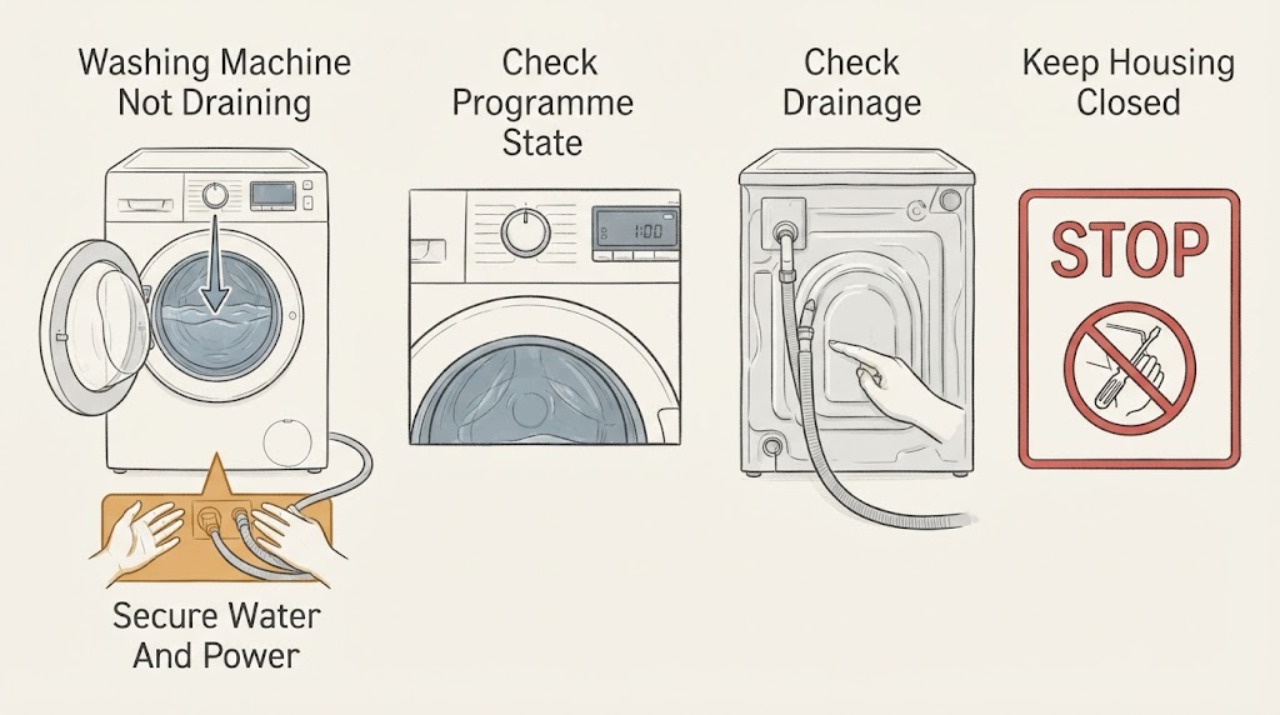
Work through in order
Diagnostic checks
Use only checks that match the exact appliance or system and its official guide.
-
Check 1
Without stepping into a wet area or reaching into the washer, observe the water level, whether the water may be hot, any active leak, the floor around the appliance, and whether the plug, socket, controls, or nearby wiring are wet. If the machine is still running and it is safe to do so from a dry position, use the normal stop control; otherwise keep clear and arrange help.
Expected result: Record empty, partly full, or full drum; cool or possibly hot water; dry or wet floor; and whether water is close to an electrical connection, rising, or escaping continuously.
Next step: Keep people away, close the water supply only if it is safely reachable without entering water, and isolate power only by a dry, safe method permitted by the installation. Do not touch wet electrical equipment; use qualified service for the fault.
Stop if: Stop immediately for hot water, active or worsening leakage, water touching electrical equipment, smoke, burning smell, sparks, a tripped breaker, or any need to reach through water.
Why this matters
Why: Hot or standing water, active leakage, or water near electrics makes access unsafe. A dry, stable area with no leak permits only the low-risk checks in the following actions.
-
Check 2
Read the selected programme and visible options without changing the installation: check for Rinse Hold, No Spin, a pause or delay, a gentle programme that leaves more water, or a cycle waiting for a start/resume command. Use only the exact model manual to identify what a button or indicator means.
Expected result: Note whether the display or indicators show Rinse Hold, No Spin, pause, delay, an incomplete cycle, or a normal drain/spin stage, and whether a normal drain or spin command is available without forcing the door.
Next step: Follow the model manual's resume, cancel, or drain/spin instruction once the area is safe. If the option is not identified in the manual, record the indicator and model number instead of guessing.
Stop if: Do not repeatedly start cycles, override a locked door, or continue operation when a safety warning, leak, unusual noise, smoke, burning smell, or electrical trip is present.
Why this matters
Why: A hold, pause, delay, or low-spin selection can leave water in the load without proving that the drain pump has failed. A selected drain/spin command that produces no flow moves the check toward the drain path or pump.
-
Check 3
From a dry, safe position, inspect the visible drain hose from the washer to the standpipe, sink, or other approved connection. Look for a sharp kink, crushing, disconnection, a hose end pushed into a blocked opening, or water backing up at the household drain; do not pull a water-filled appliance out or dismantle the plumbing.
Expected result: Classify the route as visibly clear and connected, kinked or crushed, leaking at a joint, or backing up at the standpipe/sink. Note whether the household drain also fails with another safe fixture.
Next step: Correct only an obvious, safely reachable hose position according to the model installation instructions. Keep a leaking connection or blocked household drain out of service and contact a plumber or Indesit service as appropriate.
Stop if: Do not move the washer over a wet floor, pull on a pressurized or damaged hose, open a drain connection with water still inside, or continue if the hose has split or water is escaping.
Why this matters
Why: A kink, disconnection, or external blockage can prevent flow without a pump fault. Backflow or failure of another fixture indicates a household drain problem, while a clear route keeps the pump/filter side in scope.
-
Check 4
Record the complete model number, programme, indicator pattern, and any displayed error code; observe whether the door-lock indicator remains on after the cycle is stopped. Use the exact Indesit manual or support lookup for that model rather than applying a code from a different appliance.
Expected result: Note a normal unlocked door, a door locked while water remains, a code or repeating light pattern, or no display/power at all.
Next step: Keep the door closed and follow only the model-specific safe drain or reset procedure. If the code persists, the door remains locked with water, or the display is dead, give the recorded information to Indesit support or a qualified appliance technician.
Stop if: Never pry, force, bypass, or electrically defeat the door lock, and do not open the door while water could spill or be hot.
Why this matters
Why: A locked door with water inside may be a protective state, not permission to force it open. A code or light pattern can distinguish a drain, lock, or control path only when interpreted for the exact model; no display adds a power/control branch.
-
Check 5
Only if the exact Indesit owner manual identifies a user-accessible pump filter or emergency drain arrangement, and the washer is safely isolated on a dry floor, prepare for residual water using the manual's method. Let potentially hot water cool, use a suitable container, and open only the named access point; do not guess the location or remove a cabinet panel.
Expected result: Record whether the manual confirms an accessible filter, whether residual water drains, and whether the filter contains lint or a small object; note a seized plug, damaged seal, or no accessible filter.
Next step: Clean and refit only as the model manual directs, keep the seal seated, then run the manual's safe drain test. If access differs, the plug will not move without force, or the problem remains, stop and request service.
Stop if: Do not open a filter with hot or pressurized water, force a plug, use tools to reach inside, remove the pump, or continue when water approaches electrical parts.
Why this matters
Why: Debris in a confirmed user-serviceable filter can explain slow or absent draining. A blocked or damaged access point, no model-approved filter procedure, or water that will not drain keeps the pump and internal drain path in professional scope.
-
Check 6
After the safe programme and external checks, use the model's normal drain command only from a dry, safe position and listen without removing panels. Do not perform electrical measurements or place hands near moving parts.
Expected result: Record a normal pump sound with water flow, a hum with little or no flow, repeated clicking or gurgling, or complete silence; also note whether the drum is empty but the machine reports a drain fault.
Next step: Stop the test if a leak, burning smell, smoke, sparking, abnormal grinding, or breaker trip occurs. Otherwise provide the sound, water level, code, model, and prior checks to Indesit support or a qualified technician.
Stop if: Do not remove covers, reach into the pump, bypass the lock, run a machine with a damaged hose, or keep retrying a stalled drain cycle.
Why this matters
Why: A hum without flow can be consistent with an obstruction or pump that cannot move water, while silence can involve a control, lock, wiring, or pump path. Sound alone cannot identify a failed component or justify a part replacement.
-
Check 7
Assemble a service record: model and serial information if safely visible, programme and options, water level and temperature, exact code or indicator sequence, hose and household-drain observations, filter result if model-approved, pump sound, and any leak or smell.
Expected result: Confirm whether the machine drains after the safe correction, drains slowly, remains full, locks the door, or fails again with the same code or sound.
Next step: Use Indesit's support or repair route with the record and photographs taken from safe positions. Leave the appliance unused when the fault repeats or any safety symptom occurred.
Stop if: Stop all troubleshooting for persistent water, a recurring fault, a damaged appliance, smoke, burning smell, sparks, repeated electrical trips, or any proposed live or cabinet repair.
Why this matters
Why: A repeatable no-drain result after the allowed checks points to an internal hose, pump, filter, door-lock interlock, control, or installation issue that cannot be selected safely from symptoms alone.
Use your observations
Decision map
Find the observation that best matches what you see, then follow the next safe action.
-
PATH 01Safety boundary
What you see
Water is hot, rising, leaking continuously, or close to the socket, plug, controls, or other electrical equipment.
Do this next
Keep clear, keep others away, close the water supply only if safely reachable, and obtain qualified appliance or electrical help using a dry safe route.
Why this path and its safety boundary
Why it matters: The immediate issue is safe isolation, not diagnosis of the drain component.
Safety stop: Do not step into water, touch wet electrical equipment, open the door, or move the washer.
-
PATH 02Safety boundary
What you see
The exact model shows Rinse Hold, No Spin, pause, delay, or an incomplete cycle and there is no safety symptom.
Do this next
Use the model manual's cancel, resume, or drain/spin instruction once the area is safe, then reassess the water level.
Why this path and its safety boundary
Why it matters: The washer may be waiting for a programme action rather than experiencing a confirmed pump failure.
Safety stop: Do not guess at buttons or keep restarting the machine if water remains or a code repeats.
-
PATH 03Safety boundary
What you see
The visible hose is kinked, crushed, disconnected, leaking, or the standpipe/sink backs up with other safe drainage.
Do this next
Restore only a safe, manual-approved hose position; use a plumber for a household blockage or any leaking/damaged hose, then retest only as the manual permits.
Why this path and its safety boundary
Why it matters: The external drain route can account for the symptom without proving an internal pump fault.
Safety stop: Do not pull the washer over a wet floor, open a full drain connection, or use a damaged hose.
-
PATH 04Safety boundary
What you see
The door remains locked and water is visible or suspected inside.
Do this next
Keep it closed and use only the model-specific drain or emergency procedure. Escalate to Indesit service if the water cannot be safely removed.
Why this path and its safety boundary
Why it matters: The lock may be preventing a water spill; forcing it creates a separate injury and flooding risk.
Safety stop: Do not pry, bypass, defeat, or repeatedly cycle the door lock.
-
PATH 05Safety boundary
What you see
The exact manual confirms an accessible pump filter and, after safe isolation, debris is found there.
Do this next
Clean and refit only by that manual, keep the seal seated, and perform its safe drain check. Seek service if flow is still absent or the access point leaks.
Why this path and its safety boundary
Why it matters: Filter debris is a plausible restriction, but it is not evidence that an internal pump or hose should be replaced.
Safety stop: Do not force the filter, reach into the cabinet, or open a model without a confirmed user-access procedure.
-
PATH 06Safety boundary
What you see
The hose and approved filter path are clear, but a drain command produces a hum with no flow, repeated gurgling, or silence.
Do this next
Stop repeated tests and give the model, code, water level, and sound to qualified Indesit service for model-specific diagnosis.
Why this path and its safety boundary
Why it matters: An internal obstruction, drain pump, interlock, control, or wiring path remains possible; sound alone is not a parts diagnosis.
Safety stop: Do not remove panels, reach into the pump, or attempt electrical or internal repair.
-
PATH 07Safety boundary
What you see
An error code/light sequence repeats, or the display is absent after the safe power check.
Do this next
Record the complete code or indicators and model number, then use Indesit's support/manual route; keep the washer unused if the fault recurs.
Why this path and its safety boundary
Why it matters: A code or dead display needs exact model interpretation; cross-model code lists are unsafe and unreliable.
Safety stop: Do not erase evidence by repeated resets or open the control area.
-
PATH 08Safety boundary
What you see
A hose/filter connection leaks, or there is smoke, burning smell, sparking, abnormal heat, or a repeated electrical trip.
Do this next
Stop use, keep clear, isolate only by a dry safe method, and arrange qualified appliance or electrical service. Do not retest to reproduce the symptom.
Why this path and its safety boundary
Why it matters: The fault has crossed the ordinary drain-check boundary and may involve water damage or an electrical hazard.
Safety stop: Do not touch wet electrical parts, open the cabinet, or operate the washer again until cleared.
Helpful context
Understand the symptom
Start with the water and programme state
Not draining can mean that the washer has deliberately paused for a programme option, or that water cannot pass through the external hose, household drain, filter, pump, or control path. The useful first distinction is whether the drum is empty, partly full, or full, and whether the cycle is paused at a rinse or spin stage. Do not move a water-filled machine or treat a locked door as a fault until the water state and the exact model instructions are known.
Use model-specific boundaries for the drain path
Indesit spare-parts guidance describes drain hoses and pumps as model-dependent components: a hose can be associated with blockage or failure to drain, while a pump is considered only for selected models and must be matched by model information. That supports an external, visible inspection first. A filter, emergency drain hose, or pump access may not exist in the same location on every Indesit washer, so the owner manual controls what can be opened.
Know when to stop
A leak near the outlet, wet controls, repeated breaker operation, smoke, or a burning smell changes this from a routine drain check to a safety and service call. Indesit's safety-notice page also says to check the model and refrain from using an affected appliance. Never bypass a door lock, force a locked door, dismantle the cabinet, or use a guessed error-code explanation from another model.
Safety boundary
Stop conditions
- Stop for hot or rising water, active leakage, water near electrical equipment, smoke, burning smell, sparks, abnormal heat, or a repeated breaker trip.
- Do not step into water, touch wet electrical equipment, move a water-filled washer, or open a locked door with water inside.
- Do not force or bypass the door lock, open the cabinet, reach into the pump, or attempt internal or electrical repair.
- Open a pump filter or emergency drain only when the exact model manual confirms the access and procedure; allow potentially hot water to cool and control residual water safely.
- Do not apply an error-code explanation, filter location, hose arrangement, or part fit from another model; use the exact model manual and Indesit support.
- Do not keep retrying a stalled drain cycle after an approved external check fails; arrange qualified service.
Only after diagnosis
Potential parts
- washing-machine drain hose
Consider this category only when inspection confirms a split, leaking, crushed, or internally blocked hose and the exact model requires replacement.
Indesit parts guidance requires checking the model list; confirm the complete model and fitting instructions before ordering or changing a hose. - washing-machine drain pump
Consider this category only after the exact model's external drain path and approved filter check are clear and a qualified diagnosis supports a pump fault.
Indesit identifies pumps for selected models and requires model-fit verification; symptom or pump sound alone is not compatibility evidence. - pump-filter seal or filter assembly
Consider this category only if the exact manual confirms a user-accessible filter and inspection finds a damaged seal, plug, or filter that cannot be restored safely.
Confirm the exact model and manual-approved assembly; do not substitute a generic filter or operate with a leaking access seal. - washing-machine door-lock assembly
Consider this category only when the exact model diagnosis links a persistent lock or interlock fault to the no-drain sequence after water has been safely addressed.
Do not bypass the lock; a qualified technician must confirm model fit and safe installation.
When checks do not resolve it
Need a professional?
Use Indesit support or qualified appliance service when the exact programme and visible hose checks do not restore draining, the model has no user-approved filter procedure, a filter or hose leaks, a door remains locked with water, a code or light pattern repeats, the pump hums without flow or stays silent, or the display is dead. Escalate immediately for hot or rising water, water near electrics, smoke, burning smell, sparks, abnormal heat, or repeated electrical trips.
Safety scope: This article covers observation and model-approved user checks only. Do not move a water-filled appliance, force or bypass the door lock, open the cabinet, reach into the pump, perform electrical work, or retest a hazardous symptom.
Common questions
FAQ
Why is my Indesit washing machine full of water at the end of a cycle?
The programme may be paused by Rinse Hold or No Spin, or water may be blocked by the visible hose, household drain, an accessible model-specific filter, or the pump. Check the water and electrical safety first, then use only the exact model manual before inspecting a filter.
Can I open the Indesit washer door when it will not drain?
Do not force or bypass a locked door. Water may remain inside and the lock can be protecting against a spill. Use only the exact model's safe drain or emergency procedure; request service if the water cannot be removed safely.
Could the drain hose cause an Indesit washer not to drain?
Yes. Indesit's official parts guidance associates blockages, rear leaks, and failure to drain with a possible drain-hose problem, but the hose must be checked against the exact model. Inspect only the visible route and do not move a water-filled machine.
Should I clean the pump filter?
Only if the exact owner manual confirms that your model has an accessible filter and explains how to isolate the washer and manage residual water. Let potentially hot water cool, use a container, and stop if the plug is stuck, water approaches electrics, or the access point leaks.
What does a humming drain pump mean?
A hum with no water flow can be consistent with an obstruction or pump that cannot move water, but sound does not prove which part has failed. Record the sound, water level, programme, code, and model, then arrange model-specific service rather than opening the cabinet.
When is a no-drain problem urgent?
Stop immediately for hot or rising water, a leak near electrical equipment, smoke, burning smell, sparks, abnormal heat, or a repeated breaker trip. Keep clear and obtain qualified appliance or electrical help through a safe route.
Read the exact guide
Official sources
- Safety noticesIndesit · Official safety-notice index; check the exact model and manufacture period where relevant rather than assuming every washer is affected.
- Washing Machine Drain Hose J00116504 - Indesit Spare PartsIndesit Spare Parts · Official Indesit parts page used for the conditional hose branch; the displayed part is not assumed to fit the assigned washer.
- Washing Machine Drain Pump J00244329 - Indesit Spare PartsIndesit Spare Parts · Official Indesit parts page used for the conditional pump branch; the displayed part is not assumed to fit the assigned washer.
- SupportIndesit · Official Indesit support entry point; use the model number and local support options for the assigned washer.
Community feedback
Share a repair observation
Share a plain-text repair observation. Accepted observations are published automatically; this page may take a moment to update.