
On this page
Start here
Quick answer
An Indesit washing machine may finish with wet clothes because Rinse Hold or Crease Care is holding water, the load is unbalanced, the machine has not drained, the selected programme or spin speed excludes a full spin, the door interlock is not satisfied, or a motor or control fault is present. Check the display and lights first, then keep the machine stable and inspect the load without forcing the drum. Indesit says an excessive or unbalanced load can cause the spin process to abort, and it recommends redistributing the load and selecting a spin programme. Its support guidance also says Rinse Hold can leave the wash in final-rinse water, while a kinked or blocked drain hose, pump filter, or under-sink connection can prevent emptying. Stop for a leak, uncontrolled water, violent movement, burning odour, smoke, sparks, hot wiring, or a repeated trip; do not open panels or force the drum.
Before you begin
Safety first
- This article covers model-specific controls, load redistribution, external hose observation, and a model-approved pump-filter or drain check only. A technician must handle retained water that cannot be drained safely, door interlocks, motor and control work, wiring, panel access, and any thermal or electrical hazard.
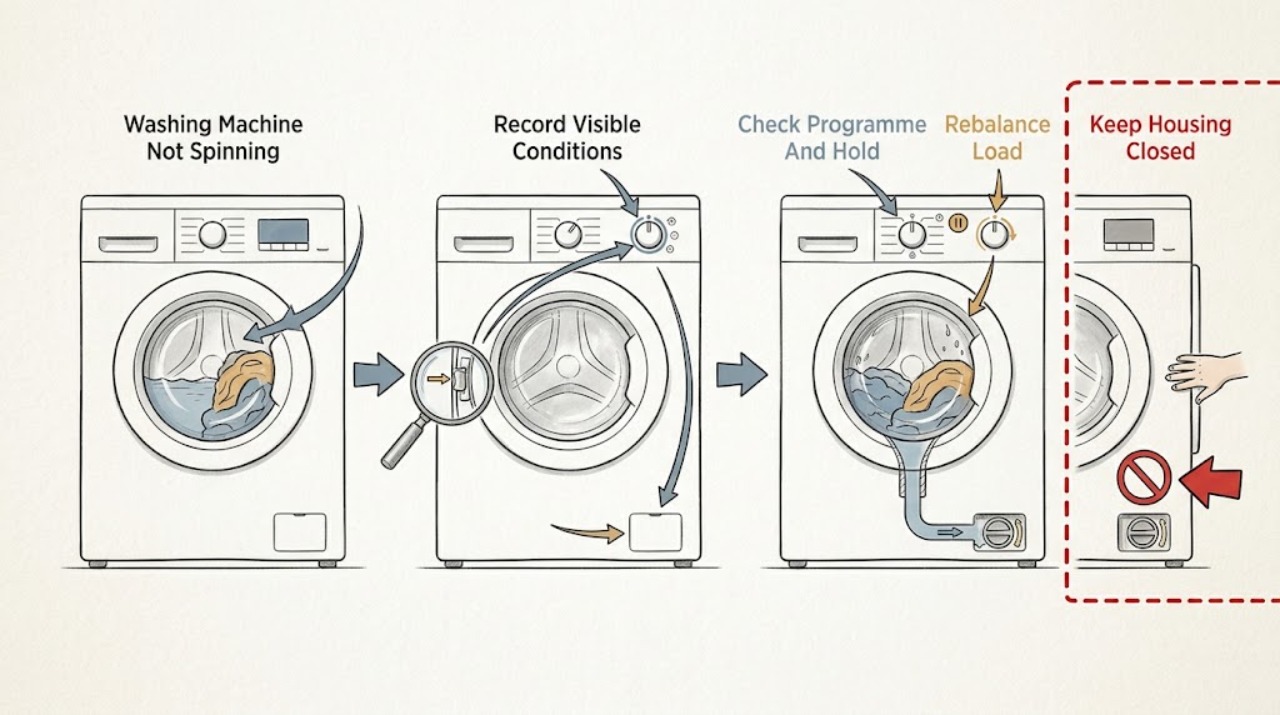
Work through in order
Diagnostic checks
Use only checks that match the exact appliance or system and its official guide.
-
Check 1
Keep the machine still and inspect from outside. Stop using it for a leak, water near the plug or socket, violent movement, metal impact, burning odour, smoke, sparks, hot wiring, damaged glass, or a repeated electrical trip; isolate power only from a dry and safe position.
Expected result: Record whether the drum is full or empty, whether water is visible, whether clothes are soaking wet, whether the programme ended or stopped, which light or code is shown, and whether the cabinet, plug, or cord is hot or damaged.
Next step: If there is no hazard, photograph the panel and continue with the programme, load, and drain checks. If there is a hazard, keep the machine out of use and arrange qualified appliance or electrical service.
Stop if: Do not restart a leaking, sparking, smoking, overheated, violently shaking, or repeatedly tripping machine.
Why this matters
Why: Water remaining points toward a hold or drain problem; a dry drum with no rotation points toward programme, lock, motor, or control behavior. A safety symptom ends ordinary troubleshooting regardless of the light pattern.
-
Check 2
Read the exact programme and option indicators in the model manual. Check whether Rinse Hold, Crease Care, a reduced-spin option, a no-spin option, or a delayed or paused state is active, then select only the documented drain or spin programme without changing several controls at once.
Expected result: Record the selected programme, spin-speed setting, hold or care option, end or pause indicator, and whether the machine begins draining or spinning after the documented command.
Next step: If the hold option was active, use the manual's drain or spin command and reassess the result. If no command works or the same light pattern returns, continue to load, drain, and code checks.
Stop if: Do not force the selector, repeatedly cancel programmes, or open the door while water is present or the drum is moving.
Why this matters
Why: Indesit says Rinse Hold or Crease Care can hold laundry in final-rinse water, and models differ in their lights and controls. If a documented spin command is ignored with an empty, cool, intact drum, the problem is less likely to be an option setting.
-
Check 3
When the drum is empty of standing water, the programme is paused or complete, and the door can be opened normally, remove or redistribute the laundry evenly; separate one heavy item from a small load and do not overload the drum.
Expected result: Record whether the load was tightly packed, consisted of one heavy item, or was gathered on one side, and whether the Spin or Final Spin indicator identified an imbalance.
Next step: Select the documented spin programme once and observe whether the machine reaches spin without excessive movement. If it remains unstable or refuses to spin, stop and continue with drainage and code evidence rather than adding more items.
Stop if: Do not hold the cabinet, press on the door, run a high-speed cycle with violent vibration, or reach into a moving drum.
Why this matters
Why: Indesit says its load-detection system may abort spin when the load stays excessive or unbalanced to limit vibration. A successful spin after redistribution supports load balance as the cause; continued no-spin with a balanced load points elsewhere.
-
Check 4
If water remains or the wash stopped before emptying, unplug the machine from a dry position and inspect only the visible drain hose, under-sink connection, and the model-approved pump-filter access; use a low container and towels if the handbook describes controlled draining.
Expected result: Record whether the hose is kinked, pushed too far into a standpipe, blocked at the sink connection, or obstructed at an accessible filter, and whether water drains in a controlled way through the documented route.
Next step: Restore only correct hose routing or clear an accessible obstruction as the manual permits, then select the documented drain or spin programme once. Arrange service if water remains or the door stays locked.
Stop if: Stop for hot water, uncontrolled discharge, water near electrical parts, a seized filter, a rocking cabinet, or any need to remove panels or force a filter.
Why this matters
Why: Indesit says a kinked or blocked waste hose, under-sink plumbing, or pump filter can prevent emptying and therefore leave the clothes too wet for spin. No flow, a humming pump, a returning obstruction, or a pump fault code indicates a pump or plumbing diagnosis.
-
Check 5
With the appliance off and the drum empty of standing water, inspect the visible door edge, latch opening, seal, and hinge for a loose item or damage, then copy the full display code or ordered flashing lights and compare them with the exact Indesit manual and official error-code page.
Expected result: Record a clear and intact latch, a caught item, an F02 motor code, an F06 door-lock code, another listed code, or an unrecognized light pattern; note whether the door closes firmly without force.
Next step: Remove only a loose visible item that does not require pulling the seal or latch. Preserve the code and model number, and arrange qualified service for a persistent code, damaged door, or unclear pattern.
Stop if: Do not bridge the door lock, remove the interlock, bend the frame, pull the seal, or run the machine with cracked glass or a loose hinge.
Why this matters
Why: F02 is identified by Indesit as a motor-circuit fault with intermittent or absent drum rotation. F06 is a door-lock fault that can stop a programme from starting. A clear door with a returning code requires service rather than a bypass.
-
Check 6
Only when the machine is cool, stable, dry, free of visible damage, and connected to a safe supply, perform one model-documented reset or retry after the drain and load checks; do not run repeated high-speed tests.
Expected result: Record whether the control panel recovers, the machine drains and spins normally, the same light or code returns, or the motor only hums or stops with the drum still wet.
Next step: Give service the model, code, programme stage, load, water level, drain observations, and retry result; do not continue normal washing until a persistent fault is assessed.
Stop if: Do not repeat resets, bypass protection, open panels, or continue when the machine leaks, shakes, smells burnt, smokes, sparks, overheats, or trips.
Why this matters
Why: A single successful retry supports a transient option or balance state. A returning fault supports a drain, lock, motor, wiring, or control diagnosis and is not solved by repeated resets.
Use your observations
Decision map
Find the observation that best matches what you see, then follow the next safe action.
-
PATH 01Safety boundary
What you see
The drum contains water but the panel shows Rinse Hold, Crease Care, a reduced-spin choice, or a paused final-rinse state.
Do this next
Use the exact manual's drain or spin command once and observe the result without opening a full or moving drum.
Why this path and its safety boundary
Why it matters: The machine may be waiting for a documented drain or spin command rather than reporting a failed motor.
Safety stop: Stop for hot water, a leak, abnormal movement, or a command that is ignored after the documented procedure.
-
PATH 02Safety boundary
What you see
The Spin or Final Spin light indicates an excessive or unbalanced load, or the clothes are gathered on one side and the machine aborted spin.
Do this next
Remove or redistribute the load, avoid overloading, and run the documented spin programme once.
Why this path and its safety boundary
Why it matters: Indesit uses load detection to limit excessive vibration and may abort spin when the load remains unstable.
Safety stop: Stop if the cabinet moves violently, metal strikes the drum, or the machine remains unstable after redistribution.
-
PATH 03Safety boundary
What you see
Water remains, the machine stopped before emptying, Wash/Rinse/Spin lights flash together, or F05 appears.
Do this next
Keep the door closed, isolate power from a dry position, and check only the model-approved hose, under-sink path, and pump-filter route.
Why this path and its safety boundary
Why it matters: Indesit associates this pattern with a waste-pipe blockage or pump issue that can leave laundry wet and prevent spin.
Safety stop: Stop for hot or uncontrolled water, water near the supply, a seized filter, or any need for panel removal.
-
PATH 04Safety boundary
What you see
The door will not close or the programme will not start, an F06 code appears, or the latch and door do not align normally.
Do this next
Check only for a loose visible obstruction and record the model and code; request qualified service if the condition remains.
Why this path and its safety boundary
Why it matters: Indesit identifies F06 as a door-lock fault; the interlock or latch may not be confirming a safe closure.
Safety stop: Do not force the door, bridge the interlock, or operate with damaged glass, seal, hinge, or latch.
-
PATH 05Safety boundary
What you see
The drum does not rotate during wash or spin, F02 appears, or a balanced, drained load still produces no rotation.
Do this next
Stop user testing, preserve the code and cycle details, and arrange qualified appliance service.
Why this path and its safety boundary
Why it matters: Indesit identifies F02 as a motor-circuit fault with intermittent or absent drum rotation; the motor, wiring, or control needs model-specific diagnosis.
Safety stop: Do not remove panels, test live wiring, turn the drum against resistance, or keep retrying a motor that hums or overheats.
-
PATH 06Safety boundary
What you see
The machine is cool, stable, drained, balanced, and set to a spin-capable programme, but it still will not spin or the fault returns.
Do this next
Arrange qualified service and provide the model, programme, load, water level, light pattern, and all safe checks already performed.
Why this path and its safety boundary
Why it matters: The ordinary options and load explanation are no longer sufficient; a door interlock, motor, control, wiring, or another model-specific fault remains possible.
Safety stop: Do not keep running test cycles or open the cabinet to inspect the drive or controls.
Helpful context
Understand the symptom
Wet clothes do not prove that the motor is failed
Start by distinguishing a spin that was deliberately held from a spin that was refused. Rinse Hold or Crease Care can leave laundry in final-rinse water. A heavy single item can also make the load unstable, so the machine may stop the high-speed phase to limit vibration. If water remains, the drain path becomes the first check; if the drum is empty but the machine never turns, the programme, door lock, motor, or control path becomes more important.
Read the light pattern and the programme before touching the load
Indesit models vary. A flashing Spin light can indicate an excessive or unbalanced load, while Wash, Rinse, and Spin lights flashing together can indicate a filter or waste-pipe blockage. Check whether the selected programme has a reduced or disabled spin and whether a hold option is active. Use the exact model manual for the controls and light sequence rather than applying a code from another panel.
Drainage determines whether spinning is allowed
A washer normally cannot enter a full spin while it still detects water. Indesit advises checking the drain hose for a kink or blockage, the under-sink connection when applicable, and the pump filter if the model has one. Water may spill when a filter or hose is opened, so power must be isolated from a dry position and the model's procedure must be followed. Hot water, uncontrolled discharge, or a filter that will not turn is a service boundary.
Keep electrical and mechanical work out of ordinary checks
After safe load and drain checks, a persistent no-spin condition can involve the door interlock, motor circuit, wiring, control board, or another model-specific fault. Indesit lists F02 as a motor-circuit fault and F06 as a door-lock fault, and directs owners to service when those faults remain. Do not remove panels, bridge a lock, or run a high-speed test while the machine leaks, shakes violently, smells burnt, or trips.
Safety boundary
Stop conditions
- Stop for leaks, uncontrolled or hot water, water near the plug or socket, violent movement, metal impact, burning odour, smoke, sparks, hot wiring, or a repeated electrical trip.
- Do not force the door, pull the seal, bridge the interlock, open panels, test energized wiring, or reach into a moving drum.
- Do not chip, pry, or force a pump filter; use only the exact model's controlled draining procedure when the water is cool and electrical access is dry.
- Do not keep running high-speed tests after a balanced and drained load still refuses to spin, or after F02, F06, or another fault returns.
- Use the exact model manual for programme, Rinse Hold, Crease Care, spin speed, light pattern, drain, and reset instructions; do not copy another model's sequence.
Only after diagnosis
Potential parts
- drain pump or pump filter assembly
Consider this category only when retained water persists after the exact model's hose and accessible blockage checks and service diagnosis confirms a pump or filter fault.
Confirm the exact model, pump, filter, seals, and electrical fit with Indesit or a qualified technician; do not force a seized filter. - door interlock or latch assembly
Consider this category only when F06 or a persistent closure fault is confirmed after a visible obstruction check and the exact model diagnosis identifies the lock assembly.
Confirm the exact model and lock revision; never bypass or substitute an interlock by appearance. - motor or motor-control component
Consider this category only when F02 or a persistent no-rotation condition remains after the load, programme, and drain paths are verified and service identifies the motor circuit.
Confirm the exact model, motor system, control revision, and safety procedure with a qualified technician; no live testing or panel work is an ordinary check.
When checks do not resolve it
Need a professional?
Arrange qualified Indesit or appliance service when the machine remains full of water after the model-approved drain checks, a pump or filter does not work, F02 or F06 returns, the door or latch is damaged, the load is balanced and drained but spin still fails, the light pattern is unclear, or any leak, hot water, violent vibration, electrical smell, smoke, spark, hot cord, or repeated trip occurs.
Safety scope: This article covers model-specific controls, load redistribution, external hose observation, and a model-approved pump-filter or drain check only. A technician must handle retained water that cannot be drained safely, door interlocks, motor and control work, wiring, panel access, and any thermal or electrical hazard.
Common questions
FAQ
Why is my Indesit washing machine not spinning but leaving clothes wet?
Check for Rinse Hold or Crease Care, an unbalanced load, retained water, a reduced-spin programme, a door-lock issue, or an error code. Redistribute a safe, drained load and use the documented spin command once. If water remains or the fault returns, follow the exact manual and arrange service.
Can Rinse Hold stop an Indesit washer from spinning?
Yes. Indesit says Rinse Hold or Crease Care can hold laundry in final-rinse water on applicable programmes. Use the exact manual's drain or spin command; do not open a full or hot drum or force the controls.
How does an unbalanced load affect Indesit spin?
Indesit says the machine can try to redistribute an excessive or unbalanced load and abort spin if it remains unstable. Remove or spread the laundry evenly, avoid overloading, and stop if the cabinet moves violently or the machine remains unstable.
What should I check if water remains in the drum?
Keep the door closed and isolate power from a dry position. Check the visible drain hose, under-sink connection, and model-approved pump-filter route for kinks or blockages using the exact handbook. Stop for hot or uncontrolled water, water near electrical parts, or a filter that resists.
What do F02 and F05 mean on an Indesit washing machine?
Indesit identifies F02 as a motor-circuit fault associated with intermittent or absent drum rotation, and F05 as a waste-pipe blockage or pump issue associated with retained water. Record the code and model, perform only the documented low-risk checks, and request service if the code remains.
Read the exact guide
Official sources
- Download Your Indesit Appliance ManualIndesit Service · Official Indesit manual portal; the exact model handbook controls its programmes, options, access points, and safe procedures.
- Indesit Washing Machine Error CodesIndesit Service · Official Indesit Service code guide; code availability and display behavior are model-dependent.
- Indesit Washing Machine FAQIndesit Service · Official Indesit Service troubleshooting content; exact model controls and access instructions remain authoritative.
- Indesit Washing Machine RepairsIndesit Service · Official Indesit repair overview for washing machines; exact appliance instructions control the selected programme and service procedure.
Community feedback
Share a repair observation
Share a plain-text repair observation. Accepted observations are published automatically; this page may take a moment to update.