
On this page
Start here
Quick answer
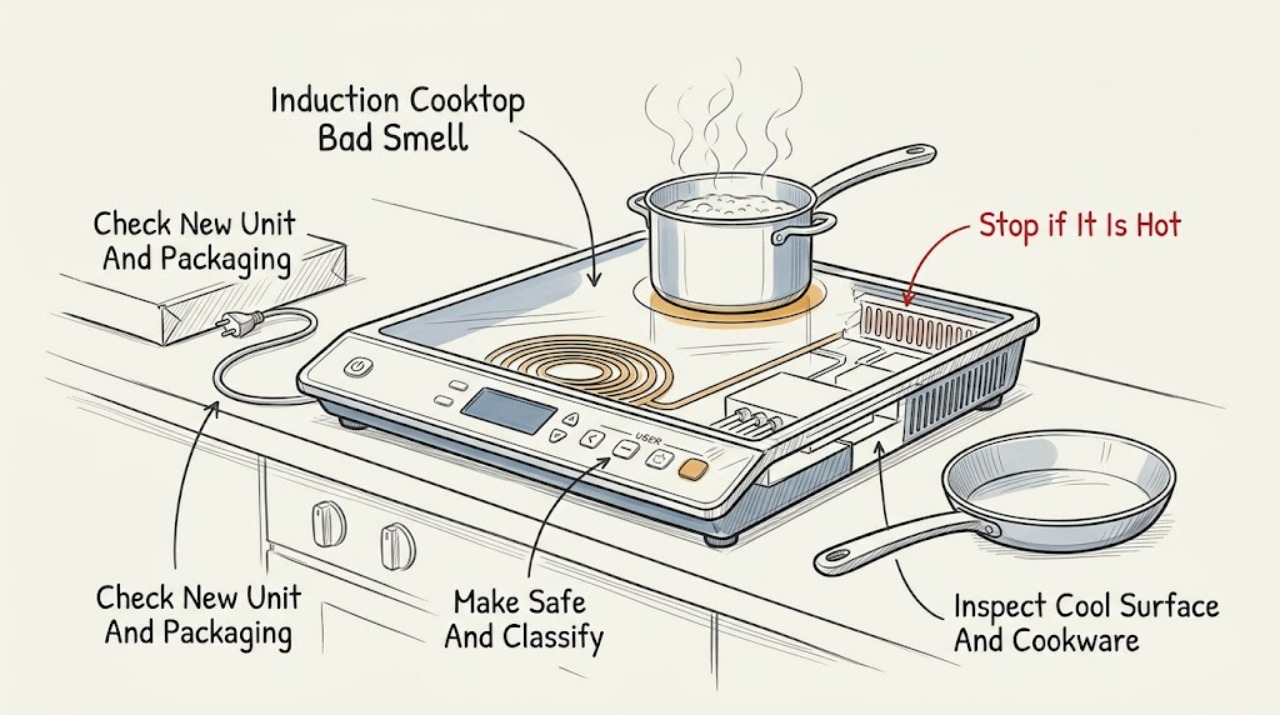
A slight odor during the first uses of a new induction cooktop can come from new parts or insulating materials and should fade quickly, but a lingering, worsening, electrical, plastic, or burning odor is not something to normalize. Turn the zone and cooktop off, let the surface cool, and identify whether the smell came from food or a spill, a pan or coating, packaging, or the appliance and its power connection. Clean only the cool, intact glass with the model manual's method and keep vents clear. Smoke, sparks, arcing, a cracked or flooded surface, an unusually hot connection, persistent overheat, or a breaker trip requires immediate shutdown and qualified service; do not open the cooktop or test it again to reproduce the smell.
Work through in order
Diagnostic checks
Use only checks that match the exact appliance or system and its official guide.
-
Check 1
Turn all cooking zones and the main control off, move away from the surface if smoke or strong fumes are present, and classify the smell without touching hot cookware: new-material odor, food or oil, melted plastic or packaging, pan coating, electrical or chemical odor, or an unknown source.
Expected result: Record when the smell began, which zone or nearby area was involved, whether the cooktop was new or recently cleaned, and whether there is smoke, flame, spark, arcing, a code, heat, or a breaker trip.
Next step: For any smoke, spark, arcing, cracked glass, liquid entry, or abnormal heat, keep the cooktop off and arrange qualified help; isolate power only from a dry, safe position if this does not involve touching damaged equipment.
Stop if: Do not restart to reproduce an electrical smell, touch a hot surface, or operate near smoke or a damaged connection.
Why this matters
Why: A mild first-use odor that fades is consistent with new materials. Food residue or a pan can create a localized odor. An electrical or chemical smell, smoke, arcing, abnormal heat, or a fault code is a stop condition rather than a cleaning clue.
-
Check 2
If the cooktop is new and the odor is slight, inspect only the accessible surface and surrounding installation for leftover protective film, tape, labels, or packaging, using the installation and owner manual. Do not remove trim or reach below the glass.
Expected result: The odor is present only during early use and fades, visible packaging remains outside hot areas, the odor persists after several uses, or the source seems to be below or beside the cooktop.
Next step: Remove only packaging that the manual identifies as accessible and keep the area ventilated. If the smell persists, grows stronger, or comes from the appliance body or connection, stop use and request service.
Stop if: Do not run a high-heat cycle to burn off an unknown material, remove the cooktop from the counter, or inspect internal insulation.
Why this matters
Why: New parts and insulation can create a brief first-use odor, but a lingering odor is not typical. Material below the glass or inside the cabinet cannot be safely identified by an ordinary user and needs service.
-
Check 3
After the glass and cookware are fully cool, inspect the affected zone and pan bottom for spilled food, oil, foil, melted plastic, discoloration, or a damaged nonstick coating. Remove the cookware and compare whether the smell is on the pan or remains at the cooktop.
Expected result: Residue is visible on the glass or pan, plastic or foil has melted, the pan coating is damaged, or both surfaces are clean but the odor returns from the appliance.
Next step: Retire damaged cookware, and clean cool residue only with the manual-approved method. If material has entered an opening or the smell remains without a cooking source, arrange service.
Stop if: Do not scrape with a knife, heat the surface to loosen plastic, use flammable solvents, or pour cleaner into controls or vents.
Why this matters
Why: A localized residue or damaged pan can explain an odor during heating, while an odor from a clean cooktop points toward the controls, electronics, cooling system, or installation. Melted material can adhere to the glass and should not be pried off while hot.
-
Check 4
With the cooktop cool and power controls off, wipe the intact glass and control area with the cleaning method allowed by the exact manual, dry it fully, and confirm that cooling openings are not blocked by objects or residue. Ventilate the room naturally when safe.
Expected result: The odor disappears after cool cleaning, returns only when one pan or zone is used, remains while the cooktop is idle, or is accompanied by a hot control, fan problem, or error indication.
Next step: Use the cooktop only after the surface is dry and no stop condition exists. If the odor returns from the appliance, keep it off and request service with the model and observations.
Stop if: Do not use steam, excessive water, abrasive tools, aerosol cleaner near controls, or block the cooling path.
Why this matters
Why: An odor that disappears with residue removal supports food or surface contamination. An idle or recurring appliance odor, especially with heat or an error, is not explained by ordinary cleaning and should be professionally assessed.
-
Check 5
If the odor came from the controls, underside, cord, outlet, or ventilation area, or the cooktop shut down unexpectedly, inspect only visible connections from a dry position after power is safely isolated. Note any breaker trip, repeated reset, unusual fan behavior, or temperature warning.
Expected result: The connection is scorched or loose, the breaker trips again, the cooktop is unusually hot after the zone is off, the cooling fan is abnormal, or no visible issue is present.
Next step: Leave the cooktop disconnected and arrange licensed electrical or appliance service for any connection damage, trip, persistent heat, or fan fault. Do not use the unit to check whether it improves.
Stop if: Do not remove covers, probe live terminals, alter the circuit, or repeatedly reset a breaker.
Why this matters
Why: A damaged connection, repeated trip, or abnormal heat can indicate an electrical or cooling fault. A clean visible connection does not rule out dangerous voltage inside the chassis, and a temperature warning can require model-specific service.
-
Check 6
If the odor occurs only with cookware on one zone and no residue or electrical symptom is present, identify the pan material, bottom condition, and placement from the manual, then compare with clean, undamaged induction-suitable cookware only if the surface is cool and safe.
Expected result: The smell follows one pan, a pan is warped or coated, the odor occurs at one zone only, or the odor appears with different suitable pans and settings.
Next step: Stop using the suspect pan and clean the cool surface. If the same odor follows the zone or occurs at idle, request service instead of changing power or wiring.
Stop if: Do not heat empty pans to test them, use plastic or paper containers, or continue with smoke, discoloration, or a damaged glass surface.
Why this matters
Why: Cookware material, damaged coating, or trapped residue can create heat-related odor. An odor tied to one zone across suitable clean pans suggests the zone or electronics rather than the cookware. A pan that is not suitable or is damaged should not be used again.
-
Check 7
If the smell persists after the surface is cool and clean, or if any safety symptom occurred, keep the induction cooktop out of use and give a qualified technician the model, installation type, odor description, zone, cookware, timing, codes, and power symptoms.
Expected result: A technician confirms residue, cookware damage, cooling failure, control or power fault, glass damage, or no safe reproducible cause.
Next step: Use authorized appliance service for persistent or internal odors and licensed electrical service for circuit or connection symptoms. Follow emergency guidance for smoke, fire, arcing, or an unsafe hot surface.
Stop if: Do not disassemble, bypass thermal protection, or perform another heating test after an electrical or fire symptom.
Why this matters
Why: Bad smell is a symptom, not a single replacement-part diagnosis. New-material odor, food, cookware, blocked cooling, and internal electrical faults require different responses. A model-specific inspection is needed before any part is chosen.
Use your observations
Decision map
Find the observation that best matches what you see, then follow the next safe action.
-
PATH 01Safety boundary
What you see
Smoke, fire, sparks, arcing, a burning electrical odor, a hot connection, or a repeated breaker trip is present.
Do this next
Turn the cooktop off and isolate power only from a dry, safe position if that can be done without touching damaged equipment; leave fire or smoke conditions to emergency help.
Why this path and its safety boundary
Safety stop: Do not restart, reset the breaker repeatedly, or open the cooktop.
-
PATH 02Safety boundary
What you see
The glass is cracked or liquid has entered the cooktop.
Do this next
Stop use, keep power isolated from a safe location, and arrange authorized service; do not wipe into the break or try to seal it.
Why this path and its safety boundary
Safety stop: Do not cook on broken glass or touch wet electrical parts.
-
PATH 03Safety boundary
What you see
The cooktop is new, the odor is slight, there is no smoke or abnormal heat, and the smell fades quickly.
Do this next
Remove accessible packaging as directed, keep the area ventilated, and monitor without cooking food until the odor has cleared.
Why this path and its safety boundary
Safety stop: A lingering, worsening, or electrical odor ends this branch and requires service.
-
PATH 04Safety boundary
What you see
The odor is localized to visible food, oil, plastic, foil, or one damaged pan and disappears when it is removed and the surface is cool and clean.
Do this next
Retire damaged cookware and clean the intact cool surface using the exact manual; make no high-power test with suspect material.
Why this path and its safety boundary
Safety stop: Smoke, melting, glass damage, or a returning appliance odor requires service.
-
PATH 05Safety boundary
What you see
A clean suitable pan triggers the same odor at one zone, or the odor accompanies fan trouble, a temperature indication, or persistent heat.
Do this next
Stop using the zone or cooktop and request model-specific appliance service for the cooling, control, or power system.
Why this path and its safety boundary
Safety stop: Do not increase power or bypass thermal protection.
-
PATH 06Safety boundary
What you see
The odor remains while the cooktop is idle, returns after cool cleaning, or comes from below the glass or the power connection.
Do this next
Keep the cooktop off and arrange qualified appliance or electrical service; provide the odor timing and installation details.
Why this path and its safety boundary
Safety stop: Do not run another cycle to locate the source.
-
PATH 07Safety boundary
What you see
The odor source cannot be safely classified or the condition persists without a visible food or cookware cause.
Do this next
Leave the cooktop off and request service rather than guessing at a component or repeating the test.
Why this path and its safety boundary
Safety stop: Do not disassemble or modify the induction unit.
Helpful context
Understand the symptom
Identify where the odor starts before cleaning
An induction cooktop heats compatible cookware through an electromagnetic field, while the glass, controls, cooling system, and nearby installation remain separate possible odor sources. Food or oil on the glass can smell when heated; a new appliance may have a short-lived manufacturing odor. An odor from the power connection, control area, underside, or ventilation opening is different and should be treated as a possible electrical or component fault. Do not assume a pan odor is harmless if smoke or overheating is also present.
A fan or cookware sound is not automatically an odor fault
Induction systems can produce a low hum, crackle, or cooling-fan sound because energy is transferred to cookware and heat is removed from the unit. Those sounds can be normal, but a new smell together with a fan that stops, a hot control area, a code, or loss of power changes the decision to service. Use the exact model manual for fan behavior and ventilation clearances; do not block vents or place flammable items near them.
Cool, intact glass is the limit of ordinary cleaning
Once the cooktop is off and cool, remove a visible spill with the approved non-abrasive method and inspect the glass and cookware for melted plastic, foil, burnt residue, or a damaged coating. Never scrape aggressively, use a steam cleaner, pour liquid into openings, or use a broken surface. A cracked glass panel, liquid that entered the appliance, or odor that returns after the residue is gone belongs with authorized service.
Safety boundary
Stop conditions
- Smoke, flames, electrical or chemical burning odor, sparks, arcing, or an unusually hot control or connection.
- A cracked glass surface, liquid entering the cooktop, or standing water near an electrical connection.
- Repeated breaker trips, damaged wiring, or any need to work on a live circuit.
- Melted plastic or foil, a damaged pan coating, visible discoloration, or a surface that remains abnormally hot.
- Any need to open the cooktop, bypass thermal protection, or inspect internal high-voltage parts.
Only after diagnosis
Potential parts
- induction cooktop cooling fan
Consider only after a qualified diagnosis confirms a cooling-fan fault associated with persistent heat or odor.
Confirm the exact cooktop model and manufacturer fit information; an odor alone does not identify a fan. - induction cooktop control module
Consider only when a technician confirms an electronic control or power fault after ruling out residue, cookware, ventilation, and the external supply.
Internal high-voltage work requires qualified service and exact model fit; do not select a module from the smell symptom alone. - induction cooktop glass surface
Consider only when authorized service confirms damage to the glass surface and replacement is appropriate for the exact model.
Do not operate cracked glass or choose a visually similar panel; confirm model-specific fit through authorized service.
When checks do not resolve it
Need a professional?
Arrange authorized appliance service for a lingering, recurring, or unexplained odor, especially when it comes from below the glass or the controls., Use licensed electrical service for a scorched connection, repeated breaker trip, arcing, damaged cord, or abnormal power symptom., Stop immediately and use emergency help for smoke, fire, or active arcing; do not perform another heating test., Request service for a cracked glass surface, liquid entry, persistent overheating, fan failure, or a temperature warning., Use the exact model manual when cleaning, ventilation, cookware, power isolation, or control behavior differs from this general guidance.
Common questions
FAQ
Is a smell from a new induction cooktop normal?
A slight first-use odor from new parts or insulation can be normal and should fade quickly. A lingering, worsening, electrical, plastic, or smoky odor is not typical; turn the cooktop off and arrange service.
Could the pan cause an odor on an induction cooktop?
Yes. Food, oil, foil, melted plastic, or a damaged pan coating can smell when heated. Let everything cool, remove the suspect pan, clean the intact glass with the manual-approved method, and do not heat damaged cookware again.
Why does my induction cooktop smell hot after cooking?
The cooktop and cookware can remain hot after a zone is off, and a cooling fan may run. If the odor is new, strong, returns while idle, or accompanies excessive heat, a code, smoke, or fan trouble, stop using the appliance and request service.
Is it safe to use an induction cooktop with a cracked glass surface?
No. Stop using it and arrange authorized service. Liquid can enter a crack and create an electric-shock or fire risk; do not seal the crack or continue cooking.
What should I do if the induction cooktop smells like burning plastic or electricity?
Turn it off immediately and do not run another test. If safe, isolate power from a dry position without touching damaged equipment; smoke, sparks, arcing, a hot connection, or a repeated trip requires emergency or qualified electrical and appliance service.
Read the exact guide
Official sources
- Ranges and Cooktops - Odor From New CooktopGE Appliances · Manufacturer guidance for first-use cooktop odor and lingering odor service boundary
- Washing Machines SafetyElectrical Safety First · Electrical safety principles for appliance damage, overheating, arcing, and breaker trips
- Humming or Crackling Noise on an Induction Cooktop - Product Help | WhirlpoolWhirlpool · Manufacturer guidance for induction cookware behavior, energy transfer, and appliance operating conditions
- HIPR36S Induction Range User ManualDacor · Official induction operation guidance for cookware, initial odor, hot-surface behavior, and cooling
- Dacor Modernist Cooktops 36 Induction Cooktop User ManualDacor · Official induction cooktop safety guidance for cracked glass, liquid entry, burning smell, smoke, high voltage, and service
Community feedback
Share a repair observation
Share a plain-text repair observation. Accepted observations are published automatically; this page may take a moment to update.