
On this page
Start here
Quick answer
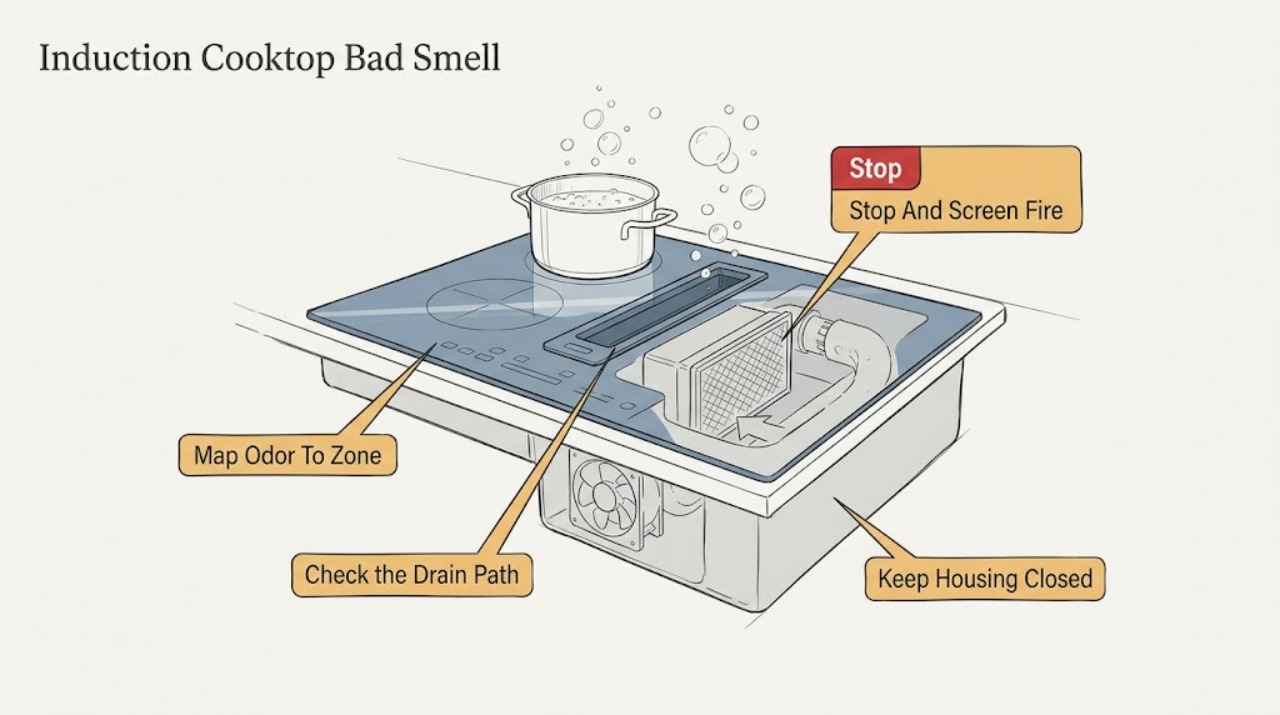
A smell from a KitchenAid induction cooktop can come from spilled food or grease on a hot glass surface, a new-installation finish, cookware, a contaminated grease or charcoal filter, poor downdraft airflow, or overheating electrical components. Turn every cooking zone off and stop immediately for smoke, flames, sparking, arcing, a melting-plastic smell, a hot cord or cabinet, a cracked glass surface, or an odor that continues with the cooktop off; disconnect power only if the disconnect is safely accessible and keep clear. If the smell is limited to cooking vapor, let the surface cool, clean it with the model-approved method, and check the hood or downdraft filter and airflow. KitchenAid says its induction cooktop needs suitable ferromagnetic cookware, clean and dry controls, and proper ventilation; poor ventilation can overheat the cooktop and shut it down. If the smell returns after cleaning and ventilation checks, comes from the cabinet or wiring, or requires opening the unit, keep it off and arrange qualified appliance service.
Before you begin
Safety first
- This article supports cool, ordinary-access cleaning, cookware, filter, and airflow checks only. Do not open the cooktop, test live wiring, defeat thermal protection, move a built-in appliance, alter duct or electrical connections, or operate with smoke, sparking, damage, or recurring electrical odor.
Work through in order
Diagnostic checks
Use only checks that match the exact appliance or system and its official guide.
-
Check 1
Turn every cooking zone and the downdraft off, step back, and check only from a safe distance for smoke, flame, sparking, arcing, a melting-plastic or electrical odor, a hot cord or cabinet, a cracked glass surface, or odor that continues while the cooktop is off.
Expected result: Record whether the odor is food or grease-like and localized above the glass, filter or vapor-like at the vent, or electrical, plastic-like, smoky, or coming from beneath the unit.
Next step: For smoke, flame, sparking, arcing, a hot or damaged cord, or an electrical or melting-plastic odor, keep the unit off, disconnect power only at a safely accessible disconnect, leave the area if necessary, and arrange qualified service. Use appropriate fire-emergency help for an active fire.
Stop if: Do not relight or repeatedly test a smoking, sparking, melting, cracked, or electrically scented cooktop, and do not use water on an energized electrical fire.
Why this matters
Why: A fire, electrical, structural, or continuing cabinet odor overrides ordinary cleaning. A normal, cooking-only odor permits cool-down and external checks, but does not justify opening the cooktop.
-
Check 2
After the hazard screen, record which zone, pan, filter inlet, or cabinet area produces the smell, when it begins, whether it follows one cookware item or heat level, and whether the cooktop is new, recently cleaned, or recently installed.
Expected result: Classify the event as first-use or finish odor, spilled-food or grease odor on the glass, cookware odor, downdraft filter odor, odor with a hot control area, or electrical odor that persists after shutdown.
Next step: Follow the matching external check below and preserve the location, timing, heat level, and control or display behavior for service if the smell returns.
Stop if: Stop if the odor source cannot be localized without lifting the cooktop, removing a panel, or touching a hot surface.
Why this matters
Why: A surface or cookware-specific smell follows the cooking path; a vent-specific smell follows filtration or airflow; a cabinet or post-shutdown smell points toward internal heat or electrical diagnosis. Timing distinguishes residue from a recurring appliance fault but does not prove a component failure.
-
Check 3
When the cooking surface and cookware are fully cool and power is off, inspect the glass, trim, pan bottom, and control area for burned food, grease, film, packaging, water, or an object resting on a touch key; clean and dry only with the product manual's approved method.
Expected result: Record whether residue is visibly charred, whether the odor disappears after cleaning, whether the glass is cracked or discolored, and whether touch controls respond normally when the unit is next used.
Next step: Remove only cool, accessible residue, dry the controls completely, and make one brief normal test with suitable cookware after the surface is safe. If the smell returns or damage is visible, keep the unit off and request service.
Stop if: Do not scrape aggressively, use abrasive or flammable cleaners, pour liquid into the controls, or clean while the surface is hot or energized.
Why this matters
Why: Residue on a hot surface or contamination on the controls can produce odor or interfere with operation. A cracked, discolored, bubbling, or persistently hot area is a damage or overheating clue rather than a cleaning issue.
-
Check 4
If the glass is intact and clean, use one clean, dry, induction-compatible pan centered on the zone and avoid an empty pan, oversized overhang, or an unusually high setting while observing from a safe position.
Expected result: Record whether the smell follows one pan, whether the pan base is magnetic and suitable, whether the pan or zone becomes excessively hot, and whether the zone turns off or displays an indication.
Next step: Stop using the suspect pan, use only cookware allowed by the model guide, and lower the setting if the manual permits. If the odor persists with clean compatible cookware, continue to ventilation and service checks.
Stop if: Do not continue heating an empty, smoking, warped, damaged, or visibly overheating pan, and do not place foil or loose metal objects on the induction surface.
Why this matters
Why: KitchenAid says ferromagnetic cookware is required, pan construction can alter heating, and an empty pan or unsuitable cookware can prevent normal operation. An odor from a pan or residue can be external to the cooktop; an odor with normal cookware and the zone still points toward the appliance or ventilation.
-
Check 5
If the odor is captured at an integrated downdraft, turn the vent off, let the inlet cool, and inspect the accessible grease filter and charcoal filter arrangement; clean or replace them only as the model guide permits and check that the inlet and exhaust path are not blocked.
Expected result: Record whether the filter is greasy, saturated, missing, incorrectly installed, or due for replacement, whether the odor is reduced in an external-vent installation, and whether the vent has normal airflow.
Next step: Restore the filters and inlet exactly as documented, improve safe room make-up air if the installation instructions require it, and make one normal cooking observation. If the filter is clean and the odor remains, arrange service for the ventilation or cooktop.
Stop if: Do not operate a downdraft with a missing filter where the manual requires one, reach into a running fan, alter ducting, or use a filter not approved for the installation type.
Why this matters
Why: KitchenAid says grease filters should be cleaned when indicated and charcoal filters are for recirculating installations and should be replaced when odor removal becomes less effective. Poor extraction can leave cooking vapor in the room, but it does not explain a burning electrical smell beneath the unit.
-
Check 6
With no active odor hazard, check that the cooktop has the ventilation clearance specified by its installation instructions and that nearby fans, registers, cabinets, or objects are not disrupting airflow; if the controls or surface became very hot, switch off and let the cooktop cool fully.
Expected result: Record whether the odor or shutdown occurs only at high power, whether the vent moves air, whether the cooktop is installed over a restricted space, and whether the symptom clears after cooling.
Next step: Use the model installation instructions to correct only an accessible airflow obstruction, then make one brief normal test. If the odor or overheat response returns, keep the unit off and arrange qualified service.
Stop if: Do not bypass an overheat response, run the cooktop unattended to reproduce the smell, move a built-in unit, or modify electrical or duct connections.
Why this matters
Why: KitchenAid states that poor ventilation can cause cooktop overheating and shutdown, and that excessive internal electronic temperature can switch the controls off. Cooling can clear a protection response, but a recurring odor or shutdown indicates a ventilation, installation, or internal fault.
-
Check 7
After the applicable cool, clean, cookware, filter, and airflow checks, make one short, attended test with a clean compatible pan and stop at the first return of the odor, smoke, unusual heat, error, or abnormal control behavior.
Expected result: Record whether the smell is gone, repeats at one zone or power level, comes from the vent or cabinet, accompanies an automatic shutdown, or remains after the cooktop is off.
Next step: Keep the cooktop off if the odor returns and arrange qualified KitchenAid appliance service with the model, odor location, timing, heat level, cookware, filter, ventilation, control, and shutdown observations.
Stop if: Do not repeat tests, open the cooktop, probe wiring, defeat thermal protection, or replace a board, fan, sensor, or power component by symptom alone.
Why this matters
Why: A smell that disappears after removing residue or servicing an accessible filter supports that external cause. A recurring smell with clean cookware, normal filters, proper ventilation, or the controls off requires diagnosis of wiring, cooling, electronics, or installation; it does not identify a safe replacement part.
Use your observations
Decision map
Find the observation that best matches what you see, then follow the next safe action.
-
PATH 01Safety boundary
What you see
Smoke, flame, sparks, arcing, melting-plastic or electrical odor, a hot cord or cabinet, visible damage, or odor while the cooktop is off is present.
Do this next
Keep the cooktop off, disconnect power only if safely accessible, leave the area for an active fire or heavy smoke, and arrange qualified service or emergency help as appropriate.
Why this path and its safety boundary
Why it matters: This is a safety stop, not a cleaning or filter problem.
Safety stop: Do not reconnect, relight, open the cabinet, or use water on an energized electrical fire.
-
PATH 02Safety boundary
What you see
The odor is localized above the glass or follows one pan, with no smoke, damage, or cabinet odor and the surface is cool.
Do this next
Clean cool accessible surfaces using the model-approved method, use a clean compatible pan, and make one brief attended test.
Why this path and its safety boundary
Why it matters: Burned food, grease, film, or cookware is plausible.
Safety stop: If the odor returns, the glass is damaged, or the pan smokes or overheats, stop and request service.
-
PATH 03Safety boundary
What you see
The odor is strongest at an integrated downdraft inlet and resembles stale cooking vapor or grease, while the cooktop itself remains normal.
Do this next
Inspect, clean, or replace accessible filters as documented and confirm the vent path and room airflow requirements.
Why this path and its safety boundary
Why it matters: Filter saturation, incorrect filter arrangement, restricted airflow, or insufficient make-up air may be involved.
Safety stop: If airflow is absent, the motor smells electrical, or the odor remains with clean filters, stop using the vent and arrange service.
-
PATH 04Safety boundary
What you see
The odor appears at high power or with a hot control area, and the cooktop shuts down, becomes unresponsive, or shows an indication.
Do this next
Switch off, clear and dry the controls after cooling, verify accessible ventilation conditions, and follow the model guide once.
Why this path and its safety boundary
Why it matters: Poor ventilation, blocked controls, unsuitable cookware, or excessive electronic temperature may be involved.
Safety stop: If shutdown, odor, or abnormal heat recurs, keep the unit off and request qualified service; do not defeat thermal protection.
-
PATH 05Safety boundary
What you see
The smell returns with clean compatible cookware, clean filters, normal airflow, and no visible residue, or its source is beneath the cooktop.
Do this next
Keep the cooktop off and arrange qualified KitchenAid service with the complete observation record.
Why this path and its safety boundary
Why it matters: An internal electrical, cooling, ventilation, installation, or component fault remains possible; the odor does not identify a part.
Safety stop: Do not disassemble the cooktop, test live circuits, move a built-in unit, or substitute parts by smell alone.
Helpful context
Understand the symptom
Identify where the smell starts
A food or grease odor above the glass, a filter odor at a downdraft inlet, and an electrical or plastic odor from beneath the cooktop are different paths. Note whether the smell appears only with a particular pan or zone, whether it continues after all controls are off, and whether there is smoke, visible residue, discoloration, or unusual heat. Do not lean over a hot surface to investigate.
An induction surface can be hot even without a flame
Induction heats compatible cookware, and residual heat or spilled food can char on the glass or nearby trim. Wait for the surface indicator and cookware to cool before cleaning. A strong odor from the cabinet, controls, wiring, or ventilation motor is not a normal cooking smell and should be treated as a stop condition.
Ventilation changes the diagnosis
KitchenAid says downdraft filters should be cleaned when the filter indicator illuminates, and a charcoal filter is for recirculating installations and should be replaced when odor removal becomes less effective. Air currents and a room without replacement air can interfere with extraction. These checks address captured cooking vapor, not an electrical odor from the appliance body.
Overheating and control behavior need a clear boundary
KitchenAid explains that an induction cooktop can shut down when its electronic parts become too hot and that poor ventilation can contribute. Objects, food, or water on the control area can also affect operation. Let the unit cool, clear and dry the controls, and follow the model installation instructions; recurring odor or shutdown needs service.
Safety boundary
Stop conditions
- Stop for smoke, flame, sparks, arcing, melting-plastic or electrical odor, a hot or damaged cord or cabinet, a cracked or discolored glass surface, or odor that continues after shutdown.
- Disconnect power only at a safely accessible disconnect; do not reach behind a hot, wet, smoking, or damaged built-in cooktop.
- Do not operate unattended to reproduce an odor, repeatedly reset an overheated unit, defeat thermal protection, or use damaged cookware.
- Do not pour liquid into controls, clean a hot or energized surface, reach into a running fan, modify ducting, or open the cooktop for live electrical testing.
- Stop using the appliance and arrange service when a clean surface, suitable cookware, clean filter, and proper ventilation do not prevent the odor from returning.
When checks do not resolve it
Need a professional?
Arrange qualified KitchenAid appliance service when the odor is electrical, plastic-like, smoky, or from beneath the cooktop; when smoke, sparking, arcing, unusual heat, glass damage, repeated overheat shutdown, or control failure occurs; when the downdraft motor or wiring smells abnormal; or when the odor returns after the cool, clean, cookware, filter, and ventilation checks. Provide the exact model, odor description and location, timing, zone and power level, cookware used, visible residue or damage, filter and airflow condition, control or error behavior, and whether the smell continued after shutdown. For an active fire or heavy smoke, leave the area and use emergency help.
Safety scope: This article supports cool, ordinary-access cleaning, cookware, filter, and airflow checks only. Do not open the cooktop, test live wiring, defeat thermal protection, move a built-in appliance, alter duct or electrical connections, or operate with smoke, sparking, damage, or recurring electrical odor.
Read the exact guide
Official sources
- Not Removing Odor or Vapor - Downdraft - Product HelpKitchenAid · KitchenAid's official induction-cooktop downdraft support page; filter and duct instructions vary by installation and model.
- Controls Not Responding - Induction - Product HelpKitchenAid · KitchenAid's official induction-cooktop control support page; control names and lock behavior vary by model.
- Burner Turns Off During Cooking - Induction - Product HelpKitchenAid · KitchenAid's official induction-cooktop support page; exact levels, clearances, indicators, and cookware requirements vary by model.
- Nothing Will Operate - Induction Cooktop - Product HelpKitchenAid · KitchenAid's official induction-cooktop no-operation support page; installation wiring and protection requirements are model and site specific.
Community feedback
Share a repair observation
Share a plain-text repair observation. Accepted observations are published automatically; this page may take a moment to update.