
On this page
Start here
Quick answer
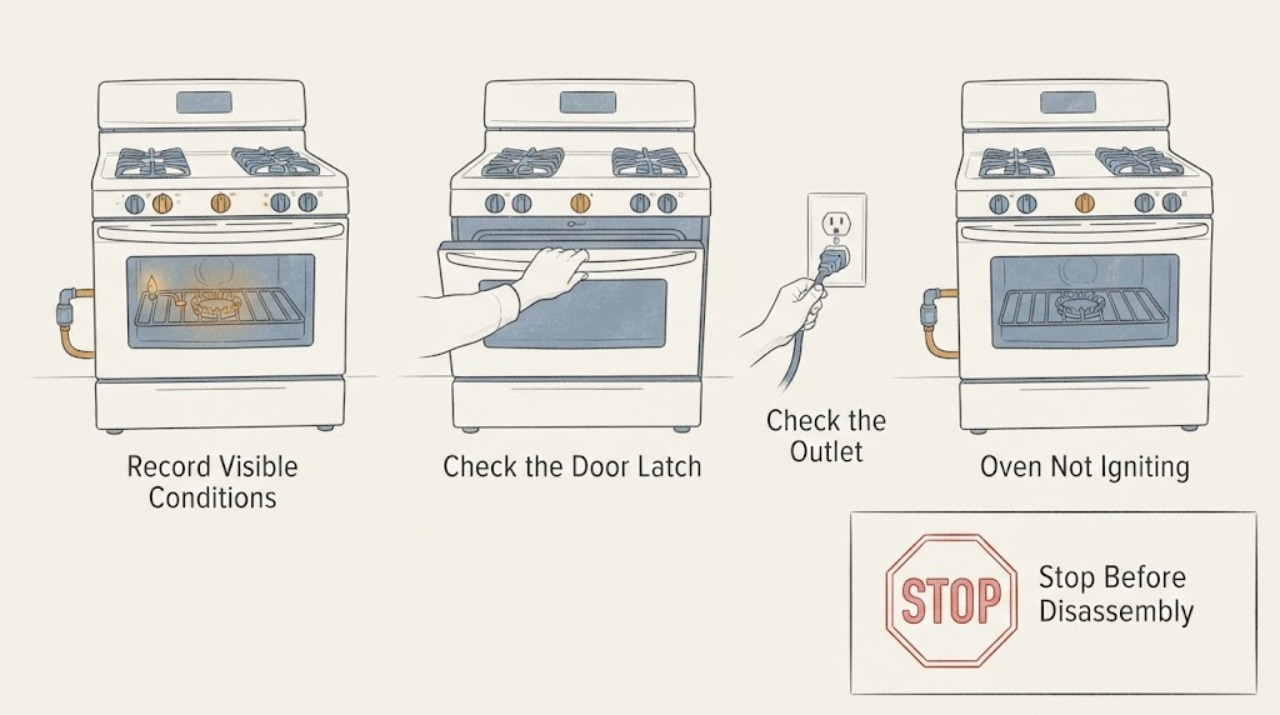
First confirm that this is a JennAir gas or dual-fuel oven; an electric oven does not use a gas igniter and needs its own manual. Record the model, selected mode, whether the display and cooktop work, and whether the oven clicks, shows a spark, produces a flame, or stays silent. With the oven cool and no gas odor, confirm the door is fully closed, the control lock or delayed start is not active, the power cord is connected to a grounded operational outlet, and the accessible main gas valve is on. A cooktop that works does not prove that the oven gas path is open, because JennAir documents a separate pressure-regulator shut-off on some gas ranges. Do not slide a hard-piped range, open gas components, test live wiring, or repeatedly attempt ignition. For gas odor, delayed ignition, continuous sparking, abnormal flame, smoke, overheating, or a tripped breaker, turn controls off, leave the area as appropriate, and obtain qualified emergency or gas-appliance help.
Work through in order
Diagnostic checks
Use only checks that match the exact appliance or system and its official guide.
-
Check 1
Record the full JennAir model number and fuel configuration, then note whether the display is active, the cooktop works, the selected mode is Bake or another gas-oven function, and whether the oven is silent, clicks, sparks, or produces a flame. Record every exact display code, lock symbol, or message before changing settings.
Expected result: The oven is gas or dual-fuel, or the fuel type is uncertain; the display is blank or active; the cooktop works or is also off; the oven clicks without flame, has a delayed flame, or never attempts ignition.
Next step: Keep the exact manual and recorded behavior for every following check. If the appliance is not confirmed gas or dual-fuel, use the matching electric guidance or request model-specific service rather than trying to inspect gas parts.
Why this matters
Why: JennAir has different gas and electric troubleshooting paths, and models differ in controls and ignition behavior. A blank display points first toward power or controls, while a clicking oven with no flame points toward gas supply or ignition; neither symptom identifies an internal part by itself.
-
Check 2
With the oven cool, close the door fully and check the user controls against the exact manual: clear control lock, cancel an unintended delayed start or timer, exit demo mode if shown, select a normal oven mode, set a permitted temperature, and press START once. Do not defeat a latch or interlock.
Expected result: The door was not fully closed, a lock, delay, or demo message was active, the control accepts the setting and begins ignition, or the panel remains unresponsive.
Next step: Correct only the setting identified by the model manual and make one start attempt. If the panel remains locked or unresponsive, or the door cannot close, stop and arrange service.
Why this matters
Why: JennAir states that some models will not operate a gas-oven function with the door open and that control lock, delayed start, or demo mode can block operation. A control that accepts a start but never ignites needs the gas and ignition checks, not repeated button presses.
-
Check 3
Check the accessible electrical supply without opening the range: verify the power cord is in a grounded, operational outlet and that the household circuit is on. Do not use a two-prong adapter or extension cord, do not touch a wet or damaged outlet, and do not repeatedly reset a breaker.
Expected result: The outlet or circuit is off, the breaker has tripped, the cord or outlet is damaged or uncertain, or the supply seems normal while the igniter remains silent.
Next step: Restore a clearly switched-off supply only once if it can be done safely. If the breaker trips again, the outlet is not grounded or operational, or the cord is damaged, leave the appliance off and use a qualified electrician or appliance technician.
Why this matters
Why: JennAir says correct gas-oven igniter operation depends on a good ground path for the spark. A repeat breaker trip or uncertain grounding is an electrical fault boundary, not a normal ignition reset.
-
Check 4
Check the normal-access main gas valve only if the JennAir installation instructions identify it and no gas odor is present. If the range was recently installed or reconnected, note that history and do not repeatedly ignite burners to purge air. Never loosen a fitting or operate a valve when gas is smelled.
Expected result: The main valve is off, the range was recently connected, the cooktop also lacks gas, or the main supply appears on while only the oven fails.
Next step: Use the exact installation manual and qualified gas service for any supply or valve issue. If ignition is delayed or any gas odor appears, turn the control off and leave the area as appropriate instead of making another attempt.
Why this matters
Why: JennAir says air can be trapped after reconnection and that the main gas valve must be on. A cooktop that also lacks gas points toward the main supply, while a working cooktop does not rule out an oven-specific regulator or ignition path.
-
Check 5
If the cooktop works but the gas oven does not ignite, inspect the storage-drawer area and oven bottom only from normal user access: remove loose pans or racks that could interfere with an igniter and confirm the oven bottom is not covered with foil or a liner. Do not remove the oven bottom, burner, or igniter.
Expected result: The storage drawer is overloaded, foil or a liner covers the oven bottom, the oven is clear, or the oven still clicks or stays silent after the obstruction is removed.
Next step: Remove only loose user items and any prohibited liner as the manual permits, then make one normal start attempt. If the fault remains, stop user diagnosis and arrange qualified gas-appliance service.
Why this matters
Why: JennAir documents that stored items can interfere with an igniter and that covering the oven bottom can block air or gas flow on applicable models. A clear user area does not prove that the igniter, burner, or gas valve is serviceable.
-
Check 6
Do not move the range unless the exact installation instructions and a safe, non-hard-piped installation permit it. If a qualified person has confirmed that the pressure-regulator shut-off is safely visible, note whether it is in the documented open position; otherwise leave the regulator and gas tubing untouched.
Expected result: The range is hard-piped, the regulator cannot be reached without movement, the documented regulator shut-off is closed, or it is open while the oven still will not ignite.
Next step: Do not slide a hard-piped range or adjust an inaccessible regulator. Have a certified gas technician verify the regulator, supply, and ignition system; if the valve is already open, stop looking for internal gas causes yourself.
Why this matters
Why: JennAir explains that the pressure-regulator shut-off can stop gas to the oven while the cooktop continues to work. Moving a hard-piped or connected range can kink or stress the flexible supply line and create a separate hazard.
-
Check 7
Make one supervised ignition observation from the normal controls only: note whether the igniter clicks, whether a flame appears promptly and remains stable, and whether smoke, popping, an unusual flame, or a burning odor occurs. Do not use a flame to search for a leak and do not keep cycling the oven if it does not light.
Expected result: There is no click, continuous clicking without a flame, delayed ignition, an unstable or abnormal flame, smoke, burning odor, or a normal flame that goes out or does not heat the oven.
Next step: Turn the oven control off and stop immediately for gas odor, delayed ignition, abnormal flame, smoke, or burning odor. Otherwise record the exact behavior and request qualified gas-appliance service; do not test live voltage or replace the igniter yourself.
Why this matters
Why: No click suggests a power or control-path issue; clicking without a stable flame can involve the gas or ignition path. Delayed ignition, an abnormal flame, smoke, or odor is a safety event rather than a prompt to access the burner.
-
Check 8
If the display shows a code or the oven has recently lost power, write down the code and sequence before any reset. Make one model-approved power confirmation only when there is no gas or electrical safety warning; then monitor whether the same code or no-ignition symptom returns. Do not repeatedly cycle power.
Expected result: The code clears and the oven ignites, the code returns, the display remains unresponsive, or a breaker trips again.
Next step: Leave the range off and provide the exact model, code, fuel configuration, and ignition sequence to qualified service. Use a licensed electrician when the house supply or breaker is implicated.
Why this matters
Why: JennAir's control guidance treats codes and modes as model-specific. A returning code or repeat breaker trip indicates a fault beyond a user setting and can make repeated ignition attempts unsafe.
Use your observations
Decision map
Find the observation that best matches what you see, then follow the next safe action.
-
PATH 01Next step
What you see
The appliance is electric rather than gas or dual-fuel.
Do this next
Stop applying gas guidance and use the exact JennAir electric-oven manual for power, lock, demo, delayed-start, and heating checks. Arrange service for a persistent no-heat fault.
Why this path and its safety boundary
Why it matters: There is no gas igniter to troubleshoot.
-
PATH 02Next step
What you see
The gas oven display is blank, the controls are unresponsive, or the cooktop and oven are both without power.
Do this next
Check the grounded outlet and circuit once from a dry, safe position. If supply is present, grounding is uncertain, or the breaker trips again, use qualified electrical or appliance service.
Why this path and its safety boundary
Why it matters: Accessible electrical supply, grounding, or a control state is the first question.
-
PATH 03Next step
What you see
The display works but a door, control lock, delayed start, or demo state prevents a normal start.
Do this next
Follow only the exact model control guide, clear the documented state, close the door, and press START once. Persistent failure or a door that will not close needs service.
Why this path and its safety boundary
Why it matters: A user-level control or closure state may be blocking the function.
-
PATH 04Next step
What you see
The cooktop works but the oven never clicks or clicks without a flame.
Do this next
Check only a safely accessible regulator position as the installation manual allows; do not move a hard-piped range or open gas components. Arrange certified gas-appliance service for a persistent no-ignition symptom.
Why this path and its safety boundary
Why it matters: An oven-specific regulator shut-off, grounded ignition path, or internal ignition fault is possible.
-
PATH 05Next step
What you see
The oven clicks but ignition is delayed, the flame is unstable or abnormal, or the oven produces smoke or a burning odor.
Do this next
Turn the control off, do not relight, and leave the area if gas is smelled or the situation is unsafe. Contact local emergency gas guidance or qualified gas-appliance service from a safe location.
Why this path and its safety boundary
Why it matters: Stop the attempt; this may be a gas, combustion, or fire hazard.
-
PATH 06Next step
What you see
The oven lights normally but goes out, does not heat, or only one mode fails.
Do this next
Record the selected mode and exact sequence, turn the control off, and arrange qualified service. Do not remove the burner or test live circuits.
Why this path and its safety boundary
Why it matters: A burner, flame-safety, temperature-control, or mode-specific fault is possible.
-
PATH 07Next step
What you see
A gas odor, continuous sparking, smoke, abnormal flame, overheating, arcing, heat damage, water near electrical parts, or a repeated breaker trip occurs.
Do this next
Stop all controls and leave the appliance off. Avoid flames and electrical switches when gas is suspected; isolate power only if safe and obtain emergency, gas, electrical, or qualified appliance help as appropriate.
Why this path and its safety boundary
Why it matters: This is a gas, fire, shock, or building-electrical safety stop.
Helpful context
Understand the symptom
Confirm the appliance type before troubleshooting
“Not igniting” is meaningful only if the oven is a gas or dual-fuel model. Check the rating label or owner manual for the full model and fuel configuration. A gas oven needs both gas and electrical ignition; an electric JennAir oven has no gas burner and must be diagnosed with its electric-oven guidance. Do not apply a gas procedure to an electric oven or infer a fault from a code used by another model.
Gas and electrical safety boundary
Only observe from normal controls and user-accessible areas. If gas is smelled, ignition is delayed, a flame is abnormal, or smoke or burning odor appears, stop the attempt and leave the appliance off. Avoid flames, smoking, and electrical switches when gas may be present. Do not remove the oven bottom, burner, igniter, regulator, or control covers, and never test live wiring.
Safety boundary
Stop conditions
- Do not open covers, remove the oven bottom or burner, access the igniter or gas valve, test live wiring, or bypass a door or flame-safety interlock.
- Do not slide a hard-piped range, stretch or kink a flexible gas line, loosen a fitting, or adjust a regulator that is not safely accessible under the exact installation instructions.
- Do not search for a gas leak with a flame, keep relighting after delayed ignition, or repeatedly reset a breaker or control code.
- For gas odor, avoid flames, smoking, and electrical switches; leave the area as appropriate and follow local emergency gas guidance from a safe location.
- Stop for smoke, burning or electrical odor, abnormal flame, overheating, arcing, visible heat damage, water near electrical parts, or repeated breaker trips; obtain emergency or qualified help.
Only after diagnosis
Potential parts
- oven igniter
Consider this only after a qualified technician confirms that the grounded supply, controls, gas path, and safety conditions are correct but the oven has no ignition response or a failed igniter.
Confirm the complete JennAir model and exact component fitment before ordering; gas and electrical work require qualified service. - gas safety valve or regulator component
Consider this only when certified gas service isolates a regulator or safety-valve fault after ruling out the main supply, user-accessible regulator position, and an unsafe leak.
Do not infer a gas component from a no-ignition symptom; model, fuel conversion, installation type, and certified diagnosis determine compatibility. - oven control or flame-safety component
Consider this only when qualified service isolates a control or flame-safety fault after the oven's power, gas, and ignition behavior are documented.
Verify the exact model and have gas and live electrical diagnosis or replacement performed by qualified service.
When checks do not resolve it
Need a professional?
Arrange qualified JennAir gas-appliance service when the oven is confirmed gas or dual-fuel, the door, controls, grounded supply, main valve, and any safely accessible user obstruction are normal, but ignition still fails; when the pressure regulator cannot be safely checked; when only one mode fails; or when a code returns. Use a licensed electrician for an uncertain outlet, grounding issue, damaged cord, or repeated breaker trip. Stop immediately for gas odor, delayed ignition, continuous sparking, abnormal flame, smoke, burning odor, overheating, arcing, water near electrical parts, or heat damage, and leave the appliance off until cleared.
Have this ready
- Provide the complete model number and gas or dual-fuel configuration, whether the display and cooktop work, selected mode, door and control state, exact display code, click or spark behavior, flame timing, recent installation or reconnection, and any gas odor, smoke, burning odor, overheating, arcing, or breaker event.
Common questions
FAQ
Does JennAir oven ignition troubleshooting apply to an electric oven?
No. Confirm the fuel configuration first. JennAir gas and dual-fuel models use an electrical igniter and gas supply, while an electric oven needs its own power, control, and heating guidance.
Why does my JennAir gas oven click but not ignite?
A clicking oven may have an oven-specific gas-path or ignition problem. Check the fully closed door, grounded supply, main gas valve, and any safely accessible regulator or storage obstruction as the exact manual allows. Stop for delayed ignition, gas odor, or an abnormal flame and arrange qualified service.
Why does the JennAir cooktop work while the oven will not light?
JennAir explains that some ranges have a pressure-regulator shut-off that can supply the cooktop while withholding gas from the oven. Do not move a hard-piped range or disturb gas tubing; have a certified technician verify the regulator and ignition path.
Can a JennAir control lock or delayed start stop gas-oven ignition?
Yes, depending on the model. A control lock, delayed start, or demo mode can prevent a normal function from beginning. Use the exact owner manual, clear only a documented setting, and press START once.
What should I check if there is no spark from my JennAir gas oven?
Check the grounded operational outlet and the control state without opening the range. JennAir says the igniter needs a good ground path. A persistent no-click or no-spark symptom requires qualified electrical or gas-appliance service; do not test live wiring.
What if I smell gas when the JennAir oven will not ignite?
Turn the oven control off, do not relight, avoid flames, smoking, and electrical switches, and leave the area if necessary. Follow local emergency gas guidance from a safe location and do not use the appliance until qualified help clears it.
Read the exact guide
Official sources
- Nothing is Working - Gas - Product Help | JennAirJennAir Product Help · JennAir gas ranges with a no-operation, delayed-start, control-lock, or demo-mode symptom
- How to Check the Gas Regulator Shut-Off Valve on an Oven - Product Help | JennAirJennAir Product Help · JennAir gas ranges only when the regulator is safely accessible and the installation instructions permit the check
- Oven Not Working - Gas and Dual Fuel Range - Product Help | JennAirJennAir Product Help · JennAir gas and dual-fuel ranges when the oven does not start or ignite
- Oven Not Working - Electric - Product Help | JennAirJennAir Product Help · JennAir electric ovens when fuel type is not gas or dual-fuel
- Oven Not Working - Gas - Product Help | JennAirJennAir Product Help · JennAir gas ranges with an oven that does not ignite or operate
- Oven Not Working - Cooktop Working - Not Clicking - Product Help | JennAirJennAir Product Help · JennAir gas ranges where the cooktop works but the oven has no ignition click
- Oven Not Working - Cooktop Working - Clicking - Product Help | JennAirJennAir Product Help · JennAir gas ranges where the cooktop works and the oven clicks or does not ignite
Community feedback
Share a repair observation
Share a plain-text repair observation. Accepted observations are published automatically; this page may take a moment to update.