
On this page
Start here
Quick answer
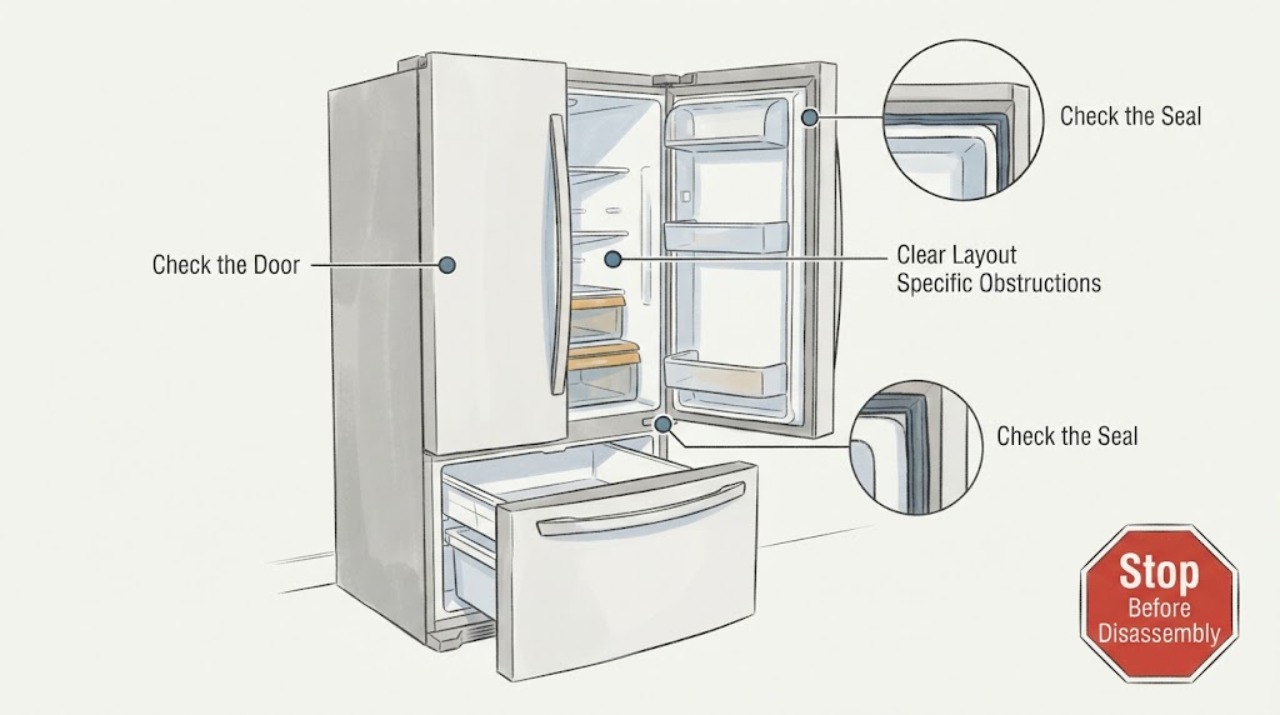
Start with the complete Kelvinator model and decide whether the door is physically blocked, closes but leaves a seal gap, will not self-close, or sits low and rubs. Kelvinator's official KTM5200WB-R top-mount page documents Door close assist, fixed rear rollers, door bins, and adjustable freezer shelving, while its KBM4300WB-L bottom-mount page documents a different bottom-freezer layout with door close assist, bins, and freezer baskets. Empty or reposition only the item, door bin, shelf, crisper, or freezer drawer that prevents closure; Kelvinator's manual says top-mount freezer food can hold the door open and bottom-mount drawers must be pushed fully back. Clean and dry the gasket and cabinet contact surfaces with the approved mild-soap method. If the cabinet is not level or does not have the model's specified slight backward lean, use only the exact manual's front-foot or roller adjustment. A damaged gasket, dropped door, uneven gap, hinge-side rubbing, or a door that remains heavy or misaligned after these external checks needs qualified service; do not force the door, adjust hinge fasteners by guesswork, or lift the appliance alone.
Before you begin
Safety first
- This article permits only model identification, accessible load/bin/drawer checks, gasket/contact cleaning, visual gap inspection, and the exact manual's stable front-foot/roller adjustment. It does not authorize hinge removal, door lifting, cabinet drilling or shimming, electrical testing, or generic replacement-part selection.
Work through in order
Diagnostic checks
Use only checks that match the exact appliance or system and its official guide.
-
Check 1
Record the complete Kelvinator model and serial, and identify whether it is top-mount, bottom-mount, multi-door, or another layout. With the appliance stable, classify the symptom as a physical obstruction, a door that reaches the cabinet but does not seal, a door that will not self-close, or a door that is visibly low, rubbing, or heavy on the hinge side.
Expected result: The door is stopped by an item or drawer; it closes but leaves a gasket gap; it remains open from a partly open position; or its top and bottom gaps are uneven or the hinge side has dropped.
Next step: Use the matching branch below and keep the exact manual available. Do not remove hinge covers or order a gasket or hinge kit from the symptom description alone.
Stop if: Stop for an unstable cabinet, damaged cord, water near electrical parts, smoke, burning odor, or a door that could fall when opened.
Why this matters
Why: The model selects the relevant load and leveling instructions. An obstruction or seal issue is an external user check; self-closing behavior depends on whether the model has self-closing hinges; a dropped or heavy door is more consistent with hinge or structural alignment and should not be diagnosed by force.
-
Check 2
Open the affected compartment and inspect the door bins, shelves, crisper, and freezer drawer or shelf for a bottle, package, liner, or mis-seated removable part projecting into the closing path. For a top-mount layout, check that food is not forward of the freezer-floor ribs; for a bottom-mount layout, push freezer drawers and shelves fully back. Remove or reposition only the accessible obstruction.
Expected result: A door bin, package, shelf, crisper, top-mount freezer-floor load, or bottom-mount drawer stops the door; the removable parts are seated and nothing blocks the path; or the obstruction returns because a drawer/slide does not travel normally.
Next step: Reposition the item, fully close or reseat the removable bin/drawer as the model manual shows, and check closure once. Arrange service for a drawer that binds, a damaged guide, or interference that cannot be corrected without disassembly.
Stop if: Do not force a drawer, trim a shelf or bin, overload a door, remove a slide, or keep slamming the door against an obstruction.
Why this matters
Why: Kelvinator treats door-held-open items and incomplete crisper/freezer bins as closure causes. A clear path that still will not close points toward seal contact, cabinet level, or hinge alignment; a drawer that cannot travel normally may have a damaged or disengaged slide rather than a simple load problem.
-
Check 3
With the obstruction removed, inspect the entire accessible gasket and the cabinet contact surface for food residue, dirt, twisting, a tear, a flattened corner, or a section pulled from its channel. Clean with the Kelvinator manual's mild detergent and warm-water method, then dry thoroughly; do not use solvents, abrasives, heat, or adhesive.
Expected result: The gasket is dirty but continuous; it is clean and contacts the cabinet all around; there is a visible gap, tear, detached section, or flattened corner; or the gap is only on the hinge side or latch side.
Next step: Allow cleaned surfaces to dry and close the door once. If the gasket is damaged, detached, or still leaves a gap, arrange model-specific service or follow only the exact manual's replacement guidance; do not reshape it with a hair dryer.
Stop if: Do not pull the gasket out, glue it, heat it, wedge the door shut, or continue storing temperature-sensitive food with a persistent seal gap.
Why this matters
Why: A dirty contact surface can prevent sealing and is a permitted cleaning issue. A persistent gap or damaged/flattened gasket may be a gasket or door-alignment problem; a one-sided gap or rubbing pattern raises hinge or cabinet alignment concerns rather than a simple cleaning issue.
-
Check 4
If the layout and gasket are clear, compare the cabinet alignment and door behavior with the exact Kelvinator installation instructions. Check whether the cabinet rocks, whether the door closes gently from a partly open position, and whether the front feet or adjustable rollers are visibly set as specified. Make only the manual-authorized small leveling or backward-lean adjustment, with the appliance stable and help available.
Expected result: The cabinet is level and stable; it lacks the model's slight backward lean; the door closes after the permitted foot/roller adjustment; the model does not have self-closing hinges; or the door remains open, low, or rubbing.
Next step: Secure the appliance using the exact manual's feet/rollers and verify the door without force. If the model is correctly installed but the door still sags, rubs, or will not seal, stop and arrange qualified service.
Stop if: Do not lift the refrigerator by its door, move it sideways on fixed rear rollers, remove stability hardware while loaded, or adjust beyond the manual's procedure.
Why this matters
Why: Kelvinator links a door that will not close or self-close to cabinet level/backward lean but warns that self-closing hinges are not on every model. Improvement after a permitted adjustment supports installation alignment. A persistent uneven gap or heavy hinge-side door is not proved by leveling and needs service.
-
Check 5
After the permitted obstruction, seal, and cabinet checks, compare the door gaps at the top, latch, and hinge side and note any drop, scraping, looseness, cracking, or unusual weight when the door is empty. Do not remove hinge covers, loosen hinge fasteners, support a loaded door, or test the hinge electrically or with improvised shims.
Expected result: The door closes and seals after an external correction; one corner remains low; the hinge side rubs; the door is heavy or loose even when empty; the cabinet or hinge is visibly bent; or the door remains open with a clean gasket and correct level.
Next step: Stop using the affected door if it cannot seal and arrange qualified Kelvinator/Electrolux-authorized service. Provide the model, layout, gap pattern, load state, gasket condition, level adjustment, and any rubbing or damage observations.
Stop if: Do not force the door, continue operation with a warm seal gap, remove hinge hardware, drill the cabinet, or install a generic hinge or gasket.
Why this matters
Why: Recovery after a documented load, seal, or level correction supports that external cause. A persistent one-sided gap, dropped/heavy door, bent cabinet, or hinge-side rub makes hinge, door support, fastener, or structural alignment service more likely; no user observation safely selects a replacement hinge.
Use your observations
Decision map
Find the observation that best matches what you see, then follow the next safe action.
-
PATH 01Safety boundary
What you see
The door stops against a bottle, package, door bin, shelf, crisper, top-mount freezer-floor load, or bottom-mount freezer drawer/shelf.
Do this next
Remove or reposition the accessible item and fully reseat the bin, crisper, shelf, or drawer using the exact manual. If the part binds or will not travel, call service rather than forcing it.
Why this path and its safety boundary
Why it matters: A closure-path obstruction is more likely than a gasket or hinge fault. Kelvinator's manual uses different checks for top- and bottom-mount layouts.
Safety stop: Do not trim storage parts, overload a door, force slides, or repeatedly close against the obstruction.
-
PATH 02Safety boundary
What you see
The door reaches the cabinet but leaves a visible gap, has a dirty/twisted gasket, or shows a damaged/flattened seal after the load path is clear.
Do this next
Clean and dry the seal/contact surfaces as Kelvinator directs, then verify contact once. Arrange model-specific service for a torn, detached, flattened, or persistently gapped gasket.
Why this path and its safety boundary
Why it matters: A contact-surface or gasket issue is more likely than a missing backward lean. A gap only at one corner can also reflect door alignment and should not be solved with heat or glue.
Safety stop: Do not reshape the gasket with heat, glue it, wedge the door, or store perishable food with a persistent seal gap.
-
PATH 03Safety boundary
What you see
The door is clear and the gasket is sound, but it will not close itself or the cabinet rocks/leans incorrectly.
Do this next
Use only the exact manual's front-foot, roller, and stability-foot procedure and verify the door gently. If it still will not seal or the gap is uneven, escalate to service.
Why this path and its safety boundary
Why it matters: Kelvinator associates this pattern with cabinet level or insufficient backward lean, while not all models include self-closing hinges. A correctly installed model may intentionally require manual closing from a larger opening angle.
Safety stop: Do not move the appliance sideways on fixed rollers, lift it by the door, or adjust feet while the cabinet is unstable.
-
PATH 04Safety boundary
What you see
An empty door remains low, heavy, loose, or rubbing on the hinge side after the obstruction, gasket, and permitted level checks are normal.
Do this next
Keep the door closed only if it seals without force and arrange qualified Kelvinator service. Provide the model, top/bottom-mount layout, gap pattern, and photos taken only with the appliance stable and dry.
Why this path and its safety boundary
Why it matters: Hinge, door-support, fastener, or cabinet alignment is more likely than a simple storage or level issue. The external checks cannot distinguish a safe replacement hinge or prove that tightening one fastener will correct the load.
Safety stop: Do not remove hinge hardware, support a loaded door, drill or shim the cabinet, or continue using a door that cannot seal.
Helpful context
Understand the symptom
Identify the Kelvinator door and the failure pattern
Kelvinator's official model pages show that refrigerator layouts differ. The KTM5200WB-R is a top-mount model with door close assist, fixed rear rollers, half-width door bins, and an adjustable freezer shelf; the KBM4300WB-L is a bottom-mount model with the freezer below, door bins, and freezer baskets. Read the model label and the manual before applying a top- or bottom-mount check. A door that is stopped by a bottle or drawer is a different problem from a door that reaches the cabinet but has a visible gasket gap, a door that will not close itself, or a door whose hinge side has dropped.
A bin, shelf, or drawer can hold the door open
Kelvinator's refrigeration manual gives layout-specific load checks. On a top-mount refrigerator, food placed forward of the freezer-floor ribs can keep the door open; on a bottom-mount refrigerator, freezer drawers and shelves must be pushed completely back. Door bins, crispers, and shelves also need to be seated in their guides. Remove only the accessible item causing the interference and close the drawer or bin fully. Do not force a drawer or keep closing the door against an overhanging container, because that can mask a damaged slide or misalignment.
A clean gasket is not the same as a worn gasket
Kelvinator directs owners to clean the door seal and refrigerator/freezer contact surfaces, and its manual specifies mild detergent and warm water followed by thorough drying. After cleaning, inspect the gasket for a continuous contact pattern, twists, tears, flattened corners, or a section pulled out of its channel. A clean seal that still leaves a consistent gap, or a gasket that is torn or detached, should not be reshaped with heat or glued; the model-specific seal and door alignment need service or an exact manual procedure.
Level and self-closing behavior depend on the model
Kelvinator's FAQ says frost-free refrigerator doors can pop open briefly because of air pressure and should close when the cabinet is installed with a slight backward lean. Its troubleshooting guidance links doors that will not close with insufficient backward lean or an unlevel cabinet, while the manual says not every model has self-closing hinges. Use the exact model's adjusting-foot or roller instructions rather than assuming every Kelvinator door should pull itself shut. A door that is still low, rubbing, or uneven after the permitted cabinet adjustment is a hinge/alignment service symptom, not a reason to keep tightening hardware.
Keep heavy-door and hinge work outside the user check
User checks are limited to the model label, accessible food/bin/drawer obstructions, gasket and contact-surface cleaning, visual gap inspection, and the exact manual's permitted leveling adjustment. Unplug before cleaning or moving as the manual directs, do not tip or drag the refrigerator across the floor, and do not support a loaded door while removing hinge hardware. A sagging door, hinge-side rub, loose or bent hinge, damaged cabinet, or a door that remains heavy after load and level checks requires qualified service. Stop immediately for a damaged cord, water near electrics, smoke, burning odor, or an unstable appliance.
Safety boundary
Stop conditions
- Stop using the affected compartment for a persistent seal gap, door that cannot close, unstable cabinet, or temperature rise that could compromise food safety.
- Unplug before cleaning or moving as the exact Kelvinator manual directs; stop immediately for a damaged cord, water near electrical parts, smoke, burning odor, or a tripped circuit.
- Do not force the door, lift the refrigerator by the door, move it sideways on fixed rear rollers, or remove a drawer, hinge, or stability part while the appliance is loaded or unstable.
- Do not heat, glue, cut, or substitute a gasket; do not drill, shim, or tighten hinge hardware by guesswork.
- If accessible obstructions, gasket cleaning, and the exact model's permitted leveling check do not restore a level, closing, sealing door, arrange qualified Kelvinator service.
Only after diagnosis
Potential parts
- model-specific refrigerator door gasket or seal
Consider only after a clean contact surface and cleared load path still leave a visible gap and qualified diagnosis confirms the gasket is torn, flattened, detached, or otherwise unable to seal.
Top-mount, bottom-mount, and multi-door Kelvinator seals differ; confirm the exact model and installation method before ordering. - model-specific hinge, door support, adjusting foot, or roller assembly
Consider only after qualified diagnosis finds a persistent dropped, heavy, rubbing, or misaligned door beyond the exact manual's permitted level adjustment.
A door gap does not identify a hinge or support part, and fixed rear rollers, front feet, and hinge arrangements vary by Kelvinator model.
When checks do not resolve it
Need a professional?
Arrange qualified Kelvinator or Electrolux-authorized service when a clean, undamaged gasket still leaves a gap; the door is dropped, heavy, loose, or rubbing on the hinge side; the cabinet or hinge is bent; a drawer or slide will not seat; the model's permitted leveling adjustment does not restore closure; or hinge, door-support, fastener, cabinet, or gasket replacement would require disassembly. Use qualified electrical service for a damaged cord, water near wiring, smoke, burning odor, or repeated breaker trips.
Safety scope: This article permits only model identification, accessible load/bin/drawer checks, gasket/contact cleaning, visual gap inspection, and the exact manual's stable front-foot/roller adjustment. It does not authorize hinge removal, door lifting, cabinet drilling or shimming, electrical testing, or generic replacement-part selection.
Common questions
FAQ
Why will my Kelvinator refrigerator door not close?
Check the model-specific closing path first: a door bin, package, top-mount freezer-floor load, bottom-mount drawer, or shelf may be projecting into the path. Then clean and dry the gasket/contact surfaces and check the cabinet's level and permitted backward lean. A clean, clear door that remains low, heavy, or gapped needs service rather than force or guessed hinge adjustment.
Why does my Kelvinator freezer door stay open or pop open?
Kelvinator says a freezer door can pop open briefly when a refrigerator door closes because of air pressure, but it should re-close when the cabinet is correctly installed with a slight backward lean. If it stays open, check the exact model's level, front feet/rollers, and any freezer-floor or drawer obstruction. Not every model has self-closing hinges.
Can food or a drawer keep a Kelvinator door from closing?
Yes. Kelvinator's manual says top-mount freezer food placed forward of the floor ribs can hold the door open, while bottom-mount freezer drawers and shelves must be pushed fully back. Check door bins, crispers, shelves, and drawers without forcing them. A drawer that binds or will not seat needs service.
How should I clean a Kelvinator refrigerator door gasket?
Kelvinator directs cleaning the door seals with mild detergent and warm water, followed by thorough drying; its troubleshooting guidance also mentions the refrigerator/freezer contact surfaces. After cleaning, look for a continuous seal. Do not use solvents, abrasives, heat, or glue, and call service for a torn, detached, flattened, or persistently gapped gasket.
Should I adjust the hinge if my Kelvinator refrigerator door is sagging?
Do not start by removing or tightening hinge hardware. First clear the door path, inspect the gasket, and perform only the exact manual's stable leveling or backward-lean adjustment. An empty door that remains low, heavy, loose, or rubs on one side needs qualified diagnosis for hinge, door support, fastener, or cabinet alignment; the symptom does not select a compatible part.
Read the exact guide
Official sources
- 520L White Top Mount Refrigerator - KTM5200WB-RKelvinator Australia · Official product page for the Kelvinator KTM5200WB-R top-mount model; its storage and door features are an example, not a universal specification.
- Service & Repair for Your Fridges & Air ConditionersKelvinator Australia · Official Kelvinator Australia service page that lists refrigerator service and identifies the authorized support network.
- Frequently Asked Questions | KelvinatorKelvinator Australia · Official Kelvinator Australia FAQ; its frost-free door behavior is conditional on the refrigerator being installed as specified.
- 430L White Bottom Mount Refrigerator - KBM4300WB-LKelvinator Australia · Official product page for the Kelvinator KBM4300WB-L bottom-mount model; exact model literature controls door and drawer adjustment.
- Refrigeration User ManualKelvinator Australia · Official Kelvinator refrigeration manual covering the top-/bottom-mount family; the appliance's own manual prevails when features or adjustment hardware differ.
- Troubleshooter | Support | KelvinatorKelvinator Australia · Official Kelvinator Australia troubleshooting library; exact model instructions control because refrigerator layouts and self-closing hardware vary.
Community feedback
Share a repair observation
Share a plain-text repair observation. Accepted observations are published automatically; this page may take a moment to update.