
On this page
Start here
Quick answer
Treat a Kelvinator refrigerator that trips a circuit breaker or safety switch as an electrical stop-use symptom until the circuit and appliance can be separated safely. Kelvinator's refrigerator troubleshooter says to check the supply point, plug, fuse, and tripped breaker when a refrigerator has no power, but it does not identify an owner repair for an appliance that keeps tripping. If there is smoke, a burning smell, a hot or discolored plug or cord, water near electrical parts, a shock or tingle, sparks, or a second trip, leave the refrigerator disconnected and arrange licensed electrical or authorized appliance service. With no hazard and a dry, accessible plug, make only safe external observations, note whether other loads were on the same circuit and whether the trip was immediate or delayed, and if appropriate perform one controlled circuit check with the refrigerator isolated. Do not repeatedly reset the breaker, fit a larger breaker, use an extension lead, open the cabinet, or perform live tests.
Before you begin
Safety first
- This article covers safe observation, isolation only when a dry and undamaged plug is safely accessible, and one controlled circuit check with the refrigerator disconnected. It does not authorize switchboard work, energized testing, cabinet opening, component replacement, bypassing protection, or repeated energization.
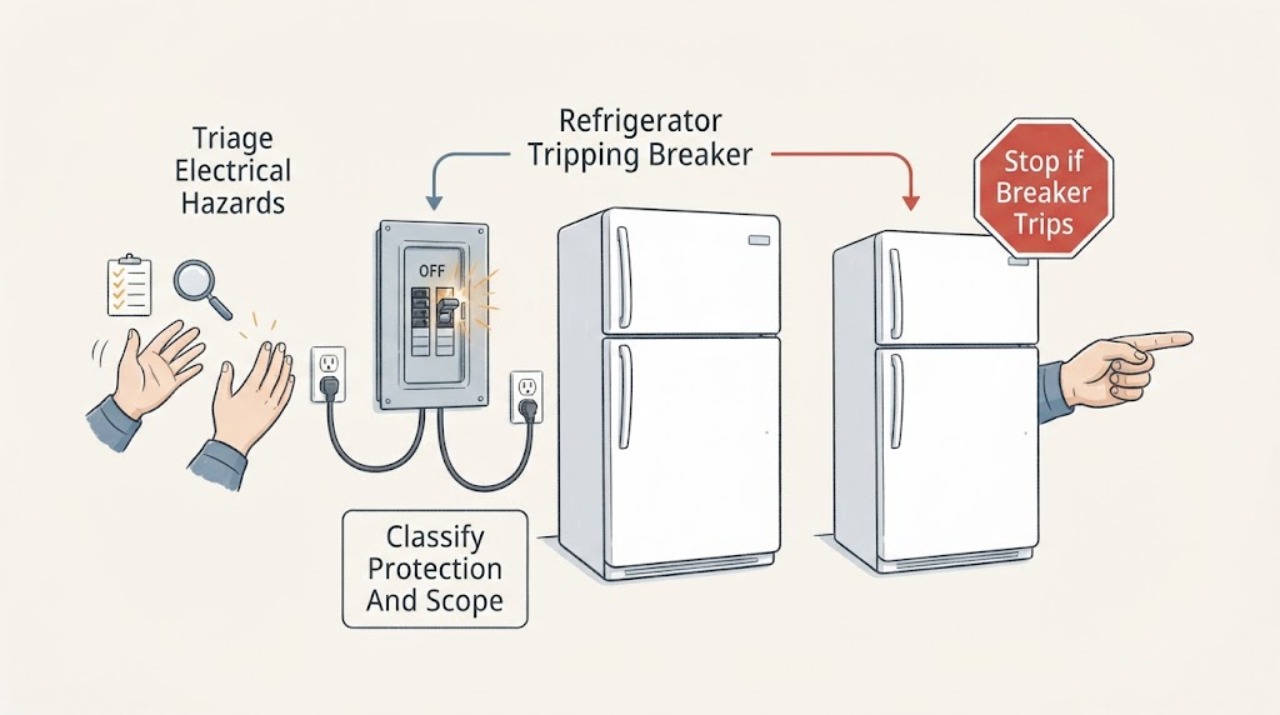
Work through in order
Diagnostic checks
Use only checks that match the exact appliance or system and its official guide.
-
Check 1
Stop using the refrigerator and look only from a safe, dry position for smoke, sparks, burning odor, a hot or discolored plug or cord, cracked insulation, water near the outlet or appliance, a shock or tingle, or visible cabinet or outlet damage.
Expected result: Any hazard sign is present, or the trip happened again after an earlier reset; alternatively, there is no visible hazard and the refrigerator is simply without power.
Next step: If any hazard or repeat trip is present, leave the refrigerator off and arrange licensed electrical or authorized appliance service. If the area is wet or a cord is damaged, do not touch the appliance or switchboard; keep people away and obtain professional help.
Stop if: Do not touch wet equipment, handle a hot or damaged plug, keep resetting the switch, or reconnect the refrigerator to see whether the symptom returns.
Why this matters
Why: A hazard or repeated trip can indicate faulty equipment, wiring, or current leakage. It is not a settings problem and cannot be safely diagnosed by opening the refrigerator.
-
Check 2
Without removing the switchboard cover or changing any setting, note which device moved to OFF and what else lost power. A TEST or T button identifies a safety-switch function; a breaker without that button is a circuit breaker. Record whether lights, other outlets, or only the refrigerator outlet were affected.
Expected result: Only the refrigerator circuit is off, several appliances on one circuit are off, the device will not remain on with appliances disconnected, or the refrigerator is the only load associated with the trip.
Next step: If the device will not remain on with loads safely disconnected, stop and call a licensed electrician. Otherwise continue with the refrigerator isolated; do not use a different circuit or extension lead as a workaround.
Stop if: Do not remove the switchboard cover, change breaker or fuse ratings, bypass a safety switch, or conduct any energized electrical measurement.
Why this matters
Why: A broad outage or a device that will not stay on with loads removed makes circuit or wiring trouble more likely. A trip associated only with this refrigerator makes the appliance, cord, plug, outlet, or its interaction with the circuit more likely, but does not identify an internal part.
-
Check 3
If there is no water, heat, damage, or shock risk and the plug is plainly accessible, switch the refrigerator off at its control and unplug it once using dry hands and the plug body. If the plug is inaccessible, wet, hot, damaged, or hard-wired, do not reach behind the appliance; leave isolation to a qualified person.
Expected result: The refrigerator is safely disconnected, or it cannot be safely disconnected at the plug.
Next step: Leave the refrigerator disconnected while arranging service or, only when the circuit is known safe and local guidance permits, while an electrician performs a controlled circuit check. Protect food using an alternative cold-storage plan.
Stop if: Do not drag the refrigerator over the cord, pull the cord, use wet hands, repeatedly reconnect it, or use an extension lead or power strip.
Why this matters
Why: Removing the suspected appliance from the circuit is a safe way to prevent another automatic start while the fault is assessed. Failure to isolate safely is itself a reason to stop, not a reason to pull the cabinet forward or handle wiring.
-
Check 4
With the refrigerator disconnected and the area dry, inspect only the visible plug, cord, and outlet face for looseness, scorching, melted plastic, moisture, fraying, cuts, or an unusual smell. Do not remove the outlet plate or perform electrical measurements.
Expected result: The plug, cord, or outlet is warm, loose, damaged, wet, discolored, or odor-bearing; or all visible exterior parts look intact.
Next step: For any damage, keep the refrigerator disconnected and have the outlet and appliance checked by a licensed electrician or authorized repairer. If the exterior is intact, use the timing and circuit observations to guide service rather than attempting internal diagnosis.
Stop if: Do not tape or splice a cord, tighten outlet wiring, replace a plug, probe the outlet, or power the refrigerator through an extension lead.
Why this matters
Why: Visible damage can be the source of the trip or a shock and fire risk. An intact exterior does not clear the refrigerator because an internal electrical fault can remain hidden.
-
Check 5
Use the event that already occurred, rather than repeating it, to record when the trip happened: immediately on connection or compressor start, after the refrigerator had run for a while, during a defrost or automatic cycle if known, or when other high-load appliances were operating.
Expected result: The trip was immediate, delayed, associated with another load, or the timing is unknown.
Next step: Give the timing, other loads, device type, and model/serial information to the electrician or authorized Kelvinator service provider. Do not recreate the event to obtain a more specific symptom.
Stop if: Do not run a deliberate start-stop test, hold a compressor or fan on, enter service diagnostics, or make an energized electrical measurement.
Why this matters
Why: Timing helps a technician distinguish a possible circuit overload or start/load event from a delayed appliance or wiring fault, but it cannot prove a failed compressor, start device, inverter, defrost heater, control, or insulation.
-
Check 6
Only if there was no hazard, the refrigerator is unplugged, and the switchboard and outlet are dry and undamaged, have an adult remove other loads from the affected circuit and perform no more than one normal reset of the tripped device. Keep the refrigerator disconnected during this check.
Expected result: The device stays on with the refrigerator disconnected, or it trips again with the refrigerator still disconnected.
Next step: If it trips again, leave the device off and call a licensed electrician. If it stays on, do not reconnect the refrigerator yourself if it previously caused the trip; arrange appliance and outlet assessment. Reconnect other loads only under the electrician's direction if the circuit remains suspect.
Stop if: Do not reset a second time, reconnect the refrigerator for a trial, increase the breaker rating, or substitute a fuse.
Why this matters
Why: A stable circuit without the refrigerator makes the refrigerator or its connection more suspicious but does not establish which part failed. A trip with the refrigerator disconnected points more strongly to circuit wiring or another load.
-
Check 7
Find the complete Kelvinator model and serial numbers from the rating label and provide them with the trip history, protection-device type, affected loads, visible findings, and timing to the service provider.
Expected result: The model is available and the official manual library identifies a matching refrigerator family, or the model cannot be read or does not match the available official material.
Next step: Use the matching official manual only for identification and owner-level instructions; arrange Kelvinator refrigerator service and licensed electrical assessment for any recurring trip, cord/outlet concern, or internal fault.
Stop if: Do not order a compressor, start relay, inverter, defrost heater, control board, thermostat, cord, or other part from a generic symptom description.
Why this matters
Why: Kelvinator's manuals and service pathways are model- and appliance-specific. Without the exact identity, a technician cannot safely confirm parts, wiring layout, or the correct repair procedure.
Use your observations
Decision map
Find the observation that best matches what you see, then follow the next safe action.
-
PATH 01Safety boundary
What you see
Smoke, sparks, burning odor, hot or discolored parts, water near electricity, shock or tingle, damaged cord or outlet, or a second trip is present.
Do this next
Leave the refrigerator disconnected and keep people away from the area. Use a licensed electrician for the circuit or outlet and authorized appliance service for the Kelvinator refrigerator.
Why this path and its safety boundary
Why it matters: The equipment or installation may be unsafe. Further energizing can increase shock or fire risk.
Safety stop: Do not touch wet or hot equipment, reset again, use an extension lead, or open the refrigerator.
-
PATH 02Safety boundary
What you see
The breaker or safety switch trips or will not remain on while the refrigerator is disconnected and other loads are removed.
Do this next
Leave the device off and call a licensed electrician to identify the circuit fault. Do not reconnect the refrigerator until the circuit has been cleared.
Why this path and its safety boundary
Why it matters: The circuit, switchboard, outlet, or another connected fault is more likely than a refrigerator-only issue.
Safety stop: Do not change the protective rating, open the switchboard, or repeatedly reset.
-
PATH 03Safety boundary
What you see
The circuit remains on with the Kelvinator refrigerator disconnected, but the prior trip occurred when this refrigerator was connected or started.
Do this next
Keep the refrigerator disconnected and arrange authorized appliance service plus an electrician's check of the outlet and circuit. Supply the exact model and the observed timing.
Why this path and its safety boundary
Why it matters: The refrigerator, its cord or plug, the outlet, or the load interaction is more suspicious, but the observation cannot identify an internal component.
Safety stop: Do not reconnect it for a trial, bypass protection, or substitute another cord or extension lead.
-
PATH 04Safety boundary
What you see
There was one trip with several high-load appliances on the same circuit, no hazard signs, and the circuit held once with the refrigerator isolated.
Do this next
Have the circuit capacity and refrigerator connection assessed before normal use if there is any doubt. If the trip recurs, leave the refrigerator disconnected and obtain professional service.
Why this path and its safety boundary
Why it matters: An overload is possible, but the refrigerator is not cleared if it was the last appliance added or if the trip returns.
Safety stop: Do not solve an overload by using an extension lead, moving a suspected fault to another circuit, or installing a larger breaker.
-
PATH 05Safety boundary
What you see
The trip occurred after the refrigerator had been operating, during an automatic cycle, or the timing was not observed.
Do this next
Keep notes of future observations without deliberately reproducing the trip, and arrange licensed electrical or authorized Kelvinator service.
Why this path and its safety boundary
Why it matters: A delayed fault cannot be assigned to a compressor, start component, defrost circuit, control, or wiring without model-specific diagnosis.
Safety stop: Do not run repeated tests, use service mode, make an energized electrical measurement, or open the cabinet.
Helpful context
Understand the symptom
A trip is a safety event, not a refrigerator reset routine
A circuit breaker protects wiring and equipment from a fault or overload, while a safety switch or RCD responds to current leakage. The switchboard device may look similar, so note whether it has a TEST or T button, but do not alter its rating or bypass it. A Kelvinator refrigerator can lose power because the outlet or breaker is off, but repeated trips need the appliance and circuit assessed separately.
Separate circuit clues from appliance clues
The most useful distinction is what else lost power and when the trip occurred. A trip with the refrigerator disconnected points toward the circuit or another load. A trip that returns when this refrigerator is connected or switched on points toward the appliance, its cord or plug, the outlet, or the circuit's interaction with that load. Immediate and delayed trips are clues for a technician, not permission to repeat a hazardous test.
Use the exact model information for service
Kelvinator's official manual library identifies refrigerator models and provides model-specific manual links. Record the complete model and serial information from the appliance label before contacting service. Do not infer a compressor, start device, inverter, defrost part, control, or wiring fault from the timing alone; those parts and procedures vary by model.
Safety boundary
Stop conditions
- Leave the refrigerator disconnected after any repeat trip or any smoke, sparks, burning odor, hot or discolored plug or cord, water near electrical parts, shock, tingle, or damaged outlet.
- Do not repeatedly reset a breaker or safety switch, increase its rating, substitute a fuse, or bypass protective equipment.
- Do not use an extension lead, power strip, substitute cord, or another circuit as a workaround for a refrigerator that caused a trip.
- Do not open the refrigerator cabinet, perform energized electrical tests, access a compressor start device, inverter, defrost heater, control, wiring, or sealed system.
- Use a licensed electrician for circuit, outlet, switchboard, cord, or protective-device concerns and authorized appliance service for internal Kelvinator diagnosis.
When checks do not resolve it
Need a professional?
Call a licensed electrician when the breaker or safety switch will not stay on with the refrigerator disconnected, when the outlet or cord is damaged or hot, or when the trip pattern suggests wiring or circuit trouble. Arrange authorized Kelvinator refrigerator service when the refrigerator was the appliance associated with the trip, when the problem recurs, or when any internal component would need access. Stop immediately for smoke, sparks, burning odor, water near electricity, shock, tingle, or exposed or damaged wiring.
Safety scope: This article covers safe observation, isolation only when a dry and undamaged plug is safely accessible, and one controlled circuit check with the refrigerator disconnected. It does not authorize switchboard work, energized testing, cabinet opening, component replacement, bypassing protection, or repeated energization.
Common questions
FAQ
Should I keep resetting the breaker if my Kelvinator refrigerator trips it?
No. A single controlled reset may be used only with the refrigerator isolated and no visible hazard; if the device trips again or will not stay on, leave it off and call a licensed electrician. Do not repeatedly reset or increase the protective rating.
Can I plug the Kelvinator refrigerator into an extension lead to see if it works?
No. Treat an extension lead as a workaround that can conceal a circuit, outlet, or appliance fault. Keep the refrigerator disconnected until the outlet, circuit, and appliance are assessed.
What if the breaker trips only when the refrigerator starts?
Record that timing, but do not repeat the start deliberately. It can point to a circuit-load interaction or a model-specific refrigerator electrical fault; a technician must separate those possibilities.
Does a tripped breaker always mean the Kelvinator refrigerator is defective?
No. Government electrical-safety guidance identifies overloads, faulty appliances, and wiring as possible causes. If the circuit trips with the refrigerator disconnected, circuit or wiring trouble becomes more likely; if it holds only with the refrigerator isolated, the appliance or its connection needs service.
What model information should I provide for Kelvinator service?
Provide the complete model and serial information, the type of protective device, what else lost power, the timing of the trip, visible plug or outlet findings, and any odor, heat, water, sparks, shock, or prior reset. Kelvinator's official manual library and service pathway are organized around appliance and model identity.
Read the exact guide
Official sources
- Power outages and energy safetyEnergy Safe Victoria · Victorian electrical-safety regulator guidance for household power faults; not a Kelvinator-specific diagnosis.
- TroubleshooterKelvinator Australia · Kelvinator Australia's refrigerator troubleshooting section; exact model controls and electrical architecture remain model-dependent.
- User ManualsKelvinator Australia · Kelvinator Australia manual index; the listed model families and instructions are not interchangeable.
- Switch on to electrical safetyElectrical Safety Office, Queensland Government · Queensland Government household electrical-safety guidance; it is general safety guidance and does not diagnose a Kelvinator model.
- Safety switches in homesConsumer, Building and Occupational Services, Tasmanian Government · Tasmanian Government general household electrical-safety guidance; not a Kelvinator repair manual.
- Service & Repair for Your Fridges & Air ConditionersKelvinator Australia · Kelvinator Australia service page; the service locator specifically lists refrigerators and air conditioners.
Community feedback
Share a repair observation
Share a plain-text repair observation. Accepted observations are published automatically; this page may take a moment to update.