
On this page
Start here
Quick answer
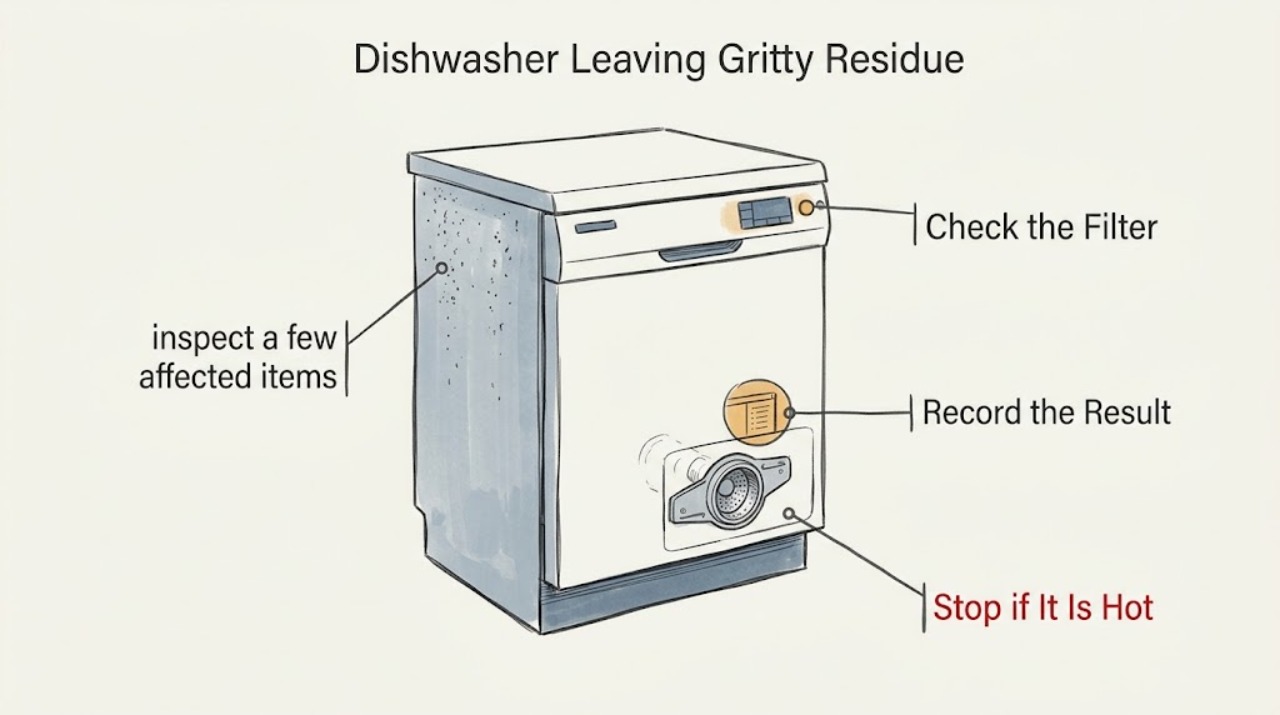
First identify whether the residue is loose food grit, a sandy or detergent-like film, or a hard white deposit, and note whether it is on every item or concentrated in one rack. Kenmore explains that the dishwasher filter catches food particles and that a dirty filter can allow dirty wash water and debris to redeposit on clean dishes. Its loading guidance also warns that overcrowding can keep water from reaching surfaces. With the dishwasher stopped and safe to service, use the exact Kenmore model manual to locate and clean the filter, correct visible loading or spray clearance, and use only the model-documented detergent and rinse-aid guidance. If gritty residue remains after those external checks, or the dishwasher has poor circulation, incomplete draining, leakage, or an electrical warning, stop using it and arrange qualified appliance service.
Work through in order
Diagnostic checks
Use only checks that match the exact appliance or system and its official guide.
-
Check 1
After the cycle has ended and the dishwasher is safe to open, inspect a few affected items and describe the residue without tasting it. Note whether it feels like loose food particles, sandy detergent, a greasy or soapy film, or a chalky white deposit, and whether it is on all racks, only one rack, or only certain cup or bowl surfaces.
Expected result: Loose particles are concentrated on one rack or upside-down surfaces, a film covers most items, or a white/chalky deposit appears with otherwise clean dishes.
Next step: Photograph the residue and continue with the model identity and filter checks; do not disassemble the dishwasher to identify it.
Stop if: Stop if there is standing water near electrical parts, a burning odor, smoke, sparks, shock, a hot or damaged cord, or a repeated breaker trip.
Why this matters
Why: The pattern separates a likely recirculation or loading path from a detergent, water-quality, or surface-deposit question. Residue texture alone does not prove a pump, filter, heater, or water-supply failure.
-
Check 2
Read the full Kenmore model number from the rating label and retrieve its owner’s manual. Identify the manual’s filter location and design, detergent and rinse-aid instructions, rack-loading limits, and any model-specific wash or drying options before changing a routine.
Expected result: The exact manual is available and describes an accessible filter, or the model/manual cannot be matched or the filter is not user-accessible.
Next step: Follow only the matching manual. If the model is unclear or access would require removing a panel, use service rather than guessing.
Stop if: Do not pull out a built-in dishwasher, loosen plumbing or electrical connections, or remove a filter housing that the manual does not identify as user-accessible.
Why this matters
Why: Kenmore’s official manual portal states that model numbers are needed to retrieve the correct dishwasher manual. Kenmore designs and filter procedures vary, so a different model’s filter removal or detergent instruction may be wrong for this unit.
-
Check 3
With the dishwasher stopped and power handled safely, remove only the user-accessible filter assembly described by the matching manual. Rinse it under the permitted conditions, gently remove food or grease with a soft brush, wipe loose debris from the filter housing, and reinstall the filter fully locked.
Expected result: The filter contains food, grease, or sludge; the housing has loose debris; the filter is clear; or the filter cannot be removed or locked as the manual describes.
Next step: Correct only the documented filter condition and run one normal test cycle if there is no hazard. If grit returns or filter service is not safely user-accessible, arrange appliance service.
Stop if: Do not use steel wool or harsh tools, run the dishwasher without the filter, reach into a sump or pump, or spray water into the cabinet or controls.
Why this matters
Why: Kenmore says the filter catches food particles and that dirty wash water can redeposit residue on dishes; a clogged filter can also impede water flow and strain the motor. A clean, correctly installed filter makes loading, detergent/water, spray, drain, and internal-circulation branches more relevant.
-
Check 4
With power safely disconnected and without forcing any part, correct visible loading issues: leave clearance around the spray area, avoid nesting bowls, space silverware, place cups and bowls so water can reach their interiors, and remove only an item that visibly blocks a spray path. Use the matching manual for any spray-arm check.
Expected result: A pan, utensil, bowl, or rack position blocks spray coverage; the load has adequate clearance; or residue remains despite a clear load.
Next step: Run one controlled cycle with a correctly spaced load if the dishwasher has no warning. If the same residue returns, stop experimenting and document the rack, item locations, and cycle used for service.
Stop if: Do not reach toward a moving spray arm, force a rack or arm, remove guards, or run a cycle with a cover or panel removed.
Why this matters
Why: Kenmore’s loading guidance says overcrowding can keep water and cleaning solution from reaching surfaces and can leave food residue cooked onto dishes. A clear load with recurring grit makes filter, detergent/water, spray circulation, or drain conditions more relevant.
-
Check 5
If the residue is a film rather than loose food, compare the detergent amount, detergent freshness, rinse-aid setting, and water-hardness or temperature guidance with the exact manual. Change one documented user setting at a time; do not combine cleaners or use a homemade mixture unless the manufacturer specifically permits it.
Expected result: The residue is sandy or detergent-like, the detergent is old or overdosed, a rinse-aid or hard-water instruction is not being followed, or the product settings match the manual but the film persists.
Next step: Apply only the manual-supported correction and run one normal cycle. If gritty or film residue remains, record the product, amount, cycle, water condition, and result and arrange service.
Stop if: Do not add excess detergent, use hand soap, mix chemicals, pour cleaner into an unapproved compartment, or change heater or service settings.
Why this matters
Why: A film that covers many dishes points more toward detergent dissolution, water condition, or rinse performance than one blocked filter location. Matching the manual’s instructions is a controlled test; persistent film can still reflect a heating, fill, circulation, or control problem.
-
Check 6
After the filter, load, and model-documented product checks, observe one ordinary cycle only if the dishwasher is safe: note whether it fills, sprays, heats, drains completely, and leaves the residue again. Record any low-water, grinding, humming, leakage, error, or cycle-completion symptom without opening the cabinet.
Expected result: Residue clears after a documented external correction, or it returns with poor spray, weak draining, water left in the tub, leakage, abnormal noise, or an electrical warning.
Next step: For recurrence or any performance fault, stop using the dishwasher and arrange qualified Kenmore appliance service with the model, residue photos, filter/load findings, detergent details, and cycle observations.
Stop if: Do not run repeated cycles to reproduce the residue, open the sump or pump, make energized measurements, or continue using the dishwasher when water or electricity is unsafe.
Why this matters
Why: Improvement after filter, loading, or product correction supports an external maintenance or use condition. Recurring grit with poor circulation or draining makes a wash pump, filter housing, spray system, inlet, heater, drain, or control issue more likely, but the symptom does not identify a safe part.
Use your observations
Decision map
Find the observation that best matches what you see, then follow the next safe action.
-
PATH 01Next step
What you see
Loose food-like grit is concentrated in one rack or on surfaces shielded from spray, and the filter contains food or grease.
Do this next
Clean and reinstall the model-matched filter, correct the visible loading pattern, and run one safe test cycle. If grit returns, arrange service for circulation or filtration diagnosis.
Why this path and its safety boundary
Why it matters: Dirty filtration and restricted spray coverage together make recirculated debris or incomplete washing more likely than an immediate replacement decision.
-
PATH 02Next step
What you see
A sandy, soapy, greasy, or chalky film covers many items even though the filter is clean and the load has clearance.
Do this next
Follow one model-documented detergent, rinse-aid, or water-condition correction and test once. If the film persists, request qualified diagnosis rather than adding more detergent or changing service settings.
Why this path and its safety boundary
Why it matters: Detergent dissolution, water hardness, rinse performance, fill/heating, or wash-circulation conditions are more likely than a single blocked rack position. The exact manual is needed for product and water guidance.
-
PATH 03Next step
What you see
Grit returns after the filter is clean, the load is correctly spaced, and the exact manual’s product guidance has been followed, especially with weak spray, incomplete draining, leakage, or abnormal cycle behavior.
Do this next
Stop using the dishwasher and arrange qualified Kenmore appliance service with the complete observation record.
Why this path and its safety boundary
Why it matters: A wash or drain pump, spray system, inlet, heater, filter housing, control, or another model-specific fault is more likely; the residue does not identify a replacement part by itself.
-
PATH 04Next step
What you see
Smoke, sparks, crackling, burning odor, shock, abnormal heat, a damaged cord or plug, water near electrical parts, or a repeated breaker trip accompanies the residue or testing.
Do this next
Stop operation, isolate power only from a dry safe position without touching the hazard, and arrange qualified appliance or electrical service.
Why this path and its safety boundary
Why it matters: This is an electrical, fire, shock, or water-safety escalation and overrides ordinary filter, loading, or detergent troubleshooting.
When checks do not resolve it
Need a professional?
Arrange qualified Kenmore appliance service when gritty residue returns after the model-matched filter, loading, and product checks, or when spray, heating, draining, leakage, or cycle completion is abnormal. Stop immediately for smoke, sparks, crackling, burning odor, shock, abnormal heat, water near electrical parts, a damaged cord or plug, or repeated breaker trips. Do not open the cabinet or sump, perform energized tests, or select a pump, heater, filter housing, or control from residue alone.
Common questions
FAQ
Can a dirty Kenmore dishwasher filter cause gritty residue?
Yes, it can contribute. Kenmore says the filter catches food particles and that dirty wash water can redeposit debris or residue on clean dishes. Clean it only by the exact model’s user procedure and reinstall it securely.
Why is the grit only on the top rack?
A rack-specific pattern can indicate that an item or nested dish is shielding that area from spray, or that debris is being redeposited there. Correct visible loading and spray clearance, then check the filter; persistent residue needs service diagnosis.
Should I add more detergent to stop gritty residue?
Not automatically. A sandy or film-like residue can relate to detergent, water condition, rinse performance, fill, heating, or circulation. Use the exact model manual and change only one documented setting at a time; excess or mixed products can make the result harder to interpret.
Read the exact guide
Official sources
- Kenmore ManualsKenmore · Official Kenmore manual lookup requiring the model number; used to keep filter, detergent, water, rack, and service instructions model-specific.
- How to Clean Your Dishwasher FilterKenmore / Livemore · Official Kenmore guidance explaining that the filter catches food particles, that dirty wash water can redeposit residue, and how to perform the general accessible filter-cleaning steps; exact filter design remains model-specific.
- How Do You Load Your Dishwasher?Kenmore / Livemore · Official Kenmore loading guidance used for general rack-clearance and water-coverage decisions; exact rack layout and model features still require the matching manual.
Community feedback
Share a repair observation
Share a plain-text repair observation. Accepted observations are published automatically; this page may take a moment to update.