
On this page
Start here
Quick answer
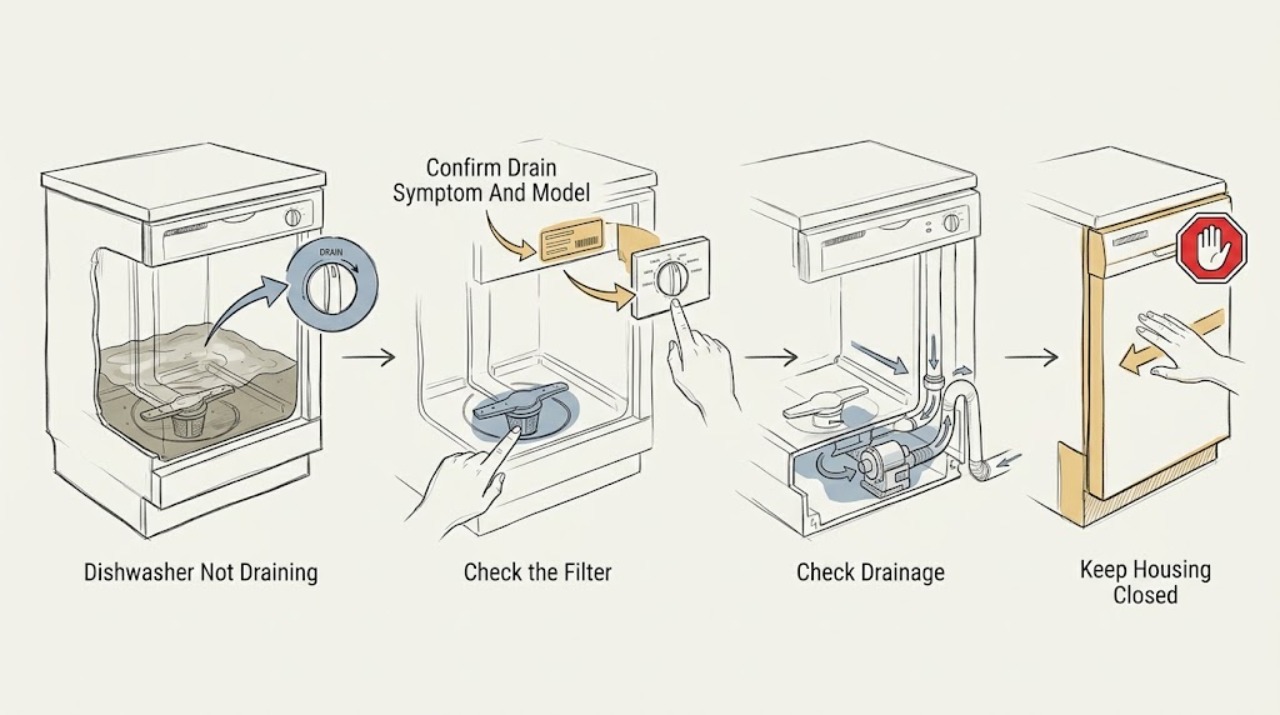
First confirm that the Kenmore dishwasher actually finished its cycle and note how much water remains; the exact model manual controls what residual water is expected and how Cancel or Drain operates. If the tub has standing water, switch off the appliance and disconnect power before reaching into the bottom. Kenmore's official maintenance guidance says a clogged dishwasher filter can contribute to drainage problems, and its filter guide describes locating the filter beneath the lower rack or spray arm on most models, rinsing it with warm water, gently brushing residue, cleaning the housing, and locking the dry filter back in place. Do not assume every Kenmore uses the same filter or drain layout. If the filter is clear and correctly installed but water remains, or if the drain pump, hidden hose, wiring, or electrical area would need access, stop and arrange qualified service. Keep the dishwasher off for leaking water near wiring, smoke, sparks, burning odor, a damaged cord or junction area, or a repeated breaker trip.
Before you begin
Safety first
- The user may identify the model, observe the cycle state, isolate power, clean a confirmed accessible filter, and inspect a clearly visible drain connection only as the exact guide permits. Qualified personnel must handle pump covers, hidden hoses, check valves, controls, wiring, built-in removal, live testing, and internal plumbing.
Work through in order
Diagnostic checks
Use only checks that match the exact appliance or system and its official guide.
-
Check 1
Read the full Kenmore model number from the door frame or tub opening and retrieve its matching manual. Note whether water remains after a completed cycle, the cycle stopped early, the controls show an error, or water drains only slowly; record any pump hum, unusual noise, leak, odor, or breaker event from outside the unit.
Expected result: The cycle is incomplete or interrupted, standing water remains after the model's documented drain phase, the filter or drain layout is unknown, or a leak or electrical warning is present.
Next step: Use only the exact manual's Cancel or Drain instruction if the unit is dry and safe. If the model is unknown or a hazard is present, stop and arrange model-specific service.
Stop if: Do not restart repeatedly, reach into standing water while energized, or continue for smoke, sparks, burning odor, exposed wiring, water near electrical parts, or repeated breaker trips.
Why this matters
Why: A cycle-state issue is different from a confirmed blocked drain, and Kenmore models differ in controls and filter access. A leak or electrical warning overrides normal drain checks.
-
Check 2
Turn the dishwasher off, disconnect power at the accessible plug or breaker, and wait for hot water to cool. Remove the lower rack only if it comes out normally, then locate the user-accessible filter exactly as the model guide shows. Inspect it and the visible filter housing for food particles, grease, glass, or other debris; rinse with warm water and use only a soft brush or sponge if the guide permits.
Expected result: The filter is visibly clogged or damaged, the housing has loose residue, the filter is missing or cannot lock, or the filter and housing are clean and intact.
Next step: Clean and dry the filter, wipe only accessible housing residue, and reinstall it until the exact manual confirms it is locked. If it is damaged or will not seat, stop before ordering a part.
Stop if: Do not use sharp tools in the sump, remove a spray arm or pump cover without the exact manual, touch broken glass bare-handed, or work with power connected.
Why this matters
Why: A clogged filter can impede water flow and contribute to incomplete drainage. A clean, correctly installed filter makes a hidden hose, pump, control, or installation issue more likely but does not identify which one.
-
Check 3
With power still disconnected, inspect only the accessible area under the sink or beside the dishwasher if the installation guide identifies a visible drain-hose, air-gap, or disposal connection. Look for a kink, crushed hose, loose visible connection, or an external obstruction; do not pull out a built-in dishwasher or loosen plumbing that is under pressure.
Expected result: A visible hose is kinked, crushed, disconnected, or blocked at an accessible end, the model has no user-accessible external drain connection, or the visible path looks normal.
Next step: Correct only a clearly visible routing or hand-tight connection issue that the exact installation guide permits. If the connection needs disassembly, the dishwasher must move, or the path is normal, arrange service.
Stop if: Do not cut or drill a hose, pull out a built-in unit, disconnect plumbing without shutting off water, or continue when water can reach electrical connections.
Why this matters
Why: A visible external restriction can explain slow or absent draining. A normal visible path does not rule out a hidden hose, pump, check valve, control, or plumbing problem.
-
Check 4
After the filter is clean, dry, and correctly locked, restore power only if there is no leak or electrical warning. Use one normal model-documented Cancel or Drain operation and observe from outside; do not hold the door latch or run a full wash cycle just to test drainage.
Expected result: The water drains normally, drains only partly, the pump is silent or makes a harsh sound, the water returns immediately, or the breaker trips or a leak appears.
Next step: If it drains normally, monitor the next model-approved cycle. For partial or absent drainage, abnormal sound, leak, or electrical response, turn it off and arrange qualified service.
Stop if: Do not repeat the test, bypass the door latch, run with a missing filter, or continue after a leak, smoke, sparks, burning odor, hot connection, or breaker trip.
Why this matters
Why: A one-time recovery after a documented cycle interruption or filter blockage supports an external condition. Persistent water, abnormal pump sound, immediate return, or a power event makes an internal or installation fault more likely.
-
Check 5
Record the model, cycle and error state, water level, filter condition, visible hose findings, pump sound, and any leak or electrical symptom. Keep the dishwasher off when the clean filter and visible path did not restore drainage or when access beyond the user checks is required.
Expected result: Water remains after the model-guided drain attempt, the filter is clear and locked, the pump is abnormal or silent, the hose or check-valve area is hidden, or a leak or electrical symptom is present.
Next step: Contact Kenmore support or a qualified dishwasher technician with the model and observations. If water is near wiring, shut off the water supply and breaker from a safe dry position and do not restart.
Stop if: Do not remove pump covers, probe wiring, perform live tests, change the breaker rating, move an unsecured built-in dishwasher, or order a pump or control by appearance.
Why this matters
Why: A drain pump, hidden hose, check valve, control, wiring, or plumbing fault may be involved. Standing water and a pump symptom do not identify a compatible part or authorize internal repair.
Use your observations
Decision map
Find the observation that best matches what you see, then follow the next safe action.
-
PATH 01Next step
What you see
Standing water follows a completed cycle and the user-accessible filter or housing contains food particles, grease, glass, or other debris.
Do this next
With power isolated and water cool, clean and dry the filter and housing using the exact model instructions, lock the filter back in place, and use one documented drain check.
Why this path and its safety boundary
Why it matters: A restricted filter path is more likely and is supported by Kenmore's guidance linking clogged filters with flow and drainage problems.
-
PATH 02Next step
What you see
The exact installation guide identifies an accessible drain connection and the visible hose is kinked, crushed, loose, or blocked at its end.
Do this next
Correct only the clearly visible issue allowed by the guide, then monitor one model-documented drain operation. Use service if plumbing must be disconnected or the problem returns.
Why this path and its safety boundary
Why it matters: An external drain-route problem is more likely than a proven pump failure, but gravity, air-gap, disposal, and hose arrangements vary by installation and model.
-
PATH 03Next step
What you see
The cycle stopped early, an error or flashing state is present, the water level is not clearly abnormal for that model, or the model and drain controls are unknown.
Do this next
Use the exact model manual to identify the cycle state and normal drain phase. If the guide does not resolve the state, arrange model-specific support rather than repeating cycles.
Why this path and its safety boundary
Why it matters: A completed drain failure has not been established, and using another Kenmore model's Cancel, Drain, filter, or reset instructions could create a wrong diagnosis.
-
PATH 04Next step
What you see
The filter is clean and locked, the visible drain route is normal, but water remains or returns; the pump is silent or harsh, or water reaches electrical parts.
Do this next
Keep the dishwasher off and arrange qualified Kenmore appliance service. Isolate water and power from a safe dry position for an active leak or electrical warning.
Why this path and its safety boundary
Why it matters: A hidden hose, drain pump, check valve, control, wiring, or plumbing fault is possible. The observation does not identify a safe replacement part.
Helpful context
Understand the symptom
Confirm a real drain failure
A dishwasher that was interrupted is different from one that completed its cycle and left standing water. Record the exact Kenmore model and follow its manual for the expected drain phase and controls. Do not assume another Kenmore family's filter, pump, or reset sequence applies.
Start with the filter while power is isolated
Kenmore's official maintenance guidance identifies incomplete draining as a repair sign and its filter guide explains that food debris can block flow and strain the pump. On most models, the filter is under the lower rack and spray arm; remove and clean it only as the exact manual permits, using warm water and a soft brush, then lock it back into place.
Separate visible hose issues from internal service
If the matching installation guide identifies a visible drain connection, inspect only for a kink, crushed section, loose connection, or accessible obstruction with power off and water isolated as needed. A clear visible path does not prove that a hidden hose, pump, check valve, control, or wiring is healthy. Built-in dishwasher removal and internal drain work belong to qualified service.
Stop for water or electrical danger
Do not keep testing a dishwasher that leaks toward wiring, a junction area, cord, or outlet, or that produces smoke, sparks, burning odor, abnormal heat, or repeated breaker trips. Keep it off and contact Kenmore support or qualified appliance service; do not bypass the door latch or probe the pump circuit.
Safety boundary
Stop conditions
- Stop immediately for water near wiring, a junction area, cord, or outlet; smoke, sparks, burning odor, abnormal heat, damaged power hardware, or repeated breaker trips.
- Disconnect power before removing the lower rack or handling a user-accessible filter. Do not reach into standing water while energized.
- Do not bypass the door latch, run with a missing filter, use sharp tools in the sump, remove pump covers, probe wiring, or perform live tests.
- Do not pull out a built-in dishwasher, disconnect plumbing, or open a hidden drain path without the exact procedure and qualified service.
- Do not order a filter, pump, hose, check valve, control, or other part by appearance or from standing water alone; verify the exact model and diagnosis first.
When checks do not resolve it
Need a professional?
Arrange Kenmore support or qualified dishwasher service when the exact model's filter is clean and locked, any permitted visible drain-path check is normal, and water still remains or returns; when the pump is silent or harsh, an internal hose or check valve needs access, or a cycle error persists. Stop immediately for water near electrical parts, smoke, sparks, burning odor, abnormal heat, damaged power hardware, or repeated breaker trips.
Safety scope: The user may identify the model, observe the cycle state, isolate power, clean a confirmed accessible filter, and inspect a clearly visible drain connection only as the exact guide permits. Qualified personnel must handle pump covers, hidden hoses, check valves, controls, wiring, built-in removal, live testing, and internal plumbing.
Common questions
FAQ
Why is my Kenmore dishwasher not draining?
First confirm that the cycle finished, then use the exact model manual to locate the filter and drain controls. Kenmore says a clogged filter can contribute to drainage problems; clean and lock the accessible filter with power disconnected. If water remains with a clean filter, arrange service for the hidden hose, pump, control, or plumbing path.
Can a dirty Kenmore dishwasher filter stop it from draining?
It can contribute to poor flow and incomplete drainage. Kenmore's official filter guide says food debris can block flow and strain the pump. Disconnect power, clean the model-approved filter and housing with warm water and a soft brush, and reinstall it until locked.
Should I run another cycle to clear standing water?
Do not repeatedly restart it. Confirm the exact model's cycle state and use one documented Cancel or Drain operation only after the filter is correctly installed and there is no leak or electrical warning. Persistent water needs qualified service.
What if the filter is clean but my Kenmore dishwasher still has water in it?
A clean filter does not identify a failed part. Check only a visible drain connection if the exact installation guide permits it. If the visible path is normal, the remaining possibilities include a hidden hose, pump, check valve, control, or plumbing fault; keep the dishwasher off and arrange service.
Can I remove the drain pump cover or test its wiring?
No. Disconnect power before user-accessible filter work, but do not remove pump covers, probe wiring, perform live tests, or move an unsecured built-in dishwasher. Give the exact model and drain observations to a qualified technician.
When should I stop using a Kenmore dishwasher that will not drain?
Stop for water near wiring, a junction area, cord, or outlet; smoke, sparks, burning odor, abnormal heat, a damaged power connection, or repeated breaker trips. Isolate water and power from a safe dry position and arrange qualified appliance or electrical service.
Read the exact guide
Official sources
- Kenmore ManualsKenmore · Official Kenmore manual lookup; it is used to require exact-model confirmation before filter, drain-control, or installation steps.
- How to Clean Your Dishwasher FilterKenmore Livemore · Official Kenmore filter article; it says most models place the filter beneath the lower rack and spray arm, so the exact manual controls exceptions and access.
- Customer Care & SupportKenmore · Official Kenmore escalation page; it does not authorize owner internal electrical or pump repair.
- Appliance Maintenance Tips to Help Maximize EfficiencyKenmore Livemore · Official Kenmore maintenance article; it supports the filter and drainage relationship but does not define a particular model's pump or hose layout.
Community feedback
Share a repair observation
Share a plain-text repair observation. Accepted observations are published automatically; this page may take a moment to update.