
On this page
Start here
Quick answer
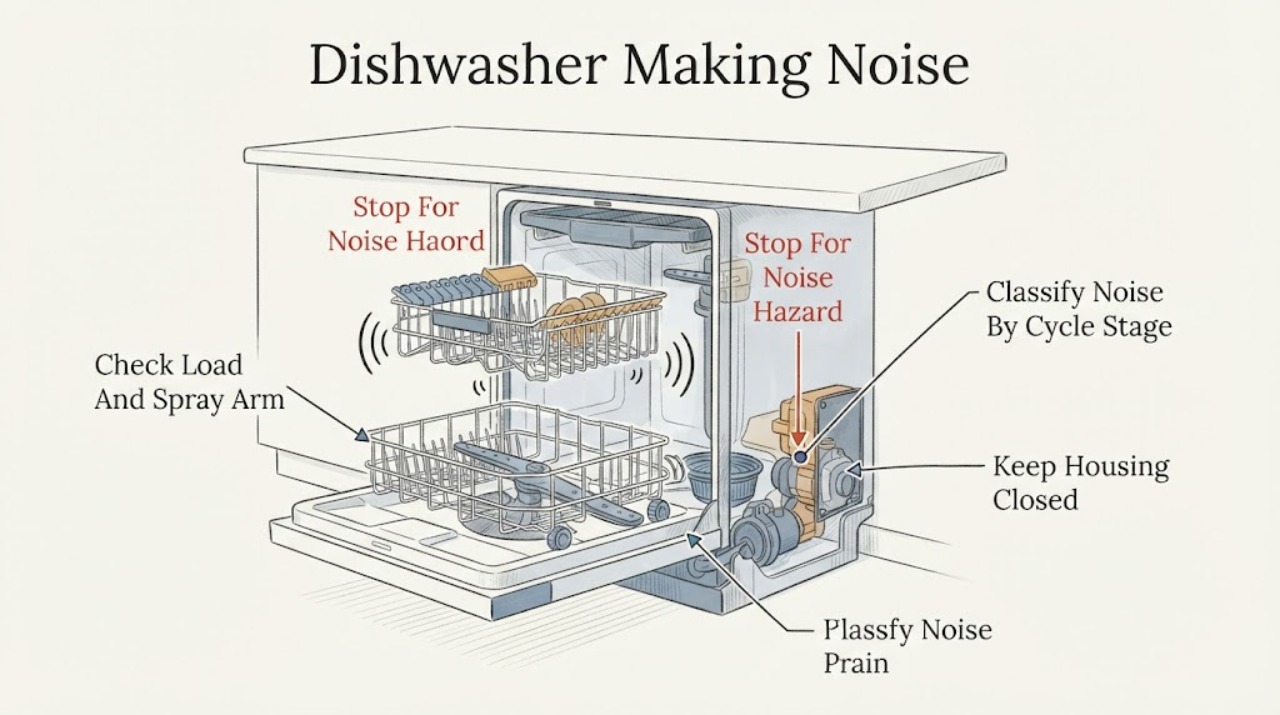
First note when the sound occurs—filling, washing, draining, drying, or after the cycle—and whether it tracks a rack, utensil, spray arm, fan, or pump event. Kenmore's official dishwasher materials show that models differ: some use pressurized spray arms, filtration, drying fans, delay start, and a Quiet Wash option, while sound ratings vary by model. With the dishwasher stopped and power safely disconnected, check only for visible loading or rack contact, a spray-arm obstruction, cabinet contact, rocking, and the exact model's owner instructions. A short water or fan sound can be part of an ordinary stage, but a persistent scrape, continuous grind, crackle, burning odor, smoke, spark, abnormal heat, water near electrical parts, or noise after a metallic object entered is a stop-use condition. Do not reach into the pump or motor, remove access panels, run repeated cycles to reproduce the noise, or perform an energized test; arrange qualified appliance service for persistent or internal noise and qualified electrical service for a circuit or power hazard.
Before you begin
Safety first
- The owner boundary is sound-stage observation, model identification, safe power isolation, visible load and spray-arm clearance, and accessible external vibration checks. Do not access the pump, motor, heater, disposer or filter housing, concealed installation, wiring, or energized circuits.
Work through in order
Diagnostic checks
Use only checks that match the exact appliance or system and its official guide.
-
Check 1
Before investigating, listen and look from a safe position for smoke, burning odor, sparks, crackling, a hot or damaged cord or plug, water near electrical parts, shock, or a breaker trip. If the cycle is active, use the normal stop or cancel control once only if it responds safely.
Expected result: An electrical, water, heat, or fire warning is present, or the sound is concerning but there is no visible hazard.
Next step: For any warning, isolate power only from a dry and safe position, keep the dishwasher out of service, and arrange qualified appliance or electrical service. Without a warning, continue only after the dishwasher has stopped and power is safely disconnected.
Stop if: Do not handle wet equipment, touch hot or damaged parts, repeatedly reset a breaker, or reach into a running tub.
Why this matters
Why: CPSC lists sparks, unusual electrical sounds, overheating, burned-wire odors, damaged insulation, and shocks as electrical warning signs. Those warnings override a normal-sound comparison.
-
Check 2
Record whether the sound occurs during fill, spray washing, draining, drying, a delay or control event, or after the cycle. Describe it as water movement, hiss, hum, thump, rattle, chopping, grind, scrape, buzz, or crackle, and note whether it is brief or continuous.
Expected result: The sound is a short water, spray, drain, fan, or control event; tracks the rotating spray area; occurs only with one load; or is new and persistent.
Next step: Use the model-specific branch that matches the stage and sound. A persistent, worsening, scraping, grinding, or electrical sound should remain on the service path even if the cycle still completes.
Stop if: Do not run additional cycles solely to reproduce a new or hazardous sound.
Why this matters
Why: Kenmore's official materials document pressurized spray arms, filtered wash systems, drying fans on some models, and model-specific quiet options. Stage and duration are therefore more useful than a generic label such as loud or noisy.
-
Check 3
With power disconnected and the tub safe to enter, remove or reposition only a visible utensil, pan handle, rack item, or small object that extends into the spray-arm path. Turn an accessible spray arm gently by hand only when the exact manual permits and without removing guards or covers.
Expected result: An item visibly contacts the spray area, a rack is loose or overloaded, the arm turns freely with a clear load, or the noise remains with the visible load corrected.
Next step: Correct only the visible loading issue and use a normal cycle only if no warning exists. If the sound remains, stop and arrange service rather than reaching into the sump or pump area.
Stop if: Do not force the spray arm, remove pump or filter covers beyond the exact manual's owner step, or test with panels removed.
Why this matters
Why: A load or spray-arm contact is more likely when the sound tracks a particular item or rotation. A free arm with persistent noise makes a simple loading explanation less likely but does not identify a pump or motor fault.
-
Check 4
With the dishwasher disconnected, look for an accessible loose rack, kickplate or exterior contact, a rocking cabinet, contact with surrounding cabinetry, or a door that rubs nearby panels. Do not pull out a built-in unit or loosen water, drain, mounting, or electrical connections as a noise test.
Expected result: The unit rocks, touches cabinetry, has a loose accessible item, or appears stable and clear of external contact.
Next step: Correct only a clearly external and safe issue. If built-in alignment, mounting, or concealed connections must be changed, arrange qualified installation or appliance service.
Stop if: Do not move a built-in dishwasher, work beneath it, or disconnect hidden plumbing or wiring.
Why this matters
Why: A vibration transferred through the rack, cabinet, or installation is more likely when the sound changes with an accessible external correction. A stable, clear installation does not rule out internal noise.
-
Check 5
Compare the stage and sound with the exact Kenmore manual and model features. Note whether the dishwasher has the model's documented spray-arm, filter, drying-fan, quiet, or delay option, whether water circulates and drains normally, and whether a metallic object or hard debris could have entered.
Expected result: A short sound matches a documented model feature and the cycle completes normally, or the sound is continuous, metallic, increasingly loud, accompanied by poor circulation or draining, or not covered by the manual.
Next step: Monitor only a brief, model-matched event with no warning. For continuous or unexplained noise, metallic-object suspicion, leakage, poor cleaning, or incomplete draining, leave the dishwasher off and arrange qualified service.
Stop if: Do not insert tools or fingers, remove a sump or pump cover, or repeat a cycle to determine whether grinding returns.
Why this matters
Why: Kenmore's lineup and buying guide show that sound levels and wash or drying systems vary. A documented brief event is different from a persistent mechanical sound; neither source authorizes owner diagnosis inside the pump, motor, or disposer area.
-
Check 6
Read the full model and serial information from the rating label and retrieve the matching Kenmore manual. Give service the cycle stage, sound description, load and external-contact findings, whether water circulated or drained, and any leak, odor, heat, smoke, spark, shock, or circuit event.
Expected result: The exact model is confirmed and the noise resolves after a safe external correction, or the model is unknown or the noise persists.
Next step: Use Kenmore's official customer-care route or qualified appliance service for persistent or internal noise. Use qualified electrical service for the receptacle, circuit, hard-wiring, or power-protection issue.
Stop if: Do not order a pump, motor, bearing, filter, heater, control, or other part from the sound alone, and do not remove access panels.
Why this matters
Why: Kenmore's official documentation is model-specific, and a sound rating or feature on one dishwasher cannot select a part for another. Persistent noise requires diagnosis of the exact wash, drain, drying, or electrical design.
Use your observations
Decision map
Find the observation that best matches what you see, then follow the next safe action.
-
PATH 01Safety boundary
What you see
Smoke, sparks, crackling or electrical buzzing, burning odor, abnormal heat, shock, water near electrical parts, a damaged cord or plug, or a repeated breaker trip accompanies the noise.
Do this next
If safe, isolate the dishwasher without touching the hazard, keep it disconnected, and arrange qualified appliance or electrical service. Do not reproduce the event.
Why this path and its safety boundary
Why it matters: This is a fire, shock, or water-safety escalation, not a normal wash-stage sound. CPSC lists unusual electrical sounds, sparks, overheating, odors, damaged insulation, and shocks as warning signs.
Safety stop: Do not reset repeatedly, change circuit protection, use the dishwasher while wet, open the cabinet, or make an energized measurement.
-
PATH 02Safety boundary
What you see
A thump or rhythmic rattle follows spray-arm rotation and an item or rack visibly contacts the wash area, with no other warning.
Do this next
With power disconnected, reposition or secure the visible item and confirm clearance using the matching manual. Escalate if the sound remains with a clear load.
Why this path and its safety boundary
Why it matters: The load or an accessible rack issue is more likely than an internal pump fault. Kenmore's materials establish that pressurized spray arms and flexible rack layouts are part of its dishwasher designs, but exact clearance is model-specific.
Safety stop: Do not reach toward a moving arm, force it, or remove pump or sump covers.
-
PATH 03Safety boundary
What you see
A short sound occurs during a model-documented spray, drain, drying-fan, or control stage, and washing, draining, and safety observations are normal.
Do this next
Confirm the exact manual and monitor ordinary cycles without deliberately repeating the sound. Escalate if it becomes continuous, louder, scraping, electrical, or linked to poor performance.
Why this path and its safety boundary
Why it matters: The sound may be part of that model's water, spray, drying, or control operation. Kenmore's published sound ratings and feature set vary, so another model's quietness or sound list cannot be used as a universal test.
Safety stop: Do not dismiss a new sound as normal solely because a different Kenmore dishwasher makes a similar sound.
-
PATH 04Safety boundary
What you see
The unit rocks, touches cabinetry, or has an accessible loose rack or panel, and the noise changes when that external condition is corrected.
Do this next
Correct only safe, accessible external contact with power disconnected. Use qualified installation or appliance service if the unit must be moved or hidden connections adjusted.
Why this path and its safety boundary
Why it matters: Installation or vibration transmission is more likely, but a concealed mounting or internal component issue cannot be ruled out by appearance.
Safety stop: Do not pull out a built-in dishwasher or loosen mounting, drain, water, or electrical connections as an experiment.
-
PATH 05Safety boundary
What you see
A continuous scrape, growl, grind, loud unexplained hum, or new noise remains after safe load and external-contact checks, or cleaning, draining, or cycle completion is affected.
Do this next
Stop using the dishwasher, disconnect power only from a dry safe position, and arrange qualified Kenmore appliance service. Use a qualified electrician for outlet, hard-wiring, or circuit concerns.
Why this path and its safety boundary
Why it matters: A wash or drain pump, motor, bearing, spray system, filter area, control, or another model-specific component may need diagnosis. The public Kenmore material does not provide a safe internal repair path for a sound alone.
Safety stop: Do not run another cycle to reproduce it, open the cabinet, reach into the pump or motor, make energized measurements, or install a part based only on sound.
Helpful context
Understand the symptom
The cycle stage changes the likely source
A dishwasher's fill, spray, drain, and drying stages use different mechanisms. Kenmore's current dishwasher materials describe pressurized spray arms, filtered wash water, and in some models a drying fan, while the buying guide describes motorized spray-arm and filter systems. Record the stage, duration, sound character, and whether the dishwasher still completes the cycle before deciding that a pump or motor has failed.
Loading and model differences matter
A utensil, pan handle, or rack item can contact a moving spray arm, while a portable or built-in installation can transmit vibration differently. Kenmore publishes several dishwasher configurations and sound ratings, and its manual portal is model-number based. Use the exact manual for rack positions, filter access, spray-arm clearance, and any model-specific quiet or drying option.
Persistent or electrical noise is a service boundary
A new continuous scrape, grind, loud hum, crackle, or buzz that remains after safe load and external-contact checks is not diagnosed by sound alone. CPSC treats unusual electrical sounds, sparks, overheating, odors, damaged insulation, and shocks as hazard warnings. Keep the dishwasher disconnected and use qualified appliance or electrical service rather than opening the pump, motor, heater, wiring, or cabinet.
When checks do not resolve it
Need a professional?
Arrange qualified Kenmore appliance service when a noise persists after safe load and external-contact checks, is continuously scraping, grinding, humming, buzzing, or otherwise unexplained, affects cleaning, draining, or cycle completion, or would require access to a pump, motor, heater, filter housing, control, wiring, or concealed installation. Stop immediately for smoke, sparks, burning odor, abnormal heat, water near electrical parts, shock, a damaged cord or plug, or repeated breaker operation; use qualified electrical service for the outlet or circuit.
Safety scope: The owner boundary is sound-stage observation, model identification, safe power isolation, visible load and spray-arm clearance, and accessible external vibration checks. Do not access the pump, motor, heater, disposer or filter housing, concealed installation, wiring, or energized circuits.
Common questions
FAQ
Which Kenmore dishwasher sounds can be normal?
Kenmore's official materials show that models use different pressurized spray arms, filters, drying systems, delay options, and—on select models—Quiet Wash. A brief sound tied to a documented wash, drain, drying, or control stage may be normal for that model, but another model's sound profile is not a universal reference.
Why does my Kenmore dishwasher thump or rattle?
First check, with power disconnected, whether a utensil, pan handle, rack item, or loose accessible panel contacts the spray area or cabinet. If the sound remains with visible loading and external-contact issues corrected, stop and arrange service rather than reaching into the pump or sump.
Is grinding during a dishwasher cycle always a failed pump?
No. The sound's stage, duration, load, and effect on draining or cleaning matter, and Kenmore wash systems vary by model. A continuous or worsening grind, metallic-object suspicion, leak, or poor performance should be treated as a service symptom, not tested by repeated cycles.
Can I remove the filter or pump cover to find the noise?
Only an exact model manual can define any owner-accessible filter step, and it does not authorize opening the pump or motor area. Disconnect power before any permitted exterior or loading check; leave internal access to qualified service.
When should I stop using a noisy Kenmore dishwasher?
Stop for smoke, sparks, burning odor, crackling or electrical buzzing, abnormal heat, water near electrical parts, shock, a damaged cord or outlet, repeated breaker trips, continuous scraping or grinding, or a metallic-object event with persistent noise. Disconnect power only from a dry safe position and arrange qualified appliance or electrical service.
Read the exact guide
Official sources
- Dish Details: Dishwasher Buying GuideKenmore / Transform SR Brands LLC · Kenmore dishwasher sound levels, spray-arm, motorized wash, filter, drying-fan, and configuration context
- Kenmore ManualsKenmore / Transform SR Brands LLC · Kenmore model-specific owner manual lookup and appliance resources
- CPSC Guide to Home Wiring HazardsU.S. Consumer Product Safety Commission · Government electrical hazard warnings and qualified-repair boundaries for appliance circuits, cords, plugs, odors, sparks, heat, and breaker trips
- Appliance and Electrical Fire SafetyU.S. Fire Administration · Government appliance and electrical fire-safety guidance for unplugging small appliances and damaged cords
- Introducing: New Kenmore Dishwasher LineupKenmore / Transform SR Brands LLC · Kenmore dishwasher wash, filtration, drying, sound-rating, quiet-option, and model-family features
- Customer CareKenmore / Transform SR Brands LLC · Kenmore manuals, repairs, warranty, and customer-care escalation
Community feedback
Share a repair observation
Share a plain-text repair observation. Accepted observations are published automatically; this page may take a moment to update.