
On this page
Start here
Quick answer
Do not decide from the words “665 UltraWash” alone. Kenmore requires the complete model number for the matching manual, and CPSC has a model-and-serial-specific recall for some older Kenmore dishwashers beginning with 665 because door-latch wiring could overheat and catch fire. First read the full model and serial label, check the CPSC recall scope, and stop using the dishwasher if the identity matches or any smoke, burning odor, heat, sparks, shock, or water near electrical parts is present. If there is no safety match and the tub is sound, a repair is usually the better first path when poor cleaning or a door problem traces to loading, spray coverage, filtration, latch, gasket, or another single serviceable part. Replacement becomes the stronger decision when the dishwasher has several recurring systems failing—cleaning, door, and rust/leak symptoms together—when the tub or racks are unsafe or corroded, parts or model documentation are unavailable, or a qualified repair quote would leave little value for a household that runs it several times a day.
Before you begin
Safety first
- Owner checks are limited to reading the rating label, checking recall identity, observing cleaning and door symptoms, and inspecting visible loading, spray, rack, gasket, rust, and leakage conditions with power safely disconnected. Do not open the door panel, reach into the pump or sump, bypass the latch, make live measurements, run a leaking or electrically suspect dishwasher, or use makeshift rust or gasket repairs.
Work through in order
Diagnostic checks
Use only checks that match the exact appliance or system and its official guide.
-
Check 1
Read the rating label on the inside edge of the dishwasher door or tub and record the complete model number, serial number, and any manufacturing or date information. Do not rely on “665 UltraWash,” a partial number, or the control-panel name.
Expected result: A complete identity is readable; only the 665 prefix or UltraWash name is known; or the label is damaged or missing.
Next step: Use the full identity to retrieve the matching manual and check recalls before running more cycles or ordering parts. If the identity cannot be recovered, treat the appliance as an unknown older built-in and obtain qualified service or replacement estimates without dismantling it.
Stop if: Do not assume all 665 UltraWash machines share the same latch, filter, pump, rack, or control design.
Why this matters
Why: Kenmore's official manual route requires a full model number, and CPSC's recall uses both model and serial ranges. Without the complete identity, neither the correct manual nor the safety status can be established.
-
Check 2
Compare the full model and serial with the CPSC recall scope before troubleshooting the door. Inspect only from outside for smoke staining, a hot or damaged cord, burning odor, sparks, shock, abnormal heat, or water near electrical parts; do not reproduce an electrical symptom.
Expected result: The model and serial match the CPSC-listed ranges; the identity does not match; or a safety symptom is present regardless of the recall result.
Next step: For a recall match or any electrical/water hazard, keep the dishwasher out of service and arrange the applicable qualified or recall service. Only after the safety gate is clear should you compare cleaning, door, food-residue, and rust repair options.
Stop if: Do not reset a breaker repeatedly, run another cycle to test the latch, touch wet equipment, or open the door panel to inspect wiring.
Why this matters
Why: CPSC reports that wiring in the door latch of the affected Kenmore dishwashers may overheat and catch fire and instructs owners of affected models to stop using them until service. A non-match does not make a hot, damaged, wet, or smoking appliance safe.
-
Check 3
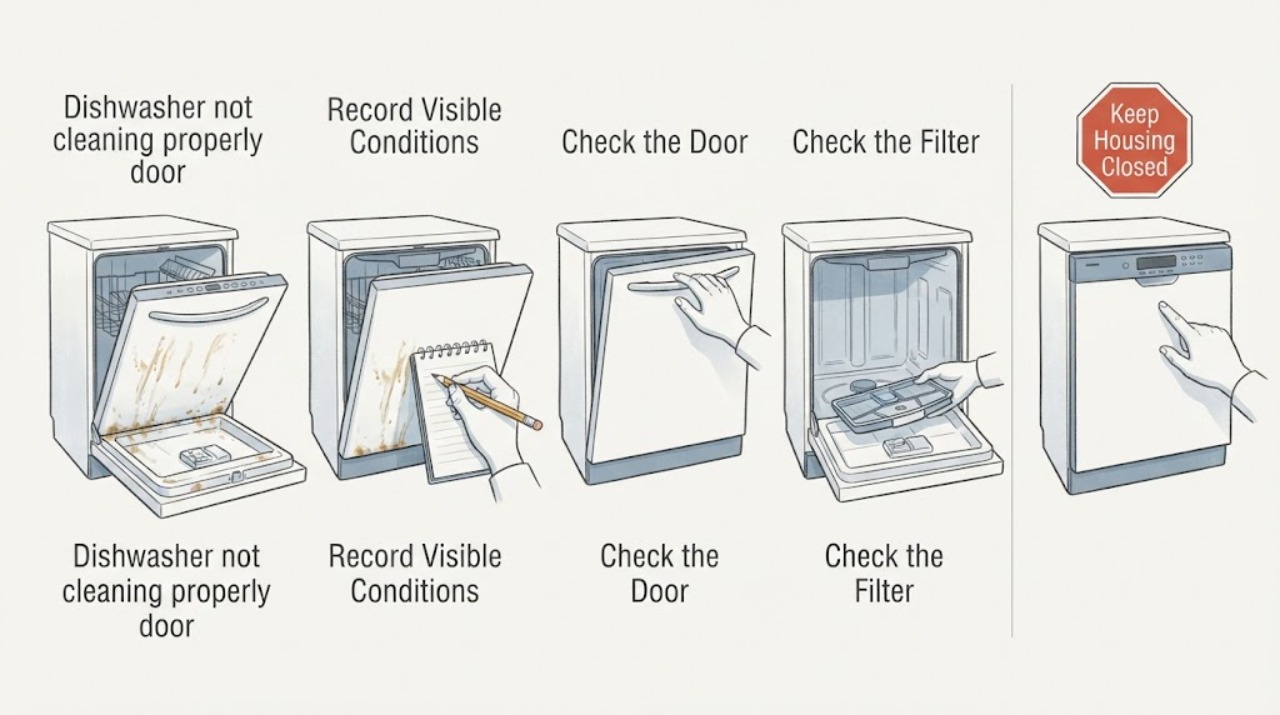
With the dishwasher off and safely disconnected, document the cleaning failure without adding new risk: note whether food residue is on every rack or only in one area, whether spray arms can turn freely, whether visible loading blocks the dispenser or spray path, whether the filter or soil-removal area is accessible according to the exact manual, and whether draining completes.
Expected result: Residue follows one blocked rack or spray area; residue and grit are widespread; standing water or poor draining is present; or the visible wash path is clear but performance remains poor.
Next step: Follow the exact manual for loading, filter, spray-arm, detergent, and drain checks, then use one normal supervised test only if no safety issue exists. If the fault remains across racks or cycles, obtain a diagnosis and written repair estimate rather than replacing parts by symptom.
Stop if: Do not reach into a running tub, remove a sump or pump cover, use tools in the spray path, or run the dishwasher with a missing filter or damaged guard.
Why this matters
Why: A localized loading or spray-coverage issue is more consistent with a repairable use or accessible maintenance problem. Widespread residue with poor drainage or clear wash paths raises the likelihood of a pump, filtration, circulation, heater, or control diagnosis that should be priced before choosing repair or replacement.
-
Check 4
Inspect the door symptom and rust from a dry, external position: note whether the door fails to latch, springs open, rubs, leaks, or has a loose handle; photograph rack rust, sharp coating loss, tub corrosion, rust flakes, or staining; and check whether the tub floor or door edge is wet after a completed cycle.
Expected result: The latch, handle, gasket, rack coating, or a small accessible fastener is the only defect; rust is cosmetic and contained; or rust, leakage, sharp metal, tub corrosion, or door failure is widespread or recurring.
Next step: Keep the appliance out of service for leakage, sharp metal, an unreliable latch, or corrosion that reaches the tub or door structure. For a contained, non-safety defect, obtain a model-matched repair quote and verify that the door seals and latches before normal family use.
Stop if: Do not use rust paint, tape, a bent latch, or a makeshift gasket as a food-contact or water-containment repair, and do not run a leaking dishwasher.
Why this matters
Why: A single latch, gasket, rack, or handle issue can be a targeted repair when the tub and electrical safety are sound. Corroded tub metal, sharp fragments, recurring leakage, or a door that cannot reliably latch affects safety and dependable cleaning, making replacement or a specialist inspection more compelling.
-
Check 5
Build the repair-versus-replace comparison for the actual household: record the qualified diagnosis and complete installed repair quote, part availability, expected downtime, number of prior repairs, remaining cleaning and door symptoms, tub/rack condition, and how many cycles the family needs each day. Compare that total with a correctly sized current dishwasher and its EnergyGuide or ENERGY STAR operating information.
Expected result: One low-complexity defect is identified with available parts and a sound tub; several systems are failing; the quote is high or uncertain; or the household cannot tolerate repeated downtime.
Next step: Choose repair only with a defined fault, model-matched part, safety clearance, and a quote that leaves reasonable value. Choose replacement when the safety gate, structural condition, repeated failures, supportability, or family reliability requirement outweighs a repair; recycle or dispose of the old unit through an appropriate local route.
Stop if: Do not make the decision from the 665 prefix, a single online part listing, or a vague promise that the next repair will solve all symptoms.
Why this matters
Why: Repair preserves a sound appliance when the cause is isolated and parts/support are available. Replacement has a stronger case when failures are clustered, the structure is compromised, the model is too uncertain to support, or a repair would not restore reliable high-frequency use. ENERGY STAR confirms that newer certified dishwashers can reduce water and energy use and improve cleaning features, but the savings depend on the selected model and household usage.
Use your observations
Decision map
Find the observation that best matches what you see, then follow the next safe action.
-
PATH 01Next step
What you see
The full model and serial match the CPSC recall scope, or there is a hot/damaged cord, burning odor, smoke, sparking, shock, water near electrical parts, or repeated breaker operation.
Do this next
Keep the dishwasher disconnected and obtain recall or qualified appliance/electrical service. Do not weigh repair cost against a replacement until the safety disposition is known.
Why this path and its safety boundary
Why it matters: This is a safety or recall path, not an ordinary cleaning-performance decision. CPSC identifies a door-latch wiring fire hazard for the listed models and directs owners to stop using them until service.
-
PATH 02Next step
What you see
The identity is clear, no recall or safety hazard is found, the tub is sound and dry, and cleaning or the door problem traces to one accessible or clearly diagnosable part such as loading, spray coverage, filtration, latch, handle, gasket, or rack.
Do this next
Get a model-matched diagnosis and complete quote, repair the defined defect, and verify several normal cycles for cleaning, drainage, latching, sealing, and rust-free operation before returning to frequent use.
Why this path and its safety boundary
Why it matters: An isolated, model-supported fault has a plausible repair path. The family can keep the established installation and avoid replacing a structurally sound appliance solely because it is old or has food residue.
-
PATH 03Next step
What you see
Poor cleaning, door malfunction, food residue, and rust or leakage occur together; the tub or door structure is corroded; parts/manual support is unavailable; or the repair quote is uncertain and the household needs dependable multiple daily cycles.
Do this next
Favor replacement after confirming the model identity and safety status, comparing an installed replacement with the repair quote, and selecting capacity, sanitation/drying needs, EnergyGuide, and ENERGY STAR information appropriate to the household.
Why this path and its safety boundary
Why it matters: The problem is no longer a single maintenance defect. Multiple system symptoms and structural or supportability risk make repeated repair less likely to deliver reliable family use, and a leak or sharp corrosion is a safety boundary.
-
PATH 04Next step
What you see
The full model or serial cannot be read, symptoms are mixed, or the dishwasher has not yet had a qualified diagnosis.
Do this next
Do not order parts or run repeated tests. Recover the rating-plate information and request a written diagnosis and quote; if that process costs more than the household is willing to risk on an unsupported older unit, compare replacement options instead.
Why this path and its safety boundary
Why it matters: The repair-versus-replace comparison is premature: 665 UltraWash covers different revisions, and the missing identity prevents manual, recall, part, and feature matching.
Helpful context
Understand the symptom
“Kenmore 665 UltraWash” is a family label, not a complete appliance identity. Kenmore's own manual portal asks for a model number of at least 11 characters, and the CPSC recall page shows why the full model and serial matter: some older 665 dishwashers are included, but not every 665 machine is the same product or safety case.
For a busy family, the repair-versus-replace decision is about safe, repeatable cleaning and dependable door operation—not just whether one cycle can be coaxed through. Separate a correctable load, filter, spray, latch, or gasket issue from a rusted tub, leak, unavailable part, or safety recall before spending money.
Only after diagnosis
Potential parts
- door latch, handle, or door gasket
Consider only after a technician confirms a single latch, handle, or gasket fault and the door panel, tub, wiring, and recall status are safe.
The 665 prefix is not enough for fitment; match the complete model and serial revision and do not bypass the interlock. - spray arm, filter or soil-removal component
Consider only when poor cleaning is traced to the exact model's accessible wash or filtration components rather than a circulation, heater, or control failure.
Confirm the manual and part fit for the full model; do not run the dishwasher without required filters or guards. - circulation pump, drain pump, heater, or control assembly
Consider only after qualified diagnosis. A cluster of cleaning, door, rust, and leak symptoms may make replacement more sensible than repeated component repair.
Do not select an internal part from food residue, a door symptom, or the 665 prefix alone.
When checks do not resolve it
Need a professional?
Contact qualified Kenmore or appliance service for a recall match, door-latch or door-panel issue, persistent poor cleaning, retained water, active leak, corrosion that affects structure, repeated repairs, or any component-level diagnosis. Use qualified electrical help for the circuit, hard-wiring, outlet, breaker, heat, smoke, or shock symptom.
Safety scope: Owner checks are limited to reading the rating label, checking recall identity, observing cleaning and door symptoms, and inspecting visible loading, spray, rack, gasket, rust, and leakage conditions with power safely disconnected. Do not open the door panel, reach into the pump or sump, bypass the latch, make live measurements, run a leaking or electrically suspect dishwasher, or use makeshift rust or gasket repairs.
Have this ready
- Provide the complete model and serial information, recall-check result, purchase or installation context, cleaning pattern, door behavior, rust and leak photographs, cycle and drainage observations, prior repair history, repair quote, part availability, and household cycle frequency.
Common questions
FAQ
Is every Kenmore 665 UltraWash dishwasher covered by the CPSC recall?
No. The CPSC notice identifies specific model and serial ranges, including an example beginning with 665, not every 665 dishwasher. Read the complete model and serial label and compare both before operating or deciding on repair.
Should I repair a Kenmore 665 UltraWash that leaves food on dishes?
Repair is the better first path when the full model is known, no safety issue is found, the tub is sound, and the problem is isolated to loading, spray coverage, filtration, detergent or a single diagnosable component. If food residue occurs across racks and cycles alongside door, rust, leak, or drainage problems, get a quote before spending on parts and compare replacement.
Does rust mean the dishwasher must be replaced?
Not automatically. A contained rack or coating issue may be repairable, but rust that is sharp, flaking into the tub, associated with a leak, or affecting the tub or door structure is a stop condition and makes replacement or specialist inspection more compelling. Do not cover structural corrosion with makeshift paint or tape.
How should a family compare repair with a new dishwasher?
Compare the complete installed repair quote, parts availability, prior repairs, remaining cleaning and door symptoms, structural condition, downtime, and the number of cycles the household needs. For a replacement, compare capacity, sanitation and drying needs, EnergyGuide operating cost, and ENERGY STAR certification rather than choosing by brand name alone.
Can I order a Kenmore 665 part from the prefix alone?
No. Kenmore's manual and support routing is model-specific, and the 665 prefix covers different dishwasher revisions. Match the complete model and serial information and confirm the diagnosis before buying a latch, pump, filter, heater, or control.
Read the exact guide
Official sources
- DishwashersU.S. Environmental Protection Agency ENERGY STAR · Opened official ENERGY STAR dishwasher guidance. It describes current certified-dishwasher efficiency, soil sensing, filtration, cleaning, EnergyGuide comparison, size, and operating-cost considerations; it does not diagnose the older Kenmore unit.
- Kenmore Appliance Manuals & GuidesKenmore / Transform SR Brands LLC · Opened official Kenmore manual portal. It requires a complete model number of at least 11 characters and states that manuals cover Kenmore dishwashers and related parts and resources.
- 24" Built-in Dishwasher with UltraWash® System and SmartWash®Kenmore / Transform SR Brands LLC · Opened official Kenmore product page for a current UltraWash model. It documents pressurized spray nozzles, a three-stage filter, SmartWash sensing, stainless tub, leak detection, and ENERGY STAR certification as features of that exact current model; these features must not be assumed for an older 665 unit.
- CPSC and Whirlpool Announce Dishwasher RecallU.S. Consumer Product Safety Commission · Opened official CPSC recall notice. It identifies certain Kenmore dishwasher models beginning with 665 and specific serial ranges where door-latch wiring may overheat and catch fire; it instructs owners of affected units to stop using them until service.
Community feedback
Share a repair observation
Share a plain-text repair observation. Accepted observations are published automatically; this page may take a moment to update.