
On this page
Start here
Quick answer
For Kenmore 110.67832794, a dryer that is quiet empty but vibrates loudly with a full load should not be diagnosed by replacing another roller, idler pulley, or belt from the symptom alone. First stop for cabinet movement, scraping, grinding, burning odor, smoke, heat, or electrical signs. Confirm the full model number, level and stable floor, nearby contact, and whether the noise returns with a small, evenly distributed load; do not repeat a dangerous full-load test. In the exact-model report, a maintenance kit with rollers, idler pulley, and belt did not resolve the full-load vibration, and community replies raised roller-shaft wear, drum bearing or felt-seal wear, and a loose or cracked blower wheel as possibilities—not confirmed diagnoses. Use the full model in Kenmore's manual lookup and ask qualified dryer service to inspect the roller shafts, drum support/bearing and felt, belt tracking, idler, blower wheel, drum alignment, and cabinet before choosing parts.
Work through in order
Diagnostic checks
Use only checks that match the exact appliance or system and its official guide.
-
Check 1
Stop the dryer and turn the cycle selector off. From a dry position, disconnect power before any permitted cleaning or inspection and record whether the vibration was a rumble, thump, scrape, squeal, or high-speed buzz; whether the cabinet moved; and whether there was a burning smell, hot cabinet, smoke, or electrical sign.
Expected result: The dryer walks or rocks, the sound is scraping or grinding, the cabinet or cord is hot, or there is smoke, burning odor, sparking, or exposed wiring.
Next step: Leave the dryer unplugged and arrange qualified appliance or electrical service. Do not run another full load to reproduce the noise.
Stop if: Do not pull the plug through a wet area, open panels while energized, or reset a breaker that trips with the dryer.
Why this matters
Why: Movement, rubbing, heat, smoke, or electrical damage is a stop-use condition. It cannot be safely separated from a worn support, blower, belt, motor, or wiring fault by adding or removing laundry.
-
Check 2
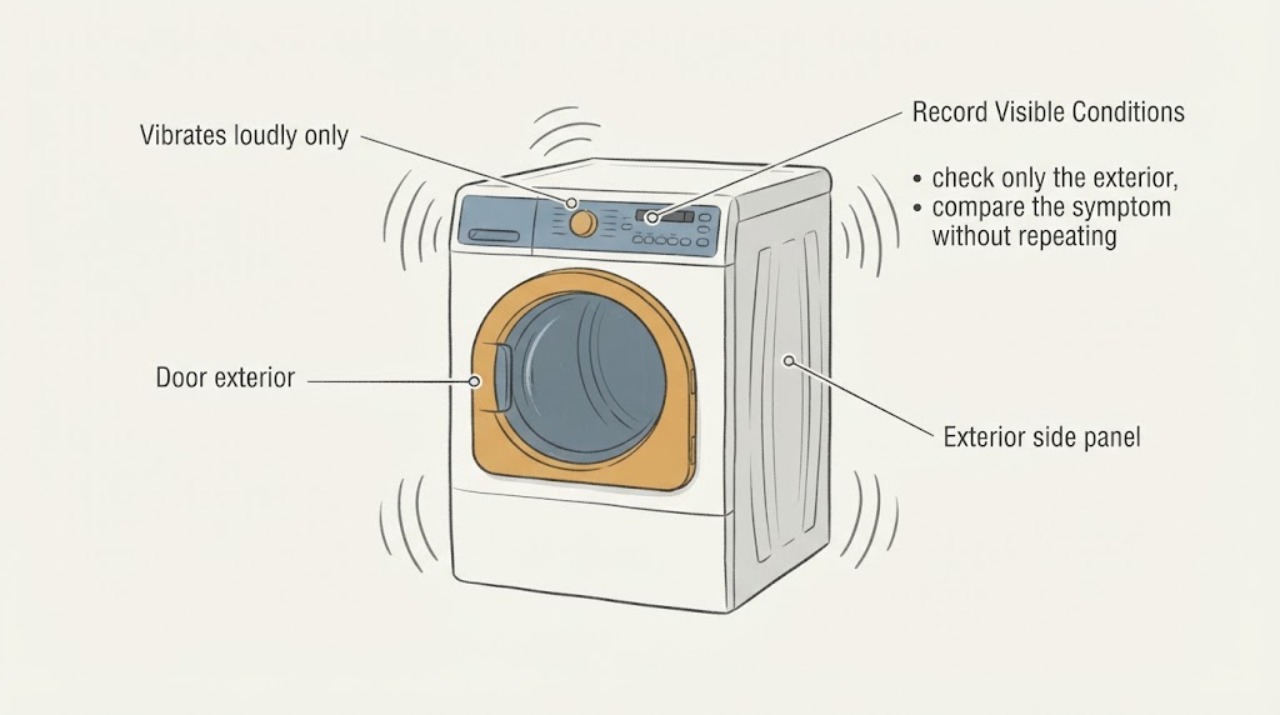
With the dryer empty and unplugged, check only the exterior for a rocking cabinet, an unlevel floor, a loose accessible foot, nearby shelving or a vent contacting the cabinet, or a stacked/adjacent installation transferring vibration. Do not unstack or move the dryer alone.
Expected result: The cabinet rocks, a foot is not firmly supported, a nearby object touches the dryer, or the dryer is stable and clear externally.
Next step: Correct only an obvious accessible contact or level issue using the exact manual. If the dryer is stacked, heavy, or built in, use a qualified installer or service provider rather than moving it.
Stop if: Do not use cardboard or loose wedges, overextend a foot, climb on the dryer, or unstack it to inspect the underside.
Why this matters
Why: An unstable base or external contact can amplify full-load movement. If the cabinet is stable and clear yet the noise returns only with added drum weight, support or rotating-part wear becomes more important than simple leveling.
-
Check 3
If there is no hazard and the dryer is stable, compare the symptom without repeating a full wet load: note whether it is silent empty and whether a small, evenly distributed dry load causes the same sound. Stop immediately if the cabinet moves or the sound becomes scraping, grinding, or rapidly louder.
Expected result: The dryer is quiet empty but vibrates with a small balanced load, or it is quiet empty and only becomes loud with a heavy/full load.
Next step: Record a short safe observation and stop testing. Give the empty-versus-loaded difference to service; do not use a full load as a stress test.
Stop if: Do not put hands in the drum while it runs, hold the cabinet to suppress vibration, run with panels removed, or continue after a new heat or electrical symptom.
Why this matters
Why: A noise with a small balanced load points toward a rotating/support fault. A noise only after added weight suggests load-dependent clearance, drum support, roller-shaft, felt, belt/idler alignment, blower-wheel, or cabinet-flex behavior; it does not prove any one part.
-
Check 4
Give the service provider the exact repair history and ask for an inspection of the whole rotating path, not just another maintenance kit: roller shafts and bearings, drum support and felt seals, belt tracking, idler alignment, blower wheel for looseness or cracks, drum seating, motor mounts, and cabinet contact. Keep the removed roller and other parts if available.
Expected result: The prior kit replaced only rollers, idler, and belt; a shaft, felt, bearing, blower wheel, drum alignment, or mount was not inspected; or the provider can document that the full rotating path is sound.
Next step: Request a written diagnosis and model-confirmed part number before authorizing another repair. If the cause is not clear, leave the dryer out of service rather than replacing parts sequentially.
Stop if: Do not lubricate a sealed bearing, bend a shaft, glue a felt seal, force a belt path, or order a blower/roller/bearing based only on a generic 110-series match.
Why this matters
Why: Replacing a wearable item does not prove the mating shaft, support surface, seal, blower, drum, or mount is healthy. A component that is quiet without load can become noisy when weight changes alignment or clearance.
-
Check 5
Use Kenmore's manual lookup with the complete 110.67832794 identifier and compare the manual's installation, leveling, load, and service instructions with the dryer in front of you. Before any part order, photograph the rating plate and write down the exact part numbers already installed, their source, and whether the repair changed the noise.
Expected result: The manual matches the full model, the number is incomplete or differs from the label, or installed parts do not have a confirmed model match.
Next step: Correct the model record and have service verify the installed parts against the exact diagram. Keep the dryer unplugged while the full-load vibration remains unexplained.
Stop if: Do not rely on the 110 prefix, a similar-looking dryer, or a retailer cross-reference as fit evidence.
Why this matters
Why: A small model-number difference can select a different drum support, blower, belt, or cabinet part. The official Kenmore site makes the complete model the starting point for manuals; the community report's Whirlpool kit does not establish that every component is correct for this Kenmore.
Use your observations
Decision map
Find the observation that best matches what you see, then follow the next safe action.
-
PATH 01Next step
What you see
The cabinet is stable and clear, the dryer is quiet empty, and the sound appears only with a heavy/full load.
Do this next
Stop full-load testing and ask service to inspect the rotating path under the exact model. Provide the empty-versus-full difference and the prior maintenance-kit part numbers.
Why this path and its safety boundary
Why it matters: Load-dependent support, clearance, drum seating, roller-shaft, felt, belt/idler, blower-wheel, or cabinet-flex behavior is more plausible than a simple foot adjustment, but no component is confirmed.
-
PATH 02Next step
What you see
The dryer is loud with an empty drum, the noise is scraping or grinding, or it remains after an obvious level/contact correction.
Do this next
Keep power disconnected and arrange qualified dryer service. Do not keep replacing rollers or pulleys without inspecting shafts, supports, blower, drum alignment, and mounts.
Why this path and its safety boundary
Why it matters: The symptom is no longer explained by the full load alone. A rotating support, blower, drum, motor, cabinet, or trapped-object fault needs diagnosis.
-
PATH 03Next step
What you see
The prior rollers, idler pulley, and belt were replaced, but full-load vibration is unchanged and no written cause-of-failure diagnosis exists.
Do this next
Request a written second diagnosis with exact model and part verification before authorizing more components. Preserve the removed parts and repair invoice.
Why this path and its safety boundary
Why it matters: The maintenance kit did not establish or correct the root cause. Roller-shaft wear, drum support/felt, blower-wheel loading, drum alignment, or another rotating interface remains possible.
-
PATH 04Next step
What you see
There is violent movement, smoke, burning odor, a hot cabinet or cord, sparking, exposed wiring, or a vent/cabinet obstruction that cannot be safely cleared.
Do this next
Stop the dryer, leave it unplugged when safe, and obtain qualified appliance or electrical help. Do not restart to confirm the symptom.
Why this path and its safety boundary
Why it matters: This is a fire, electrical, or mechanical safety event rather than a routine full-load vibration.
Helpful context
Understand the symptom
Quiet empty but loud full is a load-dependent result, not proof that the new rollers, idler, or belt were the wrong parts. Added wet-clothes weight can expose a worn roller shaft, drum support or felt, a drum that is not seated correctly, belt tracking or idler alignment, or a blower wheel that becomes unstable under load. A full-load test can also amplify a normal load imbalance or contact with the cabinet. The exact failure needs inspection rather than a parts guess.
The exact 110.67832794 community report says one roller was seized, a Whirlpool maintenance kit with rollers, idler pulley, and belt was installed, and the dryer remained very loud only when full. Replies suggested looking at the blower wheel, roller shafts, drum bearing, felt seal, and load-related shifting, but the thread records no confirmed repair. Treat those replies as diagnostic possibilities, not proof of compatibility or cause.
Kenmore's official manual page asks owners to enter the complete model number and says the model-specific manual contains appliance guidance. Record 110.67832794 exactly, including the separators used on the rating label, before consulting diagrams or authorizing another part. Keep the dryer unplugged whenever a check would require opening the cabinet or reaching near the drum, belt, motor, or blower.
When checks do not resolve it
Need a professional?
Arrange qualified dryer service when the vibration persists with an empty or small balanced load, returns after a level/contact correction, remains after a roller/idler/belt kit, or diagnosis requires opening the cabinet, reaching the blower or motor, inspecting drum supports or shafts, or moving a heavy/stacked dryer. Stop immediately for violent movement, scraping or grinding, smoke, burning odor, a hot cabinet or cord, sparking, exposed wiring, or a blocked vent that cannot be safely addressed.
Have this ready
- Provide the full model number exactly as shown, serial number, videos or description of empty versus full behavior, load type and weight, level/contact observations, maintenance-kit parts and dates, the seized roller if retained, invoice, and any burning or electrical symptoms.
Common questions
FAQ
Why is the Kenmore 110.67832794 quiet empty but loud when full?
Added drum weight can expose a support, clearance, alignment, roller-shaft, felt, belt/idler, blower-wheel, or cabinet-flex problem. It can also amplify a load imbalance. Because the exact model report stayed loud after rollers, idler, and belt were replaced, compare the empty/full behavior once safely and then request a complete rotating-path inspection.
Could the blower wheel cause vibration only with a full load?
It is a possibility raised in the exact-model discussion, not a confirmed diagnosis. A loose or cracked blower wheel can be affected by operating load, but the provider should inspect it together with roller shafts, drum support/felt, belt tracking, idler alignment, drum seating, and the motor before replacing anything.
Where should I verify the Kenmore dryer manual and parts?
Use the complete model number from the rating label in Kenmore's official manual lookup. Do not use only the 110 prefix or a similar model number; have any installed maintenance-kit parts checked against the exact model documentation before another repair.
Read the exact guide
Official sources
- Find Your Manual | Kenmore Appliance Manuals & GuidesKenmore · Official Kenmore manual portal used to enter the assigned exact model 110.67832794; it supports exact-model documentation routing but does not diagnose a vibration or certify a generic part match.
- Dryer has loud vibration when fullReddit r/appliancerepair · Exact Kenmore 110.67832794 report of quiet-empty/loud-full vibration after a roller, idler, and belt kit; replies are unverified possibilities and no repair outcome is documented.
Community feedback
Share a repair observation
Share a plain-text repair observation. Accepted observations are published automatically; this page may take a moment to update.