
On this page
Start here
Quick answer
Stop the Kenmore dryer and identify the odor before running another heated cycle. A new unit may have model-specific first-use instructions, but a burning-rubber, melting-plastic, electrical, or fuel-gas odor is not a normal maintenance signal. After the dryer is cool and disconnected when appropriate, clean the lint filter, check the visible exhaust path for crushing or restriction, and keep the outdoor vent opening clear; lint and poor airflow can raise heat and create a fire hazard. Do not open the cabinet to inspect a belt, motor, heater, burner, or wiring. Leave the dryer off and arrange qualified appliance or electrical service for a persistent smell, smoke, sparks, unusual heat or noise, a damaged cord, repeated breaker trips, or any gas odor. If gas is suspected, leave the area and follow local emergency-gas guidance rather than operating electrical equipment nearby.
Work through in order
Diagnostic checks
Use only checks that match the exact appliance or system and its official guide.
-
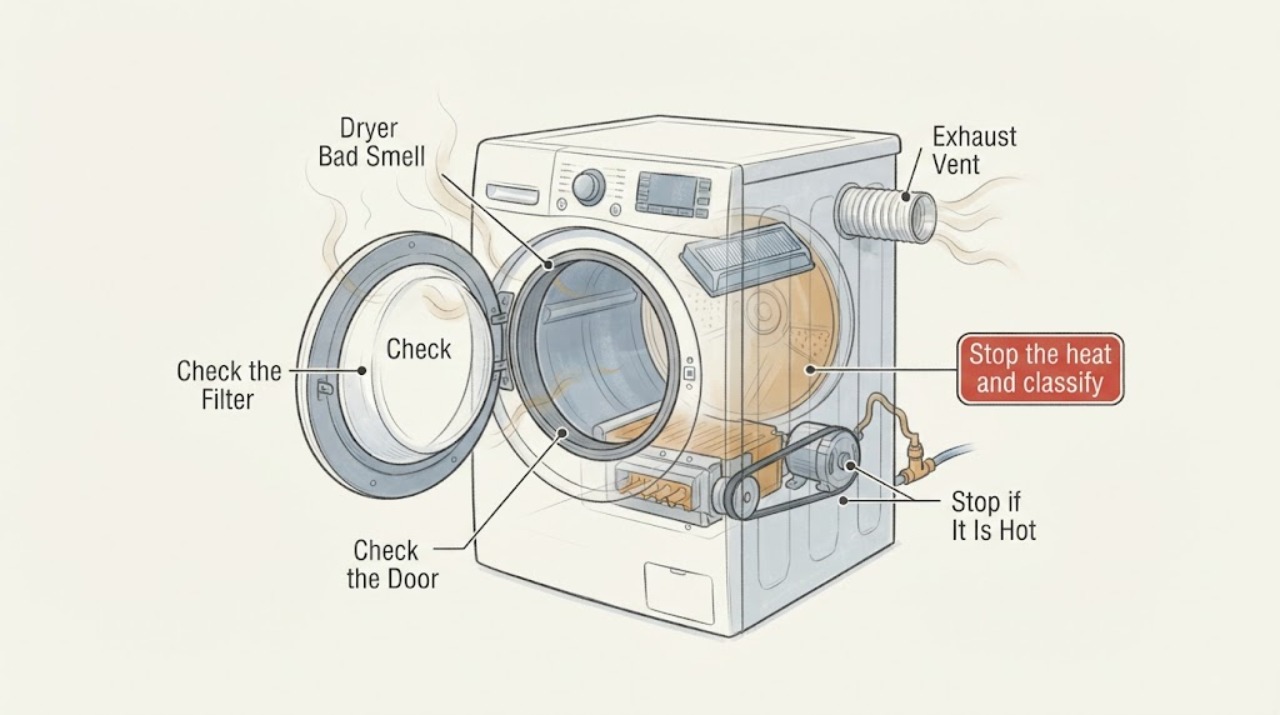
Stop the heat and classify the odor
Turn the dryer off and, once safe, note whether the smell is oily, musty, hot-lint-like, burning rubber, melting plastic, electrical, or gas-like. Look from a safe position for smoke, glowing material, scorch marks, or a load that feels abnormally hot. Do not lean into smoke or restart the dryer to reproduce the odor.
Expected result: The dryer is new and has only a mild first-use odor, the smell is persistent or worsening, smoke or scorching is visible, the odor resembles gas, or a burning-rubber or electrical smell is present.
Next step: For any smoke, gas-like odor, scorching, or strong burning smell, leave the dryer off and follow the urgent safety branch. Only a mild, first-use odor without warning signs may proceed to the model-specific new-dryer check.
Stop if: Stop immediately for smoke, flames, sparks, melting, a gas odor, a hot cord, or any symptom that makes the room unsafe; do not operate the dryer or nearby electrical equipment in a suspected gas-release area.
Why this matters
Why: A mild first-use odor should be compared only with the exact model's guidance. Persistent or material-specific burning odors, smoke, heat, or gas odor indicate a fire, mechanical, electrical, or fuel-safety condition that cannot be cleared by ordinary cleaning alone.
-
Check the lint filter and accessible lint area
After the dryer is off and cool, remove the lint filter as the exact Kenmore manual describes and clear lint from its normal user-accessible surface and housing. Check that the filter is present, intact, fully seated, and dry. Do not run the dryer with the filter missing, blocked, damaged, or wet, and do not reach into the cabinet.
Expected result: The filter is heavily loaded, coated with residue, damaged or missing, the housing contains loose lint, or the accessible filter area is clean and intact.
Next step: Clean or replace the filter only through the model-approved user procedure and keep the dryer off if it is damaged or missing. Arrange qualified cleaning or service for lint inside the cabinet or a smell that returns.
Stop if: Do not operate without the lint filter, use a wet filter, scrape the housing with metal, or remove panels to clean internal lint.
Why this matters
Why: The U.S. Fire Administration identifies an unclean filter and dryer vents as increasing dryer-fire risk. A blocked or damaged filter can reduce airflow and allow heat or lint to build up; a clean filter does not rule out lint deeper in the chassis or vent.
-
Check the visible exhaust path and outdoor vent
With the dryer off, inspect the visible vent connection behind the appliance for crushing, kinking, separation, or lint at the accessible outlet. From ground level, confirm that the outdoor vent cover is not visibly blocked and can open during normal operation; do not move a heavy dryer alone or disconnect ductwork unless the exact manual gives a safe procedure.
Expected result: The vent is crushed, kinked, disconnected, restricted, or lint-covered, the outdoor flap does not open during normal operation, or the visible exhaust path appears clear.
Next step: Leave the dryer off and arrange qualified vent cleaning or appliance service for a restriction, damaged duct, inaccessible run, or persistent odor. Restore any connection only as the exact installation instructions specify.
Stop if: Do not run a dryer with a disconnected, crushed, blocked, or improvised exhaust, and do not climb or reach into an unsafe exterior vent.
Why this matters
Why: The U.S. Fire Administration says damaged, crushed, or restricted venting raises dryer-fire risk. Poor airflow can increase drying time and cabinet heat, but a clear visible path does not prove that the full duct or internal blower is clear.
-
Separate an airflow problem from a mechanical smell
Review whether drying has recently taken longer, clothes are unusually hot or damp, the dryer makes squealing, scraping, or grinding sounds, or the smell begins when the drum starts turning. Do not remove the drum, belt, blower, rear panel, or motor cover to inspect the suspected source.
Expected result: Drying time increased with weak exhaust, the odor tracks drum rotation with a rubbing sound, the cabinet becomes unusually hot, or the smell occurs even without a load or after the visible vent check.
Next step: Keep the dryer off and provide these observations to qualified Kenmore appliance service. Do not order a belt, heater, motor, or control component before model-specific diagnosis.
Stop if: Stop for scraping, grinding, smoke, visible lint ignition, abnormal heat, sparks, or any need to open the cabinet.
Why this matters
Why: Restricted airflow can increase heat and may produce a hot-lint odor. A rotation-linked rubber or rubbing smell can indicate a belt, idler, drum support, or blower issue, while an unloaded electrical odor can indicate a heater, motor, control, or wiring problem; none can be identified safely from smell alone.
-
Check the cord, outlet, and breaker without live testing
When the dryer is cool and there is no gas or fire hazard, inspect the plug, cord, receptacle, and nearby wall for scorching, looseness, heat, or moisture. Check the breaker only from a safe position and do not repeatedly reset it. Do not use an extension cord or make live voltage measurements.
Expected result: The cord or outlet is hot, scorched, loose, wet, or damaged; the breaker trips; or the electrical connection looks normal and the odor is confined to the drum or exhaust path.
Next step: Leave the dryer disconnected and obtain qualified electrical or appliance service for any damage, heat, or breaker symptom. Continue only with documented external maintenance when the connection is normal and no hazard is present.
Stop if: Do not operate with a damaged or hot cord or outlet, bypass the breaker, use an extension cord, or touch wet electrical components.
Why this matters
Why: A damaged electrical connection or tripping breaker can create an electrical-fire risk and is not a dryer-cleaning problem. A normal-looking connection shifts attention to airflow, drum mechanics, heater or burner, or internal lint, but does not make internal diagnosis a user task.
-
Handle a gas-dryer odor as an emergency boundary
If the Kenmore dryer is gas-fueled and the smell resembles fuel gas rather than hot lint or a new-unit odor, do not operate the dryer, lights, switches, phones, or other ignition sources in the suspected area. Move people away and contact the local gas utility or emergency service from a safe location according to local guidance; do not attempt to locate or repair the gas path.
Expected result: The odor is clearly gas-like, there is hissing, the smell persists after the dryer is off, or the odor is only a transient non-gas smell with no other hazard.
Next step: For a gas-like symptom, leave the area and use local emergency-gas guidance; arrange qualified gas-appliance service before any reuse. For a non-gas odor with no hazard, continue the external checks and service boundary.
Stop if: Never run the dryer, create a spark, switch electrical equipment, smoke, or attempt a gas-line repair while a gas odor is present.
Why this matters
Why: A fuel-gas release is an immediate fire and health hazard. It is not possible to safely distinguish every gas or combustion fault by smell alone, and a normal first-use odor explanation must not be used to dismiss a gas-like smell.
-
Prepare a service handoff instead of guessing a part
Record the complete Kenmore model number, gas or electric configuration, when the smell begins, whether the drum is turning, drying-time changes, filter and vent condition, cord and breaker observations, visible lint, noises, smoke, heat, and any load involved. Keep the dryer disconnected when a hazard or persistent odor remains; do not open the cabinet to confirm a belt, heater, motor, burner, or control fault.
Expected result: The odor disappears after a documented new-unit first-use event and no warning sign returns, disappears after accessible lint or vent correction, or persists or returns during operation.
Next step: Use the exact manual for model-specific maintenance and contact qualified Kenmore appliance service for recurrence, internal lint, mechanical, heater, burner, or control symptoms. Use qualified electrical or gas service for those supply hazards.
Stop if: Stop all use for smoke, flames, gas odor, sparks, scorching, melting, abnormal heat, a damaged cord, repeated breaker trips, or a persistent burning smell.
Why this matters
Why: A one-time, mild new-unit odor or a corrected accessible airflow issue has a narrower explanation. A recurring smell, especially with heat, noise, smoke, electrical symptoms, or gas symptoms, requires internal or fuel-system diagnosis by a qualified professional.
Use your observations
Decision map
Find the observation that best matches what you see, then follow the next safe action.
-
PATH 01Next step
What you see
The dryer is new and produces only a mild oily or semi-burning smell during the first heated use, with no smoke, scorching, abnormal heat, or gas-like odor.
Do this next
Follow the exact Kenmore manual's initial-use instructions and stop if the odor persists, worsens, or gains a safety symptom.
Why this path and its safety boundary
Why it matters: The odor may match the model's documented first-use behavior.
-
PATH 02Next step
What you see
The lint filter is blocked, missing, damaged, wet, or heavily coated, or lint is visible around the accessible housing.
Do this next
Keep the dryer off, clean or replace the filter only as the model manual allows, and arrange qualified cleaning for lint inside the cabinet.
Why this path and its safety boundary
Why it matters: Restricted airflow and lint accumulation can raise heat and create a fire risk.
-
PATH 03Next step
What you see
The exhaust duct is crushed, separated, restricted, or the outdoor vent cover does not open normally.
Do this next
Leave it off and arrange qualified vent or appliance service; do not operate with an improvised or disconnected exhaust.
Why this path and its safety boundary
Why it matters: The dryer may be overheating from inadequate exhaust airflow.
-
PATH 04Next step
What you see
The smell tracks drum rotation and comes with squealing, scraping, grinding, or rubbing.
Do this next
Keep the dryer off and arrange qualified appliance diagnosis without opening the cabinet.
Why this path and its safety boundary
Why it matters: A belt, idler, drum support, blower, or motor issue is possible, but the specific part is not identified by odor alone.
-
PATH 05Next step
What you see
The cord or outlet is hot, scorched, loose, wet, damaged, or the breaker repeatedly trips.
Do this next
Leave the dryer disconnected and obtain qualified electrical or appliance service; do not reset the breaker repeatedly.
Why this path and its safety boundary
Why it matters: This is an electrical safety stop.
-
PATH 06Next step
What you see
A gas Kenmore dryer produces a fuel-gas odor, hissing, or a smell that persists after the dryer is off.
Do this next
Leave the area, avoid switches or ignition sources, and contact local gas emergency service from a safe location; arrange qualified gas-appliance service before reuse.
Why this path and its safety boundary
Why it matters: Treat it as a possible gas release and immediate fire or health hazard.
-
PATH 07Next step
What you see
Smoke, flames, visible lint ignition, melting, or a strong burning odor appears.
Do this next
Keep people away, leave the area if needed, contact emergency services for active fire, and do not re-energize the dryer until qualified service clears it.
Why this path and its safety boundary
Why it matters: This is an immediate fire stop rather than a cleaning task.
Helpful context
Understand the symptom
Treat a new-unit smell differently from an active burning odor
A new dryer may have model-specific first-use instructions, so consult the exact Kenmore manual before interpreting a mild odor. That possibility does not cover smoke, visible scorching, melting-plastic odor, burning rubber, or an odor that persists or worsens; stop immediately if the smell is accompanied by a safety symptom.
Lint and airflow are a fire-safety check
Lint can collect in the filter, housing, dryer, or exhaust path. A restricted vent reduces airflow and can increase heat, while a loose, damaged, or missing lint filter is unsafe. Clean only the user-accessible filter and visible areas described by the exact manual; interior chassis cleaning and gas or electrical diagnosis belong to qualified service.
Safety boundary
Stop conditions
- Stop immediately for smoke, flames, visible lint ignition, sparks, scorching, melting, abnormal heat, a strong burning odor, or a gas-like odor; do not restart the dryer to reproduce the symptom.
- Do not operate without a clean, dry, intact lint filter or with a crushed, blocked, separated, or improvised exhaust path.
- Do not open the cabinet, inspect energized wiring, test a heater or burner, or replace a belt, motor, control, or gas component based only on smell.
- Leave the dryer disconnected for a hot or damaged cord, wet electrical area, repeated breaker trips, or a suspected gas release, and obtain qualified service.
Only after diagnosis
Potential parts
- dryer lint filter or filter housing
Consider this category only when the model-specific inspection confirms a missing, damaged, or uncleanable filter or housing that compromises airflow or lint containment.
Confirm the complete Kenmore model and the manual's filter design before ordering; do not run the dryer without an intact filter. - dryer exhaust duct or vent component
Consider this category only when qualified inspection confirms a damaged, crushed, disconnected, or restricted exhaust component after the visible checks.
Match the installation and vent requirements for the exact model and building; do not substitute an improvised exhaust path. - dryer drive belt, idler, or blower component
Consider this category only when a qualified technician confirms that the smell tracks drum rotation and a mechanical component is slipping, rubbing, or seized.
Confirm the complete Kenmore model and technician diagnosis before ordering; a burning smell can also originate from airflow, heat, electrical, or gas faults.
When checks do not resolve it
Need a professional?
Arrange qualified Kenmore appliance service for a persistent or returning smell, internal lint, poor exhaust airflow, rotation-linked rubber or rubbing odor, unusual heat or noise, or suspected heater, burner, motor, belt, blower, control, or wiring issue. Use qualified electrical service for a damaged cord, hot or scorched receptacle, or unstable breaker. For a gas-like odor, leave the area and follow local gas-emergency guidance before arranging gas-appliance service.
Common questions
FAQ
Is a burning smell from a new Kenmore dryer normal?
A new dryer may have model-specific first-use guidance, but smoke, scorching, gas odor, melting-plastic smell, or a persistent or worsening odor is not a safe condition to dismiss. Consult the exact Kenmore manual and arrange service for warning signs.
Can lint make a Kenmore dryer smell bad?
Yes. Lint in the filter, housing, dryer, or exhaust can restrict airflow and increase heat. Clean the filter as directed, keep it installed and dry, check the visible vent path, and arrange qualified cleaning for lint inside the cabinet.
What does a burning-rubber smell from a Kenmore dryer mean?
If the odor tracks drum rotation or comes with squealing, scraping, or rubbing, a belt, idler, drum support, blower, or motor issue is possible. Keep the dryer off and have it diagnosed; smell alone cannot identify the correct component.
Can I keep using my Kenmore dryer if it smells like burning?
Do not continue a heated cycle while a burning smell is persistent, strong, or accompanied by smoke, heat, noise, sparks, scorching, or a damaged cord. Disconnect power only when safe and arrange qualified appliance or electrical service.
What should I do if a gas Kenmore dryer smells like gas?
Do not operate the dryer, lights, switches, phones, or other ignition sources in the suspected area. Move people away and follow local gas-emergency guidance from a safe location; arrange qualified gas-appliance service before using the dryer again.
Read the exact guide
Official sources
- Kenmore ManualsKenmore · Kenmore dryers when the exact model manual is needed for first-use odor, lint, exhaust, gas, or electrical procedures
- Appliance and Electrical Fire SafetyU.S. Fire Administration · Kenmore electric or gas dryers and their household electrical connections
- Clothes Dryer Fire SafetyU.S. Fire Administration · Household clothes dryers, including Kenmore gas and electric dryers
Community feedback
Share a repair observation
Share a plain-text repair observation. Accepted observations are published automatically; this page may take a moment to update.