
On this page
Start here
Quick answer
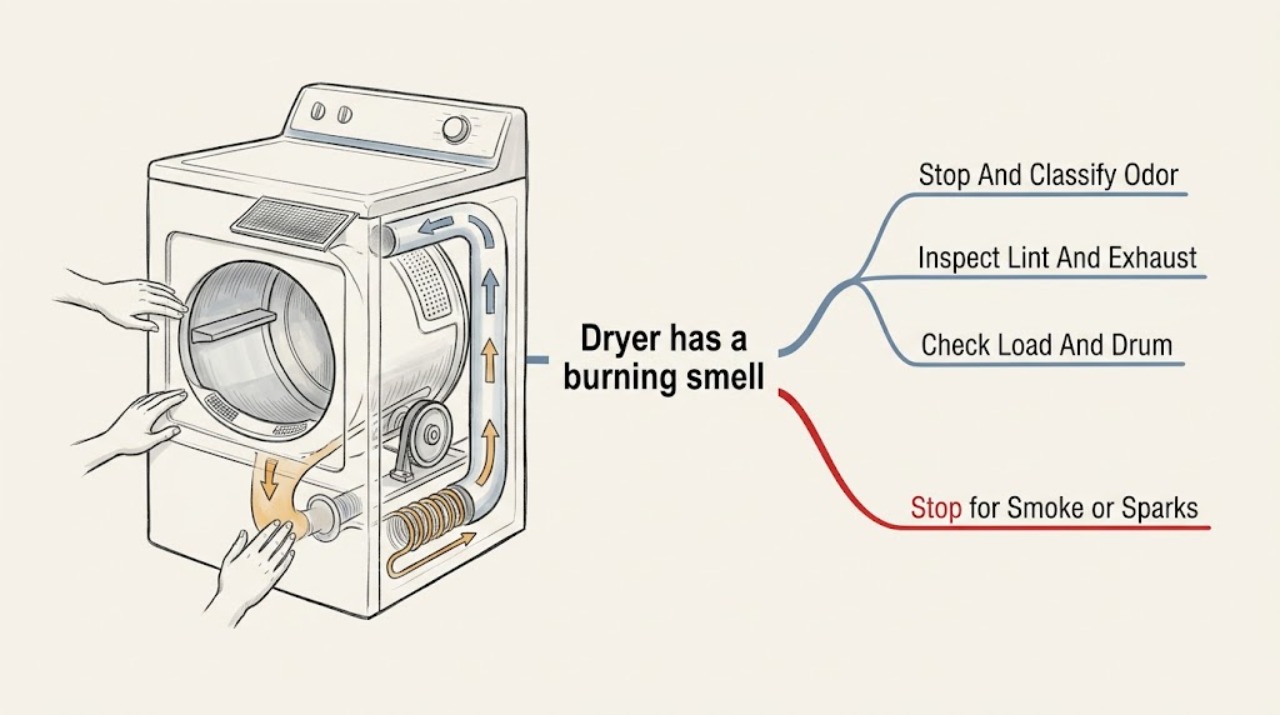
A burning smell from a Kenmore dryer is not a normal operating smell unless the dryer is new and the exact model instructions describe a brief first-use odor. Stop the cycle, remove the load, let the dryer cool, and do not keep testing it if the odor is sharp, electrical, rubber-like, accompanied by smoke, sparking, a hot cord or outlet, visible scorching, or a gas odor. From ordinary safe access, clean the lint screen, look for a blocked or crushed exhaust path and weak outside airflow, and check the cool drum for unusual drag or scraping. A lint or airflow pattern can overheat the dryer; a squeal or drag can point to a drive component; a persistent electrical, heater, or gas-related smell needs qualified service. Use the exact Kenmore model manual for any model-specific procedure and do not open the cabinet or bypass a safety device.
Before you begin
Safety first
- This article supports stopping the appliance, cooling it, inspecting ordinary-access lint, load, visible exhaust, and cool drum behavior, and recording symptoms. Do not open the cabinet, perform live electrical or gas work, bypass a safety device, or operate with a damaged or unverified exhaust path.
Work through in order
Diagnostic checks
Use only checks that match the exact appliance or system and its official guide.
-
Check 1
Stop the cycle, remove the load if it can be done without touching a hot or damaged area, and let the Kenmore dryer cool. From a safe position, classify the odor as dusty lint, hot rubber, sharp electrical or plastic, chemical or oily, or gas-like; note whether there was smoke, sparking, a hot cord or outlet, a scorch mark, or a breaker trip.
Expected result: The odor fades with cooling and there is no smoke, fire, spark, visible damage, hot connection, gas odor, or repeated electrical trip, or one of those hazards is present.
Next step: For smoke, flame, sparking, a hot cord or outlet, visible scorch, gas odor, or a breaker that trips again, keep the dryer out of service and leave the area or seek emergency or gas assistance as appropriate. Otherwise continue only after the dryer is cool and the odor has been documented.
Stop if: Do not restart the dryer to identify a dangerous odor, touch a hot plug or panel, or continue if smoke, flame, gas odor, sparking, or electrical damage is present.
Why this matters
Why: A hazard pattern is not an ordinary troubleshooting condition. If the smell is sharp or electrical, smoke-like, gas-like, or paired with heat or damage, the source could be internal wiring, heating, fuel, or a connection rather than removable lint.
-
Check 2
With power off and the dryer cool, clean the lint screen according to the Kenmore model instructions and inspect the visible exhaust hose, wall connection, and outside vent hood from ordinary access. Do not open the cabinet or reach into the blower or heating area.
Expected result: The screen or visible path has heavy lint, the hose is crushed or kinked, the outside flap is obstructed, or little or no warm exhaust was observed outside during a prior normal cycle; alternatively, the visible path is clear and airflow had been normal.
Next step: Do not use the dryer until a blocked or crushed exhaust path is corrected and the duct is securely reconnected. If the path is clear but the burning odor or overheating pattern remains, arrange qualified diagnosis rather than repeating cycles.
Stop if: Do not disconnect a hot duct, insert tools deep into the vent, operate with the exhaust disconnected, or open the dryer cabinet to clean internal lint.
Why this matters
Why: Lint, a crushed hose, or weak outside exhaust makes restricted airflow and overheating more likely. A clear visible path does not rule out lint inside the chassis, a blower fault, or a heating/control problem.
-
Check 3
Inspect the removed load, pockets, drum opening, door seal area, and lint-screen area only after all surfaces are cool. Look for a melted plastic item, paper, rubber, oily or solvent-smelling fabric, or a foreign object that could have rubbed during tumbling.
Expected result: A specific item or residue matches the odor and is removable without force, or the load and visible drum area are clean and the odor cannot be tied to an external material.
Next step: Keep contaminated or solvent-smelling items out of the dryer and follow the garment and model instructions. If residue is stuck, the drum is damaged, or the odor remains without an external source, stop use and provide the item and odor description to a technician.
Stop if: Do not scrape, pry, heat, wash with an unapproved chemical, or dismantle the drum or cabinet to remove a suspected object.
Why this matters
Why: A load or foreign-material source can create an odor without proving a dryer part has failed. An unexplained odor after a clean load makes an internal heat, electrical, airflow, or drive diagnosis more important.
-
Check 4
With the dryer unplugged only if the plug is cool, reachable, and undamaged, and with the drum empty and cool, turn the drum gently by hand from the opening. Observe for smooth movement versus scraping, binding, a repeating rub, or unusual resistance; do not remove panels or guards.
Expected result: The empty drum turns smoothly, or it drags, scrapes, rocks, or stops at a repeatable point; note any squeal or rumble heard during the last safe cycle.
Next step: If movement is abnormal or a mechanical noise accompanied the odor, leave the dryer out of service and request model-specific mechanical diagnosis. If movement is normal, use the airflow and electrical-hazard results to decide whether service is still required; an odor alone is not permission to run another cycle.
Stop if: Do not reach past guards, remove the belt, lubricate internal parts, bypass a switch, or run the dryer with a panel removed.
Why this matters
Why: A smooth cool drum makes severe drum-drive friction less evident but does not clear the heating or electrical system. Drag, scraping, or a squeal makes a belt, idler, roller, glide, bearing, or blower-related mechanical problem possible, and continued heat can worsen damage.
-
Check 5
Record whether the dryer is newly installed or was used near fresh paint, stain, varnish, or another strong room odor, and compare that timing with the burning smell. Do this without starting the dryer if any hazard from the first check remains.
Expected result: The odor occurred only during the first use and matches the brief semi-burning or oily odor described by the applicable model guidance, or the dryer is not new, the odor is strong or recurring, or the surrounding air is contaminated.
Next step: For a genuinely new dryer with no hazard signs, follow the exact Kenmore manual's first-use procedure and ventilate the room. For a recurring, strong, or unexplained odor, stop use and arrange qualified service; do not rely on a generic first-use explanation.
Stop if: Do not perform a first-use test when smoke, sparks, scorching, a hot connection, gas odor, or another stop-use condition was observed.
Why this matters
Why: Official Maytag product help notes that a new gas or electric dryer may emit a semi-burning or oily smell briefly, and that nearby paint, stain, or varnish fumes can be drawn into the dryer. That limited explanation does not cover smoke, scorching, an electrical smell, gas odor, or a recurring odor on an established appliance.
-
Check 6
Collect the Kenmore model and fuel type, the cycle and heat setting, load type, odor description, timing, lint and exhaust observations, drum-movement result, photos of any safe-to-view damage, and whether a breaker or outlet became hot or tripped. Do not remove the cabinet or perform live electrical tests.
Expected result: The evidence identifies a clear, corrected external cause with no remaining odor or damage, or the odor returns, the cause is internal or uncertain, drying was unusually slow, or a hazard was found.
Next step: Keep the dryer out of service for recurring, internal, or hazardous symptoms and give the record to a qualified appliance technician or the model's manufacturer support. If a fire or gas emergency is possible, use the appropriate emergency or gas service from a safe location.
Stop if: Do not bypass a thermal fuse, thermostat, door switch, gas safety device, or wiring; do not energize an appliance with exposed parts.
Why this matters
Why: A clear external cause can explain one event only if the appliance and load are undamaged and the odor does not return. A recurring or unexplained smell, slow drying, overheating, abnormal motion, or any electrical, gas, or fire sign requires a professional boundary.
Use your observations
Decision map
Find the observation that best matches what you see, then follow the next safe action.
-
PATH 01Safety boundary
What you see
The odor is dusty or hot, drying takes longer than normal, the lint screen or exhaust path is loaded, or little air exits the outside hood.
Do this next
Keep the dryer off until the vent path is correctly restored; request qualified cleaning or diagnosis if the path is not clearly serviceable or the smell returns.
Why this path and its safety boundary
Why it matters: Restricted airflow is a leading explanation for overheating, but a clear visible vent does not exclude internal lint, blower, heating, or control faults.
Safety stop: Do not operate with a crushed, disconnected, or blocked exhaust path, and do not open the cabinet to clean internal lint.
-
PATH 02Safety boundary
What you see
A hot-rubber odor occurred with squealing, scraping, rumbling, repeating rub, or abnormal resistance when the cool empty drum was turned.
Do this next
Leave the dryer out of service and request model-specific mechanical diagnosis; provide the noise location and drum-movement result.
Why this path and its safety boundary
Why it matters: The pattern makes a belt, idler, roller, glide, bearing, or blower-related mechanical fault more likely than a simple lint odor.
Safety stop: Do not remove guards, lubricate or replace internal drive parts by guesswork, or run another cycle to see whether the noise clears.
-
PATH 03Safety boundary
What you see
The odor is sharp electrical or plastic, the dryer or cord is unusually hot, a breaker trips, there is a scorch mark or spark, or the smell persists with a clean load and clear visible airflow.
Do this next
Stop use and arrange qualified appliance service. If there is smoke, fire, exposed wiring, or a gas odor, leave the area as appropriate and contact emergency or gas assistance from a safe location.
Why this path and its safety boundary
Why it matters: An electrical connection, heater, temperature-control, blower, or internal lint problem is possible and cannot be safely identified by an ordinary user from the outside.
Safety stop: Do not keep resetting the breaker, test live terminals, open the cabinet, or bypass a safety component.
-
PATH 04Safety boundary
What you see
A melted item, rubber, paper, oily fabric, cleaning-agent residue, or room fumes match the odor and the dryer itself has no visible damage.
Do this next
Remove the source, ventilate as appropriate, follow the Kenmore and garment-care instructions, and keep the dryer off if residue, damage, or odor remains.
Why this path and its safety boundary
Why it matters: The load or surrounding environment may be the source, but a hot or contaminated load can still create an ignition risk and should not be treated as a harmless dryer fault.
Safety stop: Do not dry items contaminated with volatile chemicals or scrape a melted material from a hot surface.
-
PATH 05Safety boundary
What you see
The dryer is genuinely new, the odor is mild and brief, and there is no smoke, scorching, electrical or gas odor, abnormal noise, or overheating pattern.
Do this next
Follow the exact Kenmore manual's first-use instructions and ventilate the area; stop and request service if the odor is strong, returns, or any hazard appears.
Why this path and its safety boundary
Why it matters: The applicable model guidance may describe a limited first-use odor, but this is not a general explanation for an established or repeatedly affected dryer.
Safety stop: Do not use the first-use explanation to justify operation after a safety symptom or on an older appliance with a new odor.
Helpful context
Understand the symptom
Treat the odor as a symptom, not a parts diagnosis
The smell alone does not identify a failed part. A dusty lint odor with weak exhaust points toward an airflow problem; a hot rubber smell with a squeal, scrape, or drum drag points toward a mechanical load; a sharp plastic or electrical odor, smoke, scorch mark, hot plug, or repeated breaker trip is a stop-use condition. A gas odor is also a stop-use condition for a gas dryer. Kenmore sells both electric and gas dryers, so the exact model manual and fuel type control the safe service boundary.
Check airflow without turning a fault into a fire risk
Lint in the screen, exhaust duct, or area behind the dryer can reduce airflow and raise operating temperature. Clean only the accessible lint screen and inspect the visible hose and outside hood without opening the cabinet. Do not run repeated cycles to see whether the smell goes away, and do not use a dryer with a crushed or disconnected vent until the exhaust path is restored.
Chemical or foreign-material odors need a different response
Laundry contaminated with gasoline, cooking oils, cleaning agents, finishing oils, or stains can introduce a volatile odor and ignition risk. Remove the load and follow the garment-care and Kenmore instructions; do not put a strongly solvent-smelling load back into a hot dryer. If a melted item, object, or residue is visible from safe access, do not scrape a hot surface or dismantle the dryer to reach it.
Safety boundary
Stop conditions
- Stop using the dryer for smoke, flame, sparking, a sharp electrical or plastic odor, visible scorching, a hot cord or outlet, repeated breaker trips, exposed wiring, or a gas odor.
- Do not keep restarting the dryer to identify the smell, and do not run it with a blocked, crushed, disconnected, or unverified exhaust path.
- Do not open the cabinet, test live electrical parts, bypass a thermal fuse, thermostat, door switch, gas safety device, or other safety control, or operate with panels removed.
- Do not scrape hot residue, use unapproved solvents, or dry clothing contaminated with gasoline, cooking oils, cleaning agents, finishing oils, or stains without following the applicable instructions.
- Stop and request qualified service when the odor returns, the cause is internal or uncertain, drying is unusually slow, the drum drags or scrapes, or the dryer overheats even after the visible airflow path is addressed.
Only after diagnosis
Potential parts
- dryer exhaust hose or venting component
Consider this category only if inspection confirms a crushed, damaged, disconnected, or model-incompatible exhaust path and the exact installation instructions specify replacement.
Confirm the Kenmore model, vent routing, material, termination, and local installation requirements; do not operate with an unverified or disconnected exhaust path. - dryer belt, idler pulley, roller, glide, or bearing
Consider these categories only after a technician confirms that abnormal drum resistance, scraping, squealing, or rumbling is a drive or support fault rather than an obstruction or blower issue.
Confirm the exact Kenmore model and the manufacturer's fit information before ordering; do not replace a mechanical part by odor alone. - dryer blower or heating and temperature-control component
Consider this category only after qualified diagnosis of persistent overheating, weak airflow with a clear external vent, or a heating-control symptom.
Confirm the exact model, electric or gas configuration, safety ratings, and manufacturer's fit information; do not bypass or substitute a safety control.
When checks do not resolve it
Need a professional?
Arrange qualified appliance service for a recurring or unexplained burning smell, any electrical or heating symptom, abnormal drum resistance or noise, persistent overheating, slow drying after the visible vent path is clear, internal lint concerns, or a damaged cord, outlet, drum, or cabinet. For smoke, fire, exposed wiring, or a gas odor, leave the area when appropriate and use the relevant emergency or gas assistance from a safe location.
Safety scope: This article supports stopping the appliance, cooling it, inspecting ordinary-access lint, load, visible exhaust, and cool drum behavior, and recording symptoms. Do not open the cabinet, perform live electrical or gas work, bypass a safety device, or operate with a damaged or unverified exhaust path.
Common questions
FAQ
Is a burning smell from a Kenmore dryer ever normal?
Maytag Product Help notes that a new gas or electric dryer may emit a brief semi-burning or oily smell, and fumes from nearby paint, stain, or varnish can be drawn into a dryer. That does not make smoke, scorching, a sharp electrical or gas odor, abnormal noise, overheating, or a recurring smell safe or normal. Follow the exact Kenmore model instructions and stop use for any hazard.
Can a clogged dryer vent cause a burning smell?
Yes, restricted airflow from lint, a blocked exhaust, or a crushed hose can let heat build up and can also cause longer drying. Clean the accessible lint screen and inspect the visible path and outside hood, but keep the dryer off until a damaged or blocked path is corrected. Internal lint, blower, or heating faults need qualified diagnosis.
What if the smell is hot rubber and the dryer is squealing?
A hot-rubber odor combined with squealing, scraping, rumbling, or cool-drum drag makes a drive or support problem possible, such as a belt, idler, roller, glide, bearing, or blower issue. Do not keep running the dryer or open the cabinet; record the noise and arrange model-specific service.
Should I run an empty cycle to clear the smell?
Do not use an empty cycle as a general test. Only follow a first-use procedure if the exact Kenmore manual permits it, the appliance is genuinely new, and there is no smoke, scorch, electrical or gas odor, abnormal noise, overheating, or other stop-use symptom. A recurring or unexplained odor needs service.
What should I do if the dryer smells electrical or I see smoke?
Stop using it immediately. Do not touch a hot cord or outlet, keep clear of smoke or fire, and do not keep resetting the breaker or open the cabinet. Leave the area when appropriate and seek emergency, gas, or qualified appliance assistance from a safe location.
Read the exact guide
Official sources
- Dryers | Laundry | KenmoreKenmore · Brand-specific identity source; the listed Kenmore model and its manual control exact procedures and fuel-specific safety details.
- How Hot Does a Dryer Get?Maytag · General dryer airflow and overheating guidance used for a Kenmore symptom; exact component access and repair depend on the Kenmore model and fuel type.
- Removing Odors or Smells - DryerMaytag Product Help · General dryer guidance from a Whirlpool Corporation brand; use the Kenmore model manual for exact Kenmore procedures and do not treat first-use guidance as an explanation for smoke, electrical, gas, or recurring odors.
- CPSC Publication 5022 - Overheated Clothes Dryers Safety AlertU.S. Consumer Product Safety Commission · General safety guidance for household clothes dryers, including Kenmore; model instructions and local requirements control the exact installation and service method.
- Possible Fixes for a Dryer That’s Making Loud NoisesMaytag · General mechanical symptom guidance used only to prioritize qualified diagnosis; Kenmore model-specific parts and access control any repair.
Community feedback
Share a repair observation
Share a plain-text repair observation. Accepted observations are published automatically; this page may take a moment to update.