
On this page
Start here
Quick answer
If a Kenmore dryer runs but the drum does not spin, first stop the cycle and check the door, selected controls, and accessible power without opening the cabinet. A dryer may appear not to spin when the cycle was not started, the door is not fully closed, or a model-specific pause or control condition is active. If the motor hums, the drum starts and stops, the drum is hard to turn by hand after power is isolated, or the drum is loose or scraping, stop using the dryer; the belt, idler, rollers, motor, drum support, or control may need qualified diagnosis. Kenmore has electric and gas dryer families, so use the exact model manual before any procedure and do not bypass the door switch or reach inside moving or energized machinery.
Before you begin
Safety first
- This guide is limited to ordinary controls, door closure, accessible supply checks, and a cool unplugged observation through the door. Do not open panels, reach into the drive, test live voltage, bypass the door switch or thermal protection, perform gas work, or keep operating a dryer whose drum is stationary.
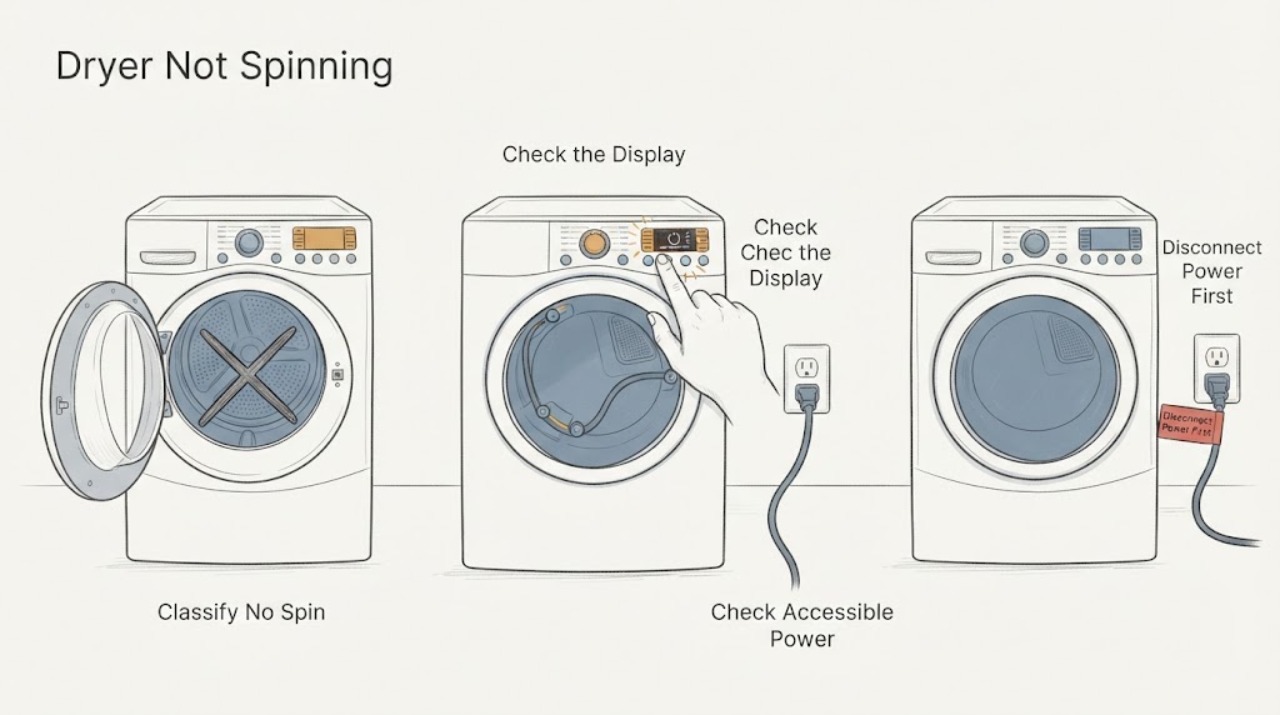
Work through in order
Diagnostic checks
Use only checks that match the exact appliance or system and its official guide.
-
Check 1
With the dryer empty, select the cycle specified by the exact Kenmore manual and start it once while standing clear of the door and drum opening.
Expected result: Record whether the control responds, whether the drum remains still, whether it starts briefly, whether the motor hums or clicks, and whether heat or an odor is present.
Next step: Stop the test for any hazard; otherwise continue with the safe door, control, and supply checks without opening the cabinet.
Stop if: Stop immediately for smoke, burning or gas odor, sparks, a hot cabinet, repeated breaker trips, a loose drum, or a loud grinding or scraping sound.
Why this matters
Why: A silent no-start, a hum with no movement, a brief start-and-stop, and a scraping or thumping drum represent different control, motor, belt, or support paths. Heat with a stationary drum increases the urgency because the load is not being moved through the air path.
-
Check 2
Turn the dryer off and check that the door closes squarely and latches without forcing; verify the chosen cycle, Start control, and any pause or wrinkle feature using ordinary front-panel access.
Expected result: Note whether the door springs open, the latch or strike is loose or damaged, the display or timer changes, the Start control responds, or a model-specific indicator shows pause, delay, or an error.
Next step: Correct only the selected control or a plainly misclosed door; use the exact manual for an indicator or error and arrange service for a damaged latch, strike, or unresponsive control.
Stop if: Do not defeat the door switch, tape the door shut for operation, insert tools into the latch, or continue with a cracked door or damaged strike.
Why this matters
Why: A door that cannot close or a cycle that is paused can prevent the motor from being enabled. A secure door and responsive controls with a stationary drum shift the fault toward power, the motor circuit, or a mechanical drive problem.
-
Check 3
Without moving the dryer or removing a cover, check the accessible plug, cord, and household breaker or fuse that serves the Kenmore dryer.
Expected result: Record whether the plug is secure, the cord or outlet shows heat or damage, the control display has power, and the breaker or fuse is open or trips again.
Next step: Restore a safe connection or reset a breaker only once if there is no hazard; if it opens again or the cord is damaged, leave the dryer off and arrange qualified electrical or appliance service.
Stop if: Do not test live voltage, use an extension lead, touch exposed conductors, open the terminal area, or continue after sparking, odor, heat, or repeated trips.
Why this matters
Why: A no-power condition can explain a still drum, while controls that light but a drum that will not start may still have a motor, drive, or internal supply fault. A recurring breaker is a safety fault, not a reason to keep restarting the dryer.
-
Check 4
With the dryer unplugged and fully cool, observe the drum through the open door and gently rotate it only as far as ordinary access allows, without tools, panels, or reaching around internal guards.
Expected result: Note whether the drum turns smoothly with light hand pressure, binds at one point, feels unusually loose, scrapes, or has a foreign object visible at the door opening.
Next step: Remove only a plainly accessible loose item without reaching into the mechanism; otherwise provide the observation and model number to qualified service.
Stop if: Stop if the drum is hot, sharp metal is exposed, the drum is unstable, rotation requires force, a belt or pulley is visible only through an opening, or panel removal would be needed.
Why this matters
Why: A smooth drum with no motor response keeps controls, door sensing, motor, and belt diagnosis active. Binding, scraping, severe looseness, or an object that cannot be removed without disassembly supports a mechanical service call and continued shutdown.
-
Check 5
From outside the cabinet, compare the sound and timing of one safe start attempt with the dryer empty; do not repeat the attempt if the drum remains stationary or a hazard appears.
Expected result: Record a click with no motor sound, a motor hum, a brief turn followed by a stop, a belt-like slapping sound, scraping, or silence with normal controls.
Next step: Stop operating the dryer and give service the sound, timing, drum feel, load condition, and whether heat was present; do not run repeated cycles to confirm the same symptom.
Stop if: Stop for any grinding, burning odor, smoke, hot cabinet, gas odor, abnormal vibration, or a breaker trip.
Why this matters
Why: These observations help service separate door or control enablement, motor overload, belt or idler failure, drum support wear, and a control or supply issue, but they do not identify a replaceable part by sound alone.
-
Check 6
Find the full Kenmore model number and compare the dryer type, control behavior, door condition, drum observation, and sound with the exact manual before requesting service.
Expected result: Record whether the dryer is electric or gas, front-load or compact or stacked, the selected cycle, whether the drum ever moved, whether heat was present, any displayed code, and all safety symptoms.
Next step: Provide the full record to qualified appliance service and request diagnosis of the door sensing, controls, motor, belt, idler, rollers, drum support, and supply as applicable.
Stop if: Stop all further troubleshooting if the manual calls for panel access, live testing, gas work, bypassing a safety device, or a procedure outside ordinary safe access.
Why this matters
Why: Kenmore has multiple dryer families and configurations. The model number determines the correct drive layout, access boundary, diagnostic procedure, and compatible service information; a generic belt or motor assumption is unsafe.
Use your observations
Decision map
Find the observation that best matches what you see, then follow the next safe action.
-
PATH 01Next step
What you see
The door does not latch or the cycle is paused or not actually started.
Do this next
Correct only the ordinary control or door-closing condition described by the exact manual. Do not bypass the door switch or tape the door closed for operation.
-
PATH 02Next step
What you see
The dryer has no power, a damaged cord, an open breaker, or a breaker that trips again.
Do this next
Leave the dryer off and arrange qualified electrical or appliance service; do not keep resetting the breaker or test exposed wiring.
-
PATH 03Next step
What you see
The unplugged, cool drum binds, scrapes, is unusually loose, or needs force to turn.
Do this next
Keep the dryer off and request mechanical service for the drum support, rollers, idler, belt, motor, or a foreign object that is not safely accessible.
-
PATH 04Next step
What you see
The motor hums, the drum turns briefly then stops, or a slapping or grinding sound occurs.
Do this next
Stop further tests and provide the sound and timing to qualified service; do not run repeated cycles or open the cabinet to inspect the drive.
-
PATH 05Next step
What you see
The dryer produces heat while the drum remains stationary.
Do this next
Leave it off immediately and arrange service because stationary fabric can overheat; do not bypass a door or thermal safety device.
-
PATH 06Next step
What you see
The external checks are inconclusive or the dryer has a compact, stacked, gas, or other model-specific configuration.
Do this next
Use the exact Kenmore manual and provide the full model number to qualified service rather than applying a generic drive procedure.
Helpful context
Understand the symptom
Separate a control or door condition from a mechanical no-spin fault
Notice whether the drum is completely still, starts briefly and stops, turns with a scraping or thumping sound, or turns only when empty. Check whether the timer or electronic control is actually running and whether the door closes fully. A completely quiet dryer points first to power, controls, door sensing, or the motor circuit; a hum or brief movement points toward a mechanical or motor-load branch. Do not continue a test when the cabinet heats, an odor appears, or the drum binds.
Use the model manual before touching the drum or vent area
Kenmore manuals are retrieved by the appliance model number and cover dryers and their parts and accessories. The manual can distinguish front-load, compact, stacked, electric, and gas configurations and can state which exterior checks are permitted. Disconnecting a belt, removing a panel, reaching past a baffle, or testing a motor requires qualified service unless the exact manual and local safety conditions support a trained repair procedure.
Treat a stationary drum as a safety issue when the dryer still heats
A drum that does not turn can leave heat concentrated in one place and can expose fabric to overheating. Do not keep restarting the dryer to see whether it catches, and do not bypass the door switch or any thermal protection. If the dryer is hot, smells of burning, shows smoke, trips a breaker, or has a gas odor, leave it off, isolate only the accessible supply if safe, and arrange qualified service.
Only after diagnosis
Potential parts
- dryer door latch or strike
Consider this category only if inspection confirms a damaged latch or strike that prevents the door from closing and the exact model manual or qualified diagnosis identifies replacement.
Confirm the full model number and the manufacturer's fit information; never bypass the door switch to compensate for a mismatch. - dryer drive belt or idler
Consider this category only after qualified diagnosis confirms a worn, broken, or displaced drive component and the exact model layout supports it.
Confirm the exact model and drive configuration before ordering; belt or idler replacement requires safe cabinet access and correct routing. - dryer drum support roller
Consider this category only if qualified diagnosis confirms binding, scraping, or support wear at a drum roller on the exact model.
Use the full model number and professional diagnosis; do not infer roller failure from a stationary drum alone.
When checks do not resolve it
Need a professional?
Arrange qualified appliance service when the door and controls are normal but the drum remains still, when the motor hums or the drum binds, when it starts and stops, when heat is present without drum movement, or when panel access or live testing would be required. Leave the dryer off for smoke, burning or gas odor, sparks, a hot cabinet, abnormal grinding, a damaged cord, or a repeatedly tripping breaker.
Safety scope: This guide is limited to ordinary controls, door closure, accessible supply checks, and a cool unplugged observation through the door. Do not open panels, reach into the drive, test live voltage, bypass the door switch or thermal protection, perform gas work, or keep operating a dryer whose drum is stationary.
Common questions
FAQ
Why does my Kenmore dryer turn on but the drum does not spin?
Check that the door latches and the cycle actually starts, then check accessible power and observe the cool unplugged drum without opening the cabinet. A hum, binding, scraping, or heat with no drum movement needs qualified service.
Can I keep running a Kenmore dryer if the drum is not turning?
No. Leave it off, especially if it produces heat, because stationary fabric can overheat and a drive fault can worsen. Arrange service when the safe door, control, and supply checks do not restore rotation.
Could a broken belt stop a Kenmore dryer from spinning?
A belt is one possible cause, but a door sensor, control, motor, idler, roller, drum support, or supply issue can look similar. Use the full model number and qualified diagnosis before considering a drive part.
Are Kenmore dryer parts the same across all models?
No. Kenmore has multiple electric and gas dryer families and configurations. Use the exact model manual and model number before selecting a part or following an access procedure.
Read the exact guide
Official sources
- Dryers | Laundry | KenmoreKenmore · Supports distinguishing Kenmore electric and gas dryer families and routing to model-specific support.
- Find Your Manual | Kenmore Appliance Manuals & GuidesKenmore · Supports obtaining the exact dryer manual before controls, access, maintenance, or part decisions.
- Customer Care & Support | Kenmore AppliancesKenmore · Supports routing an unresolved no-spin fault to model-specific Kenmore repair and support resources.
Community feedback
Share a repair observation
Share a plain-text repair observation. Accepted observations are published automatically; this page may take a moment to update.