
On this page
Start here
Quick answer
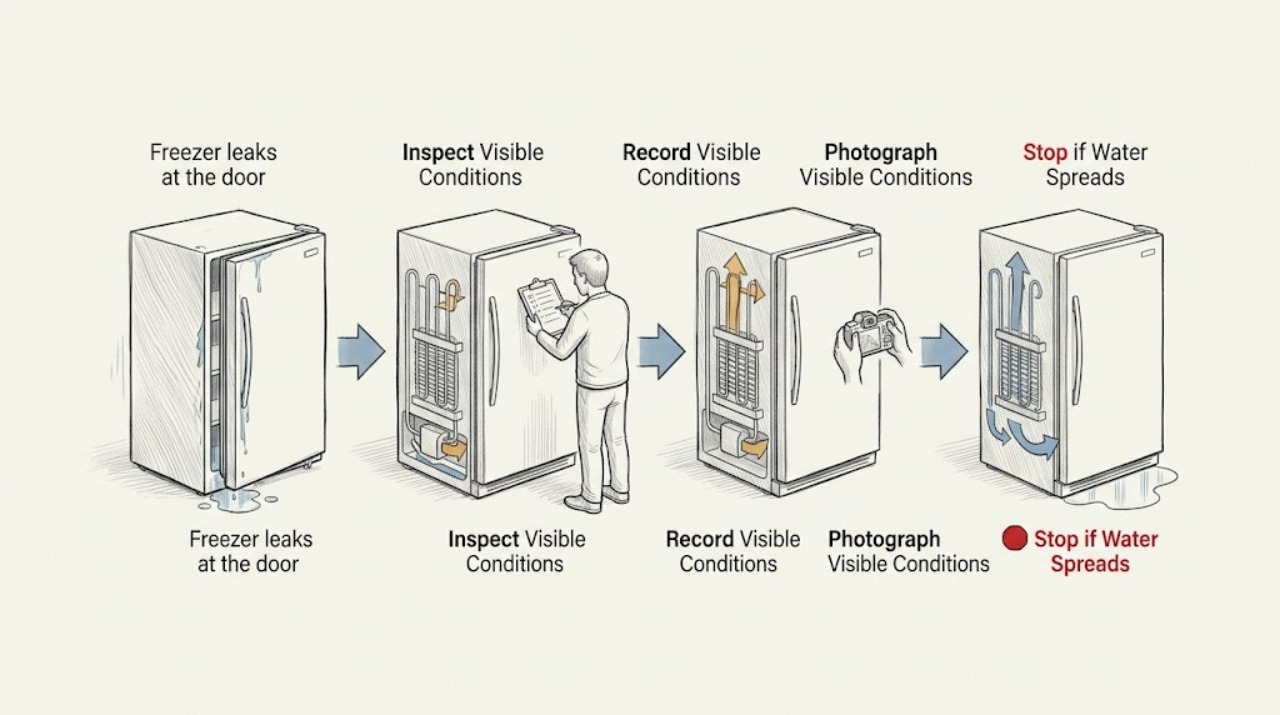
Treat the Kenmore 970-448731 as both a water-leak and food-safety problem, not as a gasket replacement request alone. The available Canadian owner report identifies 970-448731 as the freezer number from an older Sears Canada Kenmore Elite pair and describes water at the bottom of the door gasket with a freezer that could not reach its expected temperature; it also only speculates about a Frigidaire relationship, so that platform is not verified for parts. Keep the door closed as much as practical, protect the floor and nearby electrical area, measure the freezer with an appliance thermometer, and inspect only the visible gasket, door closure, frost pattern, and leak path. Do not use heat to reshape the seal, poke a drain, remove the gasket or door, pull the appliance out, or order a cross-platform part. Move or discard food according to its measured temperature and arrange service if the freezer is warming, the leak recurs, or the source is not safely visible.
Work through in order
Diagnostic checks
Use only checks that match the exact appliance or system and its official guide.
-
Check 1
Keep the freezer door closed except for brief checks, place towels on the floor, and from a dry position look for water approaching the cord, receptacle, controls, or cabinet base. Disconnect power only if the plug and surrounding area are dry and safely reachable.
Expected result: Water is actively spreading, reaches an electrical area, or the plug/outlet is wet, damaged, hot, or discolored.
Next step: Stop using the freezer, keep clear of wet electrical parts, isolate power only from a dry safe position, and arrange qualified appliance or electrical service. Do not pull or tip the loaded unit.
Why this matters
Why: Water near electricity is a safety boundary rather than a reason to continue locating the leak. An active uncontrolled leak can also damage flooring and the cabinet base.
-
Check 2
Place an appliance thermometer in a stable spot in the freezer and record the temperature without repeatedly opening the door. Record whether food still has ice crystals, is hard frozen, or is softening.
Expected result: The freezer is at or below -18 C (0 F), above that target but food remains frozen, or food is softening and the temperature is rising.
Next step: Keep the door shut and transfer vulnerable food to a known-safe freezer or cooler when needed. Do not taste food to decide whether it is safe; follow Canadian food-safety guidance and arrange service for warming temperatures.
Why this matters
Why: Health Canada identifies -18 C (0 F) or lower as the freezer target. A warm or rising freezer changes the priority from a cosmetic gasket issue to food protection and cooling diagnosis; the display setting alone does not prove the food compartment is cold enough.
-
Check 3
With the door open only briefly, photograph and map where water begins: directly at the lower gasket, along the front edge, on the freezer floor, beneath the cabinet, or at the rear. Note whether it follows a defrost event or continues between events.
Expected result: Water starts at the door perimeter, pools on the freezer floor, appears under the cabinet, or is wet at the rear; it is a one-time puddle or is returning.
Next step: Keep the freezer off if it is warming or the leak is active, and provide the photos and timing to service. Do not poke, drill, or flush a drain and do not remove a cover to follow the water.
Why this matters
Why: A perimeter trail makes door closure or humid-air entry more likely; floor or rear water keeps defrost drainage, a pan, or a concealed connection in the decision. Recurrence is more concerning than a one-time spill and cannot be resolved by guessing from the first puddle.
-
Check 4
Inspect the visible gasket and the cabinet surface it contacts. Look for a torn, hardened, folded, dirty, or visibly uneven section, a package holding the door open, frost concentrated around one edge, or a door that does not sit square; wipe only with a soft cloth lightly dampened by the manufacturer's approved cleaning method.
Expected result: The gasket is evenly contacting the frame, or there is a gap, residue, damaged section, door obstruction, or perimeter frost.
Next step: Remove only an accessible obstruction and let the door close normally. Arrange service for a damaged or persistently gapped seal, and do not use hot air, silicone, adhesive, a tool, or a gasket-removal attempt to reshape it.
Why this matters
Why: Frigidaire's refrigerator guidance says a dirty gasket can prevent full closure, and its frost guidance links a warped gasket or door with a poor seal and frost. Those general relationships support the branch but do not establish a compatible Frigidaire part for this Kenmore.
-
Check 5
Look through the compartment for a heavy frost sheet on the rear wall, frost only around the door edge, blocked visible air passages, or food packages pressing against the door or vents. Do not remove an interior panel, scrape ice, or reach into a fan or drain opening.
Expected result: Frost is concentrated around the gasket, covers much of the rear wall, blocks airflow, or there is little frost while the measured temperature is high.
Next step: Keep food protected and arrange qualified appliance service for heavy frost, weak cooling, or any pattern requiring panel access. Do not scrape, puncture, or manually thaw with a heat gun, hair dryer, open flame, or boiling water.
Why this matters
Why: Perimeter frost favors warm humid air entering through the closure path; a broad rear-wall frost pattern can restrict airflow and points toward a defrost-system path. Little frost with poor measured cooling leaves a sealed-system, control, compressor, or other internal cause possible, so sound or frost alone cannot name a part.
-
Check 6
Read the appliance label and write the complete model exactly as printed, including punctuation or suffixes, then compare it with the 970-448731 identity reported for the older Canadian Kenmore freezer. Do not infer that the unit is Frigidaire merely because its external design or number resembles one.
Expected result: The label confirms 970-448731, shows a different suffix, or is unreadable/incomplete.
Next step: Photograph the label and give the full identity to Kenmore/Sears service. Until the platform and fit are confirmed, do not order a gasket, drain part, or Frigidaire replacement by cross-reference.
Why this matters
Why: Kenmore's official manual page requires the complete model number for the correct manual and support material. A different or incomplete label prevents safe model-specific gasket, drain, defrost, or cooling instructions.
-
Check 7
Prepare a service record with the model label, measured temperature and time, food condition, leak location and recurrence, gasket photographs, frost pattern, door-closure result, and whether the unit has an ice maker or water line. Keep the freezer in place for the visit.
Expected result: The record separates a door-perimeter leak from a floor/rear leak and records whether cooling is actually below the food-safety target.
Next step: Arrange qualified Kenmore appliance service. Escalate promptly if temperatures continue to rise, food is softening, water returns, or diagnosis requires moving the unit, opening a panel, accessing a drain, or touching sealed-system components.
Why this matters
Why: This evidence lets a technician distinguish gasket air leakage, defrost drainage, pan or tubing, blocked airflow, and an internal cooling problem without using a speculative platform or replacing a part as a test.
Use your observations
Decision map
Find the observation that best matches what you see, then follow the next safe action.
-
PATH 01Next step
What you see
Water starts at the door perimeter, frost is concentrated around the opening, and the gasket has a gap, fold, residue, or damaged section.
Do this next
Remove only a visible obstruction, keep the door closed, and arrange service for a persistent gap or damaged gasket. Do not heat, remove, or replace the seal without exact fitment and cause confirmation.
Why this path and its safety boundary
Why it matters: Warm humid air entering through the closure path is more likely contributing to frost, meltwater, and weak cooling, but the gasket may not be the only cause if the door or hinge is misaligned.
-
PATH 02Next step
What you see
Water is on the freezer floor or under the cabinet, the interior shows a broad frost pattern, or water returns after it is wiped away.
Do this next
Protect food and flooring and arrange appliance service. Do not poke the drain, remove panels, use heat to force a thaw, or move the loaded freezer.
Why this path and its safety boundary
Why it matters: Defrost drainage, pan or tube routing, or an internal defrost/airflow issue becomes more likely than a door gasket alone.
-
PATH 03Next step
What you see
The measured freezer temperature is above -18 C (0 F), food is softening, or the freezer cannot recover while the gasket appears to contact evenly.
Do this next
Transfer vulnerable food using Canadian food-safety guidance and arrange qualified cooling service. Do not touch the compressor, probe live circuits, add refrigerant, or order a cooling part by guesswork.
Why this path and its safety boundary
Why it matters: The report is not adequately explained by a visible gasket gap. Restricted airflow, defrost, control, compressor, or sealed-system conditions remain possible and cannot be selected from a symptom or a suspected Frigidaire cross-reference.
-
PATH 04Next step
What you see
The exact label is not 970-448731, is incomplete, or the suspected Frigidaire platform cannot be verified from the label and model-specific manual.
Do this next
Use the complete label identity for Kenmore support or a technician and stay with the safe temperature, leak-location, and visible-closure observations above. Do not cross-order parts.
Why this path and its safety boundary
Why it matters: Model-specific gasket, defrost, drain, and cooling instructions are not safely established; the owner report's Frigidaire suggestion is not proof of interchangeability.
Helpful context
Understand the symptom
Do not assume the gasket is the whole fault
A weak door seal can admit humid air, create frost, and leave meltwater near the door. The same water can also come from a defrost drain, pan, or hidden cooling problem. In this older Canadian model, the identity is supported by an exact owner report, but the report only speculates that the unit may resemble a Frigidaire platform. That is enough for symptom-led checks, not for cross-platform parts or repair instructions.
When checks do not resolve it
Need a professional?
Arrange qualified Kenmore appliance service when the freezer is warming, food is softening, the leak recurs, the gasket remains damaged or gapped, water is near electricity, or the source is behind a panel or inside the cabinet.
Have this ready
- Provide the complete label, Canadian-market context, measured temperature, food condition, leak path, frost pattern, door-closure observations, photographs, and any ice-maker or water-line status.
Common questions
FAQ
Is the door gasket definitely the reason this Kenmore is leaking and warm?
No. A poor seal can admit humid air and create frost and meltwater, but the same symptoms can involve defrost drainage, a pan or tube, airflow, or cooling hardware. Measure temperature and map the water path before any part decision.
Can I use hot air to reshape the gasket or push a tool through the drain?
No. Do not heat the seal, poke or drill a drain, scrape ice, or use a tool through an opening. Those actions can damage the liner, tubing, seal, or concealed wiring and do not confirm the platform.
Is 970-448731 definitely a Frigidaire freezer?
The opened Canadian owner report identifies it as an older Sears Canada Kenmore freezer number and speculates about a Frigidaire relationship. That is not enough to establish a platform or compatible part. Use the complete label and model-specific support before ordering anything.
Read the exact guide
Official sources
- Refrigerators / Freezer - Frost Build UpFrigidaire · Generic Frigidaire frost guidance used for symptom-level reasoning only; it does not establish the Kenmore unit's OEM platform or part compatibility
- Kenmore ManualsKenmore · Official Kenmore manual-search page; it requires the complete model number and does not itself display a model-specific manual for 970 448731 in the opened page
- Safe food storageHealth Canada · Government of Canada guidance applicable to food stored in a Canadian home freezer
- Refrigerator Door IssuesFrigidaire · Generic Frigidaire refrigerator guidance used only for the general relationship between a dirty gasket, closure, and door sealing; not evidence that Kenmore 970-448731 is a Frigidaire platform
- Refrigerator Clean and Care GuideFrigidaire · Generic manufacturer cleaning guidance used for a soft-cloth visible gasket check; not a Kenmore 970-448731 manual
- Kenmore Elite Freezer LeakReddit r/appliancerepair · Exact Reddit post naming the older Sears Canada Kenmore freezer number 970-448731 and reporting door-gasket water plus poor cooling; not an official model manual or repair confirmation
Community feedback
Share a repair observation
Share a plain-text repair observation. Accepted observations are published automatically; this page may take a moment to update.