
On this page
Start here
Quick answer
A Kenmore freezer usually develops frost because warm, moist air is entering through a door that is ajar or not sealing, because the door is opened frequently, or because a manual-defrost unit needs defrosting. First note where the frost is concentrated, check the gasket and obstructions, keep packages away from vents, and confirm whether your exact model is manual-defrost or frost-free. If it is a manual-defrost freezer, protect the food and defrost only according to the owner manual; never chip frost with a sharp tool or use an electrical heating device. Frost that rapidly returns, covers the rear wall of a frost-free freezer, or appears with warming temperatures needs qualified service for the door, defrost, airflow, or sealed-system diagnosis.
Before you begin
Safety first
- Keep the door closed if food is warming, disconnect power before any manual-defrost procedure described by the owner manual, and do not open panels or sealed-system tubing.
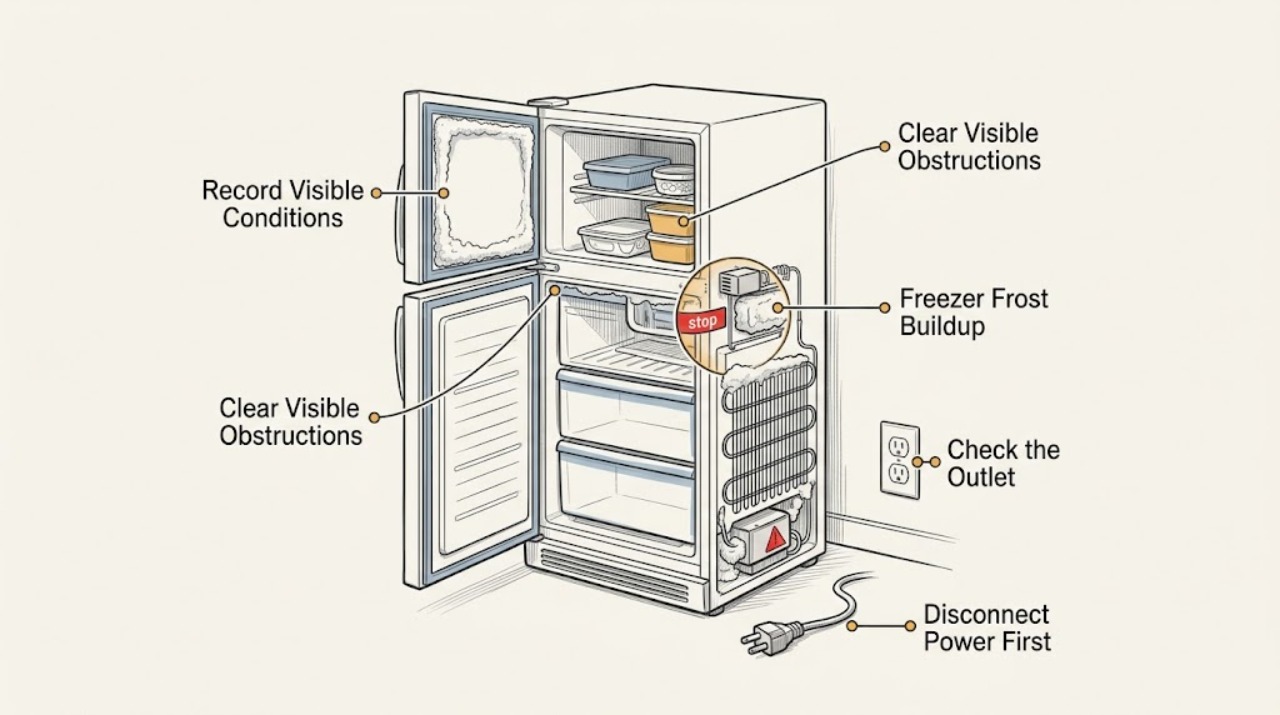
Work through in order
Diagnostic checks
Use only checks that match the exact appliance or system and its official guide.
-
Check 1
With the door closed, note where frost is building: around the gasket and front edge, on the rear interior wall, around vents, or as a solid layer on the floor. Record whether the freezer is still holding food solidly frozen and whether the frost appeared after a door was left open.
Expected result: Frost is localized at the door, widespread on the rear wall or vents, concentrated on the floor, or accompanied by warming food.
Next step: Continue with the door-seal and loading checks before defrosting. If food is warming, keep the door closed and protect the food using food-safety guidance while deciding whether service is needed.
Why this matters
Why: Frost near the opening is consistent with warm humid air entering through a gap or frequent opening. Widespread rear-wall frost can restrict airflow and on a frost-free design may warrant defrost-system diagnosis. Floor ice can be meltwater that refroze, while warming changes the priority to food protection and service.
-
Check 2
Inspect the entire door gasket and the cabinet surface it contacts. Remove crumbs, ice, or packages blocking the door, clean the gasket, and close the door over a sheet of paper so part of the sheet is outside. Pull gently at several points around the perimeter.
Expected result: The paper grips around the seal, or it slides out easily at one or more sections; the gasket is torn, stiff, folded, or pulling away from the cabinet.
Next step: Reposition only an obvious obstruction and clean the sealing surfaces. If the gasket is damaged or the door will not align and close, stop trying to reshape it and arrange service or a model-specific gasket diagnosis.
Why this matters
Why: A loose section or damaged gasket can let warm moist air enter and create recurring frost. A gasket that grips consistently makes a door leak less likely, so continue to check usage, airflow, and defrost design.
-
Check 3
Review how the freezer is being used: keep the door closed as much as practical, dry wet containers before loading, cover liquids and food with moisture-resistant packaging, and move packages away from interior air outlets and returns. Check that the cabinet has the model-specified clearance behind it.
Expected result: Frost began after frequent or long door openings, uncovered moisture, overpacking, or blocked vents; or none of those conditions is present.
Next step: Correct the loading or door-opening condition and monitor the frost pattern with the door closed. If frost keeps returning quickly despite a good seal and clear vents, continue to the manual-versus-frost-free check and arrange service if needed.
Why this matters
Why: Warm humid air and moisture provide the source for frost, while blocked vents prevent cold air from circulating. If usage and airflow are corrected but frost continues, the cause is less likely to be ordinary condensation.
-
Check 4
Find the model number and confirm in the owner manual whether the Kenmore freezer is manual-defrost or frost-free. If it is manual-defrost and the frost is substantial, move food to a suitable cold container, disconnect the unit as the manual directs, and let the frost melt without forcing it.
Expected result: The manual identifies a manual-defrost freezer, a frost-free freezer, or the defrost design cannot be confirmed.
Next step: For a manual-defrost model, complete only the manual’s safe thaw procedure and dry the cabinet before restoring operation. For a frost-free model, do not remove evaporator panels as a user repair; document the frost pattern and request service if it returns.
Why this matters
Why: Manual-defrost freezers are expected to be defrosted periodically; ENERGY STAR advises not allowing frost to build beyond its stated limit. A frost-free model should manage routine defrosting automatically, so recurring heavy frost is more suspicious for a seal, airflow, or defrost fault.
-
Check 5
During a manual defrost, do not use a knife, ice pick, or electrical heating device to remove frost. Keep frozen food cold and the freezer door closed as much as possible; follow the exact owner manual for the approved thawing method and drain handling.
Expected result: Frost melts and the freezer resumes normal cooling, the liner or seal is damaged, or frost returns after a complete manual defrost.
Next step: If cooling returns and frost stays away, maintain the model’s defrost schedule and seal practices. If the liner is damaged, food warms, or frost returns promptly, stop improvising and arrange qualified service.
Why this matters
Why: Sharp tools or unapproved heat can damage the liner or appliance, and warming food can become a food-safety issue. Frost that returns after a proper manual defrost indicates that the moisture source, seal, temperature control, or another condition remains.
-
Check 6
After the safe checks, observe the freezer for a complete cooling cycle without repeatedly opening the door. Record whether the rear wall refreezes, the evaporator airflow is weak, the compressor runs unusually long, the door becomes hard to close, or the temperature rises.
Expected result: Frost remains controlled and food stays frozen, or heavy frost returns with restricted airflow, long running, temperature rise, or a door that no longer closes.
Next step: If the pattern returns on a frost-free model or cooling is not maintained, leave the door closed, protect the food, and arrange qualified appliance service. Do not remove sealed-system tubing or bypass a defrost control.
Why this matters
Why: A stable result supports an air-entry or maintenance cause that was corrected. Recurrent heavy frost with poor airflow or warming is consistent with a fault in the defrost, fan, control, gasket, or sealed system and cannot be identified safely from the frost alone.
Use your observations
Decision map
Find the observation that best matches what you see, then follow the next safe action.
-
PATH 01Next step
What you see
Frost is mainly around the door and the gasket fails the paper check
Do this next
Clear obstructions, clean the sealing surfaces, and arrange a model-specific gasket or door-alignment diagnosis if the seal remains loose.
-
PATH 02Next step
What you see
Frost follows frequent door openings, uncovered moisture, or blocked vents
Do this next
Reduce door-open time, cover and dry food, restore airflow, and monitor the pattern before considering parts.
-
PATH 03Next step
What you see
The freezer is manual-defrost and frost is within the normal maintenance context
Do this next
Defrost it only with the exact owner manual and safe food-handling precautions; do not chip or heat the frost aggressively.
-
PATH 04Next step
What you see
A frost-free freezer rapidly refrosts on the rear wall or vents
Do this next
Request qualified service for the defrost, airflow, control, or door-seal system rather than removing interior panels.
-
PATH 05Next step
What you see
Food is warming, the door will not close, or the liner or gasket is damaged
Do this next
Keep the door closed, protect or evaluate food using food-safety guidance, and arrange prompt service.
Helpful context
Understand the symptom
Frost location is a useful clue
A light rim near the door points toward air entering at the gasket or a door left open. A thick, widespread layer can restrict airflow and may indicate a manual-defrost condition or a frost-free defrost fault. A sheet of ice on the floor is a different symptom from frost on the rear wall, so record the pattern before thawing it.
Do not assume every Kenmore freezer defrosts the same way
Kenmore sells multiple freezer designs. Its official product page describes the Elite 27009 as frost-free, while the exact feature and service access depend on the model. Find the model number and use its manual before removing panels or attempting a defrost procedure.
Safety boundary
Stop conditions
- Stop for a damaged liner, exposed wiring, smoke, a burning odor, a breaker trip, or a compressor or fan condition that sounds unsafe.
- Do not use a knife, ice pick, or electrical heating device to remove frost, and do not bypass a defrost control or open sealed-system tubing.
- Do not repeatedly open a warming freezer; protect the food and use current food-safety guidance to decide what can be kept.
- If heavy frost returns soon after a complete safe defrost, arrange qualified service instead of repeatedly thawing the unit.
Only after diagnosis
Potential parts
- freezer door gasket
Only consider this part class if the gasket fails the perimeter seal check or a technician confirms a torn, hardened, or deformed seal.
Confirm the exact Kenmore model and gasket profile before ordering. - defrost control or sensor
Only consider this class if a technician confirms recurring rear-wall frost on a frost-free design and isolates the defrost control or sensor.
Confirm the exact model and approved component with the manufacturer documentation or technician. - defrost heater
Only consider this part class after a qualified diagnosis finds that the defrost heater is not operating and the cause is not a door seal or airflow restriction.
Confirm the exact Kenmore model and heater configuration before ordering.
When checks do not resolve it
Need a professional?
Call a qualified appliance technician when a frost-free Kenmore freezer rapidly refrosts, the gasket or door is damaged, the freezer warms, airflow is restricted after safe checks, frost returns after a proper manual defrost, or a control, fan, defrost, or sealed-system fault is suspected.
Safety scope: Keep the door closed if food is warming, disconnect power before any manual-defrost procedure described by the owner manual, and do not open panels or sealed-system tubing.
Have this ready
- Kenmore model number
- upright or chest configuration
- manual-defrost or frost-free designation
- where frost is concentrated
- whether the door gasket passed the paper check
- whether airflow, cooling, or food temperature changed
- how soon frost returned after the last safe defrost
Common questions
FAQ
Why does my Kenmore freezer keep building frost?
Start with the door gasket, obstructions, door-open time, moisture, and airflow. If the freezer is frost-free and heavy frost returns on the rear wall, arrange service for a possible defrost or control fault instead of repeatedly thawing it.
How can I tell if a Kenmore freezer door seal is leaking?
Clean the gasket and cabinet contact area, close the door over a sheet of paper, and pull gently at several points. If the paper slides out easily or the gasket is torn or deformed, the seal or door alignment needs attention.
Can I scrape frost out of my Kenmore freezer with a knife?
No. USDA food-safety guidance says not to use a knife, ice pick, other sharp object, or electrical heating device to remove frost. Follow the exact owner manual for your model’s defrost procedure and protect the food while the unit is off.
Does a frost-free Kenmore freezer need to be manually defrosted?
A model advertised as frost-free is designed to manage routine defrosting automatically, but the exact feature depends on the model. If heavy frost returns on a confirmed frost-free unit, check the gasket and airflow, then arrange service rather than removing interior panels.
Read the exact guide
Official sources
- Do refrigerators need defrosting?USDA Food Safety and Inspection Service · Government food-safety guidance for household refrigerator-freezers.
- Food Safety During Power OutageFoodSafety.gov · Government food-safety guidance for freezer temperature loss.
- FreezersENERGY STAR · General residential freezer guidance, not a Kenmore model manual.
- Kenmore Elite 27009 20.5 cu. ft. Upright Freezer - BlackKenmore · This page describes model 27009 only; it is used to show why the exact Kenmore model and defrost design must be confirmed.
- EnergySavers: Tips on Saving Money and Energy at HomeU.S. Department of Energy · General residential freezer maintenance guidance.
- Customer Care & SupportKenmore · Kenmore support page for locating product manuals and repair resources.
Community feedback
Share a repair observation
Share a plain-text repair observation. Accepted observations are published automatically; this page may take a moment to update.