
On this page
Start here
Quick answer
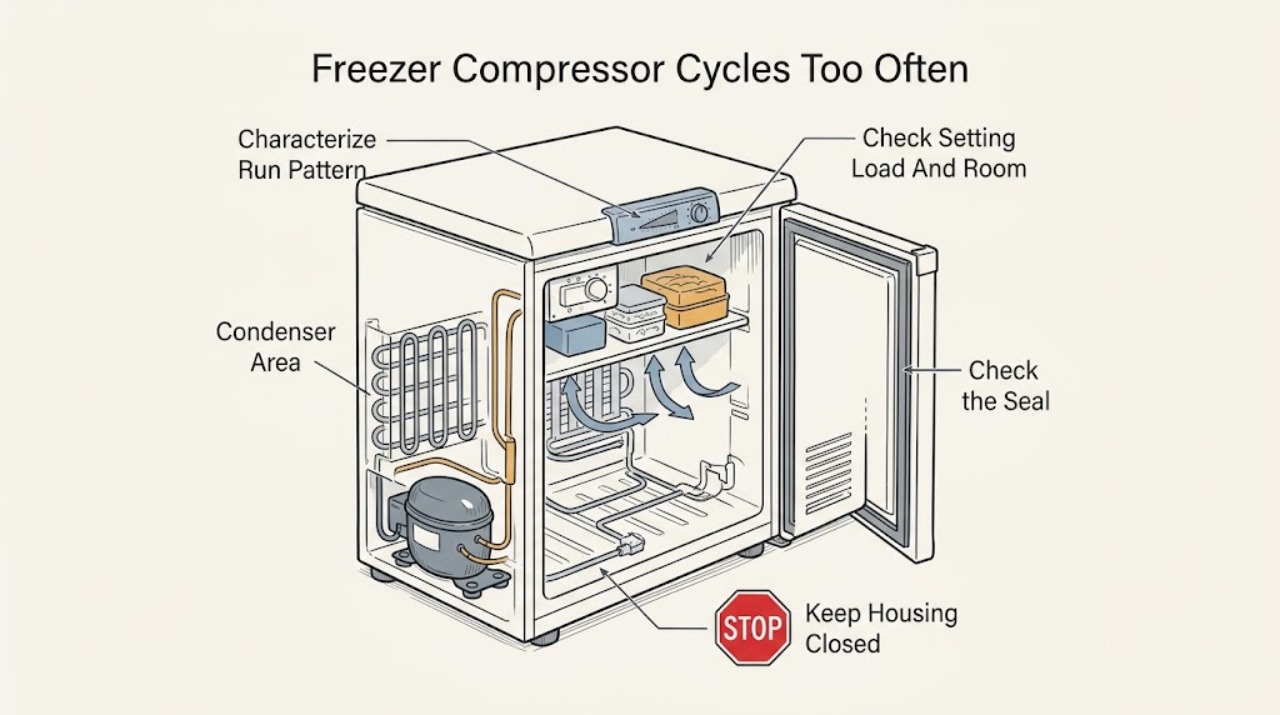
A Kenmore freezer may run more after a large load, long or frequent door openings, a warm room, or a temperature setting that is colder than necessary. First record whether the food stays properly frozen and whether the compressor ever rests, then check the model-specific Kenmore manual for the intended control setting. Make sure packages are not holding the door or lid open, inspect the gasket for gaps, keep interior vents clear, and look for heavy frost that blocks airflow. If the model has accessible condenser coils, clean them only as the manual permits; some upright and chest freezers enclose the coils and do not have user-cleanable coils. A compressor that runs nearly continuously while the freezer remains warm, develops heavy frost, trips power, or makes repeated clicking needs qualified appliance service because defrost, airflow, start, sealed-system, control, and compressor faults can look similar. Do not open the sealed system, test live electrical parts, or replace a compressor based on sound alone.
Before you begin
Safety first
- This article supports ordinary-access observation, model-approved control and loading checks, visible seal and vent inspection, and cleaning only of an accessible condenser area when the manual permits it. Do not open panels or the sealed system, perform live electrical testing, bypass safety devices, chip frost with sharp tools, or continue operation with smoke, sparks, severe heat, or electrical damage.
Work through in order
Diagnostic checks
Use only checks that match the exact appliance or system and its official guide.
-
Check 1
Without touching wiring or refrigerant components, note when the compressor runs, whether it ever rests after the freezer has stabilized, whether the food remains solidly frozen, and whether the complaint began after installation, loading, cleaning, or a power event.
Expected result: Classify the pattern as longer operation after a warm load or open door, frequent starts with normal cooling, nearly continuous running with poor cooling, repeated clicking or failed starts, or an unknown pattern.
Next step: Use the load, setting, door-seal, frost, and condenser checks for a normally cooling freezer; use the service path promptly when cooling is poor, starts fail, or power trips.
Stop if: Stop if there is smoke, an electrical odor, a hot or damaged cord, repeated breaker operation, leaking refrigerant, or a compressor housing that is dangerously hot to approach.
Why this matters
Why: A temporary pull-down or normal cooling cycle is more likely when temperature and food condition are normal. Nearly continuous operation with poor cooling, repeated clicking, or a breaker trip points toward airflow, defrost, start, control, sealed-system, or compressor diagnosis.
-
Check 2
Read the Kenmore model manual and check the temperature control, recent quantity of unfrozen food, frequency of door or lid opening, and surrounding room conditions; make only a small model-approved setting change if the control is clearly colder than intended.
Expected result: Record whether a large warm load was recently added, the door was left open, the freezer is in a warm location, or the control was set colder than the everyday recommendation; also record whether the setting and conditions are already reasonable.
Next step: Close the freezer promptly, avoid adding a large warm load at once, and allow the model's normal stabilization period after a setting change before judging the pattern; arrange service if cooling remains poor or operation remains excessive.
Stop if: Do not repeatedly change the control, use an unapproved cold setting, or continue if food is thawing, the compressor clicks off repeatedly, or the unit becomes abnormally hot.
Why this matters
Why: Warm contents, warm surroundings, extended openings, and an unnecessarily cold setting all increase heat load or run time. If these conditions are absent and the freezer still runs too often, a mechanical, airflow, defrost, or control problem becomes more likely.
-
Check 3
With the door or lid closed normally, inspect the full gasket perimeter, hinge or closing area, and nearby packages for gaps, tears, folds, ice, debris, or anything preventing a complete closure; clean only the accessible sealing surface with a suitable cloth.
Expected result: Record whether the seal contacts the cabinet continuously, whether a package or basket holds the door or lid open, whether the gasket is torn or distorted, and whether the freezer closes but the compressor still runs too often.
Next step: Rearrange packages and remove ordinary debris without forcing the door; replace a gasket only with exact model guidance or have service assess a distorted door, hinge, or seal that does not close properly.
Stop if: Stop if the door is warped, hinges are loose or damaged, the gasket will not seat without force, or correcting the closure would require cabinet disassembly.
Why this matters
Why: A closure obstruction or damaged seal allows warm air in and can make the compressor work overtime. A clean, continuous seal shifts attention to frost, airflow, temperature control, condenser heat rejection, or internal refrigeration faults.
-
Check 4
From ordinary access, look for packages against interior vents and for thick or rapidly returning frost on the freezer wall; do not chip ice with a sharp tool or remove an evaporator cover.
Expected result: Record clear vents and little frost, blocked vents, a broad frost layer, frost concentrated around a door opening, or frost that returns after a permitted defrost.
Next step: Move packages away from vents and follow the Kenmore manual for any approved defrost procedure; arrange service for persistent frost, inaccessible coils, poor cooling, or a need to access the evaporator or defrost system.
Stop if: Do not use a knife, pick, heat gun, open flame, or improvised heater to remove frost, and stop if water could contact electrical parts.
Why this matters
Why: Blocked vents or heavy frost can reduce evaporator airflow and force longer compressor operation while the freezer struggles to maintain temperature. Rapidly returning or broad frost suggests a defrost, air-leak, or airflow fault that ordinary rearranging will not resolve.
-
Check 5
If the Kenmore manual identifies an ordinary-access condenser area, disconnect power as the manual directs and inspect for dust or blocked clearance before cleaning only the accessible surface with an approved soft brush or vacuum attachment; do not remove panels to reach hidden coils.
Expected result: Record whether coils are visibly accessible and dusty, the surrounding clearance is blocked, the design encloses coils in the cabinet, or the compressor still cycles excessively after a permitted cleaning.
Next step: Restore power only after the approved cleaning is complete and the area is clear; observe the next normal cooling period, then call service if the pattern remains or access is not clearly permitted.
Stop if: Do not touch live parts, remove cabinet panels, bend tubing, spray liquid into the compressor area, or clean any coil whose access or method is uncertain.
Why this matters
Why: Dust or blocked clearance at accessible condenser coils can reduce heat rejection and lengthen operation. Enclosed coils, clean coils, or persistent poor cooling shift the diagnosis to airflow, fan, control, sealed-system, or compressor service rather than more cleaning.
-
Check 6
After safe load, setting, sealing, frost, and accessible-coil checks are complete, monitor one normal cooling period without repeatedly adjusting the control or opening the door; stop monitoring if a safety symptom appears.
Expected result: Observe whether the freezer reaches and holds its normal condition with rest periods, runs nearly continuously but remains warm, starts and stops with repeated clicks, shows a warning, or trips power.
Next step: Record the model, cycle pattern, food condition, frost, sounds, and safe-check results and arrange qualified appliance service when the symptom persists or returns.
Stop if: Stop immediately for smoke, sparks, electrical odor, a hot or damaged cord, refrigerant leakage, fire signs, repeated breaker trips, or a compressor that overheats and drops out.
Why this matters
Why: Improvement after correcting a warm load, door leak, blocked vent, or accessible condenser restriction supports that cause. Persistent excessive operation with poor cooling, failed starts, or a warning requires internal or sealed-system diagnosis.
Use your observations
Decision map
Find the observation that best matches what you see, then follow the next safe action.
-
PATH 01Safety boundary
What you see
The compressor runs longer after a large warm load, prolonged opening, recent installation, or a warm room, but the freezer returns to normal cold operation and later rests.
Do this next
Keep openings brief, avoid adding a large warm load all at once, follow the Kenmore manual's operating guidance, and reassess only after the freezer has stabilized.
Why this path and its safety boundary
Why it matters: The added heat load or surrounding condition is more likely than a failed compressor.
Safety stop: Arrange service if the freezer never recovers, food softens, or the compressor remains continuous after the temporary condition ends.
-
PATH 02Safety boundary
What you see
Food remains properly frozen and the unit eventually rests, but the compressor seems to cycle more often after a colder control setting or a change in room conditions.
Do this next
Check the exact model guidance, return to the intended everyday setting if needed, keep clearance and sealing conditions normal, and observe after stabilization rather than making repeated adjustments.
Why this path and its safety boundary
Why it matters: The control setting, ambient heat, or normal load response may account for the run pattern; the compressor is not established as defective by sound alone.
Safety stop: Call service if cooling becomes uneven, the compressor clicks repeatedly, the cabinet overheats, or the run pattern persists with no environmental explanation.
-
PATH 03Safety boundary
What you see
A package, debris, damaged gasket, door alignment problem, or lid obstruction leaves a visible gap or prevents the freezer from closing fully, and frost or warmth appears near that area.
Do this next
Remove only the ordinary obstruction, clean and reseat the visible seal as the manual permits, and have a technician assess a damaged gasket, hinge, or door alignment that does not close normally.
Why this path and its safety boundary
Why it matters: Warm-air infiltration is a plausible reason for the compressor to run longer or more often.
Safety stop: Do not force the door, stretch the gasket, or remove hinge or cabinet parts to make it seal.
-
PATH 04Safety boundary
What you see
Interior vents are blocked or a thick frost layer covers the wall or returns quickly, while the freezer struggles to hold temperature.
Do this next
Clear ordinary package obstructions and follow the model manual for an approved defrost; arrange service if frost is persistent, broad, or requires evaporator-cover or defrost-system access.
Why this path and its safety boundary
Why it matters: Airflow restriction, a door leak, or a defrost fault can make the compressor work continuously; frost pattern alone does not identify the failed part.
Safety stop: Do not chip frost with sharp tools, apply flame or improvised heat, or continue if meltwater could reach electrical parts.
-
PATH 05Safety boundary
What you see
The compressor runs nearly continuously but the freezer remains warm or unevenly cold after the door, load, setting, frost, and accessible condenser checks are normal.
Do this next
Stop experimenting and arrange qualified appliance service; provide the model, temperature or food condition, frost pattern, sounds, and all safe-check results.
Why this path and its safety boundary
Why it matters: A fan, control, defrost, sealed-system, refrigerant, or compressor problem is more likely than a simple temperature adjustment.
Safety stop: Do not open the sealed system, add refrigerant, test live start components, or replace the compressor without model-specific diagnosis.
-
PATH 06Safety boundary
What you see
The compressor clicks and drops out, repeatedly attempts to start, trips the breaker, produces an electrical odor, or the freezer loses power while cooling is poor.
Do this next
Leave the freezer off for electrical damage or repeated breaker operation and arrange electrician or qualified appliance assessment as appropriate.
Why this path and its safety boundary
Why it matters: A start device, control, wiring, compressor, or household supply fault may be present and repeated resets can create a hazard.
Safety stop: Do not repeatedly reset the breaker, bypass a start or thermal device, use an extension cord as a workaround, or touch exposed conductors.
Helpful context
Understand the symptom
Decide whether the run pattern is actually abnormal
A compressor may run longer while a freezer pulls down after installation, a large amount of unfrozen food is added, the door has been open, or the room is unusually warm. The useful distinction is whether the freezer reaches and holds its normal setpoint, whether the compressor gets any rest after conditions stabilize, and whether the food remains frozen. Use the exact Kenmore model manual because Kenmore freezer designs and controls are not identical.
Warm air enters through loading and sealing problems
A door bin, package, basket, debris, or a distorted gasket can leave a small opening that is hard to see. Warm humid air then enters continuously, causing longer cooling runs and sometimes frost around the opening. Keep packages away from vents and the seal, close the door or lid promptly, and inspect the entire gasket without pulling it out or forcing the door into alignment.
Frost and condenser access change the next safe check
Heavy frost on an interior wall can obstruct vents and the evaporator coil, while dirty accessible condenser coils can reduce heat rejection. Do not assume every Kenmore freezer has exposed coils: some chest and upright designs enclose them in the cabinet. Clear only ordinary obstructions and clean only an accessible condenser area using the model instructions. Defrost-system access, sealed refrigeration work, and hidden coil diagnosis belong to a qualified technician.
Frequent cycling with poor cooling is a service symptom
If the compressor starts and stops repeatedly without restoring temperature, clicks and drops out, runs almost continuously while the freezer stays warm, or causes a breaker to trip, stop treating it as a simple setting issue. A start device, control, fan, defrost fault, sealed-system restriction or leak, or compressor problem can produce overlapping symptoms. Record the model, temperatures or food condition, frost pattern, sounds, and the result of safe checks for the technician.
Safety boundary
Stop conditions
- Stop using the freezer for smoke, sparks, electrical odor, a hot or damaged cord or outlet, repeated breaker trips, fire signs, or a compressor that overheats and drops out; arrange urgent qualified help.
- Do not open the sealed refrigeration system, add or release refrigerant, bend refrigerant tubing, or diagnose a compressor with live electrical measurements.
- Do not chip frost with a knife or pick, apply an open flame or improvised heater, or use water where it can reach electrical parts.
- Do not remove cabinet or evaporator panels, bypass a thermal or start safety, or force a door, lid, hinge, or gasket into alignment.
- Stop and arrange qualified appliance service when long or frequent operation persists with poor cooling, frost returns, starts fail, a warning appears, or the cause requires internal access.
Only after diagnosis
Potential parts
- freezer door gasket
Consider this category only if inspection confirms a torn, distorted, or non-sealing gasket after ordinary obstructions are removed and the exact model requires gasket replacement.
Confirm the full Kenmore model and gasket profile with the manual or technician; do not force the door or substitute a seal that does not contact the cabinet continuously. - defrost system component
Consider this category only when persistent frost blocks airflow and a qualified technician confirms a defrost heater, sensor, timer, or control fault after door sealing and airflow causes are assessed.
Confirm the exact Kenmore model and the diagnosed defrost component; do not replace or bypass a heater, sensor, timer, or thermal safety based on frost alone. - compressor start device
Consider this category only when repeated clicking or failed starts lead a qualified technician to confirm a start-device fault rather than a supply, control, or compressor problem.
Confirm the full model, compressor specification, connector arrangement, and approved part information; do not test live terminals or substitute a generic start device. - compressor or sealed-system component
Consider this category only after safe airflow, frost, door-seal, temperature-control, and start checks are complete and a qualified sealed-system technician confirms the diagnosis.
Confirm the exact model and refrigerant or sealed-system specification with the technician; sealed-system work is not an ordinary user repair and must not be inferred from run time alone.
When checks do not resolve it
Need a professional?
Arrange qualified appliance service when the Kenmore freezer runs nearly continuously while warm, frequent starts continue after safe load, setting, seal, frost, and accessible-coil checks, the compressor clicks or fails to start, frost returns, or an internal fan, defrost, control, sealed-system, or compressor fault is possible. Use an electrician for a damaged cord, outlet, breaker, or household supply. Seek urgent help for smoke, sparks, burning or electrical odor, severe heat, refrigerant leakage, or fire signs.
Safety scope: This article supports ordinary-access observation, model-approved control and loading checks, visible seal and vent inspection, and cleaning only of an accessible condenser area when the manual permits it. Do not open panels or the sealed system, perform live electrical testing, bypass safety devices, chip frost with sharp tools, or continue operation with smoke, sparks, severe heat, or electrical damage.
Common questions
FAQ
Is it normal for a Kenmore freezer compressor to run often?
It can run longer after a warm load, a long door opening, a warm room, or a colder setting. The key question is whether the freezer reaches and holds its normal cold condition and eventually rests. If it stays warm, clicks repeatedly, or runs continuously after conditions stabilize, arrange service.
Can a Kenmore freezer door gasket make the compressor cycle too often?
Yes. A torn, folded, dirty, or poorly contacting gasket can let warm air in. Check the full seal and make sure packages, baskets, debris, or ice are not holding the door or lid open. Do not force the door or remove the gasket without model-specific guidance.
Can a colder temperature setting make the freezer run more?
Yes. Manufacturer freezer guidance says a colder-than-needed control setting can lengthen operation. Use the exact Kenmore manual, make only a small approved adjustment, and allow the freezer to stabilize before judging the result rather than changing the control repeatedly.
Does heavy frost cause a Kenmore freezer compressor to run too often?
Heavy frost can block vents or the evaporator airflow and make the freezer work harder. Clear only ordinary package obstructions and follow the Kenmore manual for any approved defrost. Do not chip frost with sharp tools or remove an evaporator cover; persistent or returning frost needs service.
Should I clean the condenser coils on my Kenmore freezer?
Only if the exact model manual identifies an accessible condenser area and permits cleaning. Some chest and upright freezers enclose the coils in the cabinet. Disconnect power as directed before approved cleaning, and do not remove panels or spray liquid into the compressor area.
When does frequent Kenmore freezer compressor cycling need a technician?
Arrange service when the freezer stays warm, the compressor runs nearly continuously, clicking or failed starts recur, power trips, frost returns, or safe load, setting, seal, vent, and accessible-coil checks do not help. Smoke, sparks, electrical odor, severe heat, refrigerant leakage, or fire signs require immediate stop and urgent qualified help.
Read the exact guide
Official sources
- 7 Freezer Problems & How to Help Fix ThemWhirlpool · Manufacturer troubleshooting guidance for freezer systems; use the installed Kenmore model manual for model-specific access and controls.
- Find Your Manual | Kenmore Appliance Manuals & GuidesKenmore · Kenmore's official manual portal; the exact freezer model manual controls its temperature controls, access, cleaning, and defrost procedures.
- Motor or Compressor Runs Too Much - Chest FreezerWhirlpool · Manufacturer product-help guidance for chest freezers; the operating principles are useful for diagnosis, but the Kenmore model manual controls the particular appliance.
Community feedback
Share a repair observation
Share a plain-text repair observation. Accepted observations are published automatically; this page may take a moment to update.