
On this page
Start here
Quick answer
A musty smell in a Kenmore freezer is first a food, spill, moisture, or mold-source question, not proof of a failed compressor. Keep food cold while you inspect, remove questionable packages without tasting them, and locate whether the odor is inside the liner, at the gasket, or behind/under the appliance. After transferring food safely, disconnect power as directed by the exact Kenmore manual, clean hard surfaces with detergent and water, and dry them completely. If the odor returns with visible moisture or mold, the freezer is warming, or the smell is chemical, burning, or electrical, stop using it and arrange qualified service.
Before you begin
Safety first
- Do not taste questionable food, spray chemicals into vents or controls, remove sealed-system or rear panels, run a warming freezer to test it, or treat a chemical/burning odor as a cleaning problem.
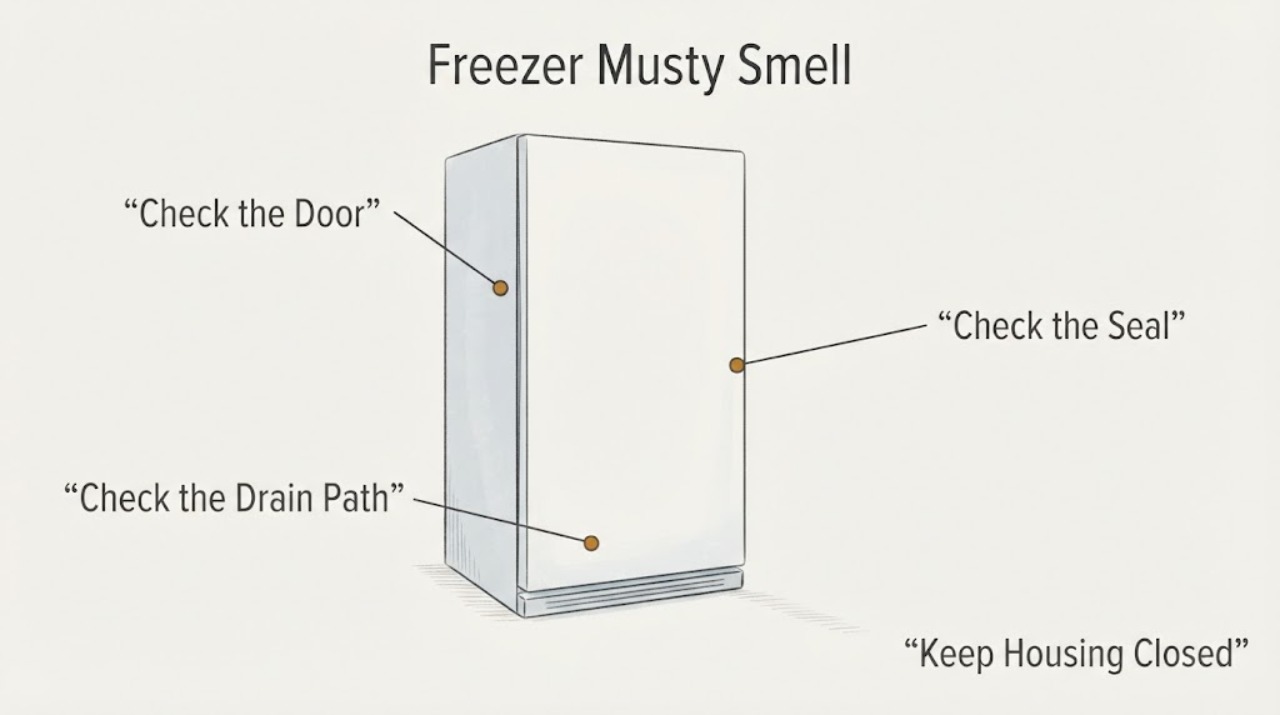
Work through in order
Diagnostic checks
Use only checks that match the exact appliance or system and its official guide.
-
Check 1
Keep the freezer door closed while you arrange a safe place for the food, and stop using or handling the unit if the smell is burning, chemical, or electrical rather than musty.
Expected result: The freezer thermometer is at or below 0°F, food remains frozen, the freezer is warming or thawing, or the odor is accompanied by smoke, heat, sparking, or a chemical smell.
Next step: Move food to a safe cold location without prolonged door opening. Discard food that is thawed or questionable under FoodSafety.gov guidance, and keep the appliance off for qualified service when the odor is hazardous or cooling is failing.
Why this matters
Why: A musty cabinet odor allows a cleaning decision, but warming food or an electrical/chemical odor changes the problem to food safety or appliance safety. Odor alone cannot establish that food is safe.
-
Check 2
With the door opened only as needed, isolate the odor source by checking sealed packages, spilled food, ice containers, the liner and gasket, and the visible floor or base around the freezer.
Expected result: The smell follows one package or spill, is strongest at the gasket or a damp liner, or is strongest behind/under the appliance or in an inaccessible cavity.
Next step: Remove the identified food source and continue only with accessible cleaning. Do not remove rear or interior panels to chase the smell; use the exact model manual and service path if the source is inaccessible.
Why this matters
Why: A package or accessible residue supports a cleanable food source. Dampness supports a moisture/mold source. An odor behind a panel or under the cabinet is not proof of a particular fan, drain, compressor, or refrigerant fault.
-
Check 3
After food is protected and the exact manual permits cleaning, disconnect power, clean accessible hard surfaces and the gasket with detergent and water, and dry every surface completely before restoring power.
Expected result: The odor fades after cleaning and drying, visible growth remains in a hard-to-reach area, or moisture returns after the surface was dried.
Next step: If the source is accessible and gone, keep the interior dry and monitor. If growth is inaccessible or moisture returns, keep the unit out of service and arrange qualified appliance or water-damage/mold help as appropriate.
Why this matters
Why: A fading odor supports an accessible residue or moisture source. Persistent growth or recurring moisture means the moisture source has not been controlled and should not be covered with deodorizer.
-
Check 4
Find and record the complete Kenmore model number, then use Kenmore's official manual portal for the model-specific defrost, drain, seal, air-filter, and cleaning instructions before touching any covered area.
Expected result: The model number is available and the manual identifies user-accessible parts, or the model remains unknown or the odor is in a sealed/inaccessible area.
Next step: Follow only the matching manual's external instructions. If no user-accessible procedure covers the odor, give the model, temperature history, moisture location, and cleaning result to qualified service.
Why this matters
Why: Kenmore directs owners to retrieve manuals by model number, and freezer layouts differ. A generic drain, defrost, or filter procedure cannot be assumed for an unidentified unit.
Use your observations
Decision map
Find the observation that best matches what you see, then follow the next safe action.
-
PATH 01Next step
What you see
The odor is limited to a leaking or uncovered package, an ice container, or an accessible spill, and the freezer is holding temperature.
Do this next
Discard questionable food, clean and dry the affected hard surfaces, reseal remaining food, and monitor without replacing internal parts.
Why this path and its safety boundary
Why it matters: The source is more consistent with food or residue than a confirmed refrigeration-system fault.
-
PATH 02Next step
What you see
The liner or gasket is damp or visibly moldy, and the odor decreases after accessible detergent-and-water cleaning and complete drying.
Do this next
Keep the seal and interior dry and correct any visible moisture source allowed by the exact manual. If dampness returns, arrange service to find the underlying leak or defrost problem.
Why this path and its safety boundary
Why it matters: Moisture and surface growth are plausible odor sources; EPA identifies moisture control and drying as the key mold-control steps.
-
PATH 03Next step
What you see
The odor returns after cleaning, is strongest behind a panel or under the cabinet, or visible growth is inaccessible.
Do this next
Keep the freezer off if it is warming or the area is wet, and arrange model-specific appliance service. Do not remove panels or guess a drain, fan, or compressor part.
Why this path and its safety boundary
Why it matters: The source is outside the supported accessible-cleaning scope; repeated deodorizing could hide a moisture, defrost, or cabinet problem.
-
PATH 04Next step
What you see
The smell is burning, solvent-like, or chemical, or it comes with heat, smoke, sparking, a damaged cord, or loss of cooling.
Do this next
Stop using the freezer, isolate power only if safe to do so, keep food cold elsewhere, and call qualified appliance or electrical service. Do not run it again to reproduce the smell.
Why this path and its safety boundary
Why it matters: This is not an ordinary musty-odor cleaning branch and may involve electrical, refrigerant, or food-safety risk.
Helpful context
Understand the symptom
Do not start by replacing a fan or compressor. A musty smell can come from a leaking or uncovered package, residue on the liner or gasket, trapped moisture, or mold. The freezer's exact construction is unknown, so the location of the smell and the food temperature decide how far a user-level check can go.
Protect the food before cleaning
Keep the door closed while you gather another freezer or cooler if food may be at risk. FoodSafety.gov recommends an appliance thermometer at or below 0°F for a freezer and says food with an unusual odor, color, or texture should be discarded; do not taste food to decide whether it is safe. A smell from the cabinet does not by itself prove every frozen package is unsafe, so evaluate damaged, thawed, or questionable food separately.
Locate the smell without opening the sealed system
After food is protected, inspect packages, ice containers, the floor and corners of the freezer, the door liner and gasket, and the visible area around or beneath the cabinet. A smell limited to one package or a spill points to a cleanable source. Dampness, condensation, visible growth, or a smell strongest at a rear panel or inaccessible cavity points to moisture or a component-area issue that should not be diagnosed by removing panels.
Clean and dry only the accessible hard surfaces
Use the exact Kenmore manual to identify approved access and cleaning instructions. Once the food is protected and power is disconnected as the manual requires, clean accessible hard surfaces with detergent and water, rinse as appropriate, and dry completely. Do not spray into controls or vents, use abrasive tools, or mix cleaning chemicals. EPA mold guidance emphasizes moisture control, detergent-and-water cleaning of hard surfaces, and complete drying.
Use the model number to decide the next service boundary
Kenmore's official manual portal requires the appliance model number to retrieve the correct owner's information. Record the full model from the rating label before looking for a drain, defrost, air filter, or access procedure; Kenmore freezer designs differ. If the odor returns after a complete clean and dry, visible mold is inside an inaccessible area, moisture keeps accumulating, the freezer cannot hold temperature, or the odor is electrical or chemical, leave it off and give the model and observations to qualified service.
When checks do not resolve it
Need a professional?
Call qualified appliance service when the odor returns after accessible cleaning and drying, moisture or mold is inaccessible or recurring, the freezer is warming, or the odor is electrical, chemical, or burning. Preserve food safety while the unit is out of service.
Safety scope: Do not taste questionable food, spray chemicals into vents or controls, remove sealed-system or rear panels, run a warming freezer to test it, or treat a chemical/burning odor as a cleaning problem.
Have this ready
- Full Kenmore model number, freezer type, thermometer reading, odor location, whether food thawed, visible moisture or mold, cleaning performed, and whether the odor changes when cooling runs.
Common questions
FAQ
Does a musty smell mean the Kenmore freezer compressor is bad?
No. The smell can come from food, packaging, spills, moisture, or surface growth. Locate and clean the accessible source first; recurring odor behind a panel or with loss of cooling needs model-specific service rather than a guessed compressor diagnosis.
What should I clean a musty freezer with?
After protecting the food and following the exact Kenmore manual's power and access instructions, clean accessible hard surfaces with detergent and water and dry them completely. Avoid spraying controls, using abrasive tools, or mixing chemicals.
Can I eat food that smells unusual after the freezer odor appeared?
Do not taste food to decide. FoodSafety.gov says food with unusual odor, color, or texture should be discarded, and temperature history matters; use an appliance thermometer and keep the freezer at or below 0°F when operating normally.
Where do I find the right Kenmore cleaning instructions?
Use Kenmore's official manual portal with the full model number. Kenmore says the portal provides manuals for freezers and other appliances; do not transfer a drain, defrost, filter, or panel procedure from a different model.
Read the exact guide
Official sources
- Cold Food Storage ChartFoodSafety.gov · Used to state the 0°F freezer reference and to keep the article from treating smell alone as a component diagnosis or food-safety test.
- What are the basic mold cleanup steps?U.S. Environmental Protection Agency · General hard-surface moisture and mold guidance used only for accessible cleaning, complete drying, and escalation when moisture or growth is inaccessible; it is not a diagnosis of a Kenmore component.
- Find Your Manual | Kenmore Appliance Manuals & GuidesKenmore · Official Kenmore portal used to establish the model-number gate and the need to use the matching freezer manual; no model was assigned to this task, so no model-specific procedure is claimed.
- Food Safety in a Disaster or EmergencyFoodSafety.gov · Used for preserving food during a freezer inspection or cooling problem, 0°F target, and discard decisions; it does not diagnose freezer odor causes.
Community feedback
Share a repair observation
Share a plain-text repair observation. Accepted observations are published automatically; this page may take a moment to update.