
On this page
Start here
Quick answer
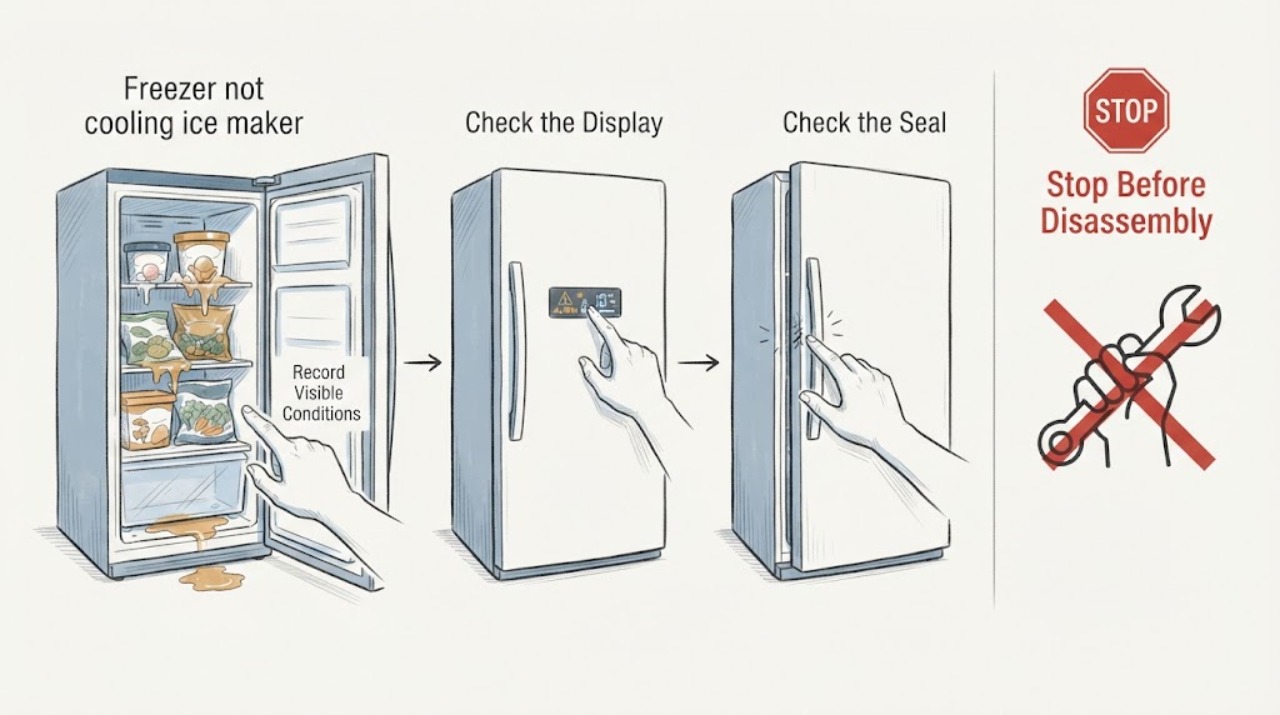
After a freezer door has been open for 4–6 hours, close it and keep it closed while you separate the food-safety decision from the cooling diagnosis. Warm air can enter, frost can form, and the refrigerator may hum more while it works to recover; a continuous hum does not by itself prove a bad compressor or fan. On this Kenmore Coldspot 106.51133.210, first record the freezer temperature and whether food still has ice crystals, then check the door seal, blocked vents, visible frost, power, controls, and the ice maker's water path from outside. If the temperature does not recover, frost blocks airflow or returns, the hum is joined by repeated clicking or overheating, or food has thawed, stop repeated testing and arrange qualified service while handling the food under current food-safety guidance.
Work through in order
Diagnostic checks
Use only checks that match the exact appliance or system and its official guide.
-
Check 1
Close the freezer door and keep it closed except for one brief observation. Note whether packages still contain ice crystals, are hard-frozen, soft, or fully thawed, and record the freezer temperature with a suitable thermometer if one is already available. Do not rely on smell or appearance alone to clear thawed food.
Expected result: Food remains hard or icy, is partly soft, or is fully thawed and warm; the measured temperature is known or unavailable.
Next step: Keep the door closed and move questionable food to a safe alternate freezer or apply current food-safety guidance. Treat the appliance diagnosis as a separate decision.
Why this matters
Why: The 4–6 hour opening is both a possible recovery cause and a food-safety event. Door openings add heat and make later temperature checks less reliable, while a later repair cannot make unsafe food safe.
-
Check 2
From outside the cabinet, confirm the interior light or display has power and verify the temperature controls are not Off or set unusually warm. Check the receptacle and breaker only from a dry, safe position; do not keep resetting a breaker that trips again.
Expected result: There is no power indication, the control is Off or warm, power is normal, or the breaker trips again.
Next step: Correct only an obvious control setting if the manual permits it. If power cannot be restored safely or a breaker trips again, stop and use an electrician or qualified appliance technician.
Why this matters
Why: No cooling can occur without power and an active cooling control. A repeated electrical trip is evidence of a fault, not a successful reset.
-
Check 3
With the door closed, inspect the accessible gasket contact area, door edges, and visible interior vents during the one brief opening. Move only a package that prevents closure, and do not scrape ice, pierce the liner, remove an interior panel, or use a flame, heat gun, or other high-heat source to defrost.
Expected result: The gasket has a visible gap or obstruction, packages block vents, the rear wall or vent is heavily frosted, or these areas look clear.
Next step: Remove only the external obstruction and close the door. If frost blocks airflow or returns after a safe manual defrost procedure stated for this exact model, arrange service rather than repeatedly defrosting or opening panels.
Why this matters
Why: A door left open admits humid air and can create frost; a poor seal or blocked vent can continue the same problem after the door is closed. Frost is a clue to restricted airflow or moisture entry, not proof of a particular defrost part.
-
Check 4
Listen from outside the closed refrigerator during a normal cooling attempt and write down whether the sound is a steady hum, an intermittent brief buzz, a gurgle, or repeated click-then-stop. Do not touch a fan, remove a guard, place a hand on hot components, or cycle power just to reproduce the sound.
Expected result: The hum is steady while temperature trends colder, the sound occurs briefly when the ice maker fills, refrigerant-like gurgling occurs, or repeated clicking is followed by silence and persistent warmth.
Next step: Use the temperature trend and frost pattern, not sound alone, to decide whether recovery is occurring. If the freezer stays warm or the compressor repeatedly clicks or overheats, stop restarts and arrange qualified service.
Why this matters
Why: Fans, a compressor, refrigerant flow, defrost water, and the ice-maker water valve can all make normal sounds. A continuous hum can mean the unit is working hard after the open-door event, but it cannot establish that cooling is successful; repeated click-stop behavior or unusual heat is more concerning.
-
Check 5
Once the freezer has been closed and the appliance is safe to observe, check only the ice maker's visible on/off control, the accessible water shutoff valve, and the visible water line for a closed valve or kink. Do not force an ejector arm, reach into moving parts, remove a filter housing, or run an ice-maker test sequence without the exact manual.
Expected result: The ice maker is off, the water valve is closed, the line is visibly kinked, the filter was recently disturbed, or the ice maker is on with a normal visible water path.
Next step: Correct only an obvious safe external valve or control setting and allow the freezer to stabilize. If the freezer reaches its normal temperature but ice production does not return, use the exact Kenmore manual or arrange service rather than guessing an inlet valve or ice-maker part.
Why this matters
Why: Ice production depends on freezer temperature as well as the ice-maker control and water path. A long-open door can delay ice production during recovery; a brief buzz can also be the water valve trying to fill, especially when supply is restricted or absent.
-
Check 6
Record the exact Kenmore model, measured temperatures and times, food state, door-seal and frost observations, sound pattern, ice-maker setting, and whether the hum changes as the cabinet cools. Keep the refrigerator accessible for a technician without removing covers or attempting sealed-system tests.
Expected result: The freezer remains warm after safe external checks, cooling is uneven, frost returns, the interior fan is absent or scraping, the compressor repeatedly clicks, or an electrical odor or hot surface appears.
Next step: Arrange qualified appliance service. Do not order a gasket, fan, start device, compressor, or other part from the symptom alone, and do not open the sealed system.
Why this matters
Why: The remaining possibilities include airflow, defrost, fan, start, compressor, control, or sealed-refrigeration issues. These cannot be distinguished reliably from the sound or from a generic 106-series description alone.
Use your observations
Decision map
Find the observation that best matches what you see, then follow the next safe action.
-
PATH 01Next step
What you see
The freezer temperature is trending colder after the door is closed, food still has ice crystals, there is no heavy frost, and the hum is steady rather than click-stop.
Do this next
Keep the door closed and recheck the temperature after the exact manual's stabilization interval. Do not keep opening the freezer to listen, and treat the ice maker as a separate recovery check.
Why this path and its safety boundary
Why it matters: The pattern is consistent with recovery from the long-open door and increased cooling demand; the hum is not enough to diagnose a compressor or fan.
-
PATH 02Next step
What you see
A thick frost layer covers the visible rear wall or blocks vents after the door was open, or frost returns after a safe manual defrost.
Do this next
Follow only a safe defrost procedure stated in the exact Kenmore manual; otherwise leave panels and liner untouched and arrange service when the frost blocks airflow or returns.
Why this path and its safety boundary
Why it matters: Humidity entry and restricted airflow are plausible, but recurrence indicates an underlying seal, moisture, or defrost problem rather than a reason to keep applying heat or scraping.
-
PATH 03Next step
What you see
The freezer remains warm while the hum continues, or the sound changes to repeated clicking, stop-start attempts, or abnormal heat.
Do this next
Stop repeated power cycles, keep the door closed, move food to a safe alternate freezer, and arrange qualified service. Do not identify or replace a compressor, start device, or fan from the sound alone.
Why this path and its safety boundary
Why it matters: A running sound does not prove that the cabinet is cooling. Persistent warmth with abnormal starting behavior requires professional diagnosis of the cooling and electrical system.
-
PATH 04Next step
What you see
The freezer temperature is normalizing but the ice maker remains idle, or the brief buzz occurs during a fill attempt while water is unavailable or restricted.
Do this next
Check only the visible ice-maker control, water shutoff, kink-free line, and exact-model filter instructions. If cooling is normal but ice does not return after the manual's wait period, arrange model-specific service.
Why this path and its safety boundary
Why it matters: Ice production can lag after a warm-door event, and the ice-maker valve can buzz when the supply is off or restricted. This is not proof that the ice maker motor or valve has failed.
-
PATH 05Next step
What you see
The gasket cannot seal, a package holds the door open, power is absent, or the breaker trips again.
Do this next
Remove only the accessible obstruction or correct an obvious control setting. For a damaged seal, persistent power loss, or repeated trip, leave the appliance off and arrange qualified service or an electrician.
Why this path and its safety boundary
Why it matters: An external closure or power condition can explain the warmth, but repeated electrical trips are a safety fault and not a reset opportunity.
-
PATH 06Next step
What you see
Food is fully thawed or has been warm for an uncertain period after the 4–6 hour opening.
Do this next
Follow current food-safety guidance and use a known-safe freezer for replacement or retained food. Do not use the appliance diagnosis as permission to taste or keep questionable food.
Why this path and its safety boundary
Why it matters: This is a food-safety decision independent of whether the refrigerator later recovers. Smell, appearance, and a later repair do not establish that perishable food is safe.
When checks do not resolve it
Need a professional?
Call a qualified appliance technician if the freezer remains warm after the door has been closed and the safe external checks, if frost blocks or repeatedly returns, if the hum is joined by repeated clicking or unusual heat, or if cooling is uneven. Use an electrician for a damaged receptacle or repeated breaker trip. Handle thawed food under current food-safety guidance.
Common questions
FAQ
Does a continuous hum mean the Kenmore compressor is bad?
No. A compressor, fan, refrigerant flow, or ice-maker water valve can make operating sounds, and a refrigerator may run more after a long-open door. Use measured temperature, frost, and whether the sound is click-stop or steady; do not identify a part from the hum alone.
Why did the ice maker stop when the freezer door was open?
The freezer may be too warm to resume normal ice production immediately, and the ice maker also depends on its visible control and water path. Check only the on/off setting, accessible shutoff valve, visible kink, and exact-model instructions; do not force the ejector or guess a valve or motor.
Can I keep the food if the freezer was open for 4–6 hours?
Handle that separately from the repair. Record whether food is still hard or has ice crystals, and follow current food-safety guidance for soft, fully thawed, or warm perishable food. Do not use smell, appearance, or a later cooling repair as the safety test.
Read the exact guide
Official sources
- Refrigerator Noise - Buzzing - Product HelpWhirlpool · General manufacturer interpretation of compressor, fan, water-valve, airflow, and high-cooling-demand refrigerator buzzing
- Preventing Frost or Ice Crystals on Food - Product HelpWhirlpool · General manufacturer frost, door-seal, vent, control, and stabilization guidance for full-size refrigerators/freezers
- Find Your Manual | Kenmore Appliance Manuals & GuidesKenmore · Kenmore Coldspot 106.51133.210 refrigerator and freezer owner's-manual lookup
- Owner's ManualWhirlpool · Manufacturer refrigerator owner guidance used only for general temperature, door, water, ice-maker, and normal-sound observations; not an exact Kenmore part or control map
- How to Turn the Ice Maker On and Off - Product HelpWhirlpool · General manufacturer ice-maker control, water-supply, buzzing, and model-manual boundary guidance
Community feedback
Share a repair observation
Share a plain-text repair observation. Accepted observations are published automatically; this page may take a moment to update.