
On this page
Start here
Quick answer
Start by locating the water. Moisture on the outside wall or around the door edge points to a warm, humid-air or door-closure observation; droplets or frost on the inside wall and packages point to moisture entering the compartment; water on the floor must be treated as a possible leak until its source is identified. Check the visible door seal and closure without removing parts, record how often the door is opened, and measure the freezer with an appliance thermometer. FDA guidance uses 0°F (-18°C) for a freezer and says food-safety decisions should use temperature and time, not appearance or odor alone. Kenmore publishes model-specific manuals, so persistent floor water, a damaged seal, or a freezer that is warming needs the exact model manual or qualified service; do not assume an internal drain or other part is the cause.
Before you begin
Safety first
- This no-model article covers visible location, door closure, temperature, food safety, and service routing only. Do not remove freezer panels, disassemble a drain, test live parts, move a water-connected appliance to chase a leak, or choose an internal part from condensation alone.
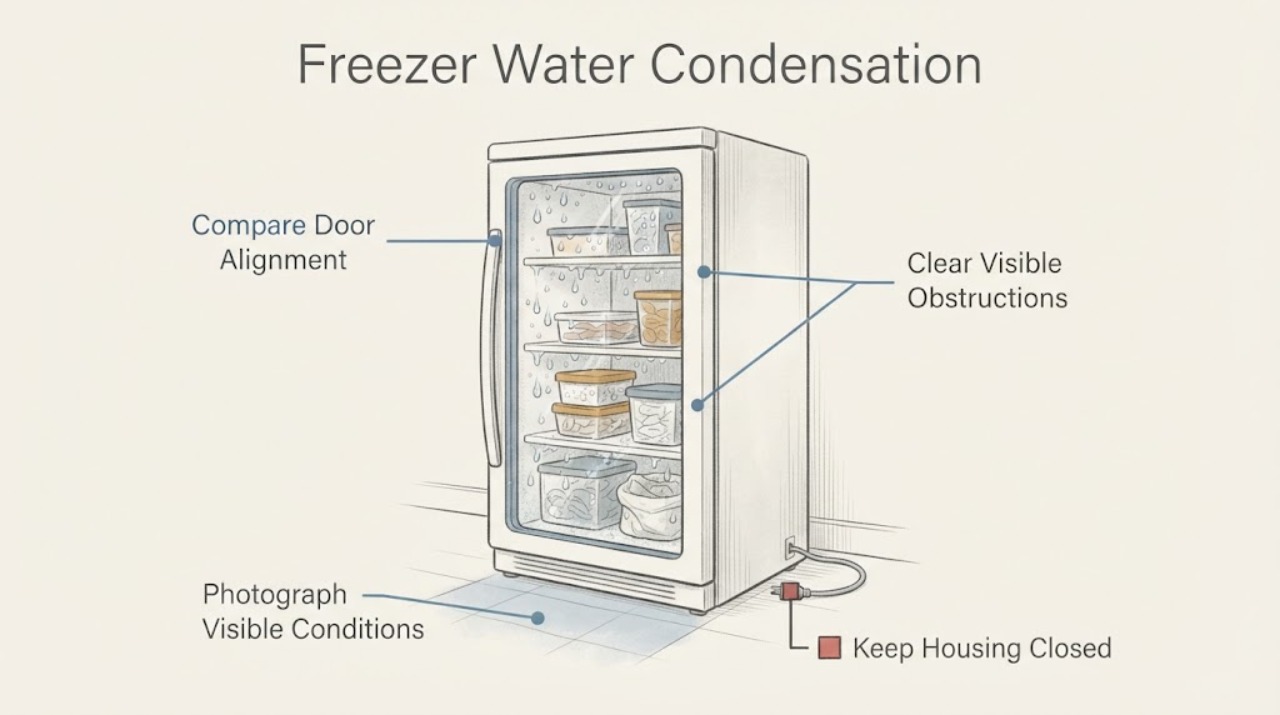
Work through in order
Diagnostic checks
Use only checks that match the exact appliance or system and its official guide.
-
Check 1
Photograph and map the first wet area before wiping it: outside cabinet or door edge, inside wall or package, or floor beneath the freezer. Note whether the moisture is a film, droplets, frost melt, or a larger pool.
Expected result: Water is on an exterior surface, inside the compartment, on food or packages, or on the floor; the pattern may be isolated or recurring.
Next step: Use the matching branch below, keep the exact Kenmore model available for its manual, and do not remove panels to trace the water.
Why this matters
Why: The location separates a visible condensation pattern from moisture entering the compartment or a possible leak. It cannot identify an internal drain, water valve, or cooling component.
-
Check 2
Place an appliance thermometer where it can remain in the freezer without blocking the door or vents, and record the temperature trend. Check whether frozen food is still hard, has ice crystals, or is softening; do not taste food to decide whether it is safe.
Expected result: The freezer is at or near 0°F (-18°C), or it is warmer and food is softening or thawing.
Next step: If the freezer is warming or food has thawed, keep the door closed, protect food using FDA guidance, and arrange qualified service. If temperature is stable, continue with visible door and moisture checks.
Why this matters
Why: A stable temperature lowers the urgency of a condensation-only observation; a warm freezer changes the problem to cooling and food safety. Temperature, time, and food history matter more than smell or appearance alone.
-
Check 3
Close the freezer door slowly and inspect only the visible gasket perimeter and frame for dirt, tears, deformation, frost, or a section that does not contact the frame. Remove only a container or package that visibly prevents closure; do not remove the gasket or adjust hinges without the exact manual.
Expected result: The door closes evenly with a continuous visible contact, or there is a gap, damaged seal, frost block, or loading obstruction.
Next step: Correct a visible loading obstruction and dry an intact, accessible gasket according to the model manual. Request service for a torn/deformed gasket, persistent gap, or condensation that returns after closure is corrected.
Why this matters
Why: An incomplete closure can admit warm humid air and produce exterior or interior moisture, but the observation does not prove a failed seal or another internal part.
-
Check 4
Record whether the moisture appears after frequent or prolonged door openings, loading warm food, or a humid room. Keep food covered and allow hot food to cool safely before loading; do not leave the door open while testing the pattern.
Expected result: Moisture follows a known opening or humid-weather pattern, or it returns even when the door remains closed and the visible seal is sound.
Next step: Reduce avoidable openings and monitor the location and temperature. If water keeps returning under closed-door, normal-humidity conditions, use the model-specific manual or Kenmore service route.
Why this matters
Why: A repeatable humidity or opening pattern supports moisture entry as a working explanation; recurrence with normal closure and stable conditions needs model-specific evaluation rather than a guessed drain repair.
-
Check 5
If water reaches the floor, wipe it up and observe from outside the cabinet whether it reappears at the door perimeter, underneath, or near a visible supply connection if this freezer has one. Do not move the appliance, remove a kick plate, or open a panel to chase the water.
Expected result: The floor stays dry after wiping, or water returns repeatedly, reaches an electrical area, or is accompanied by a rising freezer temperature.
Next step: Keep people and stored items clear, isolate the appliance from use if water threatens electrical components, and contact qualified appliance service through Kenmore customer care. Do not assume an internal drain or order a part from this observation.
Why this matters
Why: A recurring floor pool is not safely classifiable as condensation without locating its source. Water near electricity or alongside warming food raises the service priority.
-
Check 6
Find the full Kenmore model number on the rating label and give it to support with the moisture location, photos, temperature reading, door-closure result, room conditions, and whether food has thawed.
Expected result: A matching Kenmore manual is available, or the model cannot be identified and the moisture persists.
Next step: Follow only the matching manual for accessible care. If no matching manual or safe external remedy resolves the problem, use Kenmore or qualified refrigeration service and describe the evidence rather than a presumed failed part.
Why this matters
Why: Kenmore's manual and customer-care routes are model-specific; without the model, the correct drainage, defrost, door, and water-system boundaries remain unresolved.
Use your observations
Decision map
Find the observation that best matches what you see, then follow the next safe action.
-
PATH 01Next step
What you see
Water is a light film or droplets on the outside cabinet or door perimeter, the door closes flush, and the freezer stays near 0°F.
Do this next
Document room humidity and door-opening pattern, inspect the visible gasket, and monitor. Use the exact model manual or service if the seal is damaged or moisture persists.
Why this path and its safety boundary
Why it matters: Warm humid air and the visible door-closure condition are plausible contributors, but the pattern does not prove a damaged gasket.
-
PATH 02Next step
What you see
Droplets, frost, or wet packages are inside the freezer while the measured temperature remains near 0°F and the door is sometimes opened for long periods.
Do this next
Cover food, reduce avoidable openings, keep visible airflow unobstructed, and monitor the location and temperature. Escalate if moisture recurs with a closed door or temperatures rise.
Why this path and its safety boundary
Why it matters: Moisture entry from the room is a reasonable working explanation; the observation is not evidence of a failed internal drain or cooling part.
-
PATH 03Next step
What you see
The freezer is warmer than its target, food is softening or thawing, or the condensation is accompanied by a repeated temperature rise.
Do this next
Keep the door closed, protect food using FDA temperature/time guidance, and arrange qualified refrigeration service with the model and temperature history.
Why this path and its safety boundary
Why it matters: This is a cooling and food-safety concern, not a cosmetic condensation issue. The symptom does not identify the failed component.
-
PATH 04Next step
What you see
Water repeatedly reaches the floor, returns after wiping, threatens an electrical area, or cannot be traced to a visible door-edge pattern.
Do this next
Stop using the appliance if water threatens electrical components, keep the area safe, and contact Kenmore or qualified service. Do not move the appliance or open panels to investigate.
Why this path and its safety boundary
Why it matters: A recurring floor pool may be a leak or another model-specific water path; guessing an internal drain or hose could worsen damage.
Helpful context
Understand the symptom
Condensation is a location clue, not a diagnosis. Photograph the first wet area before wiping it: the outside cabinet or door perimeter, an inside wall or package, or the floor beneath the freezer. Those observations separate moisture entering through the door from a possible water leak or a cooling-temperature problem, without assuming an internal drain, valve, fan, or control failure.
Kenmore's public manuals page asks for the complete model number before showing the applicable owner's documentation. Use that model-specific document for any cleaning or service procedure. The public Kenmore refrigeration information also describes drier freezer air as a way to reduce ice crystals, but it does not make a model-independent diagnosis from a wet spot.
Food safety comes first when condensation is paired with warming. FDA guidance identifies 0°F (-18°C) as the freezer target and recommends using temperature and time information rather than appearance or smell alone. If food is softening or the measured temperature is rising, keep the door closed as much as practical and move food to safe cold storage if available while arranging service.
When checks do not resolve it
Need a professional?
Use Kenmore or qualified refrigeration service when a gasket is visibly damaged, water repeatedly reaches the floor, condensation persists with a closed door and stable room conditions, the freezer is warming, or the model-specific manual is unavailable. Protect food and stop use if water reaches electrical areas.
Safety scope: This no-model article covers visible location, door closure, temperature, food safety, and service routing only. Do not remove freezer panels, disassemble a drain, test live parts, move a water-connected appliance to chase a leak, or choose an internal part from condensation alone.
Common questions
FAQ
Is condensation on a Kenmore freezer always a failed door seal?
No. First record whether it is outside, inside, or on the floor, and check the visible closure and room/opening pattern. A damaged seal is one possibility, but condensation alone does not identify a gasket or internal part.
What temperature should a Kenmore freezer hold?
Use an appliance thermometer. FDA consumer guidance identifies 0°F (-18°C) as the freezer target; if food is thawing or the temperature is rising, protect the food and arrange service instead of treating the water as cosmetic.
Should I clean or replace the freezer drain when I see water?
Not from this symptom alone. The model is missing and a floor pool can have more than one cause. Find the model-specific Kenmore manual and use qualified service for recurring water; do not remove panels or guess a drain part.
What should I give Kenmore support?
Provide the complete model number, moisture location and photos, temperature reading, door-closure result, room/opening pattern, and whether food has thawed. Kenmore's manual and customer-care pages route support by model and service need.
Read the exact guide
Official sources
- Are You Storing Food Safely?U.S. Food and Drug Administration · Opened the FDA consumer food-storage guidance. It identifies 0°F (-18°C) for freezers, recommends an appliance thermometer, and explains that food safety depends on temperature/time and ice-crystal status rather than appearance or smell alone.
- Customer Care & Support | Kenmore AppliancesTransform SR Brands LLC / Kenmore · Opened the Kenmore customer-care page. It provides support routes for manuals, warranty, repairs, and service; it is used for escalation and model-identification boundaries, not as evidence of a particular failed part.
- Find Your Manual | Kenmore Appliance Manuals & GuidesTransform SR Brands LLC / Kenmore · Opened the Kenmore manuals page. It asks the owner to enter the model number to access the matching manual and lists freezer/refrigeration support categories; it is used here for model-scope and lookup boundaries, not as proof of an unseen model-specific condensation rule.
- Refrigerators & Freezers | French Door, Side-by-Side | KenmoreTransform SR Brands LLC / Kenmore · Opened the Kenmore refrigeration page. Its product information says dual cooling keeps freezer air drier to help prevent ice crystals and describes temperature consistency; it supports the article's moisture context, not a diagnosis for an unspecified freezer.
Community feedback
Share a repair observation
Share a plain-text repair observation. Accepted observations are published automatically; this page may take a moment to update.