
On this page
Start here
Quick answer
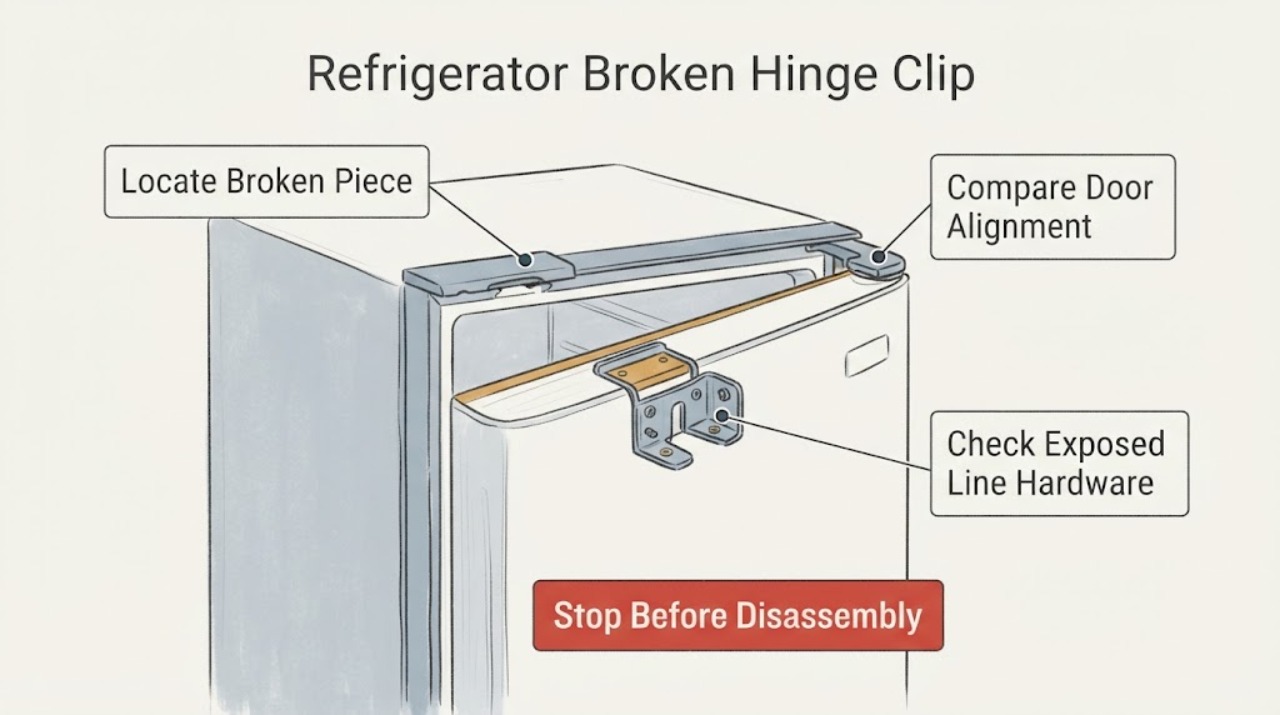
Do not order a generic clip or keep using a refrigerator door that is sagging, loose, rubbing, unable to seal, or at risk of falling. First identify whether the broken piece is actually at the hinge, a hinge cover, a wire/tube retainer, or a door-trim/bin clip; “clip” is not enough to establish the part. With the refrigerator stable and power left undisturbed, observe the closed-door alignment and gasket contact from outside, then record the complete Kenmore model/serial and use Kenmore’s exact manual and repair route. Support the door only as needed to prevent movement, do not remove hinge hardware or door wiring, and arrange service if the hinge or mounting area is damaged.
Work through in order
Diagnostic checks
Use only checks that match the exact appliance or system and its official guide.
-
Check 1
From outside, identify the broken piece’s position—top/center/bottom hinge area, hinge cover, wire/tube route, door trim or door bin—and photograph it without pulling on the door, line or wiring.
Expected result: The piece is at the hinge/mounting area, retains a line or wire, belongs to trim/bin hardware, or its identity is uncertain.
Next step: Keep the door movement minimal and use the model-identity step. Do not order a generic clip or substitute another Kenmore model’s part.
Why this matters
Why: “Hinge clip” may describe different parts and assemblies; location is needed before the exact model manual can match it.
-
Check 2
Close the door gently once and observe the gap, hinge-side movement, rubbing, latch feel and gasket contact around the full opening; do not force or repeatedly cycle it.
Expected result: The door is even and seals, or it sags/rubs/springs open/has a gap or the gasket does not contact.
Next step: If alignment or sealing is abnormal, stop using the affected door as much as possible and arrange model-specific service; do not bend or shim the hinge.
Why this matters
Why: An intact seal does not prove the clip is correct, while sagging or loss of gasket contact means the hinge/door support needs attention rather than a cosmetic clip-only assumption.
-
Check 3
Look only from outside for an exposed water tube, wire, sharp edge, loose hinge cover or hardware that could fall; do not remove the cover or pull the line.
Expected result: A water line/wire is exposed, the hinge is loose, hardware is sharp/falling, or only a cosmetic cover/trim piece appears affected.
Next step: Keep the door closed and the appliance stable. For line, wiring, loose-hinge or falling-hardware symptoms, use repair service; for a cosmetic piece, identify the exact model before any part search.
Why this matters
Why: Line or hinge damage can create a leak, electrical or falling-door risk; a cosmetic cover still cannot establish the correct replacement without the model.
-
Check 4
Read the complete Kenmore model/serial label without moving the refrigerator and enter the model number in Kenmore’s manual lookup; record door style and hinge side.
Expected result: A valid model number is available, or the label cannot be read safely.
Next step: Use the exact manual/repair route for the model. If the label is inaccessible, give service the appliance photos and do not use another model’s hinge procedure.
Why this matters
Why: Kenmore states that model-number lookup provides the applicable manual and parts information; without it, a clip cannot be matched reliably.
-
Check 5
Contact Kenmore repair support when the door cannot stay aligned/sealed, the hinge or mounting area is damaged, a line/wire is exposed, or the door would need to be removed or supported for clip replacement.
Expected result: The problem persists after the external observation, or internal hinge access is required.
Next step: Provide model/serial, door style, hinge-side location, photos and the closed-door result. Keep the affected door closed and do not dismantle it.
Why this matters
Why: The task supplies no model and Kenmore routes model-specific manuals, parts/literature and repair separately; a universal clip or disassembly path would risk a mismatch.
Use your observations
Decision map
Find the observation that best matches what you see, then follow the next safe action.
-
PATH 01Next step
What you see
The piece is only a trim/bin retainer, and the door remains aligned, stable and fully sealed.
Do this next
Do not glue or substitute it. Identify the exact model and part location through Kenmore’s manual/parts lookup before replacing the piece.
Why this path and its safety boundary
Why it matters: The reported “clip” may not be a hinge component; the door result does not prove a hinge failure.
-
PATH 02Next step
What you see
The hinge side sags, rubs, leaves a gasket gap or the door can move/drop after the clip broke.
Do this next
Minimize opening, keep people away from the hinge side and arrange model-specific refrigerator repair. Do not bend, shim or remove hinge hardware.
Why this path and its safety boundary
Why it matters: The door support or mounting area may be involved, so a clip-only fix cannot be assumed.
-
PATH 03Next step
What you see
A water line or wire is exposed near the broken piece, or the refrigerator has a leak, sharp edge or unstable door.
Do this next
Keep the door closed and the refrigerator stable; avoid pulling the line or wire and contact repair service. If water is actively leaking, use the safe household shutoff and protect the floor/food as appropriate.
Why this path and its safety boundary
Why it matters: The situation has a water, electrical or falling-door hazard beyond a cosmetic retainer.
-
PATH 04Next step
What you see
The model/serial cannot be confirmed and the exact clip function is unclear.
Do this next
Return the model identity to service or obtain the label safely; do not use a generic clip, another model’s diagram or an improvised repair.
Why this path and its safety boundary
Why it matters: Kenmore’s model-based manual/parts path cannot be applied, so compatibility and removal steps remain unsupported.
Helpful context
Understand the symptom
Confirm which clip is broken
A refrigerator may have several small retainers around a door: a hinge-area cover or retainer, a water/ wire-line clip, a door-trim clip or a bin retainer. Do not infer the part from appearance or a photograph alone. Record whether the door is sagging, whether the piece is at the top/center/bottom hinge area, and whether any wire or tube is exposed. Kenmore’s manual lookup is model-based, so the exact model controls the identification.
Check the closed-door result from outside
With the refrigerator standing normally, close the affected door gently and look for an even gap, gasket contact all around the opening, rubbing, a door that springs open, or movement at the hinge side. Do not force the door or keep cycling it. A damaged clip may be cosmetic, may retain a cover or line, or may indicate that the hinge/mounting area itself is no longer secure.
Protect the appliance while waiting
If the door is loose or could drop, stop opening it and keep people away from the hinge side. Do not remove the hinge cover, pull on a water line or wire, drill, glue, bend the hinge or insert a substitute clip. If the gasket cannot seal, protect perishable food and arrange repair rather than trying to realign a loaded door.
Use the exact model support path
Read the model/serial label without moving the refrigerator, then enter the model number on Kenmore’s manual page. Compare the exact door configuration and hinge illustration before any part decision; Kenmore Customer Care lists manuals, parts/literature and repair services as separate support routes.
Escalate when the hinge or lines are involved
A loose hinge, damaged mounting surface, exposed water line or wire, sharp broken plastic/metal, door that will not seal, or a clip that cannot be identified externally needs model-specific service. Do not remove the door or hinge hardware without the exact instructions and a safe way to support the door.
When checks do not resolve it
Need a professional?
Contact Kenmore repair support for a sagging or unstable door, loss of gasket seal, loose hinge/mounting, exposed line/wire, sharp/falling hardware, active leak, or any need to remove the door or hinge hardware.
Have this ready
- Provide the complete model/serial, door style and hinge side, exact clip location/function, photos, whether the door sags/rubs/seals and whether a water line or wire is exposed.
Common questions
FAQ
Are all Kenmore refrigerator hinge clips interchangeable?
No. Kenmore’s manual lookup is model-based, and the word clip can describe hinge, cover, line-retainer, trim or bin hardware. Confirm the complete model and exact location before ordering anything.
Can I keep using the refrigerator if the hinge clip is broken?
Only an exact-model assessment can determine whether a cosmetic retainer is affected. If the door sags, rubs, cannot seal, exposes a line/wire or may fall, keep it closed and arrange repair.
Can I glue or shim the broken clip?
Do not improvise a hinge or line retainer. Glue or shimming can conceal an alignment or mounting problem and may not withstand a loaded refrigerator door; use the exact manual or repair route.
What information does Kenmore service need?
Provide the complete model/serial, door configuration, hinge side, clip location, photos and whether the door seals, rubs, sags or exposes a line/wire. Kenmore provides manuals and repair routing through Customer Care.
Read the exact guide
Official sources
- Find Your Manual | Kenmore Appliance Manuals & GuidesKenmore · Official Kenmore manual lookup page; used to establish the need for the complete model number and exact manual/parts scope. It does not verify any particular hinge clip without a model.
- Kenmore RefrigeratorsKenmore · Official Kenmore refrigerator product page; used only to confirm refrigerator product scope and links to manuals, repair and parts support.
- Customer Care & Support | Kenmore AppliancesKenmore · Official Kenmore customer-care page; used for manuals/parts and repair routing, not for a universal door-hinge repair procedure.
Community feedback
Share a repair observation
Share a plain-text repair observation. Accepted observations are published automatically; this page may take a moment to update.