
On this page
Start here
Quick answer
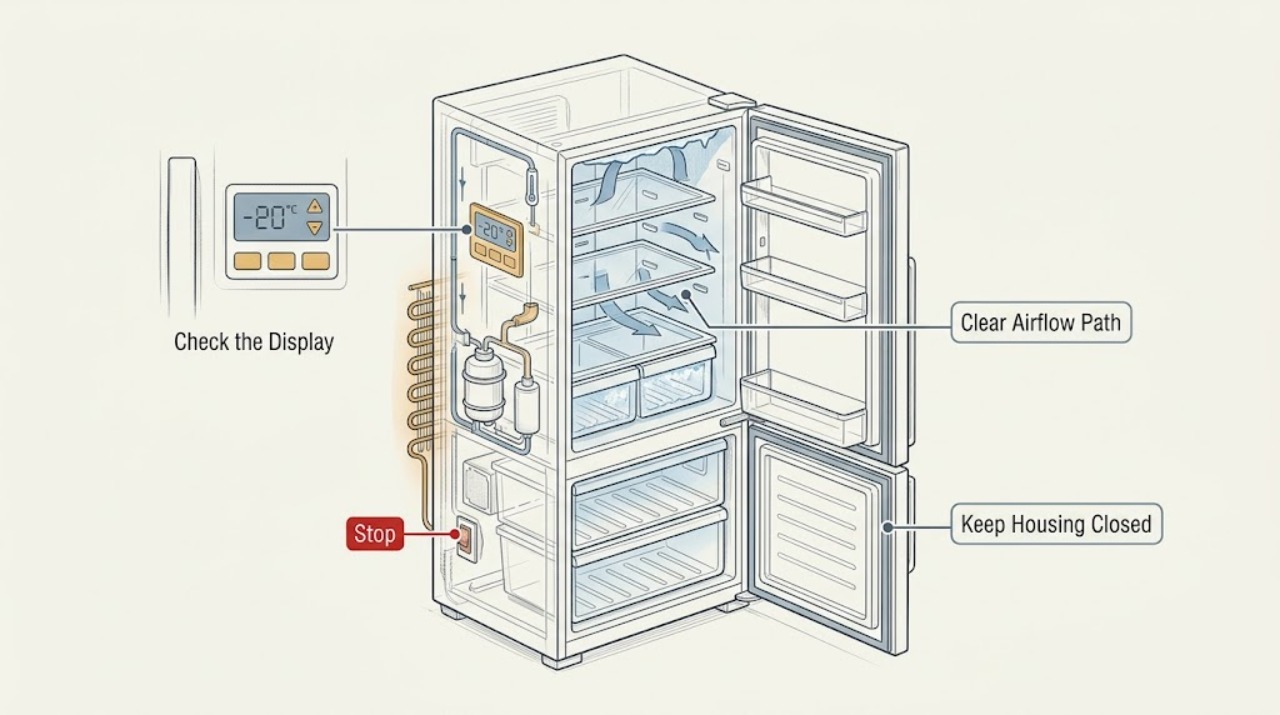
First separate fresh-food freezing from a freezer that is simply running a rapid-freeze mode. Record the full Kenmore model number, the compartment affected, where the item froze, the displayed settings, and whether a rapid-freeze or rapid-chill feature is active. Kenmore documents one model with an Accela Freeze mode that lowers freezer temperature for up to 24 hours, while its refrigeration guide describes model-dependent vents, cooling zones, adjustable shelves, and different French-door, side-by-side, and top-freezer layouts. Turn off a documented rapid-freeze or rapid-chill mode only through the model's normal controls, set the compartment warmer only as the exact manual permits, and move food away from any labeled cold-air outlet or rear wall without blocking airflow. If only a vent-adjacent area freezes, placement or airflow is more plausible; if the whole fresh-food compartment freezes, the setting or an internal control/air-distribution problem becomes more concerning. Do not remove panels, probe a sensor, force a damper, or perform live electrical tests. If the temperature does not respond to the model-approved control changes, the freezer and fresh-food compartments behave abnormally together, or there is heavy frost, water near electrical parts, smoke, a hot or damaged cord, or another hazard, leave the refrigerator alone and arrange qualified service.
Before you begin
Safety first
- Do not remove panels, chip ice around internal components, force dampers, bypass protection, disconnect wiring, or perform live electrical tests. For smoke, burning odor, sparking, water near electrical parts, or a hot or damaged cord, stop using the appliance and isolate power only if safe before obtaining qualified help.
Work through in order
Diagnostic checks
Use only checks that match the exact appliance or system and its official guide.
-
Check 1
Without moving the refrigerator or removing any cover, record the complete Kenmore model number, refrigerator layout, compartment affected, shelf or bin location, food that froze, and whether the freezer, fresh-food section, or both show the symptom. Note whether the item touched a rear wall or a labeled air outlet.
Expected result: Only one item or one vent-adjacent area freezes; many items in the fresh-food compartment freeze; the freezer alone is unusually cold; or both compartments change together.
Next step: Use the matching branch below and the exact Kenmore manual. Do not apply a French-door, side-by-side, or top-freezer procedure solely because the brand is Kenmore.
Stop if: Stop for smoke, a burning smell, sparking, water near electrical parts, a hot or damaged cord, or any need to pull out a built-in unit or remove a panel.
Why this matters
Why: The location selects the next check. A localized pattern keeps placement or airflow in consideration, while whole-compartment or two-compartment behavior is less likely to be explained by one package and requires closer attention to model settings and service boundaries.
-
Check 2
Read the displayed refrigerator and freezer settings and look for a named rapid-freeze, rapid-chill, vacation, or similar mode. Change a mode or temperature only through the normal controls and only when the exact model manual documents the control; do not enter service diagnostics.
Expected result: A documented rapid-freeze mode is active, a setting is colder than intended, no setting or mode explains the symptom, or the display does not respond to an ordinary control input.
Next step: Return the confirmed model to its normal documented setting and allow the model's stated stabilization period. If the control does not respond or freezing persists, stop changing settings and arrange service.
Stop if: Do not remove the control panel, force a keypad, bypass a lock, or use live electrical measurements.
Why this matters
Why: Kenmore model 5694 documents an Accela Freeze mode that lowers freezer temperature for up to 24 hours, but the feature is model-specific. A mode or setting can explain a freezer-only complaint; a nonresponsive control or persistent fresh-food freezing points toward a model-specific service path rather than a universal reset.
-
Check 3
From the normal open-door position, inspect only visible shelves, bins, packages, and labeled cold-air outlets. Move a freeze-sensitive item away from a rear wall or outlet, leave the outlet unobstructed, and avoid packing the compartment so tightly that air cannot circulate. Do not remove an interior cooling panel.
Expected result: The frozen item was directly beside an outlet or rear wall, an outlet was covered by food, the layout is crowded, or several shelves freeze despite clear visible airflow.
Next step: Observe one ordinary cooling period after the documented setting is restored. If many shelves still freeze, use the service branch rather than removing panels or forcing an air door.
Stop if: Do not chip ice with a sharp tool, dismantle shelves or ducts, or reach behind a panel or fan guard.
Why this matters
Why: Kenmore describes strategically placed vents and adjustable storage in applicable refrigerator families. A localized improvement after repositioning makes placement or airflow distribution more plausible; widespread freezing despite clear outlets is not proved to be a blocked vent.
-
Check 4
After the model-approved setting and accessible storage checks, record whether the displayed temperature and the actual food-freezing pattern change together. Note heavy visible frost, a persistent ice sheet, an alarm, abnormal running behavior, or a change in both compartments; do not open a sealed or rear cooling area to inspect it.
Expected result: Freezing improves after a normal control change, remains throughout the fresh-food compartment, returns after a temporary improvement, or is accompanied by heavy frost, an alarm, leak, unusual noise, or abnormal operation.
Next step: Leave the appliance at the documented normal setting and arrange qualified Kenmore or appliance service for a persistent or recurring symptom. Protect food according to its safety needs while the appliance is evaluated.
Stop if: Stop using the appliance for smoke, burning odor, sparking, water near electrical parts, hot or damaged cord, or another electrical/fire hazard.
Why this matters
Why: A response to the normal control supports a setting or mode explanation. A persistent or recurring pattern, especially across compartments or with heavy frost, requires model-specific diagnosis; the public Kenmore material does not justify naming a sensor, damper, fan, defrost part, or control as the cause.
-
Check 5
Arrange qualified service when the refrigerator continues freezing food after the exact model's normal controls and visible storage/airflow checks, when the source would require a panel or internal component, or when a safety or performance warning is present. Give the technician the model number, compartment and shelf pattern, settings, active modes, frost observations, and what changed after the controls were restored.
Expected result: The symptom persists or returns, the control is unresponsive, internal frost or airflow parts are implicated, both compartments behave abnormally, or smoke, heat, water, cord damage, or sparking is present.
Next step: Keep the refrigerator off if an electrical or fire hazard is present and obtain qualified service. If there is no hazard, follow the technician's food-protection advice and do not repeatedly force cooling cycles to reproduce the problem.
Stop if: Do not remove panels, bypass protection, test energized wiring, or replace a part based only on the Kenmore brand name.
Why this matters
Why: The remaining possibilities are model-specific cooling, air-distribution, defrost, control, or electrical conditions that cannot be safely identified from a brand-only page or by live user testing.
Use your observations
Decision map
Find the observation that best matches what you see, then follow the next safe action.
-
PATH 01Next step
What you see
Only food beside a visible cold-air outlet, rear wall, or tightly packed area freezes while the rest of the fresh-food section is normal.
Do this next
Keep freeze-sensitive food away from the outlet or rear wall and follow the exact model's storage guidance. Escalate if multiple shelves freeze or the pattern returns.
Why this path and its safety boundary
Why it matters: Placement or localized airflow distribution is more plausible than a whole-refrigerator temperature failure, but the observation does not identify an internal damper or fan part.
-
PATH 02Next step
What you see
The freezer is the main affected compartment and a documented rapid-freeze mode or colder-than-intended setting is active.
Do this next
Leave the model at its documented normal setting. If the freezer remains abnormally cold or the fresh-food side also freezes, arrange service.
Why this path and its safety boundary
Why it matters: A mode or setting is a supported explanation for that model and symptom. Kenmore documents Accela Freeze on model 5694, but not as a universal feature across all Kenmore refrigerators.
-
PATH 03Next step
What you see
Several shelves or bins in the fresh-food compartment freeze despite clear visible outlets and a documented normal setting.
Do this next
Leave internal parts untouched and arrange qualified diagnosis using the model number and recorded pattern.
Why this path and its safety boundary
Why it matters: A single misplaced item is unlikely to explain the result. An internal, model-specific cooling or control condition is more concerning, but the available brand material does not establish which component has failed.
-
PATH 04Next step
What you see
Both compartments change abnormally, heavy frost or a persistent ice sheet appears, the appliance is leaking or unusually noisy, or an electrical/fire warning occurs.
Do this next
Stop using the refrigerator for an electrical or fire warning and isolate power only from a dry, accessible position if safe. Arrange qualified service; do not remove a panel or repeatedly restart it.
Why this path and its safety boundary
Why it matters: This is beyond a safe food-placement check. Internal cooling, defrost, control, or electrical work may be involved, and a hazard overrides further testing.
Helpful context
Understand the symptom
Define what is actually freezing
A carton or vegetable on the fresh-food side freezing is not the same complaint as a freezer running a rapid-freeze mode. Note the compartment, shelf or bin, food type, whether the item touched a rear wall or cold-air outlet, and whether other items in that compartment remain normal. Kenmore's current refrigeration materials cover several layouts and feature sets, including French-door, side-by-side, and top-freezer designs, so a procedure from one layout should not be applied to another.
Treat rapid-freeze features as model-specific
Kenmore's model 5694 page documents an electronic temperature panel and an Accela Freeze mode that lowers the freezer temperature for up to 24 hours. That is evidence for that model, not a universal Kenmore control sequence. Look for a named rapid-freeze, rapid-chill, vacation, or similar mode only on the appliance's own panel and manual, and change it only through the normal controls. Do not use a hidden service mode or an undocumented button combination as a test.
Use food location to assess airflow
Kenmore's refrigeration guide says strategically placed vents balance cool air throughout the refrigerator, from the back to the front and into the door bins. If only food immediately beside a labeled outlet or rear wall freezes, move it to a different shelf and keep packages from covering the outlet. If the whole fresh-food compartment freezes, moving one package is unlikely to explain the result; use the control-response branch and seek service if the setting does not correct it.
Keep internal diagnosis out of a user check
A refrigerator can have model-specific sensors, dampers, fans, defrost components, or controls, but the opened Kenmore product and guide pages do not establish a universal user test or part diagnosis for those components. Do not remove an evaporator or control cover, force an air door, pierce an ice buildup, or measure energized wiring. Record the model, settings, affected locations, and any frost or alarm pattern for a qualified technician instead.
When checks do not resolve it
Need a professional?
Call qualified service when food continues freezing throughout the fresh-food compartment after the model-approved setting, mode, and visible airflow checks; when the symptom returns; when heavy frost, a leak, unusual noise, an alarm, or abnormal operation appears; or whenever the suspected source is behind a panel or near electrical components.
Safety scope: Do not remove panels, chip ice around internal components, force dampers, bypass protection, disconnect wiring, or perform live electrical tests. For smoke, burning odor, sparking, water near electrical parts, or a hot or damaged cord, stop using the appliance and isolate power only if safe before obtaining qualified help.
Common questions
FAQ
Why is only food near the back of my Kenmore refrigerator freezing?
Kenmore describes strategically placed vents that distribute cool air through applicable refrigerator layouts. Move the food away from a visible outlet or rear wall and keep the outlet clear, then observe the result at the model's documented normal setting. If several shelves freeze, placement alone is unlikely to explain it and service is appropriate.
Can Accela Freeze cause a Kenmore refrigerator to freeze food?
Kenmore's model 5694 product page says Accela Freeze lowers the freezer temperature for up to 24 hours. Check for that named mode only if your exact model has it; do not assume the same feature or button sequence on another Kenmore refrigerator. Restore the documented normal setting through ordinary controls.
Should I turn the refrigerator temperature warmer?
Use only the normal temperature control and the exact model's manual. Record the original setting first, make one documented adjustment, and allow the model's stated stabilization period. If the display does not respond or the entire fresh-food compartment still freezes, do not enter service mode or remove a panel; arrange qualified service.
Is a frozen refrigerator food item proof that the thermostat or sensor failed?
No. The symptom can be localized to food placement, a documented rapid-cooling mode, a setting, or an unresolved model-specific cooling or control condition. Kenmore's public product materials do not establish a universal user test for a thermostat, sensor, damper, fan, defrost component, or control board.
When should I stop troubleshooting a Kenmore refrigerator that is freezing?
Stop when smoke, burning odor, sparking, water near electrical parts, a hot or damaged cord, heavy frost requiring panel removal, or another electrical/fire hazard appears. Leave the appliance off and obtain qualified service; do not perform live tests or bypass protection.
Read the exact guide
Official sources
- Fridge Buying Guide: NEW French Door and Side-By-SideKenmore Livemore · Kenmore's 2024 guide to selected French-door and side-by-side models; use it for the documented features and do not generalize every feature to every Kenmore refrigerator.
- Customer Care & Support | Kenmore AppliancesKenmore · Kenmore support page; it provides service routing rather than a universal refrigerator freezing diagnosis.
- Find Your Manual | Kenmore Appliance Manuals & GuidesKenmore · Brand manual portal; it establishes the need for the exact model manual but does not itself establish a refrigerator freezing diagnosis.
- Appliance and Electrical Fire SafetyU.S. Fire Administration · General household electrical safety; it does not diagnose Kenmore refrigerator cooling behavior.
- 33 inch 18 Cu Ft Counter-Depth French Door Refrigerator, E-starKenmore · Specific Kenmore model 5694 product page; Accela Freeze and its duration must not be generalized to other models.
- Refrigerators & Freezers | French Door, Side-by-Side | KenmoreKenmore · Kenmore refrigeration family page; features vary by model and are not a universal troubleshooting or parts diagnosis.
Community feedback
Share a repair observation
Share a plain-text repair observation. Accepted observations are published automatically; this page may take a moment to update.