
On this page
Start here
Quick answer
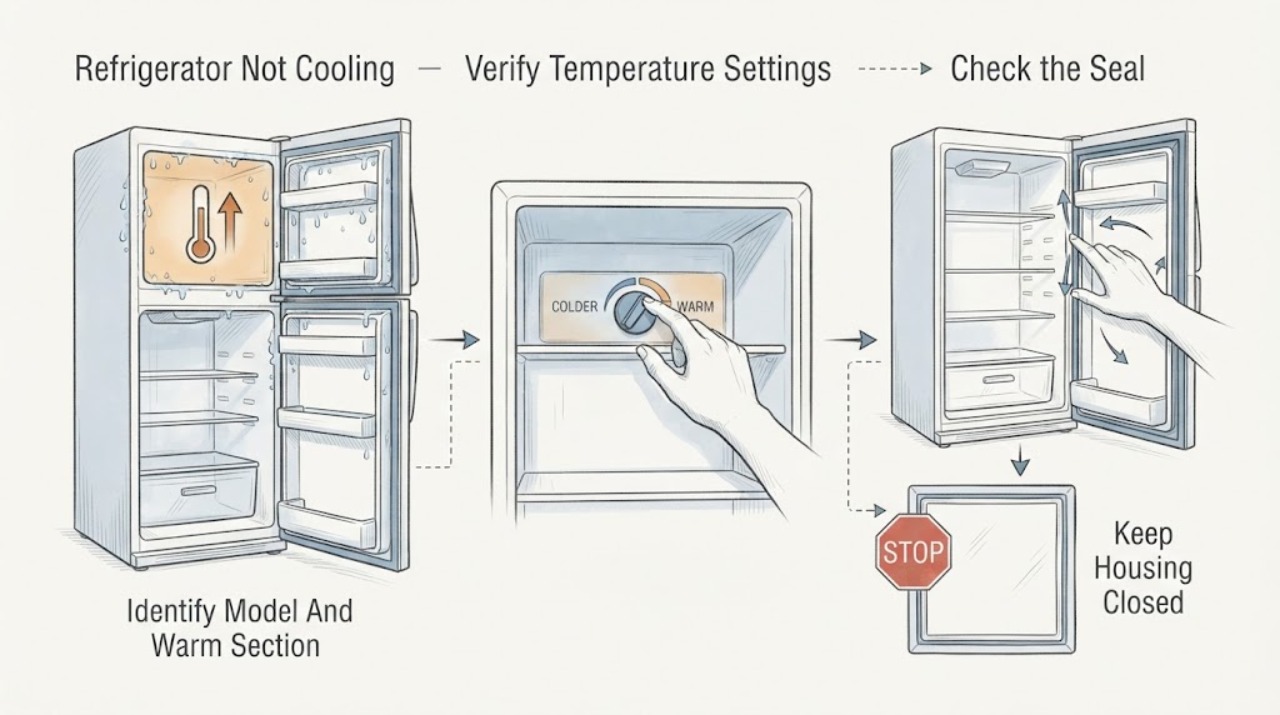
Start by recording the exact Kenmore model and the actual symptom: whether the refrigerator, freezer, or both sections are warming. Confirm the controls against the Kenmore guidance of 37–40°F for the refrigerator and 5°F for the freezer, then check that the doors close and that the gasket is not warped or torn. Kenmore also advises cleaning dust from condenser coils behind the refrigerator. These checks can correct a setting, seal, or heat-rejection problem, but they do not identify an internal fan, control, compressor, or sealed-system fault. Use the model manual for any model-specific control or access instruction, and arrange qualified service if the simple checks do not restore cooling or if there is a burning smell, smoke, water near electrical parts, a hot connection, or a repeated breaker trip.
Before you begin
Safety first
- The user may identify the model, read settings, inspect door closure and gasket surfaces, and clean accessible external coils with power disconnected when the model permits it. Qualified personnel must handle internal panels, live electrical tests, refrigerant, compressor, fan, defrost, control, and sealed-system work.
Work through in order
Diagnostic checks
Use only checks that match the exact appliance or system and its official guide.
-
Check 1
Read the complete Kenmore model number from the appliance label and retrieve its matching manual. Without opening panels, note whether the refrigerator section, freezer section, or both feel warm; record the displayed settings, any warning or error text, and whether the unit has recently been installed, moved, or left open.
Expected result: The model number or control layout is unknown, one compartment is warmer than the other, both sections are warm, or a warning/error state is displayed.
Next step: Use the exact manual to interpret the controls and any displayed state. Continue only with the external checks below; do not remove covers or attempt internal testing.
Why this matters
Why: The symptom is not yet tied to a specific Kenmore platform. Different models can use different controls and cooling layouts, so another model's reset or access procedure would be unreliable.
-
Check 2
Compare the displayed settings with Kenmore's general refrigerator guidance: 37–40°F for the refrigerator compartment and 5°F for the freezer. If the model uses different labels or ranges, follow its own manual instead. Do not judge cooling from a single item or from the display alone; note the compartment that is actually warming.
Expected result: A setting is warmer than the Kenmore guidance, the controls show a special mode or warning, the settings are already in range, or the model gives different instructions.
Next step: Correct only a clearly incorrect setting using the model's normal controls, then monitor the temperature trend without repeatedly changing settings. If the controls are in range and the compartment remains warm, continue to the door and coil checks.
Why this matters
Why: An incorrect setting or model-specific mode can explain a warm compartment, but settings already in range do not prove that the compressor, fan, or sealed system is healthy.
-
Check 3
Close each refrigerator and freezer door normally and inspect the gasket around the full visible perimeter for a twist, tear, gap, or section that is not contacting the cabinet. For an accessible edge, close the door on a strip of paper with part of the strip outside and gently pull; compare several clean, undamaged areas without forcing the door.
Expected result: The door is held open by a container or shelf, the gasket is dirty, warped, or torn, a visible gap remains, or the paper slips out easily at one or more areas.
Next step: Rearrange only the item that visibly blocks closure and clean the accessible gasket and mating surface with a suitable damp cloth. Do not reshape, heat, remove, or order a gasket without the exact model information; arrange service if the gasket, hinge, or door alignment is damaged.
Why this matters
Why: A physical obstruction or poor seal can admit warm room air and make the refrigerator work harder. A passing paper check does not rule out an internal cooling fault.
-
Check 4
From the outside and with the appliance safely disconnected before cleaning, look behind or beneath the refrigerator for accessible condenser coils covered with dust or lint. Keep hands, clothing, and tools away from fans, wiring, and the compressor; do not remove a rear cover or touch hot components.
Expected result: Accessible coils are visibly dusty, the area is blocked by stored items, the coils are not accessible on this model, or there is a hot connection, burning smell, smoke, water near electrical parts, or repeated breaker trip.
Next step: If there is no hazard, clear surrounding space and gently vacuum or wipe only the accessible external coil area as the model instructions permit. If cooling remains poor, or any hazard is present, keep the refrigerator off as appropriate and arrange qualified service.
Stop if: Stop immediately for smoke, burning odor, sparks, damaged wiring or cord, water near electrical parts, an unusually hot plug or connection, or a repeated breaker trip.
Why this matters
Why: Kenmore says dust on condenser coils can make the compressor work harder and hinder cooling. A hazard or inaccessible coil area is not an invitation to probe or disassemble the appliance.
-
Check 5
Record the model number, which compartment is warm, the settings, door/gasket observations, coil condition, displayed warnings, and any unusual sound or odor. Do not remove interior panels, perform energized electrical work, open sealed-system tubing, or attempt compressor, fan, control-board, or sealed-system repair.
Expected result: Settings are appropriate, doors seal and close, accessible coils are clean, but one or both compartments remain warm; or an internal component or electrical area would need access.
Next step: Keep the appliance in a safe state and contact Kenmore support or a qualified refrigeration technician with the model and recorded symptoms. Move perishable food according to applicable food-safety guidance; do not recreate a hazard to obtain a diagnosis.
Stop if: Do not continue testing after a leak near electrical parts, smoke, sparks, burning odor, abnormal heat, damaged power hardware, or a repeated breaker trip.
Why this matters
Why: The remaining fault may involve model-specific controls, airflow, a fan, compressor, defrost system, or sealed system, but these observations do not identify a part or make internal DIY safe.
Use your observations
Decision map
Find the observation that best matches what you see, then follow the next safe action.
-
PATH 01Next step
What you see
One or both compartments are warm, and a control is set warmer than the Kenmore guidance or the door was visibly left open or blocked.
Do this next
Restore the model-appropriate setting, remove the visible obstruction, close the door, and monitor without repeated control changes. Escalate if temperatures continue to rise.
Why this path and its safety boundary
Why it matters: A user-correctable setting or warm-air entry is more likely than a confirmed component failure, but the exact model still controls the valid range and modes.
-
PATH 02Next step
What you see
A gasket is torn, warped, visibly separated from the cabinet, or the paper-strip check slips out easily at multiple areas.
Do this next
Clean the accessible sealing surfaces and have the exact model's gasket, hinge, or alignment inspected if the gap persists. Do not heat or replace the gasket by appearance.
Why this path and its safety boundary
Why it matters: A poor door seal is a plausible source of warm-air entry and extra cooling load; the observation does not establish which gasket or hinge part fits.
-
PATH 03Next step
What you see
Accessible condenser coils behind or beneath the refrigerator are visibly coated with dust or lint, without any electrical or heat hazard.
Do this next
Clean only the accessible external coil area as the exact manual permits, then monitor. Use service if cooling remains poor or access requires cover removal.
Why this path and its safety boundary
Why it matters: Restricted heat rejection is plausible because Kenmore says dust on the coils makes the compressor work harder; this does not prove a compressor or sealed-system failure.
-
PATH 04Next step
What you see
Settings are appropriate, doors seal, and accessible coils are clean, but one or both sections remain warm or a warning persists.
Do this next
Stop owner troubleshooting and arrange qualified model-specific service. Preserve the model number and observations, and move food according to applicable food-safety guidance.
Why this path and its safety boundary
Why it matters: An internal control, fan, defrost, compressor, or sealed-system issue remains possible, but the public Kenmore guidance does not identify a safe cross-model test or compatible part.
Helpful context
Understand the symptom
Start with the exact model and the warm compartment
Kenmore's official manual page requires a model number to retrieve the matching manual. Record the full number and distinguish a warm refrigerator section from a warm freezer or a unit in which both sections are warming. Do not borrow a reset, control mode, panel location, or fan procedure from another Kenmore family.
Verify the settings and door seal
Kenmore's general guidance recommends 37–40°F for the refrigerator compartment and 5°F for the freezer. It also says to keep the door closed and inspect seals; a dollar-bill strip that slips out easily can indicate a loose seal. Use the exact model manual when the control layout or range differs.
Clean only accessible condenser coils
Dust behind the refrigerator can collect on condenser coils and make the compressor work harder, according to Kenmore. Disconnect power before any external cleaning, keep clear of fans and wiring, and clean only the accessible coil area permitted by the model instructions. A clean coil does not prove that internal cooling components are working.
Know when the checks are over
If the controls, door seal, and accessible coils are satisfactory but the compartment remains warm, stop before removing panels or testing electrical or sealed-system parts. Arrange qualified service with the model number and observations. Stop immediately for smoke, sparks, burning odor, water near electrical parts, abnormal heat, damaged power hardware, or repeated breaker trips.
Safety boundary
Stop conditions
- Stop immediately for smoke, sparks, burning odor, damaged wiring or cord, water near electrical parts, an unusually hot plug or connection, or a repeated breaker trip.
- Disconnect power before cleaning accessible external coils or handling any user-accessible area; keep hands and tools away from fans, wiring, and the compressor.
- Do not remove rear or interior panels, perform live electrical tests, handle refrigerant, or touch compressor, fan, defrost, or control components.
- Do not order a gasket, fan, control, compressor, or sealed-system part by appearance; verify the exact model and diagnosis first.
When checks do not resolve it
Need a professional?
Arrange qualified Kenmore or refrigeration service when the exact model's settings are appropriate, the doors and gaskets close and seal, and accessible condenser coils are clean but the refrigerator or freezer remains warm. Call urgently for smoke, sparks, burning odor, water near electrical parts, abnormal heat, damaged power hardware, or repeated breaker trips.
Safety scope: The user may identify the model, read settings, inspect door closure and gasket surfaces, and clean accessible external coils with power disconnected when the model permits it. Qualified personnel must handle internal panels, live electrical tests, refrigerant, compressor, fan, defrost, control, and sealed-system work.
Common questions
FAQ
What temperature should a Kenmore refrigerator be set to?
Kenmore's general refrigerator guidance recommends 37–40°F for the refrigerator compartment and 5°F for the freezer. Follow the exact model manual if its controls or instructions differ, and do not assume a displayed setting proves the food compartment has reached that temperature.
Can a Kenmore refrigerator door seal cause poor cooling?
Yes, a warped or torn seal can let cold air escape. Check for a visible gap and use a gentle paper-strip check on clean areas as Kenmore describes. If the gasket or door alignment is damaged, use the model number before selecting a part or adjustment.
Should I clean the condenser coils if my Kenmore refrigerator is not cooling?
If the coils are accessible and there is no hazard, Kenmore advises cleaning dust from condenser coils behind the refrigerator because dust makes the compressor work harder. Disconnect power first and follow the exact manual; do not remove covers or touch wiring just to reach hidden components.
What if the freezer is cold but the refrigerator section is warm?
First record the model and check the refrigerator setting, door seal, and visible obstructions without opening panels. The public Kenmore guidance does not establish a cross-model airflow or fan test, so persistent warming after those checks needs model-specific service rather than a borrowed fan or damper procedure.
When should I stop using a Kenmore refrigerator that is not cooling?
Arrange service when appropriate settings, a closing door, and clean accessible coils do not restore cooling. Stop immediately for smoke, sparks, burning odor, water near electrical parts, an unusually hot plug or connection, damaged wiring, or a repeated breaker trip. Do not remove panels, test live voltage, handle refrigerant, or work on the compressor or sealed system.
Read the exact guide
Official sources
- Kenmore ManualsKenmore · Official Kenmore manual lookup; it is used as a model-identity gate and does not itself define a generic cooling diagnosis.
- Customer Care & SupportKenmore · Official Kenmore support navigation; it does not authorize internal electrical or sealed-system repair.
- Tips for Running Your Fridge More EfficientlyKenmore Livemore · Official Kenmore guidance for general refrigerator upkeep; it supports the listed external checks but does not identify internal components or model-specific repair procedures.
Community feedback
Share a repair observation
Share a plain-text repair observation. Accepted observations are published automatically; this page may take a moment to update.