
On this page
Start here
Quick answer
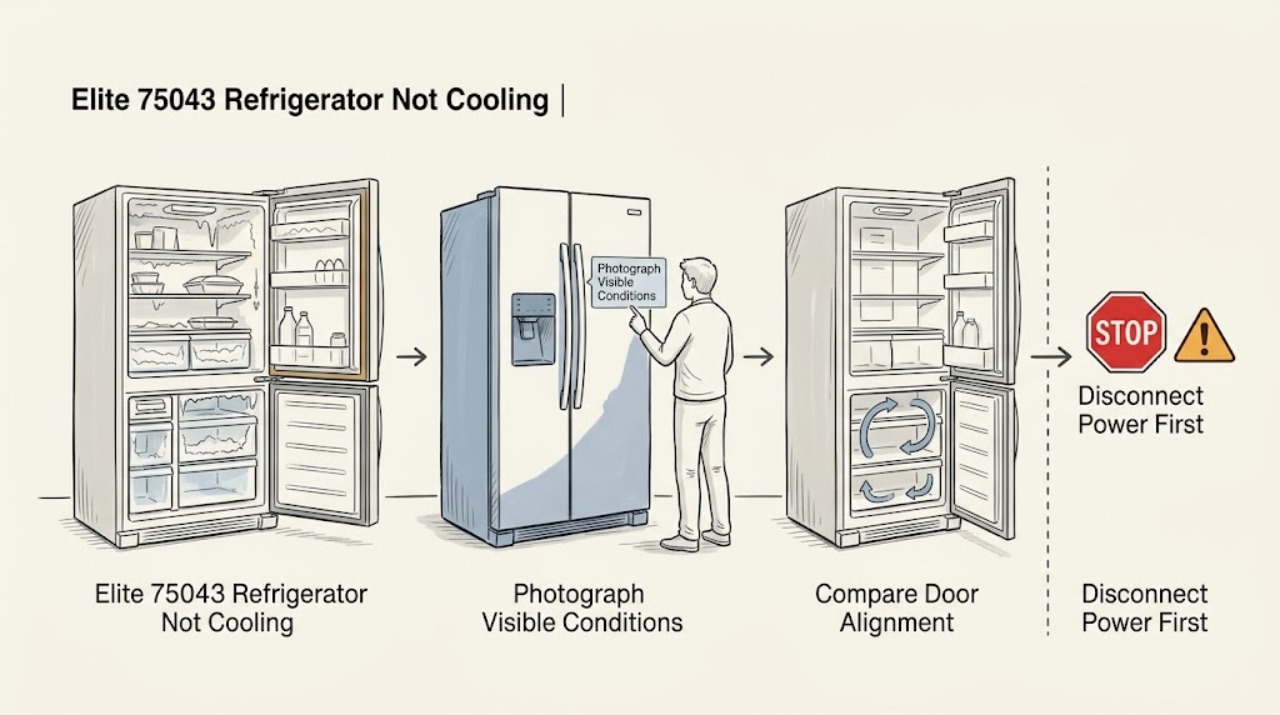
Treat the eight-hour freezer-door opening as both a food-safety event and a possible frost/airflow problem. Move perishable food to a working refrigerator or cooler, keep the doors closed, and check food or appliance temperatures with a thermometer; FDA guidance says the refrigerator should be at or below 40°F and the freezer at 0°F. Then read the complete model label: Kenmore's manual page says model numbers are at least 11 characters, so 75043 alone is not enough to assume a French-door or LG platform. Check the visible gasket, door closure, accessible vents and frost without removing panels. A short warm period after warm air entered does not prove a failed compressor, but if temperatures do not trend down after the door is sealed, or frost blocks airflow or both compartments remain warm, stop owner diagnosis and arrange model-specific service.
Before you begin
Safety first
- Do not remove interior or rear panels, chip or heat frost, probe wiring, access a fan or compressor, open sealed-system tubing, or select a replacement part from the open-door event or a sound. Keep doors closed, disconnect power before any manual-approved cleaning, and stop immediately for electrical, water or fire hazards.
Work through in order
Diagnostic checks
Use only checks that match the exact appliance or system and its official guide.
-
Check 1
Move meat, poultry, seafood, eggs, leftovers and other perishables to a known-cold refrigerator or cooler. Check the food and both compartments with an appliance or food thermometer if available, and do not taste food to decide whether it is safe.
Expected result: Food is still at or below 40°F, frozen food still has ice crystals, food is above 40°F, or the time/temperature is unknown.
Next step: Keep food in the working cold source. Follow FDA discard guidance for perishables that have been above 40°F for more than two hours or whose exposure cannot be determined; do not wait for the appliance to recover before making the food decision.
Why this matters
Why: FDA says the refrigerator should be at or below 40°F and the freezer at 0°F; food that still has ice crystals or is 40°F or below may be refrozen or cooked, while uncertain time/temperature should not be treated as safe from appearance or smell alone.
-
Check 2
Read and photograph the complete Kenmore rating label, including the model suffix, then record whether the refrigerator section, freezer section, or both are warm, the current displayed settings, and any warning or alarm. Do not assume that 75043 alone identifies a French-door or LG layout.
Expected result: The full model can be read and matches a manual, or only the short 75043 identity is available and the platform/layout is uncertain.
Next step: Use the full label in Kenmore's manual lookup. Until it is matched, use only the external checks below and do not apply a different LG or Kenmore model's procedure.
Why this matters
Why: Kenmore says its manuals are retrieved by entering the full model number and that model numbers are at least 11 characters. A partial model cannot safely determine a reset, temperature range, damper location, or service part.
-
Check 3
Close the freezer and refrigerator doors normally and inspect the visible gasket perimeter, hinge side and shelves for a container, drawer or ice buildup holding a door open. Clean only accessible sealing surfaces with a damp cloth; do not heat, reshape or remove the gasket.
Expected result: A door still fails to close, a gasket is torn/warped or separated, visible frost bridges the seal or vents, or both doors close with no visible obstruction.
Next step: Remove only a visible closure obstruction and keep the doors closed. If the seal is damaged or frost blocks an opening, follow the exact manual or arrange service; do not remove interior panels or chip ice.
Why this matters
Why: A remaining gap continues warm-air entry and can sustain frost and poor cooling. A clear seal does not rule out a hidden airflow, defrost, fan or sealed-system fault.
-
Check 4
With the appliance in a safe state, inspect only visible interior vents and shelves for food blocking cold-air circulation. Look for a thin film of frost versus a thick, continuous frost sheet; do not pry ice, use a hair dryer, or remove an evaporator cover.
Expected result: Visible vents are blocked by food, a thick frost sheet covers an air path, only light frost is visible, or no frost/obstruction is visible.
Next step: Rearrange only food that visibly blocks a vent. For thick frost or persistent warmth, keep doors closed and use the exact manual or qualified service; do not thaw hidden parts with heat or disassembly.
Why this matters
Why: A blocked vent or heavy frost can explain uneven cooling after humid air entered, but its location and cause cannot be diagnosed from the outside. No visible frost does not prove the cooling system is healthy.
-
Check 5
Record compartment temperatures at consistent intervals while the doors remain closed, without repeatedly changing settings. If the manual permits an external coil check, look for accessible dust or lint with power disconnected; do not remove a rear cover or touch a fan, compressor, wiring or refrigerant tubing.
Expected result: Temperatures trend down, remain flat or rise; accessible coils are dusty, inaccessible, or there is smoke, a burning odor, water near electrical parts, abnormal heat or a repeated breaker trip.
Next step: If the trend is not improving, stop owner troubleshooting and arrange qualified refrigeration service with the full model and temperature log. Stop immediately for an electrical or fire symptom and keep clear of the appliance.
Why this matters
Why: A downward temperature trend supports recovery monitoring after the open-door event. Flat or rising temperatures after the seal and external checks leave an internal airflow, defrost, control, compressor or sealed-system issue possible, but do not identify a part.
Use your observations
Decision map
Find the observation that best matches what you see, then follow the next safe action.
-
PATH 01Next step
What you see
Food remains at or below 40°F, frozen packages still have ice crystals, the doors now seal, and measured compartment temperatures show a downward trend.
Do this next
Keep the doors closed and continue monitoring with a thermometer. Do not repeatedly change settings or reload the freezer while recovery is being observed.
Why this path and its safety boundary
Why it matters: The appliance may be recovering from the warm-air event, and the food-safety state is more favorable than a fully thawed or unknown-temperature load.
-
PATH 02Next step
What you see
A thick frost sheet blocks a visible vent or air path, a door remains ajar, the gasket is damaged, or a shelf/container prevents full closure.
Do this next
Correct only a visible obstruction and follow the complete model manual. Do not chip ice, heat the liner, remove panels or order a part by appearance; arrange service if the seal or frost problem persists.
Why this path and its safety boundary
Why it matters: Warm-air entry or restricted circulation remains a plausible cause, but the observation does not prove a defrost part, damper, fan or gasket model.
-
PATH 03Next step
What you see
The doors seal, no visible vent obstruction is present, but freezer and/or refrigerator temperatures remain flat or rise after the door-open event, or the appliance is making an unusual electrical or mechanical symptom.
Do this next
Move food to a working cold source, keep the Kenmore off if a safety symptom is present, and arrange qualified model-specific refrigeration service with the temperature trend and exact model label.
Why this path and its safety boundary
Why it matters: The open door may have exposed or aggravated an internal cooling problem, but sound, warmth or an open-door history cannot identify a compressor, fan, board, defrost or sealed-system failure.
-
PATH 04Next step
What you see
Food was above 40°F for more than two hours or its exposure time and temperature cannot be established.
Do this next
Discard the affected perishable food according to FDA guidance, keep replacement food in a known-cold appliance, and troubleshoot the refrigerator separately.
Why this path and its safety boundary
Why it matters: Food safety cannot be decided from smell, appearance or the refrigerator's eventual recovery.
Helpful context
Understand the symptom
Do not assume the platform from 75043
The title describes a Kenmore Elite 75043 and an LG French-door refrigerator, but that wording does not establish the exact product family. Kenmore's own manual lookup says to enter the full model number and notes that model numbers are at least 11 characters. Read every character on the rating label before applying a layout, reset sequence, or airflow instruction from another Kenmore or LG model.
Why it may stay warm after the door was ajar
An open freezer door admits warm, humid room air. That can soften food and create visible frost around an air path, but it does not by itself identify a compressor, fan, defrost, or sealed-system failure. The useful distinction is whether the doors now seal, whether frost or stored food blocks visible circulation, and whether measured temperatures show a downward trend after the event.
When checks do not resolve it
Need a professional?
Arrange qualified Kenmore or refrigeration service when temperatures do not trend down after the doors seal and visible obstructions are removed, a thick frost sheet returns, both compartments remain warm, the exact platform cannot be matched, or a gasket/hinge/airflow issue needs disassembly. Seek urgent help for smoke, sparks, burning odor, water near electrical parts, abnormal heat, damaged power hardware or a repeated breaker trip.
Safety scope: Do not remove interior or rear panels, chip or heat frost, probe wiring, access a fan or compressor, open sealed-system tubing, or select a replacement part from the open-door event or a sound. Keep doors closed, disconnect power before any manual-approved cleaning, and stop immediately for electrical, water or fire hazards.
Have this ready
- Provide the complete model and serial label, whether the freezer and refrigerator are French-door, bottom-freezer or another layout, the eight-hour door-open history, food and compartment temperatures, visible frost/vent/gasket observations, settings, alarms and unusual sounds. Ask the technician to verify the model-specific airflow and cooling diagnosis before naming a part.
Common questions
FAQ
Is Kenmore Elite 75043 definitely an LG French-door refrigerator?
The short 75043 reference is not enough to establish the exact platform. Kenmore says its manual lookup requires the complete model number, so read the full rating label before using French-door or LG-specific instructions.
How long should the refrigerator take to recover after the freezer was open for eight hours?
Do not use an invented recovery deadline. Keep the doors closed and monitor actual refrigerator and freezer temperatures with a thermometer. A clear downward trend supports monitoring; flat or rising temperatures after the external checks need service.
Can I keep food that partially thawed?
FDA guidance says frozen food that still has ice crystals or is at or below 40°F can be refrozen or cooked. Perishables above 40°F for more than two hours, or with unknown exposure, should not be kept merely because they look or smell normal.
Read the exact guide
Official sources
- Find Your Manual | Kenmore Appliance Manuals & GuidesKenmore · Kenmore states that owners should enter the model number to access manuals and resources, and that model numbers are at least 11 characters; this prevents treating 75043 as a complete platform identity.
- Customer Care & Support | Kenmore AppliancesKenmore · Kenmore's Customer Care page provides warranty/repair information and links to product manuals, recalls, safety/compliance and repair services; use the exact appliance information when requesting support.
- Refrigerator Thermometers - Cold Facts about Food SafetyU.S. Food and Drug Administration · FDA states that a refrigerator should be at or below 40°F and the freezer at 0°F, recommends appliance thermometers, says frozen food with ice crystals or at 40°F or below can be refrozen or cooked, and says uncertain or over-two-hour exposure above 40°F should not be treated as safe.
Community feedback
Share a repair observation
Share a plain-text repair observation. Accepted observations are published automatically; this page may take a moment to update.