
On this page
Start here
Quick answer
For a Kenmore 106 50043 717 that freezes food and later seems unable to stay cold, measure the room and both compartments before changing controls or suspecting a part. The exact Kenmore model number and manual must be confirmed first; Kenmore's manual portal says to search by the model number without special characters. As an environmental comparison only, Whirlpool's general refrigerator guidance warns that operation outside its stated ambient range can cause improper temperatures and fluctuations, and that very cold rooms can change cooling cycles. Keep the refrigerator away from a direct draft only if it can be done safely and the exact manual permits it, then check an appliance thermometer in the center of each compartment after stabilization. If the room is stable, settings are model-appropriate, the doors seal, vents are clear, and temperatures still swing or remain unsafe, stop owner troubleshooting and arrange qualified refrigerator service.
Before you begin
Safety first
- Do not add external heat, block ventilation, remove interior or rear covers, perform energized electrical work, bypass a control, open sealed-system tubing, or attempt compressor, fan, defrost, or refrigerant repair. Keep the appliance off for smoke, sparks, burning odor, abnormal heat, water near electrical parts, damaged power hardware, or repeated breaker trips.
Work through in order
Diagnostic checks
Use only checks that match the exact appliance or system and its official guide.
-
Check 1
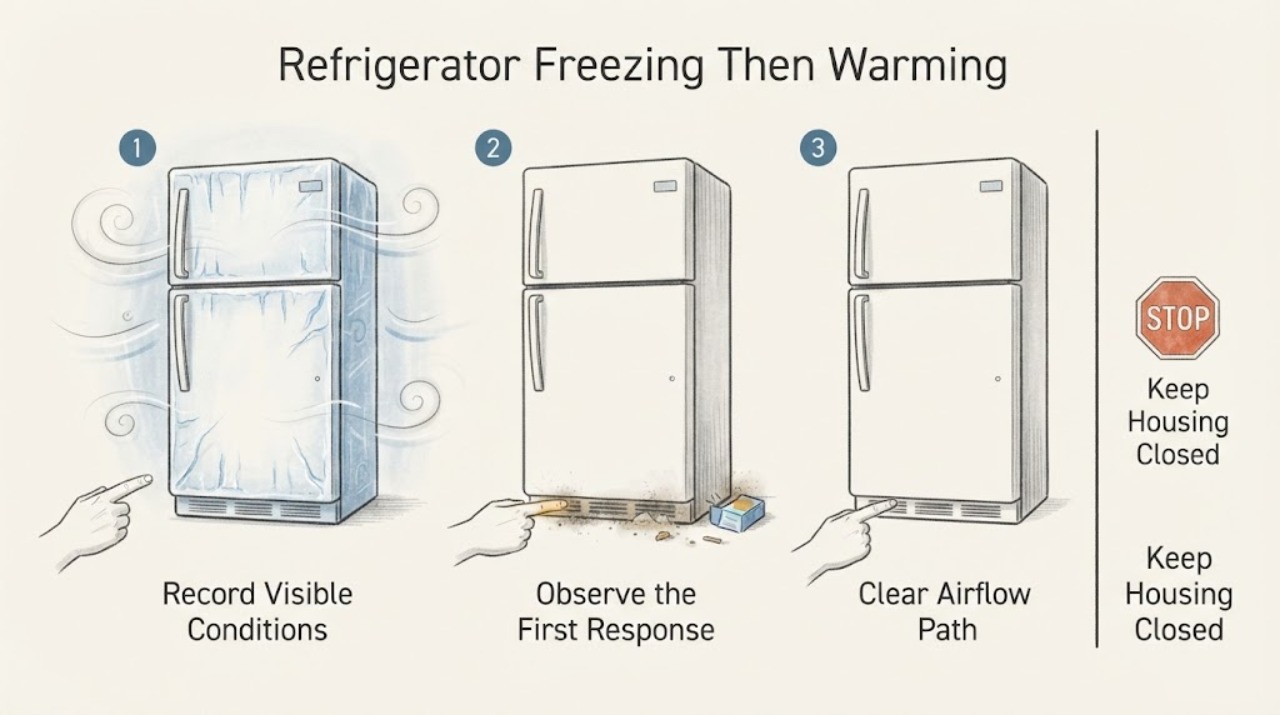
Read the complete rating-plate model, including every digit and suffix, and enter the model as 10650043717 in Kenmore's official manual search because its portal instructs users to search model numbers without special characters. Without opening panels, record whether the refrigerator section, freezer section, or both are warm, which items are freezing, the displayed settings, and the coldest room temperature beside the appliance. Note whether an exterior door, window, HVAC outlet, or walkway creates a direct draft across the cabinet.
Expected result: The rating plate confirms 106 50043 717 and the room stays stable, or the model cannot be matched, the room drops well below ordinary indoor conditions, or a draft reaches the cabinet or base grille.
Next step: If the model is confirmed and the exact manual allows the location, stabilize the room and stop the direct draft without adding heat or blocking ventilation, then monitor. If the model cannot be confirmed, keep all model-specific adjustments on hold and arrange model identification or service.
Stop if: Do not pull the refrigerator, remove covers, or handle a damaged cord, water line, plug, or grille to investigate the draft.
Why this matters
Why: A missing model match prevents safe transfer of another Kenmore or Whirlpool control procedure. Whirlpool's general guidance says that very cold rooms can change refrigerator cycling and that operation outside its stated 55°F to 110°F range can produce improper temperatures or fluctuations; this does not establish the exact Kenmore rating.
-
Check 2
Place an appliance thermometer in the center of the refrigerator compartment away from walls, doors, and vents, and another between frozen packages. Leave the doors closed as much as practical and record readings after the exact manual's stabilization period; as a general Whirlpool reference, allow 24 hours after one small control change before judging a new trend.
Expected result: The center refrigerator temperature is in the model's documented range while only food near a vent freezes; the refrigerator is actually too warm; the freezer is too warm; or readings swing substantially between checks.
Next step: Use the Kenmore manual's exact set points and make at most one normal control change, then recheck after stabilization. Do not keep making colder or warmer changes when the measured trend is unstable; use the branch below and service boundary instead.
Stop if: If perishable food has been above 40°F for more than 2 hours, follow the opened Whirlpool food-safety guidance and discard it; do not taste food to decide whether it is safe.
Why this matters
Why: A single frozen item or a display setting cannot distinguish a local cold spot from a compartment-wide failure. Actual compartment readings establish whether the food-safety risk is warming, whether over-cooling is localized, and whether the cold-draft condition is still confounding the result.
-
Check 3
With the appliance stopped and the doors open only briefly, inspect the visible refrigerator and freezer vents and the placement of food. Move only food or containers that are directly against a vent or back wall; do not remove an interior cover or insert cardboard or insulation into an opening. Pay special attention to the exact pattern: frozen items near the cold-air path versus freezing throughout the refrigerator compartment.
Expected result: Only items directly in a vent path freeze and the center thermometer is acceptable, or the vents are blocked, the entire refrigerator compartment is too cold, or both compartments are warm.
Next step: Clear the visible obstruction and keep temperature-sensitive food out of the direct vent stream, then recheck the center readings after stabilization. If the whole compartment is too cold or both sections are warm despite clear vents, continue to the environment, door, coil, and service decisions rather than guessing a part.
Why this matters
Why: Whirlpool explains that cold air moves between compartments through vents and that items placed directly in this airflow can freeze; blocked vents can also create uneven temperatures. That observation supports an airflow or placement branch, not a diagnosis of a damper, fan, or control board.
-
Check 4
Close the refrigerator and freezer doors normally and inspect the full visible gasket perimeter for a twist, tear, separation, dirt, or a container preventing closure. At several clean, undamaged edges, close the door on a strip of paper and gently pull; do not heat, reshape, remove, or order a gasket based on appearance alone.
Expected result: A door does not close fully, a visible gap remains, the gasket is torn or warped, or the paper slips easily at repeated areas; alternatively, the door closes and the gasket makes even contact.
Next step: Rearrange only the item that blocks closure and clean accessible sealing surfaces with a suitable damp cloth. If a gap or damage remains, preserve the exact model information for a model-specific gasket, hinge, or alignment inspection; do not select a replacement by shape.
Why this matters
Why: A closure problem can admit room air and cause temperature fluctuation, but a passing paper check does not prove that internal cooling is healthy. A cold draft can make the outside condition unusual, while a damaged seal is a separate physical finding.
-
Check 5
If the exact manual permits owner cleaning, disconnect power from a safe dry position before looking behind or beneath the refrigerator for accessible condenser coils coated with dust or lint. Keep hands, clothing, and tools away from fans, wiring, and the compressor; do not remove a rear cover or touch hot components.
Expected result: Accessible coils are visibly dusty but there is no hazard, the coil area is inaccessible, or there is water near electrical parts, an unusually hot plug or connection, smoke, a burning odor, damaged wiring, sparks, or a repeated breaker trip.
Next step: Only when the area is safe and the exact manual permits it, gently vacuum or wipe the accessible external coil area, restore the grille, and monitor. If cooling remains poor, access requires cover removal, or any hazard is present, leave internal diagnosis to qualified service.
Stop if: Stop immediately for smoke, burning odor, sparks, damaged wiring or cord, water near electrical parts, abnormal heat, or a repeated breaker trip.
Why this matters
Why: Whirlpool's not-cooling guidance says dust on accessible condenser coils can make the compressor work harder, but coil condition does not identify a compressor or sealed-system failure. Electrical, heat, or water hazards change this from a cleaning check to a stop condition.
-
Check 6
After the room has been stabilized and the safe external checks are documented, record the exact model, minimum and typical room temperature, draft source, compartment thermometer readings and times, settings, vent pattern, door/gasket result, coil condition, unusual sounds, and any warning. Do not remove interior panels, perform energized electrical work, open sealed-system tubing, or attempt compressor, fan, control, defrost, or refrigerant repair.
Expected result: The refrigerator and freezer reach and hold model-appropriate temperatures after the environment and visible airflow issue are corrected, or readings remain unsafe/unstable despite stable room conditions and safe external checks.
Next step: For persistent or recurring instability, arrange qualified Kenmore or refrigeration service and provide the measurement log. Move perishable food to a safe appliance while waiting and do not recreate the cold-draft or warming condition just to obtain another symptom.
Stop if: Keep the refrigerator disconnected as appropriate and seek urgent qualified help for smoke, sparks, burning odor, abnormal heat, water near electrical parts, damaged power hardware, or repeated breaker trips.
Why this matters
Why: Recovery only after the environmental variable is removed supports an environmental contribution but does not certify the appliance. Persistent compartment-wide instability after the external checks leaves model-specific controls, airflow, defrost, compressor, or sealed-system causes possible without identifying a part.
Use your observations
Decision map
Find the observation that best matches what you see, then follow the next safe action.
-
PATH 01Next step
What you see
The room repeatedly falls outside the exact manual's allowed range or has a direct draft, and the refrigerator's compartment temperatures improve and stabilize after the environment is corrected without a safety hazard.
Do this next
Keep the refrigerator in a stable, manual-approved location and recheck temperatures after stabilization. If the same instability returns under stable conditions, arrange model-specific service.
Why this path and its safety boundary
Why it matters: The environment is a credible contributor to the freezing-then-warming pattern, but it is not proof that every internal component is sound.
-
PATH 02Next step
What you see
The room is stable, the center refrigerator and freezer readings remain outside the exact model's documented range or swing over time, and changing the environment does not correct them.
Do this next
Stop owner troubleshooting and arrange qualified Kenmore or refrigeration service with the model and temperature log; do not enter service mode or open the sealed system.
Why this path and its safety boundary
Why it matters: This pattern is no longer explained by a draft alone. An internal control, airflow, defrost, fan, compressor, or sealed-system issue remains possible, but the observations do not identify which part fits.
-
PATH 03Next step
What you see
The center refrigerator reading is acceptable, but only food directly in a freezer-air path freezes while vents or food placement are visibly involved.
Do this next
Clear the visible obstruction and keep sensitive food out of the direct vent path, then verify the center reading after stabilization. Escalate if the whole compartment freezes or the temperature remains unstable.
Why this path and its safety boundary
Why it matters: A local airflow or placement issue is more likely than a compartment-wide cooling failure; the pattern does not establish a damper or fan fault.
-
PATH 04Next step
What you see
Perishables have measured above 40°F for more than 2 hours, or the appliance has smoke, sparks, burning odor, abnormal heat, water near electrical parts, damaged power hardware, or a repeated breaker trip.
Do this next
Move or discard food according to the opened Whirlpool safety guidance, keep the appliance off, and obtain qualified refrigeration or electrical help as appropriate. Do not restart it to reproduce the condition.
Why this path and its safety boundary
Why it matters: Food safety or electrical/fire safety takes priority over further diagnosis. Temperature, smell, and appearance cannot certify a hazardous food or appliance state.
Helpful context
Understand the symptom
The symptom has two parts: the fresh-food compartment may freeze items, yet the refrigerator later does not maintain a stable cold temperature. A cold draft is a real variable, but it does not identify a thermostat, fan, gasket, compressor, or sealed-system part. First separate a room-condition problem from an internal appliance problem with measurements and a time trend. Whirlpool's public guidance is used below only as general refrigeration guidance; the exact Kenmore manual controls the valid settings and location requirements for 106 50043 717.
Do not warm the cabinet with a heater, cover a grille, block an air vent, repeatedly change controls, or move a loaded refrigerator in a way that can damage the floor, cord, water line, or doors. If the refrigerator compartment has been above a safe food temperature, protect the food first and do not rely on smell or appearance alone.
When checks do not resolve it
Need a professional?
Call qualified Kenmore or refrigeration service for persistent or recurring compartment-wide temperature instability after stable-room and safe external checks, an unconfirmed model-specific control situation, damaged door alignment or gasket that does not close, or any internal component diagnosis.
Safety scope: Do not add external heat, block ventilation, remove interior or rear covers, perform energized electrical work, bypass a control, open sealed-system tubing, or attempt compressor, fan, defrost, or refrigerant repair. Keep the appliance off for smoke, sparks, burning odor, abnormal heat, water near electrical parts, damaged power hardware, or repeated breaker trips.
Have this ready
- Provide a photo or transcription of the full rating plate, the exact manual lookup result, market/location, room temperature range, draft source, compartment thermometer readings and times, settings, vent and gasket observations, coil condition, warnings, odors, and any food-safety action already taken.
Common questions
FAQ
Does a cold draft prove that the Kenmore thermostat or compressor is bad?
No. It is an environmental confounder. Measure the room and compartment temperatures, stabilize the location if the exact manual allows it, and use the resulting trend to decide whether qualified service is needed.
Why can food freeze while the refrigerator later seems warm?
Food next to a freezer-air vent can freeze while the center of the compartment is in range. A cold room can also alter cycling on some refrigerator designs. Measure the center, keep vents clear, and do not infer a part from one frozen item.
Read the exact guide
Official sources
- What to Check if the Refrigerator Section is Too ColdWhirlpool Product Help · General Whirlpool refrigerator guidance for a too-cold fresh-food section; use only as a cross-model mechanism comparison.
- What is the Proper Location and Environment for a RefrigeratorWhirlpool Product Help · General Whirlpool full-size refrigerator location and ambient guidance; not an exact Kenmore 106 50043 717 manual.
- Not CoolingWhirlpool Product Help · General Whirlpool full-size refrigerator not-cooling checks; not an exact Kenmore 106 50043 717 manual.
- What to Do During a Power OutageWhirlpool Product Help · General Whirlpool refrigerator food-safety temperature guidance; not a Kenmore model-specific operating manual.
- Preventing Food from Freezing in the RefrigeratorWhirlpool Product Help · General Whirlpool refrigerator airflow and fresh-food freezing guidance; not proof of exact Kenmore component identity.
- Tips for Properly Setting the ControlsWhirlpool Product Help · General Whirlpool refrigerator temperature measurement and stabilization guidance; not a Kenmore 106 50043 717 control manual.
- Find Your Manual | Kenmore Appliance Manuals & GuidesKenmore / Transform SR Brands · Kenmore model-number lookup and manuals portal; use the complete appliance model to retrieve the matching documentation.
Community feedback
Share a repair observation
Share a plain-text repair observation. Accepted observations are published automatically; this page may take a moment to update.