
On this page
Start here
Quick answer
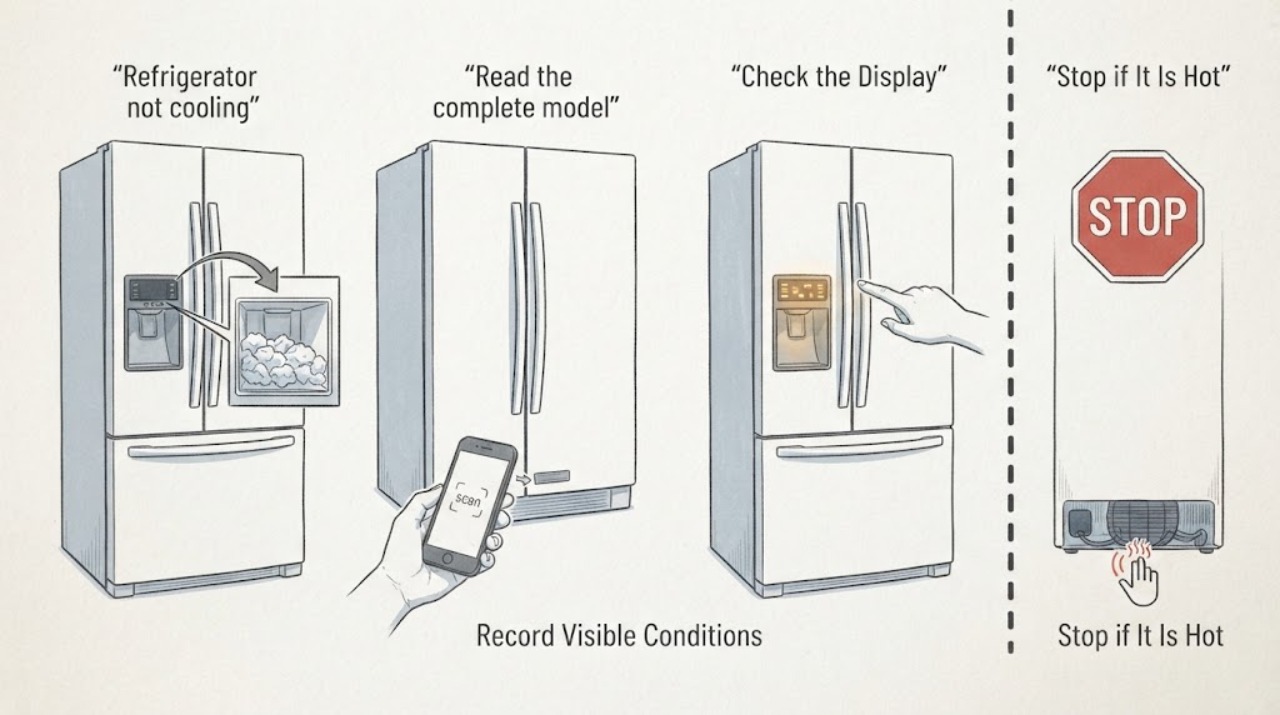
The supplied Kenmore 795.7409 identifier is a family prefix, not a complete model number: Kenmore's own manual lookup says model numbers must be at least 11 characters, so do not use another 795 platform's manual or order a compressor from this string alone. First measure the refrigerator and freezer separately with an appliance thermometer, check the controls and any special mode, and confirm that doors, gaskets, and interior vents are not allowing or blocking airflow. Kenmore's care guidance also points to clean accessible condenser coils and intact door seals. Record whether the indoor ice maker is still producing ice, but that observation does not prove a compressor problem; it may simply show that the cooling or water/ice system needs separate diagnosis. Keep perishables at or below 40°F and frozen food at 0°F; move or discard food when those limits or the safe time are uncertain. If both sections remain warm after the safe external checks, or there is water near electrical parts, smoke, burning odor, abnormal heat, or a repeated breaker trip, stop and arrange qualified refrigerator service.
Work through in order
Diagnostic checks
Use only checks that match the exact appliance or system and its official guide.
-
Check 1
Read the complete model and serial label inside the refrigerator compartment, including every character after 795.7409. Do not assume that 795.7409 alone is a service model or that another 795-series manual applies.
Expected result: The label supplies a longer exact model, or only the partial 795.7409 prefix can be confirmed.
Next step: Use the complete label for the model manual and service request. Until then, stay with the external symptom checks below and do not order a compressor or control part.
Why this matters
Why: Kenmore's own manual page says model numbers must be at least 11 characters, so the partial value cannot safely establish exact controls, cooling layout, or compatible parts.
-
Check 2
Place an appliance thermometer in the middle of the refrigerator compartment and another among freezer contents. Record both readings after the thermometers have stabilized, along with the control display and whether the indoor ice maker is producing ice.
Expected result: The freezer is cold while the refrigerator is warm, both sections are warm, or the display looks normal but thermometer readings are unsafe; ice production is normal, reduced, or absent.
Next step: Keep the doors closed and protect food while continuing with settings, door, and airflow checks. If both sections remain above safe temperatures, plan qualified service rather than a guessed part.
Why this matters
Why: The compartment split is more useful than the word compressor: it separates an airflow or refrigerator-section problem from a whole-appliance cooling problem. Ice production alone does not prove or rule out a compressor fault.
-
Check 3
Check the temperature controls and any visible vacation, demo, lock, or similar mode using only the normal controls. Compare settings with the exact manual once the full model is known; do not repeatedly change the setting while temperatures are being measured.
Expected result: A special mode or clearly warm setting is active, or the controls appear normal but measured temperatures remain high.
Next step: Correct only a clearly incorrect setting or mode, then monitor without repeated resets. If the temperatures do not recover, continue to the visible seal, load, and coil checks and prepare for service.
Why this matters
Why: A setting or mode can explain warming without proving a component failure. Normal controls with unsafe measured temperatures shift the problem toward airflow, defrost, fan, power, or sealed-system diagnosis.
-
Check 4
Close both doors normally and inspect the full visible gasket perimeter for tears, warping, dirt, or gaps. Move only containers that visibly block the door or interior air vents; do not reshape, heat, remove, or buy a gasket without the complete model.
Expected result: A door does not close flush, the gasket has a persistent gap or damage, food blocks an air path, or the seals and vents appear clear.
Next step: Clean an accessible gasket and clear a plainly blocked vent or door path, then monitor. Have damaged alignment or a persistent gap inspected against the exact model manual.
Why this matters
Why: Warm-air entry or blocked circulation can raise temperatures and make the refrigerator run longer. A good visible seal does not identify or exclude an internal cooling fault.
-
Check 5
With power safely disconnected before cleaning, look from the outside for accessible condenser coils covered with dust or lint and for stored items blocking ventilation. Keep hands and tools away from fans, wiring, and the compressor; do not remove a rear cover or open the sealed system.
Expected result: Accessible coils are dusty or ventilation is blocked, or the coils are inaccessible/clean while one or both sections remain warm.
Next step: Clear surrounding space and clean only accessible coil surfaces as the complete model manual permits. If access needs a cover removed, or cooling remains poor, stop owner troubleshooting and arrange qualified service.
Why this matters
Why: Kenmore says dust on condenser coils makes the compressor work harder, but coil condition does not prove the compressor itself failed. Clean coils and persistent warming require professional diagnosis.
-
Check 6
Record whether the compressor or fans seem to run continuously, click repeatedly, or remain silent, and whether ice production changed at the same time. Do not touch the compressor, force a fan, bypass a door switch, use a meter on powered wiring, add refrigerant, or open tubing.
Expected result: The refrigerator runs constantly, makes repeated clicks or unusual noise, is silent despite unsafe temperatures, or the indoor ice maker changed at the same time.
Next step: Keep the appliance and food safe, preserve the exact temperature trend and model label, and arrange qualified refrigeration service when temperatures stay unsafe or the abnormal sound persists.
Why this matters
Why: These observations help a technician choose a diagnostic path but cannot identify a compressor, relay, fan, control, defrost, or sealed-system failure. The ice-maker timing is correlation, not proof of a common failed part.
Use your observations
Decision map
Find the observation that best matches what you see, then follow the next safe action.
-
PATH 01Next step
What you see
The refrigerator is warm but the freezer is at a safe temperature, while a visible vent, door seal, or loading problem is present.
Do this next
Clear only the visible obstruction, clean the accessible gasket, and monitor temperatures with both doors closed. Escalate if the refrigerator section remains unsafe.
Why this path and its safety boundary
Why it matters: A compartment airflow or warm-air-entry problem is more plausible than a proven whole-system compressor failure.
-
PATH 02Next step
What you see
Both refrigerator and freezer temperatures are unsafe, the ice maker is no longer producing ice, and settings, doors, vents, and accessible coils do not explain the change.
Do this next
Move or discard food according to the measured temperatures and safe time, then arrange qualified Kenmore/refrigeration service with the complete model label and observations.
Why this path and its safety boundary
Why it matters: A whole-appliance cooling, power, fan, defrost, or sealed-system issue remains possible, but the incomplete 795.7409 identifier and ice-maker symptom do not establish a compressor failure.
-
PATH 03Next step
What you see
The control display looks normal but thermometer readings remain high, or the unit runs constantly, clicks repeatedly, or makes an unusual sound.
Do this next
Stop changing settings and do not perform internal tests. Preserve the sound pattern and temperature trend for qualified diagnosis.
Why this path and its safety boundary
Why it matters: A display or compressor sound cannot substitute for temperature measurement and does not safely identify a relay, compressor, fan, or control board.
-
PATH 04Next step
What you see
Smoke, burning odor, sparks, an unusually hot plug or connection, water near electrical parts, damaged wiring, or a repeated breaker trip appears.
Do this next
Turn controls off and disconnect power only from a safe location; keep clear of the hazard and seek qualified appliance or emergency help as appropriate. Do not restart the refrigerator to test it.
Why this path and its safety boundary
Why it matters: This is an immediate stop-use electrical or fire-risk condition, not a routine cooling check.
Helpful context
Understand the symptom
Why the compressor is still only a hypothesis
Kenmore's supplied 795.7409 string does not identify the complete refrigerator platform. The Kenmore manual finder requires a longer model number, and Kenmore's general care advice cannot establish which compressor, fan, control, defrost, or sealed-system design is inside a particular unit. The indoor ice maker is useful as a symptom to record, not as a test that proves a compressor failure. A split temperature reading is more informative: freezer cold with refrigerator warm suggests an airflow or compartment-specific path, while both sections warm calls for service after the safe external checks.
Protect food while you diagnose
Use thermometers in both sections and keep the doors closed as much as possible. FDA says refrigerated food should be kept at or below 40°F and frozen food at 0°F; if perishable food has been above the safe range for too long or the duration is unknown, do not taste it to decide whether it is safe. A refrigerator that is constantly running, making odd noises, or spoiling food should be checked rather than repeatedly adjusted.
When checks do not resolve it
Need a professional?
Arrange qualified refrigerator service when the complete model is still unavailable, measured temperatures stay unsafe after the visible setting, door, airflow, and accessible coil checks, both compartments are warm, ice production changed with cooling, or the refrigerator runs constantly or clicks repeatedly. Seek urgent help for smoke, sparks, burning odor, water near electrical parts, damaged power hardware, abnormal heat, or a repeated breaker trip.
Have this ready
- Provide the complete rating-plate model and serial information, separate refrigerator/freezer thermometer readings, controls or modes, door and vent observations, coil condition, indoor ice-maker status, sound pattern, and the time course of the warming.
Common questions
FAQ
Is Kenmore 795.7409 a complete refrigerator model number?
It appears to be a family prefix or incomplete identifier. Kenmore's manual lookup says model numbers must be at least 11 characters, so read the full rating-plate string before using a manual or checking parts.
Does a stopped indoor ice maker prove that the compressor failed?
No. Record ice production together with separate refrigerator and freezer temperatures, settings, airflow, and door-seal observations. Ice production is not a compressor test, especially when the exact platform is not confirmed.
What temperature means food may be unsafe while the refrigerator is not cooling?
FDA advises keeping the refrigerator at or below 40°F and the freezer at 0°F. Use appliance thermometers, keep doors closed, and discard perishable food when it has been above the safe range too long or the duration is unknown.
Read the exact guide
Official sources
- Refrigerator Thermometers - Cold Facts about Food SafetyU.S. Food and Drug Administration · U.S. food-safety guidance for evaluating warming food; it does not diagnose refrigerator components.
- Appliance Maintenance Tips to Help Maximize EfficiencyLivemore by Kenmore · General Kenmore refrigerator care guidance; exact model manual controls access and component procedures.
- Tips for Running Your Fridge More EfficientlyLivemore by Kenmore · General Kenmore refrigerator tips used for symptom-level checks only; not a model-specific repair or parts guide.
- Find Your Manual | Kenmore Appliance Manuals & GuidesKenmore · Official Kenmore manual finder; it states that model numbers must be at least 11 characters, so 795 7409 is not enough to establish an exact platform.
Community feedback
Share a repair observation
Share a plain-text repair observation. Accepted observations are published automatically; this page may take a moment to update.