
On this page
Start here
Quick answer
A cooling symptom, long run, noise, frost pattern or moisture does not prove a compressor or refrigerant leak. Record the exact Kenmore model and the symptom pattern, then make only safe external checks: door closure and gasket, loading and visible airflow, and accessible condenser coils if the exact manual allows it. Kenmore's opened service-valve information says access to the sealed refrigerant system is regulated and should be handled by a qualified service technician. Do not open the sealed system, recover or add refrigerant, or replace a compressor from symptoms alone.
Before you begin
Safety first
- No sealed-system opening, refrigerant handling, gauge connection, compressor replacement or live electrical testing is included.
Work through in order
Diagnostic checks
Use only checks that match the exact appliance or system and its official guide.
-
Check 1
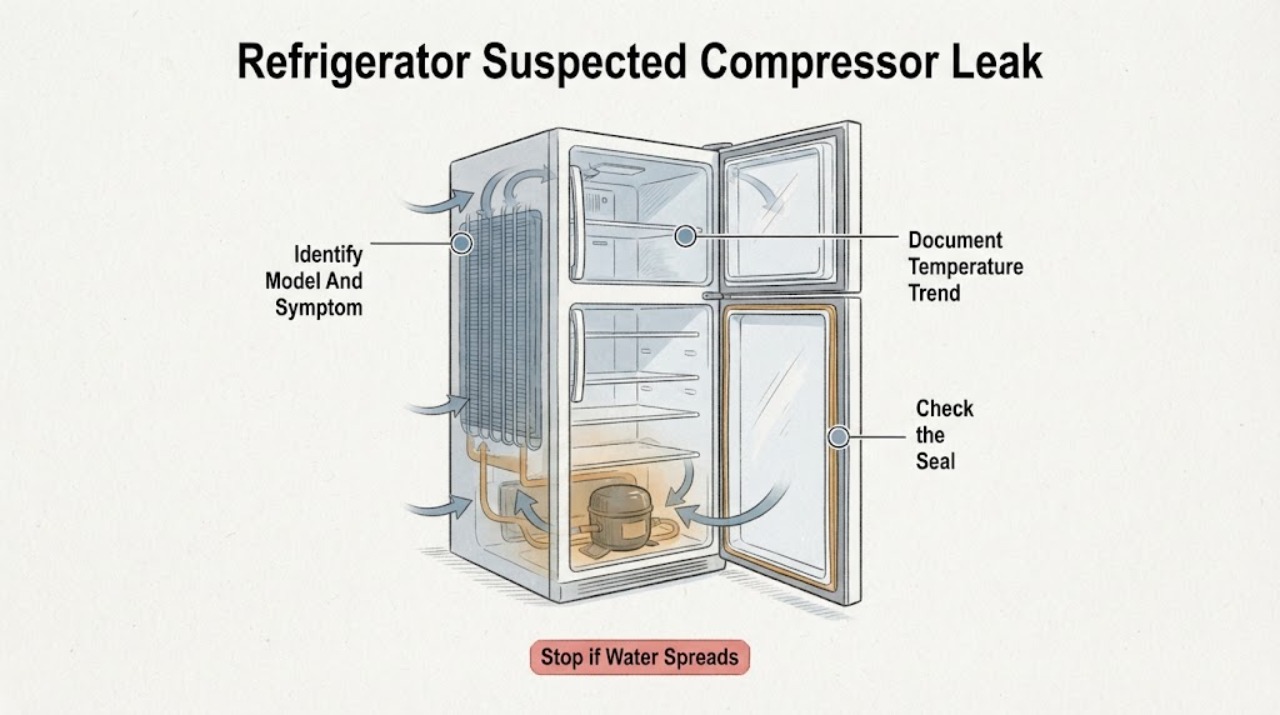
Record the complete Kenmore model and serial information and describe whether the refrigerator is warm, running unusually long, noisy, showing frost, or showing moisture; do not label any one observation a leak.
Expected result: The model and a repeatable symptom pattern are available, or the model and pattern remain unknown.
Next step: Use the exact manual for the appliance's controls and user-maintainable areas. If the model cannot be identified, keep the checks generic and prepare the observations for service.
Why this matters
Why: Kenmore's manual portal uses the model number for the applicable guide, and the reported symptom has several possible causes without a model-matched diagnostic procedure.
-
Check 2
Document where the refrigerator is warm or cold, whether the condition changes after the door has been closed and whether the compressor appears to run continuously; avoid repeatedly changing settings while collecting the observation.
Expected result: The symptom is isolated to one compartment or changes with door closure and loading, or it persists despite normal external conditions.
Next step: Use the matching external-check branch below and give the technician the recorded trend rather than a component diagnosis.
Why this matters
Why: Kenmore's opened efficiency guidance links performance to door openings, cold-spot behavior and sealing; a change after an external correction does not prove or disprove a refrigerant leak.
-
Check 3
With the refrigerator closed and safe to inspect, check that doors close fully, the gasket sits continuously against the cabinet, and shelves or food are not holding a door open; do not remove the gasket.
Expected result: A door is obstructed, not closing, or has a visibly displaced or damaged seal, or the door and gasket appear normal.
Next step: Correct only a clear loading or closure issue. If the seal is damaged or the refrigerator remains warm, use the exact manual or arrange service instead of changing refrigerant-system parts.
Why this matters
Why: Kenmore's opened guidance treats door use and gasket sealing as external contributors to refrigerator performance, but a normal gasket does not identify a sealed-system fault.
-
Check 4
Inspect only visible ventilation openings and the accessible condenser area for heavy dust or blocked clearance, following the exact model manual; do not remove panels or reach into a fan.
Expected result: Accessible airflow is obstructed or dusty, or the visible area is clear but the cooling symptom persists.
Next step: If the model manual permits it, power the refrigerator off safely before gently cleaning accessible coils with a plastic brush or vacuum. If the area is not safely accessible, leave it for service.
Why this matters
Why: Kenmore's opened cleaning guidance says condenser location varies by refrigerator and that dust can reduce airflow; this is an airflow observation, not evidence of a refrigerant leak.
-
Check 5
If moisture or residue is visible near the compressor area, photograph its location from a safe external position and do not touch, wipe, smell or identify it as refrigerant; keep hands away from wiring and tubing.
Expected result: There is no visible residue, or there is an unexplained wet or oily-looking mark near the appliance base or compressor area.
Next step: If the mark is accompanied by a leak, electrical hazard, smoke or damaged tubing, stop using the refrigerator and isolate it only from a safe location. Otherwise provide the photograph, location and symptom history to qualified service.
Why this matters
Why: A visible mark is an observation that needs qualified assessment; it is not a field confirmation of a compressor or refrigerant leak.
-
Check 6
Stop at external observation and arrange qualified Kenmore or appliance service when cooling remains poor, the unit runs abnormally, an unexplained residue is present or the exact manual does not resolve the condition.
Expected result: The external checks do not restore normal performance, or a technician-level sealed-system assessment is needed.
Next step: Provide the model, serial, symptom timeline, compartment observations, visible residue photographs and external-check results. Do not open tubing, connect gauges, recover refrigerant or replace the compressor yourself.
Why this matters
Why: Kenmore identifies service-valve access as access to a regulated sealed refrigerant system for qualified technicians; the task evidence does not support a user leak test or repair.
Use your observations
Decision map
Find the observation that best matches what you see, then follow the next safe action.
-
PATH 01Next step
What you see
The refrigerator improves after a door-obstruction, gasket or loading issue is corrected.
Do this next
Monitor the documented symptom and use the exact model guide; arrange service if cooling loss or abnormal operation returns.
Why this path and its safety boundary
Why it matters: The change supports an external airflow or sealing contribution, but it does not establish whether a sealed-system leak exists.
-
PATH 02Next step
What you see
Accessible coils or ventilation are heavily dusty or obstructed and the exact manual permits external cleaning.
Do this next
Power off safely, clean only the accessible area as the model guide permits, and request service if the refrigerator remains warm or runs abnormally.
Why this path and its safety boundary
Why it matters: Restricted airflow can affect cooling workload, but cleaning cannot be used to confirm a compressor or refrigerant leak.
-
PATH 03Next step
What you see
Cooling remains poor after safe external checks, or an unexplained wet or oily-looking mark is visible near the compressor area.
Do this next
Keep the refrigerator and any food-safety concern under control, record the model and observations, and arrange qualified service without opening the sealed circuit.
Why this path and its safety boundary
Why it matters: This warrants a qualified sealed-system assessment; the observation is not a confirmed leak diagnosis.
-
PATH 04Next step
What you see
There is smoke, burning odor, damaged wiring, water near electrical parts, or another immediate electrical hazard.
Do this next
Stop using the appliance and isolate power only from a safe location; contact appropriate appliance or electrical emergency service. Do not restart it to test the compressor.
Why this path and its safety boundary
Why it matters: This is a safety stop rather than a refrigerant troubleshooting branch.
Helpful context
Understand the symptom
Treat compressor leak as a reported possibility, not a confirmed diagnosis. A refrigerator that is warm, runs for a long time, makes a new sound or shows frost or moisture can also have a door-seal, airflow, setting, loading or other service issue. This task has no exact model or verified leak test, so the checks below are deliberately external.
Use the complete model number and region to find the Kenmore manual before applying any control sequence or maintenance instruction. Kenmore's manual portal requires model lookup, and the opened refrigerator articles describe general gasket, door-use and condenser-coil care rather than a universal compressor or refrigerant diagnosis.
A sealed-system diagnosis belongs with a qualified appliance technician. Do not remove a sealed-system cover, loosen tubing, connect gauges, handle refrigerant, or order a compressor or refrigerant part based on the reported symptom.
When checks do not resolve it
Need a professional?
Arrange qualified service for persistent warming, abnormal continuous operation, unexplained residue, damaged tubing, or symptoms that remain after the model-matched external checks., Protect temperature-sensitive food if the refrigerator is not maintaining safe storage conditions; do not keep running repeated tests to prove a leak., Stop immediately for smoke, burning odor, damaged wiring, water near electrical parts or any condition that cannot be isolated safely.
Safety scope: No sealed-system opening, refrigerant handling, gauge connection, compressor replacement or live electrical testing is included.
Have this ready
- complete Kenmore model and serial information
- compartment temperature trend and whether food is warming
- run pattern, noise, frost and visible moisture or residue observations
- door/gasket, loading and accessible airflow observations
- any smoke, burning odor, wiring damage or water near electrical parts
Common questions
FAQ
Can cooling loss confirm a Kenmore compressor leak?
No. Cooling loss, long run time, noise, frost and moisture have multiple possible causes. Record the exact model and external observations, then arrange a qualified sealed-system assessment if the problem persists.
Can I clean the condenser coils first?
Only if the exact model manual permits access and the area can be reached safely. Kenmore's opened cleaning guidance says to unplug before cleaning, use a plastic brush or vacuum, and avoid damaging the coils. Cleaning is an airflow check, not proof of a leak.
Can I add refrigerant or open the compressor tubing?
No. Kenmore's opened service-valve page describes this as access to a regulated sealed refrigerant system for a qualified service technician. Do not open the circuit or handle refrigerant yourself.
Read the exact guide
Official sources
- Tips for Running Your Fridge More EfficientlyKenmore / Livemore · Opened official Kenmore Livemore article. It supports external maintenance observations but does not diagnose compressor or refrigerant leaks; generic settings from the page are not used.
- Kenmore ManualsKenmore · Opened official Kenmore manual portal. It requires the model number and provides manuals for refrigerators and freezers; exact model controls setup and user checks.
- Refrigerator Service Valve Genuine Original Equipment Manufacturer (OEM) PartKenmore · Opened official Kenmore page. It says service-valve access to a sealed refrigerant system is federally regulated and should be performed by a qualified service technician. It supports the safety boundary, not a diagnosis or part fit.
- Spring Cleaning Your RefrigeratorKenmore / Livemore · Opened official Kenmore article. It supports only safe, accessible coil cleaning with power removed; it does not establish a leak or authorize sealed-system access.
Community feedback
Share a repair observation
Share a plain-text repair observation. Accepted observations are published automatically; this page may take a moment to update.