
On this page
Start here
Quick answer
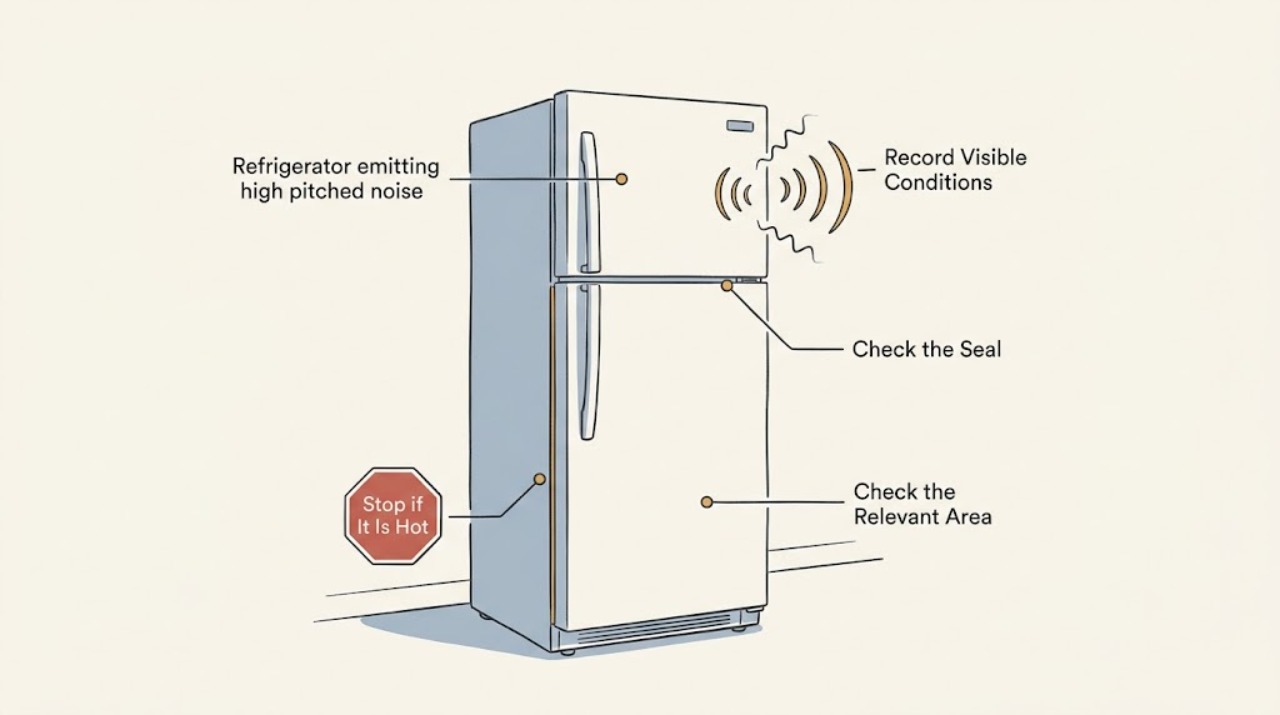
For the supplied Kenmore 106 51713411 identity, a brief, soft high-pitched or pulsating tone can come from normal fan or compressor-speed changes, and a faint whistle or refrigerant sound can occur as a cooling cycle changes. A high-frequency sound heard from the freezer does not identify a fan, compressor, or another part by itself. First record whether it is brief and repeatable during cooling, defrost, or door-related events, then check temperature trend, visible frost, blocked air openings, door sealing, and external vibration without approaching an operating fan or removing panels. If the freezer is warming, frost is building, the tone is loud or continuous, or there is smoke, burning odor, arcing, overheating, or a breaker trip, stop using the refrigerator and arrange qualified service. Confirm the exact model manual through Kenmore before using any model-specific procedure.
Work through in order
Diagnostic checks
Use only checks that match the exact appliance or system and its official guide.
-
Check 1
From outside the cabinet, record the exact tone, location, duration, and timing. Note whether the high-pitched sound begins when cooling starts, changes during a defrost period, follows a door opening, or appears while the ice maker or water system is active. Do not open the freezer or reach toward a fan to make the sound change.
Expected result: The tone is brief and soft, repeats at a regular cooling event, changes with a normal operating transition, or is continuous, harsh, rapidly worsening, or accompanied by another sound.
Next step: Keep the timing record and compare it with the temperature and frost observations below. Do not deliberately reproduce a harsh noise or treat its pitch as a parts diagnosis.
Stop if: Stop immediately for smoke, burning odor, arcing, a hot cabinet, water near electrical equipment, or repeated breaker operation; keep the refrigerator off and seek qualified or emergency help as appropriate.
Why this matters
Why: Whirlpool's opened manufacturer guidance says high-frequency sounds can relate to air movement, fan operation, refrigerant flow, or compressor-speed changes; brief, soft, repeatable sounds are more consistent with routine operation than a continuous harsh tone. This does not prove which internal source is involved on the Kenmore model.
-
Check 2
Without removing an interior panel or touching any fan, use a refrigerator/freezer thermometer if one is already available and note the freezer temperature trend and whether food remains solid. Also record whether the fresh-food section is cooling normally and whether the high-pitched sound continues when temperatures are stable.
Expected result: Temperatures remain stable, the freezer is warming, both compartments are warming, or the sound changes together with a loss of cooling.
Next step: If temperature is rising or food safety is uncertain, minimize door openings, protect perishable food using a safe alternate cold source, and arrange service rather than testing components. If temperatures are stable, continue only with external observations.
Stop if: Do not touch an evaporator fan, insert an object into an air opening, remove a cover, or use a live electrical test to investigate the tone.
Why this matters
Why: A stable temperature with a brief stage-linked tone supports normal-operation monitoring. A freezer that struggles to stay cold while a loud buzz, click, or hum occurs is a different branch; Whirlpool notes that abnormal evaporator-fan noise may accompany difficulty maintaining freezer temperature, but the symptom does not identify a specific fan or control part.
-
Check 3
With the doors closed, inspect only the visible freezer interior for a thick frost layer or items resting against an air opening. Check the door gasket visually around its perimeter for a tear, gap, or section that is not contacting the cabinet; do not remove shelves or an evaporator cover to reach the fan.
Expected result: There is little or no frost and the air openings are clear, thick frost blocks an opening, food is pressed against an opening, or the gasket has a visible gap or damage.
Next step: Move only an obvious item that is blocking a visible opening, without reaching into the air path. For rapid frost accumulation, a damaged gasket, or continued warming, leave the unit operating only if safe for food and electrical conditions and arrange model-specific service; do not use heat or sharp tools to defrost it.
Stop if: Do not chip ice, apply a heat source, remove an interior panel, or reach toward a fan or coil.
Why this matters
Why: Whirlpool's freezer guidance says thick frost can block vents and coils and make temperature maintenance harder, while a damaged gasket can let warm air in. These conditions can make cooling run more often and alter normal fan or compressor sounds, but they do not prove a defrost component or fan has failed.
-
Check 4
From the front and sides, inspect only the surrounding installation: note whether the cabinet touches a wall or nearby object, whether an item on top is vibrating, and whether the refrigerator rocks or sits visibly out of level. Do not pull the refrigerator out or place a hand near the rear fan or compressor.
Expected result: The sound changes when an external object is removed, the cabinet is visibly transmitting vibration, the floor or unit appears unstable, or no external contact is visible.
Next step: Remove only a loose external item that is clearly vibrating and does not require moving the appliance. If the cabinet rocks or the noise persists, have an installer or qualified technician check leveling and clearance; do not adjust hidden components as a guess.
Stop if: Do not move a heavy refrigerator alone, remove rear panels, touch the condenser fan or compressor, or apply oil to any moving part.
Why this matters
Why: Whirlpool identifies hard surfaces, surrounding cabinets, items on top, and an unlevel refrigerator as ways normal operating sounds can become louder or vibrate. A clear exterior shifts attention back to the operating cycle, temperature, frost, and service boundary rather than proving an internal part.
-
Check 5
Without operating the ice maker, dispenser, or water valve to provoke a sound, note whether the tone coincides with ice production, a water-fill attempt, or an empty ice-maker condition. Record any visible frost around the ice-maker area, a water leak, or a dispenser symptom from normal use only.
Expected result: The high-pitched noise is isolated to an ice or water event, the ice maker is on without an available water connection, the sound is unrelated to those events, or a leak is present.
Next step: Use the exact Kenmore manual to confirm the installed water and ice configuration. If there is a leak, water near electrical components, or a persistent sound with no normal event, stop the affected function or the refrigerator as safety requires and arrange service.
Stop if: Do not disconnect water tubing, bypass the ice maker, reach into the ice-maker mechanism, or remove a panel to observe a valve or fan.
Why this matters
Why: Manufacturer refrigerator guidance identifies a water-valve buzz during ice-maker filling and other ice-maker sounds as possible normal operation. A sound linked to ice or water timing can be separated from a freezer-airflow sound, but it still does not identify a valve, motor, or ice-maker assembly as failed.
-
Check 6
Write the exact model from the rating label as 106 51713411, the sound description and location, its timing, temperature readings or trend, frost and gasket observations, ice/water timing, and any electrical warning. Use Kenmore's official manual portal to confirm the model before any care or service step.
Expected result: The identity matches the supplied model and the sound is brief with normal cooling, or the model is uncertain or the sound is persistent with temperature, frost, water, or electrical symptoms.
Next step: If the sound is persistent, worsening, paired with temperature loss, or not explained by an external observation, leave the unit alone and give service the model, timing, temperatures, frost, and safety details. Do not order a part from the pitch alone.
Stop if: Do not enter service mode, remove covers, perform live testing, or continue operating an appliance with smoke, burning odor, arcing, overheating, or repeated breaker trips.
Why this matters
Why: Kenmore's manual portal requires the model number and provides manuals for refrigerators and related appliances. Exact configuration determines which fan, ice-maker, airflow, and user-care instructions apply; a similar-looking Kenmore model is not a safe substitute.
Use your observations
Decision map
Find the observation that best matches what you see, then follow the next safe action.
-
PATH 01Next step
What you see
The tone is brief, soft, and repeatable during cooling or a normal transition, while freezer and fresh-food temperatures remain stable and there is no frost, leak, or electrical warning.
Do this next
Monitor the timing and sound character without deliberately reproducing it. Arrange service if it becomes continuous, louder, changes character, or cooling performance changes.
Why this path and its safety boundary
Why it matters: This pattern is compatible with manufacturer-described fan, compressor, refrigerant, or other normal operating sounds. It is not evidence that a compressor or fan needs replacement.
-
PATH 02Next step
What you see
The high-pitched noise is loud or persistent and the freezer is warming, thick frost blocks visible airflow, or the door gasket has a visible gap.
Do this next
Protect perishable food and arrange model-specific service. Do not chip ice, apply heat, remove the evaporator cover, or reach for the fan.
Why this path and its safety boundary
Why it matters: The sound is occurring with a cooling or airflow symptom. Frost, air leakage, or a fan-related issue is possible, but the observations do not distinguish a defrost system, fan, gasket, or another internal cause.
-
PATH 03Next step
What you see
The tone is tied to an ice-maker or water event, but cooling is stable and there is no leak or electrical warning.
Do this next
Confirm the exact water/ice configuration in the Kenmore manual and stop the affected function if it leaks or behaves abnormally. Escalate if the sound persists outside the event or ice/water performance fails.
Why this path and its safety boundary
Why it matters: A water-valve or ice-maker operating sound may be involved, and manufacturer guidance includes buzzing during an ice-maker fill as a possible normal sound. The event timing does not prove a failed valve or ice-maker motor.
-
PATH 04Next step
What you see
The sound changes when a loose external object is removed, or the cabinet visibly contacts a wall, rocks, or transmits vibration.
Do this next
Correct only the obvious external contact that is safe to reach. Have a qualified person address leveling or clearance if the cabinet is unstable or the noise continues.
Why this path and its safety boundary
Why it matters: External resonance, clearance, or leveling may be amplifying a normal refrigerator sound. This is not a basis for adding oil or replacing an internal component.
-
PATH 05Next step
What you see
Smoke, burning odor, arcing, a hot cabinet, water near electrical components, a repeated breaker trip, or rapid worsening occurs with the noise.
Do this next
Stop using the refrigerator. From a safe location isolate power if needed and safe, keep clear of smoke or fire danger, and contact qualified appliance or emergency services as appropriate.
Why this path and its safety boundary
Why it matters: This is an immediate electrical, fire, or water-safety boundary, not a normal-noise diagnosis.
When checks do not resolve it
Need a professional?
Call qualified appliance service when the high-pitched noise is persistent, harsh, worsening, or occurs with freezer temperature loss, thick frost, a damaged gasket, failed ice/water operation, or unexplained vibration after safe external checks. Stop immediately for smoke, burning odor, arcing, a hot cabinet, water near electrical components, or repeated breaker trips. Do not approach an operating fan, remove panels, add oil, enter service mode, or order a component based only on the sound.
Common questions
FAQ
Is a high-pitched sound from the freezer always a bad fan or compressor?
No. Official refrigerator guidance says brief, soft high-pitched or pulsating sounds can occur as fans or compressor speed changes, and refrigerant can also create normal sounds. A tone with warming, thick frost, or persistent loud operation needs service, but its pitch alone cannot identify a part.
Should I open the freezer door or touch the fan to locate the noise?
No. Do not approach an operating fan, remove an evaporator cover, insert anything into an air opening, or use a live test. Record the sound from outside, then compare safe temperature, frost, gasket, and external-vibration observations with the exact Kenmore manual.
When should I stop using the Kenmore refrigerator?
Stop and arrange qualified service if the noise is persistent or worsening, the freezer is warming, frost blocks airflow, a leak reaches electrical equipment, or smoke, burning odor, arcing, overheating, or repeated breaker trips occur. Protect perishable food while the cooling condition is unresolved.
Read the exact guide
Official sources
- Refrigerator Normal Sounds and Noises - Product Help | WhirlpoolWhirlpool · Manufacturer symptom-level refrigerator sound distinctions including fans, compressor, refrigerant, ice maker, water valve, vibration, and leveling
- Customer Care & Support | Kenmore AppliancesKenmore · Kenmore 106 51713411 refrigerator support, product manuals, recalls, and repair handoff
- Find Your Manual | Kenmore Appliance Manuals & GuidesKenmore · Kenmore 106 51713411 refrigerator model identity and official owner-manual lookup
- 7 Freezer Problems & How to Help Fix Them | WhirlpoolWhirlpool · Manufacturer symptom-level freezer noise, frost, airflow, gasket, and temperature-loss distinctions; not a Kenmore model-specific service manual
- Refrigerator Noise - High-Pitched or Pulsating - Product Help | WhirlpoolWhirlpool · Manufacturer symptom-level guidance for high-pitched refrigerator noise; not a substitute for the Kenmore 106 51713411 manual
Community feedback
Share a repair observation
Share a plain-text repair observation. Accepted observations are published automatically; this page may take a moment to update.