
On this page
Start here
Quick answer
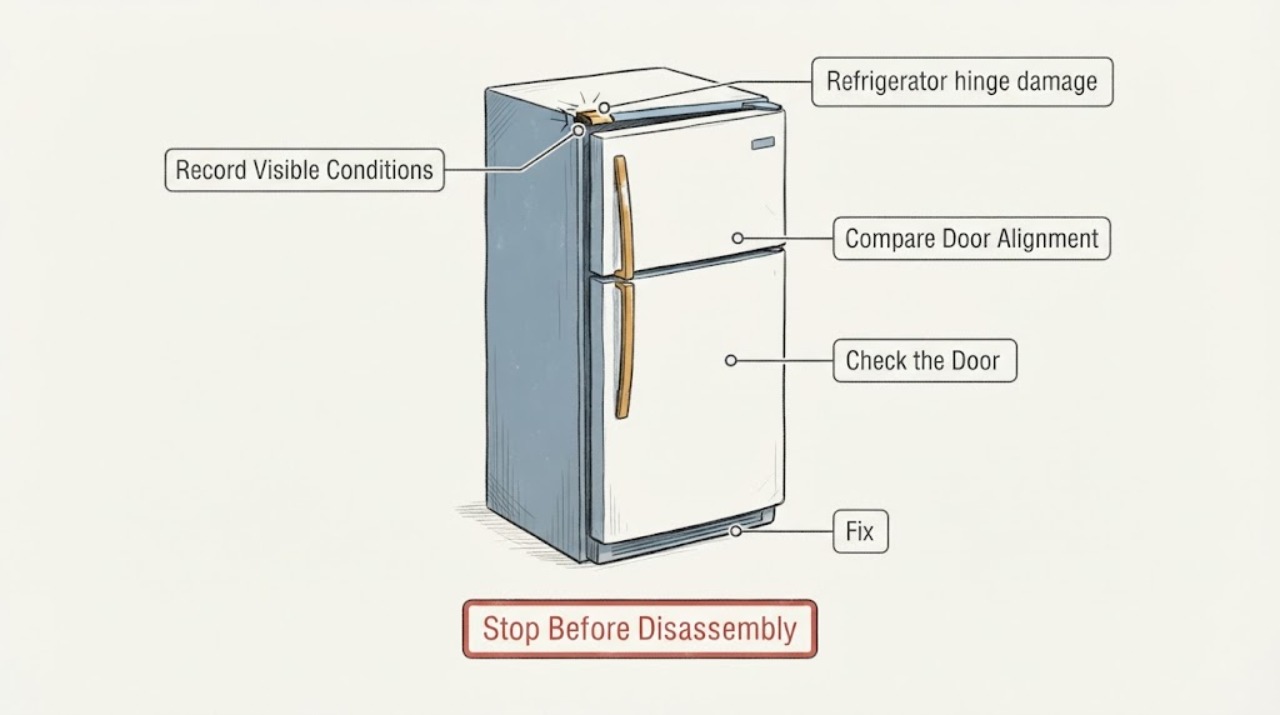
Do not assume that a damaged Kenmore refrigerator hinge can be matched by appearance. Record the complete model number, keep the door supported and closed as much as practical, and inspect only the visible gap, gasket and hinge area without forcing the door or removing hardware. If the door sags, cannot close tightly, rubs the cabinet, or the hinge or mounting area is cracked, stop using the affected compartment as needed to protect food and arrange model-specific service. Kenmore's official manual lookup requires the exact model for the correct manual and parts information, and USDA guidance says the refrigerator should stay at 40 °F or below with the door closed tightly.
Work through in order
Diagnostic checks
Use only checks that match the exact appliance or system and its official guide.
-
Check 1
Find and record the refrigerator's complete model number, serial information and country or region before ordering anything.
Expected result: The model label is legible and matches a Kenmore refrigerator manual, or the label is missing, incomplete or inconsistent with the appliance.
Next step: Use the exact model in Kenmore's manual lookup. If it cannot be confirmed, stop at external inspection and request Kenmore support rather than choosing a hinge by shape or brand name.
Why this matters
Why: Kenmore's official lookup uses the model number to retrieve the applicable manual and model-specific parts information; a partial number cannot establish hinge compatibility.
-
Check 2
With the refrigerator stationary, inspect the closed door from the front and side without loosening screws or pulling on the hinge.
Expected result: The door sits squarely, the gasket contacts the cabinet continuously, and the hinge area has no visible crack, missing cover, pulled-out fastener or fresh deformation; or the door sags, rubs, leaves a gap or the mounting area is visibly damaged.
Next step: Do not force the door or tighten an unknown fastener. If it cannot close or the mounting area is cracked or unstable, keep the door closed as far as it safely allows, limit opening and arrange model-specific service.
Why this matters
Why: A continuous seal and stable alignment do not prove the hinge is sound, but a persistent gap, sag or visible structural damage means the door may not protect the cold compartment; the visible symptom does not identify which internal or mounting part failed.
-
Check 3
Check the refrigerator temperature with an appliance thermometer while keeping the affected door closed as much as possible.
Expected result: The refrigerator is at or below 40 °F, or it is above 40 °F or the door cannot remain closed tightly.
Next step: Move perishable food to a known-safe cold location if the temperature is rising or the door will not seal. Follow official food-safety discard guidance for food held above 40 °F for two hours or more, and keep the Kenmore closed while arranging service.
Why this matters
Why: USDA identifies 40 °F or below as the safe refrigerator target and says doors should close tightly; a damaged hinge can create a food-safety concern if it prevents that condition, but temperature alone does not diagnose the hinge.
-
Check 4
Photograph the hinge area, door gap, gasket contact and any cracked or displaced mounting surface, and note whether the damage is at the top, center or bottom hinge position.
Expected result: The photos show only cosmetic cover damage, or they show a loose door, exposed sharp edge, displaced hinge, cabinet damage or a gap that remains when the door is gently closed.
Next step: Send the model and photos through Kenmore's official support or repair route. Do not tape, glue, shim, drill or substitute hardware as a structural repair.
Why this matters
Why: Photos can help Kenmore or a technician match the exact door configuration, but they cannot establish a compatible part or safe removal sequence without the model manual.
-
Check 5
Stop handling the door and isolate the situation when the hinge or cabinet mount is unstable, the door may fall, the gasket is torn through, or water and electrical components are exposed.
Expected result: The door is loose or unsupported, the cabinet mounting point is cracked, the door cannot close, or there is a leak near electrical parts.
Next step: Keep people clear of the door, avoid removing it, keep the refrigerator closed if safe, and arrange qualified Kenmore appliance repair. If water is near electrical components, do not touch wet electrical areas; isolate power only when it can be done safely.
Why this matters
Why: The external checks cannot make a damaged load-bearing door safe, and continued opening can worsen the damage or warm the refrigerator.
-
Check 6
Give the service provider the exact model, region, door type, hinge position, temperature reading and photos rather than a generic hinge description.
Expected result: The model and symptom record is complete, or the model remains unknown and the door configuration cannot be identified.
Next step: Use Kenmore customer care or its official repair route for model-specific advice. Do not order a replacement hinge, bushing, cam or fastener until the exact model documentation confirms it.
Why this matters
Why: Kenmore's support and manual resources are organized around the product and model; without that identity, compatibility and procedure remain unresolved.
Use your observations
Decision map
Find the observation that best matches what you see, then follow the next safe action.
-
PATH 01Next step
What you see
The model is confirmed, the door closes evenly, the gasket contacts the cabinet and the refrigerator remains at or below 40 °F.
Do this next
Avoid stressing the door, document the damage and use the model-specific Kenmore manual or repair route for the next step.
Why this path and its safety boundary
Why it matters: There is no evidence in the supplied task of an immediate loss of the cold seal, but visible hinge damage still requires the exact manual or service assessment before parts are selected.
-
PATH 02Next step
What you see
The door sags, rubs, will not close tightly, or a visible hinge or cabinet mount is cracked or displaced.
Do this next
Stop forcing or removing the door, keep it closed as safely possible, protect perishable food and arrange model-specific service.
Why this path and its safety boundary
Why it matters: The damaged support or mounting area may prevent a reliable seal and cannot be safely diagnosed by the generic problem label.
-
PATH 03Next step
What you see
The model cannot be read or the door layout does not match the available manual.
Do this next
Do not order a part or start door removal. Obtain the complete model and region information through Kenmore support.
Why this path and its safety boundary
Why it matters: Hinge geometry and compatible hardware remain unresolved; a visually similar Kenmore part may still be wrong.
-
PATH 04Next step
What you see
The refrigerator is above 40 °F or the door has been unable to stay closed tightly.
Do this next
Move perishable food to a known-safe cold location and follow USDA time-and-temperature guidance while keeping the damaged refrigerator closed and awaiting service.
Why this path and its safety boundary
Why it matters: Food safety and temperature control take priority over hinge troubleshooting.
Helpful context
Understand the symptom
Hinge damage is a mechanical symptom, not a universal Kenmore part number. Different door layouts can use different hinge positions and mounting hardware, so begin with the full model number from the refrigerator label and use Kenmore's official manual lookup before selecting a part or attempting door removal.
The checks below are external and low-force. They help determine whether the door is still supported and sealing; they do not prove that the hinge, bushing, closing cam, cabinet mount or door liner is the failed component.
When checks do not resolve it
Need a professional?
Arrange Kenmore or qualified appliance service when the hinge, door or cabinet mount is visibly damaged; the door sags, rubs or cannot seal; the temperature rises; the model-specific part or procedure is unclear; or the door is unstable. Do not remove the door, substitute hinge hardware, or attempt a structural repair from a generic guide.
Common questions
FAQ
Can I buy a Kenmore refrigerator hinge by matching its appearance?
No. The exact model is needed to retrieve the applicable Kenmore manual and model-specific parts information. Do not select a hinge, bushing, cam or fastener by appearance alone.
Can I keep using the refrigerator with a damaged hinge?
Only if the door remains stable, closes tightly and the refrigerator stays at or below 40 °F; a damaged or sagging door that leaves a gap needs service. Keep the door closed as much as possible and protect perishable food if the temperature rises.
Should I remove the refrigerator door to inspect or replace the hinge?
Do not start door removal without the exact model manual and a safe way to support the door. With no model supplied, limit the check to external observation and give the model and photos to Kenmore support or a qualified technician.
Read the exact guide
Official sources
- Customer Care | KenmoreKenmore / Transform SR Brands LLC · Official Kenmore customer-care page; used for support and service boundaries, not for a generic hinge diagnosis.
- Kenmore ManualsKenmore / Transform SR Brands LLC · Official Kenmore manual portal; it requires the exact model and does not establish a hinge part or procedure for this model-less task.
- Refrigeration & Food SafetyUSDA Food Safety and Inspection Service · Government food-safety guidance for refrigerated food; it does not diagnose the Kenmore hinge.
- Contact Us | Kenmore Customer SupportKenmore / Transform SR Brands LLC · Official Kenmore contact page; used to direct model-specific support without exposing contact details in the article.
Community feedback
Share a repair observation
Share a plain-text repair observation. Accepted observations are published automatically; this page may take a moment to update.