
On this page
Start here
Quick answer
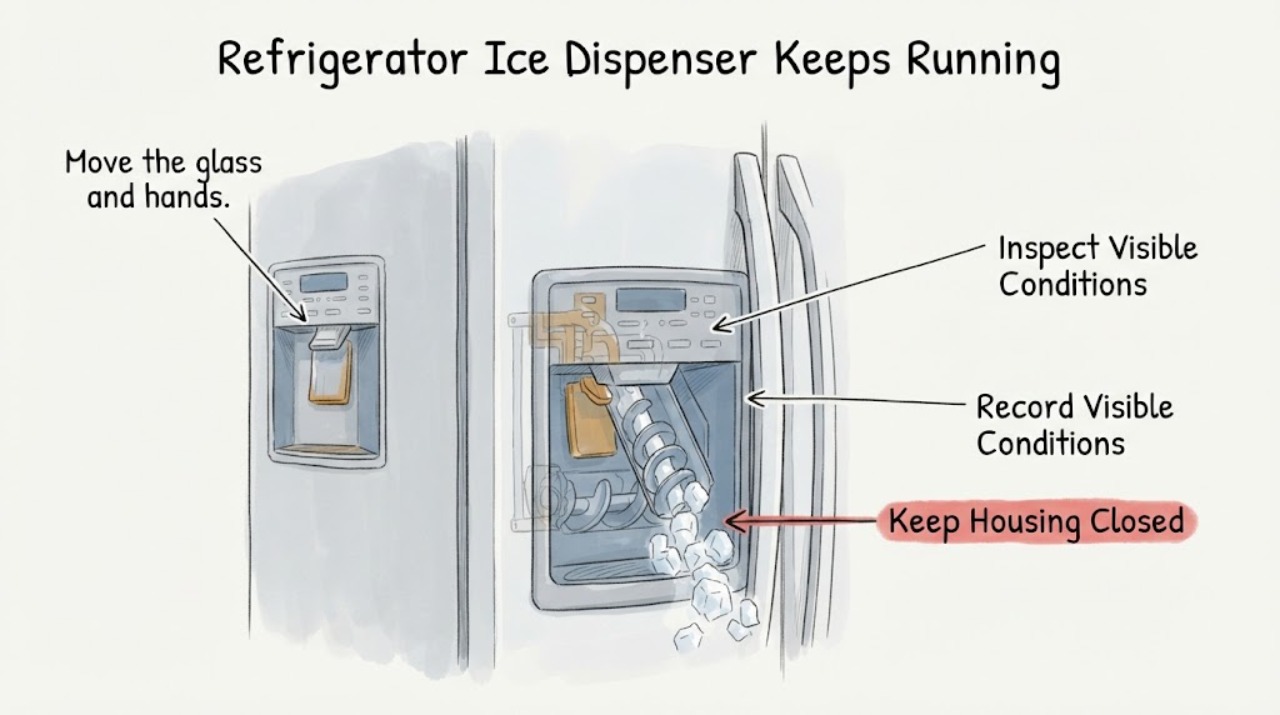
A small amount of ice can fall after the glass is removed, but a Kenmore dispenser that keeps driving or dispensing after the lever is released should not be treated as normal without checking the exact model. Keep hands and containers clear of the chute, stop requesting ice, and use the dispenser lock if the refrigerator has one and the lock is accessible. Record the complete model number before following any manual procedure: Kenmore says its manuals and appliance resources are found by entering the model number, and its refrigerator configurations and dispenser controls differ. Do not reach into the chute, bypass a lever or door switch, open the door panel, or order a dispenser motor or switch from the symptom alone. If the lock does not stop the behavior or the dispenser restarts by itself, stop using the dispenser and arrange Kenmore-qualified service; close the refrigerator water supply only if a water leak is also present.
Before you begin
Safety first
- Keep hands and tools out of the ice chute. Do not open the dispenser door panel, probe wiring, bypass a lever or door switch, repeatedly test an uncontrolled dispenser, or order a part without exact model confirmation.
Work through in order
Diagnostic checks
Use only checks that match the exact appliance or system and its official guide.
-
Check 1
Move the glass and hands away from the chute, stop pressing the lever, and keep children away from the dispenser. If ice is still being driven, the refrigerator is making an abnormal electrical sound, or the dispenser area is damaged, stop using the dispenser; do not reach into the chute or try to block it with an object.
Expected result: Ice stops after the chute clears, or the auger/noise/ice flow continues after the lever is released.
Next step: If the dispenser continues, use the model's dispenser lock if it is clearly available and safe to operate, then arrange service if the behavior does not stop. Do not keep testing by repeatedly pressing the lever.
Why this matters
Why: A few residual cubes are different from a continued request signal or self-starting dispenser; an active uncontrolled dispenser creates cut and property-damage risk.
-
Check 2
Observe the timing without placing anything into the chute: note whether the final cubes stop after a short delay, whether the motor/auger continues, whether dispensing resumes without a press, and whether the behavior occurs for cubed ice, crushed ice, or both if the model offers those selections.
Expected result: Only residual cubes fall briefly, the drive continues, or ice starts without a new lever/pad request.
Next step: Treat continued driving or unsolicited dispensing as abnormal, stop using the dispenser, and record the observation for service. Do not infer a bad lever switch, control board, or auger from timing alone.
Why this matters
Why: Residual chute clearing is not the same finding as a continued control command or an unsolicited restart; the exact model is needed to interpret the dispenser layout.
-
Check 3
Locate and record the complete Kenmore model number from the appliance label or the owner's paperwork. Enter it in Kenmore's official manual search before following any dispenser-cleaning, lock, door, or control procedure; do not substitute a similar-looking model number.
Expected result: A complete model number is available, or the label is missing/illegible and only a partial family or feature description is known.
Next step: Use the exact manual for any user-level lock or dispenser instruction. If the model cannot be confirmed, stop at the safe external checks and give the model uncertainty to the service provider.
Why this matters
Why: Kenmore states that its manual search requires the model number and uses it to provide the matching refrigerator manual and parts/accessory information; a family name alone cannot establish the control layout.
-
Check 4
If the exact manual shows a dispenser lock, activate it using that manual's user-control method and observe whether the ice motor and flow stop. Do not assume that a lock cuts power to the ice maker or refrigerator, and do not open the door panel or bypass a switch to test it.
Expected result: The dispenser lock stops the request, does nothing, is not present, or the dispenser starts again without a request.
Next step: If the lock does not stop the dispenser or the dispenser restarts, keep the dispenser out of service and arrange model-specific repair. If it stops, leave it locked until the exact manual or service provider confirms the next step.
Why this matters
Why: Kenmore describes a touch lock on some dispenser-equipped models, but its presence and behavior are model-dependent; a lock result does not identify the failed component.
-
Check 5
Prepare the model and serial, refrigerator configuration, ice selection, exact release behavior, duration of residual dispensing, whether the motor keeps running, lock result, any visible chute/lever damage, and any water spill or electrical sound for Kenmore service.
Expected result: Ice continues after the lever is released, dispensing resumes by itself, the lock fails, the control is damaged, or the model cannot be matched to a manual.
Next step: Keep the dispenser locked or out of service as appropriate and arrange Kenmore-qualified appliance service. Do not remove the door panel, probe wiring, bypass the dispenser or door switch, or reach into the ice chute.
Why this matters
Why: The remaining possibilities include a model-specific lever/pad, door interlock, control, auger, or chute condition, but the no-model evidence cannot choose a part or internal repair.
Use your observations
Decision map
Find the observation that best matches what you see, then follow the next safe action.
-
PATH 01Next step
What you see
Only a few cubes fall after the lever is released, the motor stops, and no ice restarts without a new request.
Do this next
Keep the glass under the chute until the final cubes fall and use the exact manual for the model. Escalate if the motor continues, flow is sustained, or dispensing restarts by itself.
Why this path and its safety boundary
Why it matters: The observation is consistent with chute clearance rather than a confirmed continuously commanded dispenser.
-
PATH 02Next step
What you see
The motor or auger continues after release, or ice keeps flowing until the dispenser is locked or power is interrupted.
Do this next
Stop using the dispenser, activate the exact model's lock if it safely stops the request, keep hands clear, and arrange model-specific service.
Why this path and its safety boundary
Why it matters: The dispenser is not responding normally to release; the no-model task does not establish whether the cause is a lever, pad, interlock, control, auger, or chute condition.
-
PATH 03Next step
What you see
The dispenser lock stops the behavior and the refrigerator does not restart dispensing without a request.
Do this next
Leave the dispenser locked, retrieve the exact manual using the model number, and arrange service if the symptom returns when the dispenser is used.
Why this path and its safety boundary
Why it matters: The lock has isolated the user-control function for this model, but it does not identify or repair the underlying condition.
-
PATH 04Next step
What you see
Ice restarts without pressing the lever, the dispenser area is cracked or wet, wiring is visible, or the model cannot be identified.
Do this next
Keep the dispenser out of service, isolate the water supply only if a water leak is present and this can be done safely, and obtain qualified appliance service. Do not open panels or bypass controls.
Why this path and its safety boundary
Why it matters: The situation is not suitable for continued user testing or a generic part swap; uncontrolled ice can create injury or water/property damage.
Helpful context
Understand the symptom
Separate a few falling cubes from a dispenser that is still being driven
Ice can continue to fall briefly because ice already in the chute is clearing, but continued auger noise, a steady stream, or a restart after the lever is released is a different observation. Do not put fingers or tools into the chute to stop it. Keep the container clear, use the lock if your model provides one, and note whether the ice stops at once, after the chute clears, or only when the dispenser is locked or the refrigerator door is opened according to the exact manual.
The exact Kenmore model controls the next safe step
Kenmore's official manual page asks for the model number before supplying a refrigerator manual and parts/accessory information. Kenmore also describes different refrigerator form factors and dispenser controls, including a touch lock on some current models. Without the model, the symptom cannot establish whether the appliance has a lever switch, touch pad, door interlock, lock control, or a different dispenser layout, so internal access and part selection stay with qualified service.
When checks do not resolve it
Need a professional?
Arrange Kenmore-qualified service when ice continues after the lever is released, the motor keeps running, dispensing restarts without a request, the lock does not stop it, the chute or controls are damaged, or the exact model cannot be matched to a manual.
Safety scope: Keep hands and tools out of the ice chute. Do not open the dispenser door panel, probe wiring, bypass a lever or door switch, repeatedly test an uncontrolled dispenser, or order a part without exact model confirmation.
Have this ready
- Full model and serial, refrigerator configuration, ice mode, whether a few residual cubes or continuous motor drive is observed, lock result, unsolicited restarts, visible chute/lever damage, water spill, and any unusual electrical sound.
Common questions
FAQ
Is it normal for a Kenmore dispenser to drop ice after I release the lever?
A few cubes already in the chute may fall after release, but continued motor noise, a sustained stream, or ice restarting without a new request is not something to assume is normal. Keep the chute clear, use the model's lock if available, and use the exact manual or service path.
Can I lock the Kenmore ice dispenser to stop it?
Some Kenmore dispenser-equipped refrigerators have a touch lock, but Kenmore's brand guide describes it as a feature of certain models. Confirm the exact model and use only its documented control method; a lock result does not identify or repair the underlying fault.
Should I replace the dispenser lever or motor?
Not from this symptom and no-model identity alone. Kenmore directs users to the model-number manual and parts information, and dispenser layouts differ. Keep the dispenser out of service and provide the exact model and release behavior to qualified service.
Read the exact guide
Official sources
- Refrigerators | RefrigerationKenmore / Transform SR Brands LLC · Opened official Kenmore refrigerator category page. It supports using model manuals and Kenmore service/support routes, but it does not provide a model-independent dispenser repair procedure.
- Find Your Manual | Kenmore Appliance Manuals & GuidesKenmore / Transform SR Brands LLC · Opened official Kenmore manual-search page. It supports model identification and the need to use the matching manual, but it does not define a universal dispenser repair for an unspecified refrigerator.
- Fridge Buying Guide: NEW French Door and Side-By-SideKenmore Livemore / Transform SR Brands LLC · Opened Kenmore-owned brand guide. It supports that dispenser controls and a lock exist on some model configurations, not that every Kenmore refrigerator uses the same control or internal layout.
Community feedback
Share a repair observation
Share a plain-text repair observation. Accepted observations are published automatically; this page may take a moment to update.