
On this page
Start here
Quick answer
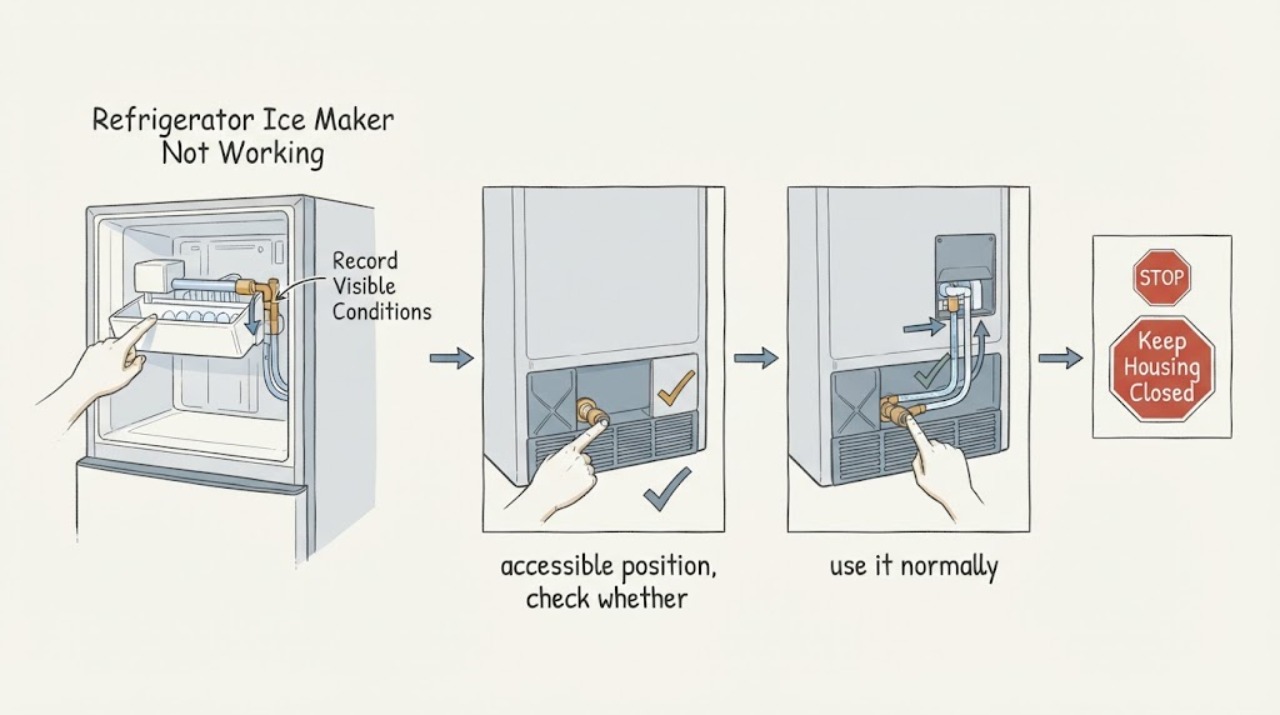
For a Kenmore 25350683001 refrigerator that was supplied with a new house, first separate an installation or shared-water-flow problem from an ice-maker-only problem. A weak or dry water dispenser as well as a dry ice mold points toward the home's shutoff, trapped air after installation, a restricted filter, a kinked visible line, or the refrigerator's water-delivery path. Normal dispenser flow with a cold freezer points instead toward the ice-maker fill branch or control. Confirm the complete model label and use its own manual before changing a filter or ordering anything; generic guidance from another refrigerator brand cannot establish a Kenmore 25350683001 part, test key, or control sequence. Limit owner checks to normal controls, external flow and visible conditions. Do not disconnect water lines, force a test cycle, probe wiring, remove the ice maker, or apply heat to frozen tubing.
Before you begin
Safety first
- Owner checks are limited to the full model label, normal controls, a brief dispenser comparison when present, visible shutoff/line conditions from a dry accessible position, the model-specific filter instructions, and observations of the freezer, mold, and bin during normal operation. Do not disconnect water lines, move the refrigerator across a wet floor, remove the ice-maker cover, run a forced test, bridge contacts, probe wiring, apply direct heat, or open the sealed system.
Work through in order
Diagnostic checks
Use only checks that match the exact appliance or system and its official guide.
-
Check 1
Read the full rating or model label and record Kenmore 25350683001 exactly, the refrigerator style, whether a water dispenser and ice maker are actually installed, when the refrigerator was connected in the new house, and whether a filter was supplied or changed. Locate the model-specific owner's manual before changing a setting or filter.
Expected result: The full model and installed features are confirmed; only a partial number is visible; the appliance was connected recently; or the filter and water features are aftermarket or unclear.
Next step: Use the exact Kenmore manual or installer documentation for the control and filter procedure. If the label cannot be read or the feature configuration is not original, give the full identity and photos to qualified service instead of ordering by appearance.
Stop if: Stop if the label is inside an unsafe area, the refrigerator must be pulled across a wet floor, or identifying the water hardware would require removing a cover or line.
Why this matters
Why: A 253-series model identity and the installed feature set are necessary to keep the advice on the correct platform. A generic filter, valve, ice-maker control, or service test cannot be assumed from the Kenmore name or from another brand's refrigerator page.
-
Check 2
If the refrigerator has a dispenser, use it normally for a brief comparison and note whether the stream is absent, sputtering, or consistently weaker than expected. Do not hold the paddle continuously, disconnect the line, or pull the refrigerator forward to reach a shutoff.
Expected result: The dispenser is dry or weak, the flow sputters and then improves, the dispenser is normal, or the model has no dispenser.
Next step: Record the result and follow only the model manual's filter and water-system instructions. Escalate for a leak, inaccessible shutoff, or any need for pressure testing or line disassembly.
Stop if: Stop for water near electrical parts, a bulging or damaged hose, an active leak, a seized shutoff, or a need to disconnect a water connection.
Why this matters
Why: Weak or uneven flow at the dispenser and no ice is a shared water-path pattern that keeps the household supply, trapped installation air, filter status, visible line routing, and inlet path in focus. Normal dispenser flow makes a problem isolated to the ice-maker fill branch more plausible, but does not prove a valve or control failure.
-
Check 3
From a dry, accessible position, check whether the refrigerator's water shutoff is visibly intended to be on and whether the accessible line has an obvious kink or crushing point. Do not operate an unknown valve, remove fittings, or move the cabinet to inspect behind it.
Expected result: The shutoff appears closed or partly closed, the line is visibly kinked, the visible route is normal, or the connection cannot be safely reached.
Next step: Correct only an obvious, harmless external position shown in the Kenmore installation instructions. Ask the installer or appliance service to correct an inaccessible, leaking, or uncertain connection; do not substitute a line or valve based on a generic diagram.
Stop if: Stop for a leak, wet flooring, a damaged connection, a shutoff that will not move normally, or any need to pull the refrigerator or open a fitting.
Why this matters
Why: A supply restriction can lower both dispenser flow and ice-maker fill, particularly after a new installation or when the refrigerator was pushed back. A normal visible route does not rule out pressure or valve faults, and an inaccessible connection cannot be safely diagnosed by the owner.
-
Check 4
If the exact Kenmore manual identifies a replaceable filter, compare the filter's seating and replacement history with that manual. If the refrigerator was just connected or the filter was just changed, follow only that model's documented priming or flushing method and observe whether air sputter or uneven flow settles; do not force a cartridge or use a generic filter.
Expected result: The filter is missing, not seated as the manual shows, recently changed with a flow reduction, overdue under the manual, or the water path remains weak after the documented procedure.
Next step: Keep the result and filter identity for the installer or technician. Stop using the water function for a leak or cracked housing and arrange service for persistent low flow or a filter path that cannot be accessed without disassembly.
Stop if: Stop for a cracked housing, leaking filter, sharp or frozen parts, direct-heat temptation, or any need to pry, remove tubing, or open a panel.
Why this matters
Why: A restricted or incorrectly installed filter and trapped air can reduce apparent flow, but the generic manufacturer pages do not prove that this model uses the same filter design, interval, or priming sequence. Persistent low flow after the model-specific step moves the case to supply or appliance service rather than a guessed filter or valve.
-
Check 5
Without using a forced test key or removing the ice maker, observe the ice mold and bin during normal operation. Note whether the mold remains dry, receives only a partial amount, contains water that does not freeze, or contains frozen cubes that remain in place; also note whether the freezer is cold and the door seals normally.
Expected result: The mold is dry or partly filled, the dispenser is normal but the mold is not receiving water, water reaches the mold but does not freeze, frozen cubes remain, or the freezer is warm or poorly sealed.
Next step: Record the pattern and use the complete model number when arranging service. Address a harmless door or loading obstruction only as the manual allows; arrange appliance service for a warm freezer, repeated no-fill, a recurring frozen fill opening, or a non-harvesting mechanism.
Stop if: Stop for a jammed mechanism, exposed wiring, unusual heat or odor, a leak, or any need to pry ice, bridge contacts, apply heat, probe voltage, or remove the ice-maker assembly.
Why this matters
Why: A dry mold with normal dispenser flow narrows the concern to the model-specific ice-maker fill path, fill control, or related mechanism. Water that does not freeze points first to freezer temperature or cooling. Frozen cubes that remain point to harvest behavior. None of these observations identifies a Kenmore part without the exact service documentation.
Use your observations
Decision map
Find the observation that best matches what you see, then follow the next safe action.
-
PATH 01Next step
What you see
The refrigerator was newly connected, the dispenser is weak or sputtering, and the ice mold is dry or the first cycles produce no ice.
Do this next
Use the exact Kenmore installation/manual instructions for safe priming, filter seating, and visible supply checks. Refer an inaccessible, leaking, or uncertain hookup to the installer or qualified appliance service; do not name a cross-platform valve or filter.
Why this path and its safety boundary
Why it matters: A shared installation-water pattern is more likely than an isolated ice-maker failure: the supply may not be open, air may remain in the new line, the filter may restrict flow, or the visible line may be kinked.
-
PATH 02Next step
What you see
The dispenser has normal flow, the freezer is cold and sealed, and the mold remains dry or only partly fills.
Do this next
Keep the ice maker closed and record the dry-mold observation. Arrange exact-model appliance service for water-path and control diagnosis rather than running an improvised test key or replacing a part by appearance.
Why this path and its safety boundary
Why it matters: The shared household supply is less likely, while the Kenmore model's ice-maker fill branch, fill control, or a localized frozen path becomes more plausible. This pattern still does not identify a failed part.
-
PATH 03Next step
What you see
Water reaches the mold but the cubes do not freeze, or the freezer is warm, the door does not seal, or frost blocks normal airflow.
Do this next
Correct only a harmless loading or door obstruction shown in the exact manual and protect food if it is warming. Arrange appliance service for persistent warmth, heavy frost, a damaged seal, or any cooling diagnosis that requires panels.
Why this path and its safety boundary
Why it matters: The immediate decision is a freezer cooling or sealing path, not proof of an ice-maker water-valve fault. Ice production cannot be judged independently while the freezer temperature is abnormal.
-
PATH 04Next step
What you see
Frozen cubes remain in the mold or bin path even though the freezer is cold and water delivery is otherwise normal.
Do this next
Do not force the ejector, pry the cubes, or initiate a service test sequence. Provide the model and observation to qualified appliance service for a safe model-specific diagnosis.
Why this path and its safety boundary
Why it matters: The symptom is now more consistent with harvest or ice-maker mechanism behavior than low household water flow, but a motor, heater, sensor, or control cannot be selected without the exact 25350683001 documentation.
-
PATH 05Next step
What you see
There is a water leak, water near electrical equipment, an inaccessible or damaged connection, smoke, burning odor, repeated power trips, exposed wiring, or food warming.
Do this next
Stop the ice and water functions from a safe dry position if possible, protect food if cooling is affected, and arrange qualified appliance service or appropriate electrical help. Do not restore power repeatedly or open the cabinet.
Why this path and its safety boundary
Why it matters: This is a stop-use water, electrical, fire, or food-safety condition, not a routine filter or ice-maker adjustment.
Helpful context
Understand the symptom
Why the new-house detail changes the first check
A refrigerator installed with a home may have a closed or partly open shutoff, air in a newly connected line, an incorrectly seated filter, or a line pinched when the cabinet was positioned. Those conditions can reduce both dispenser flow and the water delivered to the ice maker. If the dispenser is normal but the ice mold stays dry, the shared supply is less likely and the model-specific ice-maker branch becomes the next service question. The opened manufacturer pages describe general refrigerator behavior only; they are not a Kenmore 25350683001 manual and must not be used to select a cross-platform filter, valve, or test procedure.
What a safe result can and cannot show
The useful result is a pattern, not a guessed part: weak flow at both outlets, normal dispenser flow with a dry mold, warm-freezer symptoms, or frozen cubes that are not released. Keep the refrigerator and floor dry, avoid moving an installed appliance across a wet area, and stop before any line disconnection or internal electrical access. A new installation that never receives water should be referred back to the installer or qualified appliance service, especially if the shutoff is inaccessible or there is any leak.
When checks do not resolve it
Need a professional?
Use the installer for a new-house hookup problem and qualified appliance service for persistent low flow, a dry mold with normal dispenser flow, a warm freezer, repeated frozen fill symptoms, a non-harvesting mechanism, or any internal water/electrical diagnosis. Use appropriate electrical help for a damaged or tripping supply.
Safety scope: Owner checks are limited to the full model label, normal controls, a brief dispenser comparison when present, visible shutoff/line conditions from a dry accessible position, the model-specific filter instructions, and observations of the freezer, mold, and bin during normal operation. Do not disconnect water lines, move the refrigerator across a wet floor, remove the ice-maker cover, run a forced test, bridge contacts, probe wiring, apply direct heat, or open the sealed system.
Have this ready
- Provide Kenmore 25350683001, the complete label and serial if available, refrigerator style, which water and ice features are installed, connection date, dispenser-flow comparison, visible supply observations, filter identity and history, freezer/door/frost observations, mold pattern, leak or electrical symptoms, and any installer work already performed.
Common questions
FAQ
If the water dispenser is also weak, is the ice maker itself definitely bad?
No. Weak flow at both outlets keeps the new-house shutoff, trapped air, filter status, visible line routing, and shared water path in play. Follow the exact Kenmore manual or installer instructions and stop before line disconnection or pressure testing.
Can I use another refrigerator brand's filter or ice-maker test button for Kenmore 25350683001?
Do not assume that. The opened manufacturer pages provide generic refrigerator symptom guidance, not the Kenmore 25350683001 parts list or control sequence. Confirm the exact manual and model fitment before any filter change, and do not run an undocumented test key.
What does a normal dispenser but dry ice mold suggest?
It makes a shared household flow problem less likely and moves attention toward the exact ice-maker fill branch, localized fill obstruction, or control. It does not prove an inlet valve or ice-maker assembly failure; record the pattern and arrange exact-model service if it persists.
Should I force the ejector or thaw a suspected frozen fill tube?
No. Do not pry ice, force the mechanism, apply direct heat, remove a tube, or reach into the ice maker. A recurring frozen path or jam requires model-specific service diagnosis.
Read the exact guide
Official sources
- Refrigerators - What does it mean to ‘Prime the Water Supply System’ and why is it important for my refrigerator?Frigidaire · Opened official manufacturer guidance for refrigerator platforms. It describes trapped air after installation, uneven initial dispenser flow, and empty early ice cycles. It is a generic mechanism reference only and does not validate the Kenmore 25350683001 priming sequence or filter design.
- My refrigerator was just installed and my Ice and Water dispenser is not working, how do I fix it?Frigidaire · Opened official manufacturer guidance for refrigerator platforms. It supports checking that the water supply is connected and on and explains that air in new plumbing can cause uneven flow. It is used here only for the symptom-level installation distinction and does not establish Kenmore 25350683001 parts, filter fit, or control behavior.
- My refrigerator was just installed and the ice maker is not working, how do I fix it?Frigidaire · Opened official manufacturer guidance for refrigerator platforms. It supports checking the ice-maker enabled state, priming after installation, and leaving the ice maker off when no water supply can be connected. It is not evidence of the Kenmore 25350683001 switch layout, fill valve, test key, or part compatibility.
- What should I do if my ice maker is not making enough ice in my refrigerator?Frigidaire · Opened official manufacturer guidance for refrigerator platforms. It discusses slow dispenser flow, a restricted or overdue filter, a kinked supply line, and freezer temperature as generic contributors. It is used only to structure observations and does not establish a Kenmore 25350683001 filter interval, line size, temperature target, or component fit.
Community feedback
Share a repair observation
Share a plain-text repair observation. Accepted observations are published automatically; this page may take a moment to update.