
On this page
Start here
Quick answer
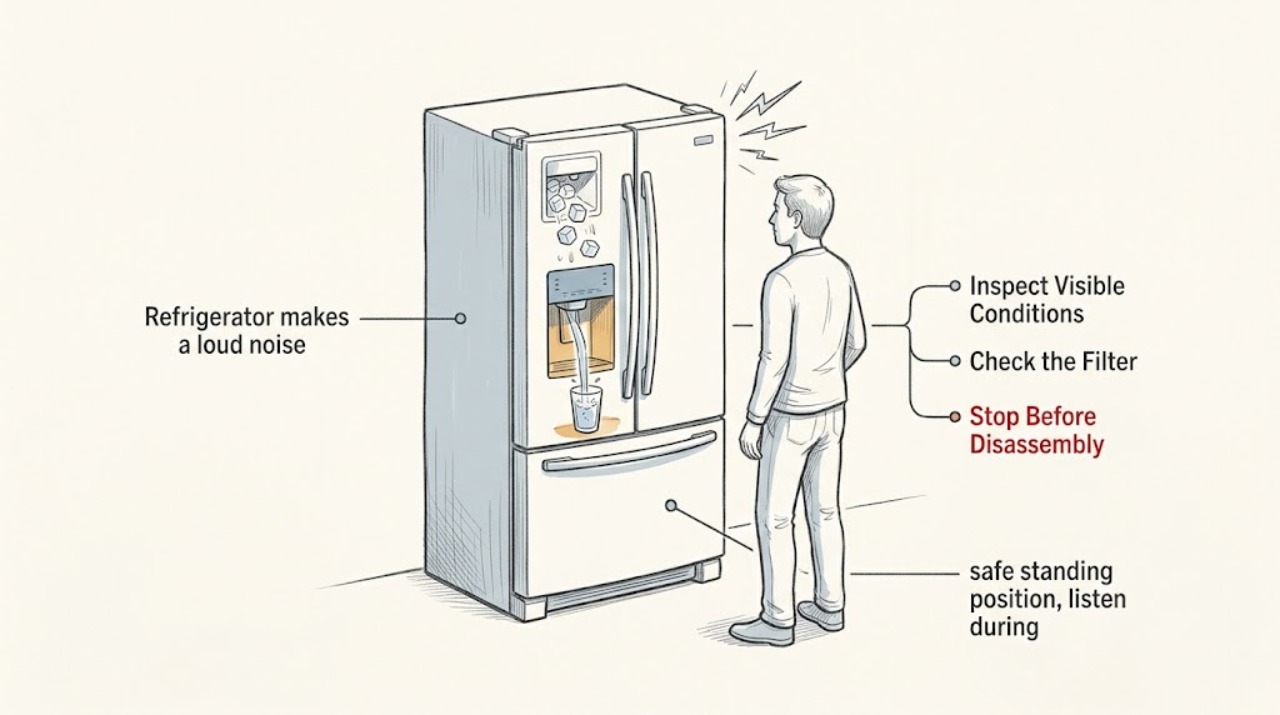
A loud sound that occurs only while the ice maker is filling is often caused by water movement through the valve or supply line, or by the line vibrating against the cabinet; it does not identify a failed part by itself. On Kenmore 106.56929600, first record whether the sound is a brief buzz, chatter, thump, or grinding noise and whether water actually enters the mold. From outside the refrigerator, confirm the water supply is fully open, the visible line is not kinked or pressed against the cabinet, and the dispenser flow has not also become weak. If the noise is accompanied by a leak, repeated electrical trip, burning smell, or a line that needs to be disconnected, stop using the ice maker and arrange qualified service. Do not replace the inlet valve or ice-maker assembly from the sound alone.
Work through in order
Diagnostic checks
Use only checks that match the exact appliance or system and its official guide.
-
Check 1
From a dry, safe standing position, listen during one normal ice-maker fill and note the timing and sound character: brief buzz or hum, chatter, thump or hammer, vibration, grinding, or a noise that continues after filling. Also note whether the mold receives water and whether the sound occurs when the dispenser is used.
Expected result: The noise is brief and synchronized with water entering the mold; it is a thump or vibration; it is a rapid chatter; or it is grinding/continuous and not tied to filling.
Next step: Record a short audio clip if safe, then continue only with the external water and line checks below. If the sound is grinding, accompanied by a burning smell, or continues after the fill event, turn the ice maker off using the model's documented control and arrange service.
Why this matters
Why: A fill-synchronized buzz can be valve operation, while a thump or rattle can be water-line movement or cabinet vibration. Chatter keeps flow restriction, pressure fluctuation, a kink, or valve vibration in consideration. Grinding or continuous noise is not explained by a normal fill sound alone and should not be used to name a part.
-
Check 2
Without moving the refrigerator or disconnecting tubing, verify that the household water shutoff is fully open and inspect the visible supply line for a sharp kink, crushing, or contact with the cabinet or wall. Look for any moisture at the accessible floor area, filter housing, and visible connection points.
Expected result: The shutoff is partly closed, the line is kinked or vibrating against a surface, the line is dry and clear, or there is water at a connection or near electrical equipment.
Next step: Correct only a harmless visible contact or obstruction without pulling the appliance. For any leak, wet floor, damaged line, or inaccessible shutoff, stop the ice-maker water function and obtain qualified service or plumbing help; do not loosen a fitting to test pressure.
Why this matters
Why: A partly closed or restricted path can change flow and make valve or tubing noise more noticeable; a line touching the cabinet can amplify a normal fill event. Moisture changes this from a noise question to a leak-safety issue and does not establish which internal part is at fault.
-
Check 3
Use the cold-water dispenser normally for a brief comparison, if this Kenmore has one, and compare its flow with its usual stream. Do not run it continuously or remove the filter housing. Note whether the loud fill sound started after a filter change or after the refrigerator was moved.
Expected result: The dispenser is also weak or chattering, the dispenser is normal while the ice-maker fill is noisy, the filter was recently changed, or there is no dispenser on this unit.
Next step: Use only the exact Kenmore manual for filter removal, seating, and replacement guidance. If flow requires line disconnection, pressure testing, or opening the appliance, stop and arrange service rather than ordering a valve from a symptom.
Why this matters
Why: Weak flow at both outlets makes a shared supply, filter, line, or inlet path more likely; normal dispenser flow narrows the issue toward the ice-maker fill branch but still cannot distinguish a valve, fill opening, or control without model-specific diagnosis. A symptom after filter replacement makes filter seating or restriction worth checking before parts are considered.
-
Check 4
Observe the ice mold and visible fill area during normal operation without starting a forced cycle, prying ice, using heat, or removing the ice maker. Record whether water enters cleanly, splashes or misses the mold, the mold remains dry, or the mold overfills.
Expected result: Water enters the mold normally, the mold stays dry, water splashes or misses the mold, the visible fill opening is iced, or the mold overfills.
Next step: Photograph the result and give it to service with the full model number and sound timing. Leave the ice maker off for an overfill, leak, inaccessible ice blockage, or any visible wiring or heater issue.
Why this matters
Why: A normal fill with an isolated brief sound supports a water-flow or vibration explanation rather than a confirmed failed assembly. A dry mold or repeated splash/miss points toward a fill-path, valve, or control diagnosis; overfilling raises a water-control concern. None of these observations authorizes removal of a tube or testing the valve while energized.
-
Check 5
Confirm the freezer remains cold enough to keep existing food hard and that the door and gasket close normally, without blocking vents or removing panels. Note whether the noise complaint is accompanied by warming, heavy frost, or a door-seal problem.
Expected result: The freezer is cold and sealed with no cooling symptom, or it is warm, heavily frosted, or not sealing.
Next step: Remove only harmless door or vent obstructions and use the exact manual's temperature guidance. Arrange refrigerator service for persistent warming, heavy frost, or a door that cannot seal; do not use a heat source or remove an airflow panel.
Why this matters
Why: A cold, sealed freezer with a fill-timed noise keeps the water-path branch in focus. Warming or heavy frost can interrupt ice production and create fan or airflow noise, so it is not safe to treat every sound as an inlet-valve issue.
Use your observations
Decision map
Find the observation that best matches what you see, then follow the next safe action.
-
PATH 01Next step
What you see
The sound is a brief buzz, hum, or soft thump that begins and ends with water entering the ice mold, the dispenser flow is normal, and there is no leak or cooling symptom.
Do this next
Keep the line from touching the cabinet, monitor whether the sound changes or becomes continuous, and use the exact Kenmore manual for model-specific settings. Request service if the noise becomes disruptive, the mold stops filling, or the pattern changes.
Why this path and its safety boundary
Why it matters: The pattern is consistent with valve operation or water-line movement during a fill event; it does not by itself justify replacing the inlet valve or ice-maker assembly.
-
PATH 02Next step
What you see
The noise is rapid chatter or a louder buzz during filling, and the dispenser is also weak, the filter was recently changed, or the visible line is kinked or partly closed.
Do this next
Correct only the visible, model-documented filter or line condition. Stop for leaks or any need to disconnect tubing; have service or a qualified plumber evaluate pressure and the water path.
Why this path and its safety boundary
Why it matters: A shared flow restriction, pressure fluctuation, filter seating issue, or line vibration is more likely than an isolated ice-maker harvest failure, but the exact cause remains unconfirmed.
-
PATH 03Next step
What you see
The dispenser is normal and the freezer is cold, but the ice mold stays dry or the fill opening repeatedly ices while a loud fill-related sound persists.
Do this next
Turn the ice maker off if the model permits and arrange service with the dry-mold or frozen-fill observation. Do not pry ice, apply direct heat, remove the tube, or force a test cycle.
Why this path and its safety boundary
Why it matters: The issue is narrowed to the ice-maker fill branch, fill path, or its control, but the sound cannot identify a specific valve, tube, or assembly on the 106.56929600 without a service diagnosis.
-
PATH 04Next step
What you see
The noise is grinding, continues when the ice maker is not filling, is accompanied by a leak, overfill, burning smell, visible wiring, repeated power trips, or freezer warming.
Do this next
Stop using the ice maker and keep clear of water or exposed electrical areas. Arrange qualified appliance service; seek urgent help for smoke, fire, or an immediate electrical hazard.
Why this path and its safety boundary
Why it matters: The symptom is outside a simple fill-noise comparison and may involve a mechanical, water-control, cooling, or electrical safety issue that cannot be diagnosed safely from sound alone.
Helpful context
Understand the symptom
This topic is about a sound during the fill event, not a general refrigerator hum. The useful first separation is timing: a brief sound that starts when the mold is being filled points toward the water path, while noise that continues after filling or occurs with no ice-maker activity needs a different refrigerator diagnosis. The 106.56929600 model number should be copied from the rating plate and used with the exact Kenmore manual before any part is ordered.
Manufacturer refrigerator-noise guidance describes brief buzzing or clicking when a water valve opens, thumping or hammering from a water line during a fill cycle, and rattling or vibration when water tubing or the cabinet transfers vibration. Those descriptions are useful symptom comparisons, not proof that this Kenmore uses a particular valve or ice-maker assembly.
Keep hands out of the ice-maker mechanism. Stop immediately for water near electrical parts, a damaged or bulging line, smoke, a burning odor, repeated power trips, or a noise that becomes grinding and does not stop with the fill event. Do not pull the refrigerator out across a wet floor, disconnect a water line, bridge ice-maker contacts, or test energized wiring.
When checks do not resolve it
Need a professional?
Arrange qualified appliance service when the noise is grinding or continuous, the ice mold stays dry despite a cold freezer and normal dispenser flow, the fill path repeatedly freezes, the mold overfills, the sound is accompanied by a leak or water near electrical equipment, or diagnosis would require disconnecting a water line, removing a panel or ice-maker assembly, pressure testing, or probing wiring. Stop immediately for smoke, burning odor, repeated electrical trips, exposed wiring, a damaged line, or food warming. Do not repeatedly cycle power, force the ejector, bridge contacts, use direct heat, or replace a part based only on the noise.
Common questions
FAQ
Is a loud buzz while the Kenmore ice maker fills always a bad water inlet valve?
No. A brief fill-timed buzz can be normal valve operation, while a restricted filter, kinked line, pressure fluctuation, or tubing vibration can change the sound. Check only the visible water path and flow comparison; do not order a valve from the sound alone.
What does a thump during ice-maker filling mean?
Manufacturer refrigerator-noise guidance associates a thump or hammering during a fill cycle with water-line movement. If the line is visibly contacting the cabinet, that can amplify the sound. A leak, damaged line, or noise that continues after filling needs service rather than a guessed part.
Why compare the water dispenser when the problem is the ice maker?
The dispenser provides a safe symptom comparison. Weak flow at both outlets keeps a shared supply, filter, line, or inlet path in consideration; normal dispenser flow narrows attention toward the ice-maker fill branch without proving a specific component.
Can I remove the ice-maker fill tube to stop the noise?
Do not remove the tube or test the valve while energized. For a leak, frozen fill path, overfill, or inaccessible connection, turn the ice maker off if the exact manual documents that control and arrange service.
Read the exact guide
Official sources
- Refrigerator Noise - Thumping or HammeringWhirlpool Product Help · The page states that a thump or hammering noise may be caused by the water line during a fill cycle and treats that as normal operation.
- Kenmore ManualsKenmore · Kenmore's official manual portal says to enter the complete appliance model number to obtain the matching owner's manual and resources; it does not establish a universal part fit from a symptom.
- Refrigerator Noise - Chattering Noise When DispensingWhirlpool Product Help · The page identifies pressure changes, a partially closed shutoff, kinked tubing, air after filter replacement, filter restriction, and valve vibration as possible contributors to chattering; use only as symptom-level context.
- Refrigerator Noise - BuzzingWhirlpool Product Help · The page describes valve buzzing when an ice maker fills and says a restricted filter or line can make the valve buzz louder; use only as symptom-level context for the Kenmore water path.
- Refrigerator Normal Sounds and NoisesWhirlpool Product Help · The page distinguishes fill-related buzzing, rattling or vibrating from water lines, and other cooling sounds; it does not identify a Kenmore component.
- Ice Maker Not Working - TroubleshootingWhirlpool Product Help · The page covers restricted supply, kinks, freezer temperature, ice-maker state, and filter seating as symptom-level checks; it does not establish Kenmore 106.56929600 component compatibility.
Community feedback
Share a repair observation
Share a plain-text repair observation. Accepted observations are published automatically; this page may take a moment to update.