
On this page
Start here
Quick answer
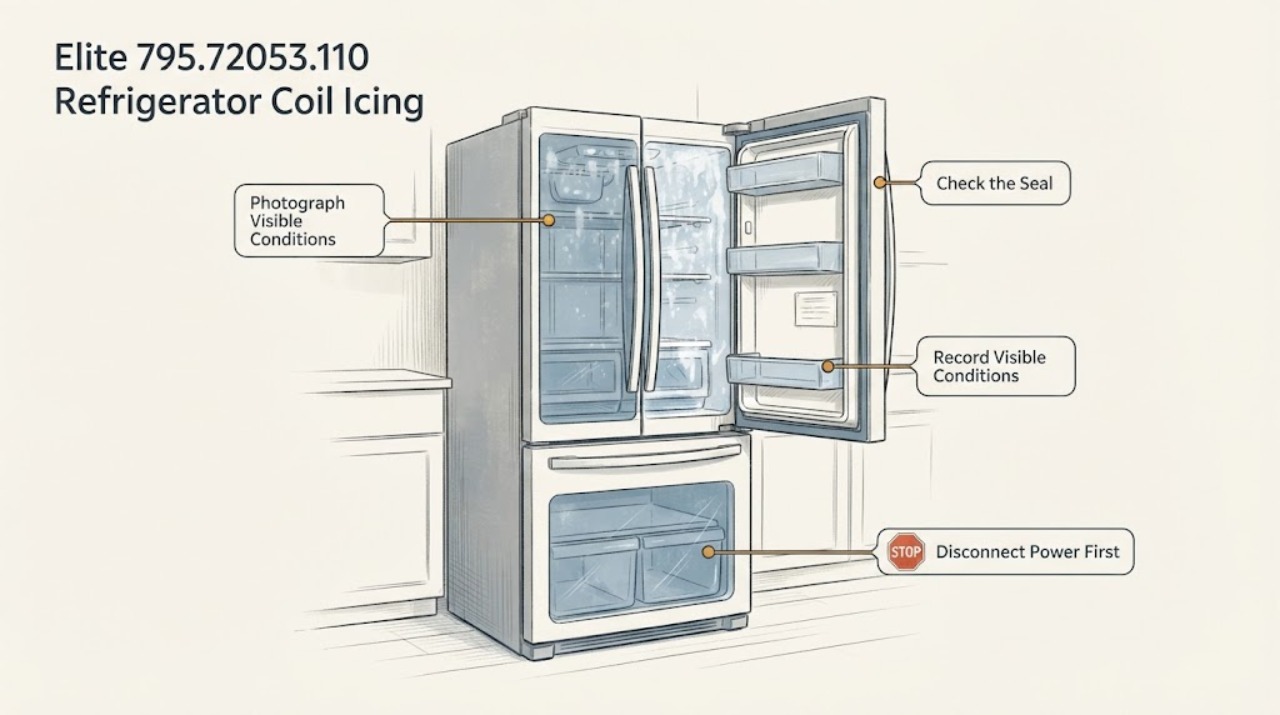
For a Kenmore Elite 795.72053.110 that appears to ice over, first protect the food and verify the full rating-plate model; the Kenmore/Sears owner guide identifies this unit within the 795.7205* bottom-freezer family, but it does not make a visible frost layer proof of a failed heater, sensor, or control. With power and water connections left undisturbed, document where the frost is, whether it blocks an air path, whether a door or gasket is admitting humid air, and whether both compartments hold safe temperatures. A light frost pattern after frequent door opening or shortly after a defrost cycle can have a non-component explanation. A thick frost block that returns, restricts airflow, or accompanies a warm refrigerator needs qualified diagnosis. Do not remove the evaporator cover, test a heater or sensor, add refrigerant, use a hair dryer or heat gun, or chip ice with a sharp tool.
Before you begin
Safety first
- User checks are limited to dry-position identity, temperature, door/gasket, visible vent, loading, control, and installation observations. Unplug before cleaning or service. Do not remove panels, probe live circuits, test a heater or sensor, touch wiring or fans, use a hair dryer, heat gun, knife, ice pick, or other sharp/heat tool, add refrigerant, disconnect sealed-system tubing, or move the refrigerator alone.
Work through in order
Diagnostic checks
Use only checks that match the exact appliance or system and its official guide.
-
Check 1
Read and photograph the rating plate from a dry, accessible position without removing a cover. Compare every character with Kenmore 795.72053.110 and record the serial number. Use the exact model in Kenmore or Sears support rather than treating 795.7205, an LG model, or a neighboring Kenmore suffix as interchangeable.
Expected result: The plate confirms 795.72053.110; a suffix or digit differs; the label is unreadable; or the appliance layout does not match a bottom-freezer refrigerator.
Next step: Use the confirmed model and serial for the owner guide and service request. If the label cannot be safely read, stop at identity and do not order a defrost component.
Stop if: Do not move the refrigerator alone, remove panels, or reach behind it to find the label near wiring or a wet area.
Why this matters
Why: The opened owner guide covers model 795.7205* and states that the model may have only some of the illustrated features. An unresolved identity blocks model-specific defrost procedures and part compatibility.
-
Check 2
With the refrigerator closed normally, inspect only visible frost, food packages, door edges, gaskets, and the air vents in both compartments. Note whether frost is a thin layer on food or walls, concentrated at a door edge, covering a rear vent, or forming a thick mass behind an inaccessible panel. Do not pry, scrape, or chip the ice.
Expected result: Frost is light and vents remain open; it clusters at a door edge or gasket; it is on food packaging; or a solid mass blocks an air path.
Next step: Remove only a visible package obstruction, wipe damp containers, and make sure the door can close without forcing it. If a block restricts airflow or is behind a cover, preserve the evidence and arrange service.
Stop if: Stop if the gasket is torn, water is near electrical parts, ice is hiding wiring, or clearing it would require a tool or interior-panel removal.
Why this matters
Why: The owner guide identifies frequent or prolonged door opening, a door that does not close correctly, humidity, damp or uncovered food, and a recent defrost cycle as causes of moisture or frost. A solid recurring block is more concerning than a light surface layer, but the observation does not identify a heater, sensor, or board.
-
Check 3
Place an appliance thermometer in the middle of the refrigerator section and another between frozen packages. Record the readings after the appliance has had time to stabilize, along with the time and whether the refrigerator section or freezer is affected. Do not rely on the display alone and do not probe the evaporator or wiring.
Expected result: The refrigerator is at or below 40°F and the freezer at or below 0°F; the freezer is cold but the refrigerator warms; both compartments are warm; or readings change after a door or loading correction.
Next step: Move perishable food to a working appliance when the temperature is uncertain or above the safe target. Give the temperature log and frost location to a qualified technician.
Stop if: Do not keep food in the appliance when its temperature cannot be verified, and stop immediately for smoke, burning odor, sparks, abnormal heat, or water near electrical parts.
Why this matters
Why: Safe temperatures make a light frost pattern less urgent, while persistent warm compartments plus recurring frost indicate a cooling or airflow problem needing diagnosis. FoodSafety.gov uses 40°F or below for refrigeration and 0°F or below for frozen storage.
-
Check 4
Check the visible installation and controls without pulling the cabinet out: confirm the temperature settings have not been changed, the doors close fully, no container prevents the gasket from contacting the cabinet, and the appliance is not in a hot location or pressed against a wall. Note whether the complaint followed frequent door opening, humid weather, or loading warm or uncovered food.
Expected result: A door or package obstruction is corrected; the gasket appears to seal; the setting or environment is abnormal; or none of these conditions explains the recurring frost.
Next step: Monitor the temperature and frost pattern after the safe external correction. If a solid pattern returns or cooling remains poor, schedule model-specific service.
Stop if: Do not adjust sealed-system controls, remove the rear grille, touch a fan, or continue if the cabinet is unstable or the power cord is damaged.
Why this matters
Why: The owner guide says installation temperature, door closure, door opening frequency, humidity, food moisture, and temperature settings can affect frost and cooling. A corrected external condition should reduce recurrence; persistent frost after those checks needs service rather than a guessed component.
-
Check 5
Record whether frost or condensation appears after the refrigerator's normal defrost period, how quickly a cleared visible area becomes blocked again, and whether the refrigerator section recovers temperature. Observe from outside only; do not force a defrost mode, open a service panel, or repeatedly cycle the appliance to provoke a fault.
Expected result: Moisture clears and temperatures recover; a thick frost block returns quickly; the refrigerator remains warm; or the symptom cannot be observed without opening the cabinet.
Next step: Keep the temperature/frost log, move food if needed, and arrange qualified refrigerator service for a recurring block or persistent warming. Request diagnosis against the exact model.
Stop if: Do not remove the evaporator cover, test a heater or sensor, use a hair dryer, heat gun, knife, ice pick, or other heat/sharp tool, or add refrigerant.
Why this matters
Why: The manual notes that a defrost cycle can cause temporary condensation and a short temperature rise. Rapid recurrence with reduced airflow or unsafe temperatures is a service-level defrost, airflow, temperature-control, or sealed-system decision, not proof of one failed part.
-
Check 6
Prepare the service handoff: provide the full model and serial, frost photographs showing location and thickness, compartment temperature readings, door/gasket observations, the date of any recent power or installation event, and whether a safe external correction changed the symptom. Keep the refrigerator powered only while it maintains safe temperatures and has no electrical hazard.
Expected result: The frost pattern, temperature trend, and recurrence interval are documented; food has been moved; or the source is hidden and cannot be safely observed.
Next step: Arrange qualified refrigerator service when the pattern recurs, food temperatures are unsafe, or any diagnosis would require panels, wiring, sealed-system work, or a forced test.
Stop if: Stop using the appliance for troubleshooting if there is smoke, burning odor, sparks, exposed wiring, water near electrical parts, or inability to disconnect power safely.
Why this matters
Why: This separates a visible moisture or loading condition from a recurring internal fault while avoiding an unsupported heater, sensor, control, or refrigerant diagnosis. The owner guide recommends qualified service for repair work.
Use your observations
Decision map
Find the observation that best matches what you see, then follow the next safe action.
-
PATH 01Next step
What you see
The rating plate confirms 795.72053.110, frost is light or limited to food packaging or a door edge, vents are open, and both compartments remain at safe temperatures.
Do this next
Correct only the visible package, door, gasket, or loading condition and monitor the temperature and frost pattern. Do not order a heater or sensor from light frost alone.
Why this path and its safety boundary
Why it matters: The pattern is more consistent with moisture entering during door opening, a transient post-defrost condition, or a loading/sealing issue than a proven failed defrost component.
-
PATH 02Next step
What you see
A thick frost mass repeatedly blocks a vent or inaccessible evaporator area, the refrigerator section warms, or either compartment cannot maintain the food-safety target after visible door, loading, and setting checks.
Do this next
Move perishable food to a working appliance and arrange qualified service with the exact model, photos, and temperature log. Do not open the cabinet or specify a replacement part from the frost symptom.
Why this path and its safety boundary
Why it matters: This is consistent with a service-level airflow, automatic-defrost, temperature-control, wiring, or sealed-system problem, but the result does not distinguish the heater, sensor, fuse, board, or refrigerant circuit.
-
PATH 03Next step
What you see
Frost returns after a safe external correction or a normal defrost period, but the source is hidden behind a panel or the model label does not resolve the exact suffix.
Do this next
Pause model-specific troubleshooting, retain the photos and readings, and have qualified service identify the correct documentation and fault path.
Why this path and its safety boundary
Why it matters: The evidence supports recurrence or identity uncertainty, not a safe owner-level component diagnosis. The 795.7205* family guide should not be treated as a universal procedure for every Kenmore or LG refrigerator.
-
PATH 04Next step
What you see
There is smoke, burning odor, sparking, exposed wiring, water near an outlet or electrical component, abnormal heat, or food has been held above a safe temperature.
Do this next
Stop using the refrigerator, disconnect power only if it can be done safely from a dry position, move food to safe storage, and arrange qualified appliance or electrical service.
Why this path and its safety boundary
Why it matters: The immediate issue is electrical, fire, water, or food safety, not a defrost-part selection problem.
Helpful context
Understand the symptom
What the frost pattern can and cannot tell you
Frost is evidence of moisture freezing, not a component diagnosis. On this bottom-freezer family, a door that is opened often or left slightly open, a dirty or obstructed gasket, humid air, damp or uncovered food, a blocked vent, or a recent defrost cycle can change the visible pattern. A solid recurring block with reduced cooling is more concerning, but the same symptom can require diagnosis of airflow, defrost control, temperature sensing, wiring, or sealed-system performance. The owner guide's model family is the boundary for this article; do not substitute an LG or another Kenmore platform's test sequence.
Food and electrical safety first
Keep an appliance thermometer in each compartment while you observe the symptom. If temperatures are not controlled, move perishable food to a working appliance and do not taste questionable food to decide whether it is safe. Unplug the refrigerator before any cleaning or service, and keep water away from the outlet and electrical parts. The owner guide recommends qualified service for repair work.
When checks do not resolve it
Need a professional?
Provide Kenmore Elite model 795.72053.110 and serial number, frost photographs and location, refrigerator and freezer thermometer readings with times, door and gasket observations, whether frost follows a defrost period or frequent opening, and any recent power or installation event. Request model-specific diagnosis; do not request a heater, sensor, board, or refrigerant charge solely from the visible frost.
Common questions
FAQ
Does frost on the coil prove the defrost heater failed?
No. The Kenmore guide also identifies door opening, door closure, humidity, damp or uncovered food, temperature settings, and temporary post-defrost condensation as frost or moisture factors. A recurring solid block with warming needs diagnosis, not a guessed heater or sensor.
What temperature should I use to decide whether food is safe?
FoodSafety.gov lists 40°F or below for the refrigerator and 0°F or below for the freezer. Use appliance thermometers rather than the display alone; move perishable food to a working appliance when those temperatures cannot be maintained.
Can I melt the ice with a hair dryer or chip it off?
Do not use a hair dryer, heat gun, knife, ice pick, or other sharp or heat tool. If the ice blocks airflow or returns, disconnect and service the refrigerator according to the exact model documentation rather than risking liner, wiring, water, or electrical damage.
Can I use an LG or another Kenmore 795 model's forced-defrost test?
Not safely from this evidence. The opened owner guide is a 795.7205* family guide, and the service procedure must match the full model and revision. Confirm 795.72053.110 and let qualified service handle any forced test or component measurement.
Read the exact guide
Official sources
- Cold Food Storage ChartFoodSafety.gov · Home refrigerator and freezer food-storage temperature targets
- Kenmore elite refrigerator defrost drain keeps freezing upNot applicable; exact Reddit post used only as an anecdotal recurrence signal for Kenmore 79572053110
- Kenmore ManualsTransform SR Brands LLC / Kenmore · Kenmore official manual lookup for Kenmore Elite model 79572053110 (795.72053.110) and its 795.7205* bottom-freezer guide family
Community feedback
Share a repair observation
Share a plain-text repair observation. Accepted observations are published automatically; this page may take a moment to update.