
On this page
Start here
Quick answer
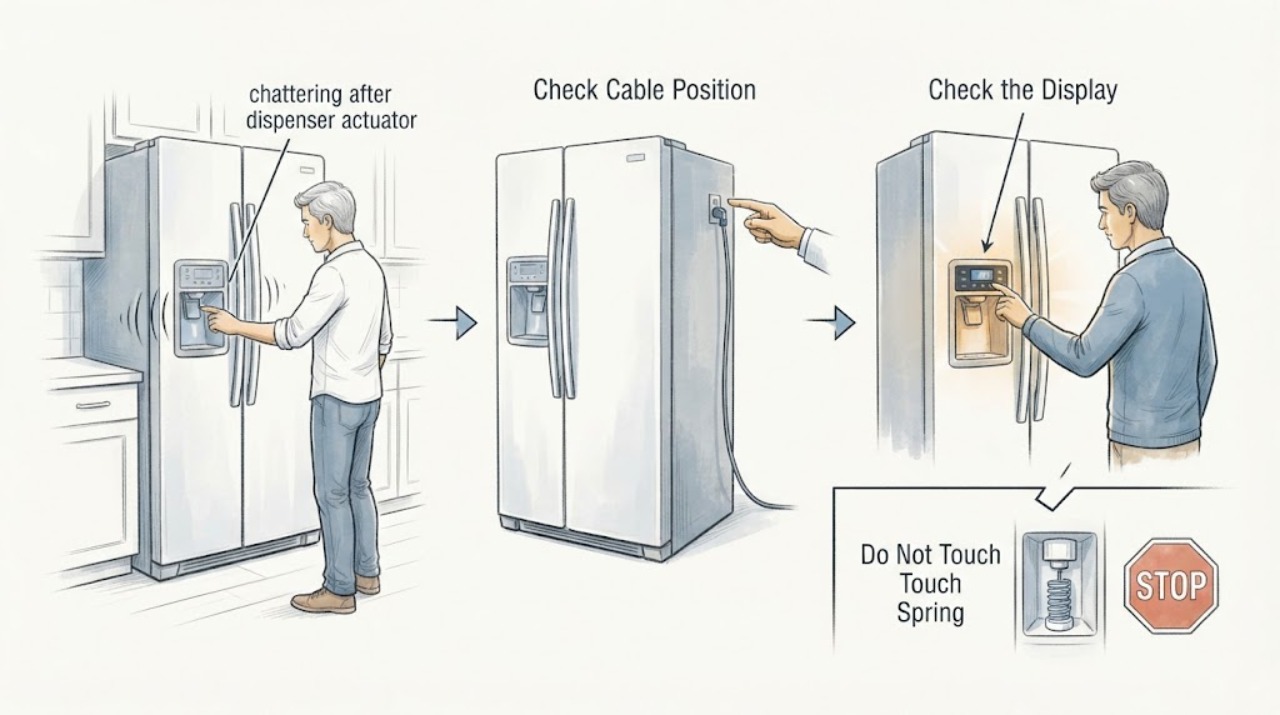
Stop using the water-and-ice dispenser while the Kenmore 253.4438340A chatters. The exact community report says the noise and loss of both water and ice began after the dispenser actuator was replaced and electrical connections were reconnected while the refrigerator was still powered; disconnecting a ribbon cable stopped the noise, but that is not a safe repair or proof that a board failed. First remove power from a dry accessible point, close the accessible water shutoff if there is a leak, and do not reconnect, unplug, bridge, or probe dispenser wiring while energized. Once the appliance is safe, verify the actuator is not held in, the dispenser control is not locked, and no visible water or crushed ice is obstructing the chute. Check the complete nameplate model and serial before using a manual or parts lookup: Kenmore's official manual finder requires the exact model, and the 253 prefix alone is not enough to prove a particular OEM platform or component fit. If both water and ice remain unavailable, the chatter returns with the dispenser intact, or the repair requires panel/board access, have qualified refrigerator service diagnose the actuator alignment, switch/control circuit, harness, inlet valve, and ice path rather than guessing a board or valve.
Before you begin
Safety first
- Do not reconnect or disconnect dispenser boards, ribbon cables, switches, or harnesses while energized. Do not leave the dispenser control disconnected for normal operation, probe live wiring, bridge contacts, open the board compartment, disconnect water tubing, or operate with a leak, exposed conductor, burning odor, abnormal heat, or repeated power trip.
Work through in order
Diagnostic checks
Use only checks that match the exact appliance or system and its official guide.
-
Check 1
Stop pressing the water or ice paddle. From a dry accessible position, disconnect the refrigerator from power according to the installation, close the accessible water shutoff if water is leaking, and leave the dispenser wiring and ribbon cable untouched until the appliance is fully isolated.
Expected result: Chattering stops when power is isolated, water continues to leak, there is a burning odor or heat, or the refrigerator is quiet but neither water nor ice dispenses.
Next step: Keep the dispenser off and proceed only with dry, external observations. Arrange prompt appliance service for noise, leak, odor, heat, or any need to access the dispenser boards or harness.
Stop if: Do not reconnect power to a wet or damaged assembly, repeatedly reset the refrigerator, or leave a ribbon cable or connector disconnected for normal use.
Why this matters
Why: A noise that stops only when de-energized is an electrical or mechanically driven warning, not evidence that a disconnected cable is an acceptable operating state. A leak or heat raises the safety priority above dispenser troubleshooting.
-
Check 2
With power isolated, look at the actuator from the user side and verify that it returns freely, is not trapped by trim, and is not being held in by a cup, ice buildup, or mispositioned dispenser cover. Do not remove the control panel or reach behind it.
Expected result: The actuator is held in or misaligned, the dispenser cover or chute is obstructed, the paddle returns normally, or the repair area shows a loose part, cracked trim, wetness, or exposed wiring.
Next step: Remove only a loose accessible obstruction without force. If the actuator does not return normally or any repair-area damage is visible, keep power off and have the exact model inspected.
Stop if: Do not force the paddle, insert a tool into the switch, remove trim or boards, or test the actuator energized.
Why this matters
Why: A mechanical actuator that remains engaged can continuously request water or ice and produce chatter, but normal front-side movement does not clear the switch, control board, harness, or valve. Wetness or exposed wiring after the repair is a service-level condition.
-
Check 3
From the normal user interface, check that the dispenser or control lock is not enabled and that the freezer door is fully closed. Inspect the chute and accessible ice bin for a compacted obstruction without reaching into the auger or motor.
Expected result: A lock is shown, the door is not closing, the chute is blocked by loose ice, the bin is mis-seated, or controls and visible ice path are normal while both outputs remain dead.
Next step: Correct only the documented lock, door, bin, or loose-chute condition, then make one brief normal request after the refrigerator is safely re-energized. If chatter returns or neither output works, stop and arrange service.
Stop if: Do not bypass the door switch or lock, pry compacted ice, turn the auger by hand, or run with a cover removed.
Why this matters
Why: A lock, door state, bin position, or chute obstruction can suppress dispensing without proving an electrical board failure. When both water and ice are unavailable despite normal user controls, the shared dispenser control/supply path remains a possibility, but no particular board or valve is established.
-
Check 4
Check the accessible household water shutoff and visible line for a normal open position, kink, or leak without moving the refrigerator or loosening a fitting. If the dispenser later has normal electrical response but no water, record that separately from the ice result.
Expected result: The line or shutoff is visibly restricted or leaking, water flow is absent, water is normal but ice is unavailable, or both water and ice remain unavailable after the repair.
Next step: Close the water supply for a leak and use a plumber for a household connection problem. For normal visible supply with both outputs dead or chatter, obtain exact-model appliance diagnosis.
Stop if: Do not disconnect tubing, pressure-test by loosening a connection, force a seized shutoff, or operate over a wet floor.
Why this matters
Why: A supply restriction can explain no water and some ice symptoms, but a new chatter after actuator work plus loss of both outputs keeps the dispenser switch/control and harness in consideration. Normal water supply does not prove a valve or board fault.
-
Check 5
Write down the complete model/serial, what was replaced, whether power was on during reconnection, which plugs or ribbon connectors were disturbed, whether the chatter is continuous or paddle-triggered, and whether water, ice, or both fail. Give these notes to a technician; do not repeat the live reconnection to reproduce it.
Expected result: The failure began immediately after energized reconnection, the noise is continuous, the noise occurs only when the paddle is pressed, the repair connector was wet or loose, or the refrigerator remains quiet but both outputs are dead.
Next step: Keep the dispenser disabled and arrange qualified service to inspect the intact circuit and water/ice paths. Do not purchase a board, actuator, valve, or ice-maker assembly solely from the symptom.
Stop if: Do not open energized panels, measure live voltage, bridge connectors, or continue using a disconnected dispenser control.
Why this matters
Why: Timing and trigger behavior can help service separate actuator alignment from switch/control, harness, valve, and ice-path diagnosis. The exact community case includes a later unresolved hammering symptom even after board replacements, so it does not support a one-part conclusion.
Use your observations
Decision map
Find the observation that best matches what you see, then follow the next safe action.
-
PATH 01Next step
What you see
The refrigerator chatters as soon as power is restored after the actuator repair, and the sound stops only when a dispenser cable is disconnected or power is removed.
Do this next
Keep power isolated or the dispenser out of use and arrange exact-model service to inspect actuator return, switch/control boards, connectors, harness routing, and evidence of moisture or damage.
Why this path and its safety boundary
Why it matters: This is a post-repair electrical/control interaction or mechanically held input until proven otherwise. The disconnected-cable result does not prove a board, switch, or actuator failure and is not a safe operating mode.
-
PATH 02Next step
What you see
The actuator returns normally from the front, the control is unlocked, the freezer door and chute/bin are normal, and both water and ice remain unavailable without a visible household supply issue.
Do this next
Stop repeated requests and have a qualified technician diagnose the exact model with power and water safely controlled; do not swap cross-platform boards or valves.
Why this path and its safety boundary
Why it matters: A shared dispenser control, wiring, valve-control, or water/ice path issue is more likely than a simple broken front actuator, but no single component is confirmed.
-
PATH 03Next step
What you see
Only the water side is weak or dry and the accessible shutoff, line, or filter arrangement changed during the repair, while the ice path has a separate normal response.
Do this next
Close water for leaks, use a plumber for the household connection, and use exact-model appliance service for an internal valve or dispenser diagnosis.
Why this path and its safety boundary
Why it matters: A supply, connection, or water-control issue becomes more plausible than a dispenser-board chatter, but the exact model's water path and parts fit still need confirmation.
-
PATH 04Next step
What you see
The connector area is wet, wiring is exposed or damaged, the chatter is accompanied by heat or burning odor, water is on the floor, or power trips.
Do this next
Keep the refrigerator/dispenser off, isolate power from a dry accessible point, close the accessible water supply if safe, and obtain prompt qualified appliance service; use an electrician for a house-circuit or outlet hazard.
Why this path and its safety boundary
Why it matters: This is an electrical or water safety condition, not an actuator adjustment problem.
Helpful context
Understand the symptom
Treat the chattering as an electrical stop condition
A dispenser actuator is a user-facing mechanical input, but the water and ice outputs also depend on switches, control electronics, wiring, water routing, and the ice dispenser path. Chattering immediately after reconnecting the actuator assembly while powered is a repair-history clue, not a diagnosis. Do not keep the refrigerator powered with a loose connector or a disconnected ribbon cable simply because the noise stops.
Do not infer the OEM platform from 253 alone
Kenmore's current official manual finder asks for the complete model number and says to omit special characters for searching. That supports using the exact 253.4438340A nameplate and serial, but the opened official Kenmore pages do not publish a platform cross-reference for this older model. Do not transfer a Frigidaire, Electrolux, or other platform's actuator, board, valve, or test procedure without exact fit evidence.
When checks do not resolve it
Need a professional?
Call qualified Kenmore/Sears or refrigerator service for post-repair chatter, loss of both water and ice, wet or damaged connectors, a continuously held actuator, or any diagnosis requiring internal dispenser access. Confirm that the provider has the exact 253.4438340A model data; do not assume an OEM platform or cross-model part fit from the 253 prefix.
Safety scope: Do not reconnect or disconnect dispenser boards, ribbon cables, switches, or harnesses while energized. Do not leave the dispenser control disconnected for normal operation, probe live wiring, bridge contacts, open the board compartment, disconnect water tubing, or operate with a leak, exposed conductor, burning odor, abnormal heat, or repeated power trip.
Have this ready
- Provide the complete nameplate model and serial, repair date and replaced actuator, whether power was on during reconnection, every connector or ribbon cable disturbed, whether the chatter is continuous or paddle-triggered, water and ice output observations, visible leak or moisture evidence, and the exact Reddit-like symptom only as an unverified history.
Common questions
FAQ
Can I leave the dispenser ribbon cable disconnected so the refrigerator keeps cooling?
No. It changes the dispenser's circuit and is not an approved operating condition. Keep the dispenser out of use and have the post-repair chatter diagnosed with the appliance intact and power isolated for service work.
Does chattering after reconnecting the actuator prove I fried the dispenser board?
No. The timing makes the actuator alignment, switch/control input, connector, harness, moisture, valve control, or another dispenser-path interaction relevant. The exact community report remained unresolved after board replacements, so it does not identify one part.
Is Kenmore 253.4438340A definitely made by a particular OEM?
The opened official Kenmore pages do not publish an OEM-platform cross-reference for this older model. Use the complete model and serial with Kenmore's manual/service resources and do not transfer parts or test procedures from another platform solely because the number begins with 253.
Why are both water and ice unavailable after the actuator replacement?
Both outputs point toward a shared dispenser control, wiring, water-control, or related path, but they do not identify a board or valve. First stop the chatter and check only the dry, external actuator, lock, chute, door, and water-supply conditions; then arrange service if both remain dead.
Read the exact guide
Official sources
- Customer Care & Support | Kenmore AppliancesKenmore · Official support-routing page used for service escalation; it does not authorize user electrical disassembly or identify a component for this model.
- Find Your Manual | Kenmore Appliance Manuals & GuidesKenmore · Official Kenmore identity and documentation guidance used to require the complete model number; the page does not itself publish a 253.4438340A manual or OEM-platform mapping.
- Kenmore 253.4438340A Refrigerator - Replaced Water Dispenser Actuator Replacement, once reconnect the refrigerator is chattering. What did I do wrong?Reddit r/appliancerepair · Exact-model community report used only for symptom timing and unresolved repair history; it is not manufacturer guidance and does not confirm a board, valve, or actuator failure.
Community feedback
Share a repair observation
Share a plain-text repair observation. Accepted observations are published automatically; this page may take a moment to update.