
On this page
Start here
Quick answer
First separate a slow or stopped dispenser from water that flows normally but still tastes or looks unchanged. Kenmore's official filter guidance says a slow dispenser can mean the filter is due for replacement and recommends changing its cartridge every six months, or sooner when flow slows noticeably. Do not choose a filter by the Kenmore brand name alone: the official pages describe individual cartridges as fitting only select refrigerator models, and Kenmore's manual finder requires the complete model number. Find that model, identify the exact filter or a documented bypass arrangement, and follow the matching manual and package instructions for removal and installation. If the correct new filter is properly installed but flow or filtration does not improve, or the filter area leaks, stop using the dispenser and arrange model-specific service rather than guessing at a filter head, inlet valve, or tubing part.
Before you begin
Safety first
- Owner checks stop at dry external observation, model identification, and a filter replacement only when the exact manual permits it. Do not work on pressurized tubing, remove the housing or rear panels, bypass a required filter, or handle wet electrical areas.
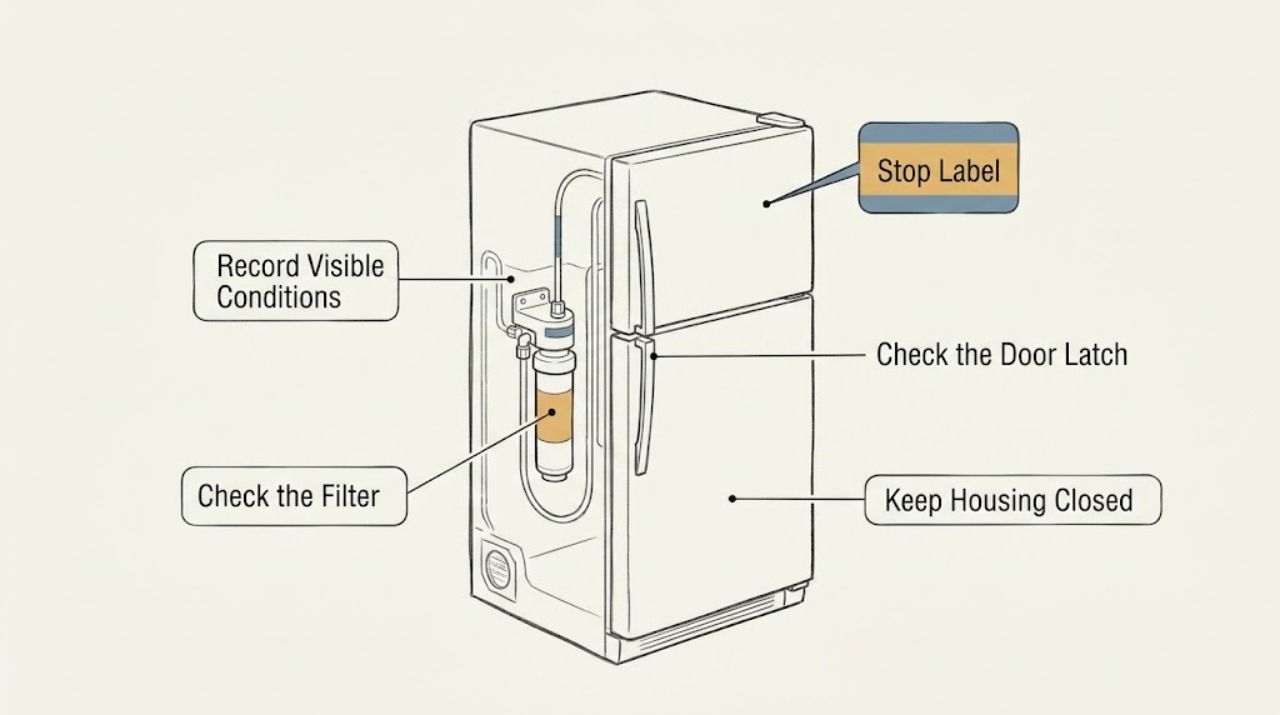
Work through in order
Diagnostic checks
Use only checks that match the exact appliance or system and its official guide.
-
Check 1
Run one brief, normal dispenser check only if the dispenser area is dry and safe. Record whether the stream is slow, absent, intermittent, or normal, and whether the complaint is taste/odor, visible particles, or a filter-status indication. Do not repeatedly dispense to provoke a leak.
Expected result: Flow is slow or absent, flow is normal but taste or appearance is unchanged, or water appears around the filter housing or dispenser.
Next step: Photograph the filter area and continue with model and filter identification. Stop dispensing and address the water connection if water is escaping or approaching electrical components.
Stop if: Do not keep cycling the dispenser, touch wet electrical parts, or treat a taste complaint as proof of a particular failed component.
Why this matters
Why: Slow flow supports a restricted or overdue filter as an early possibility because Kenmore links slow dispenser flow with a filter due for change. Normal flow with a quality complaint needs the exact cartridge's certified scope and water source considered; a leak changes the task to water-safety and model-specific service.
-
Check 2
Read the complete Kenmore refrigerator model number from the appliance label and use Kenmore's official manual finder. Confirm whether the refrigerator has an internal or base-grille filter, a documented bypass cap, a dispenser, and an ice-maker water path before selecting a cartridge or procedure.
Expected result: The model and matching manual are found, or the model is incomplete, unreadable, or the manual does not match the refrigerator's controls and filter housing.
Next step: Use only the matching manual and filter listing. If the identity cannot be matched, do not force a cartridge or use a generic bypass; provide the model and photos to Kenmore support or an appliance technician.
Stop if: Do not assume that a filter from another Kenmore refrigerator, another brand, or a visually similar cartridge fits this appliance.
Why this matters
Why: Kenmore's manual finder is model-based, and the official filter pages describe fitment for select refrigerator models or configurations. An incomplete identity leaves filter size, direction, bypass requirements, and user-serviceable steps unresolved.
-
Check 3
Check the filter's installation date or the refrigerator's filter reminder, then inspect the accessible cartridge and housing for an obvious incomplete latch, damaged seal, crack, or filter that is not the model-listed part. If the exact manual permits owner replacement, remove and install the correct cartridge exactly as the manual and package instructions show.
Expected result: The filter is at or beyond six months, flow has slowed noticeably, the cartridge is mis-seated or damaged, or the filter is recent and appears correctly installed.
Next step: Correct only a clearly documented installation issue or replace only the exact model-compatible cartridge. Keep the old filter and record its part number for service if the symptom remains.
Stop if: Do not force the cartridge, bypass a required filter without the manual's approval, or continue using a cracked or leaking housing.
Why this matters
Why: Kenmore's official filter guidance supports replacement at six months or sooner when flow slows; a mis-seated or damaged cartridge can also leave the water path unresolved. A recent, correctly installed cartridge makes age alone less likely, but it does not establish a failed filter head or inlet valve.
-
Check 4
After the matching cartridge is installed according to the exact manual, make one controlled dispenser test and compare flow with the original observation. Record whether the stream improves, remains slow or absent, or flows normally while taste, odor, or visible-particle concerns remain.
Expected result: Flow improves, flow does not improve, the dispenser remains dry but quality concerns remain, or the filter area begins leaking.
Next step: If the symptom remains, stop repeated tests and arrange Kenmore or qualified appliance service with the model, cartridge part number, photos, and before/after observations. Use an alternate known-safe water source until the filtration question is resolved.
Stop if: Do not order a filter head, valve, tubing, or control part from the symptom alone, and do not drink water from a leaking or unverified filtration path.
Why this matters
Why: Improved flow after a due or mis-seated filter supports a filter restriction or installation condition. No improvement with a correct cartridge leaves the filter head, inlet, tubing, air in the water path, or household supply unresolved; normal flow with a quality complaint is not proof of any one internal part.
-
Check 5
If water flow is normal but filtration performance is the concern, read the exact cartridge's certification and contaminant-reduction scope and compare it with the intended water use. Keep the refrigerator's model, cartridge number, replacement date, and water symptom together; do not infer that a general taste or odor claim covers an unlisted contaminant.
Expected result: The cartridge's official scope matches the concern, the concern is outside the stated scope, or the cartridge and model cannot be identified.
Next step: Follow the exact cartridge documentation and use a known-safe alternate water source when necessary. Contact Kenmore support or an appropriate water-quality professional if the concern persists with normal flow and a correctly matched filter.
Stop if: Do not use an unverified cartridge to treat water of unknown safety or claim that a filter removes a contaminant not listed in its official scope.
Why this matters
Why: Kenmore's official product pages state specific certification and reduction claims for individual cartridges, not a universal promise for every Kenmore refrigerator or every contaminant. An unidentified or out-of-scope concern needs water-quality guidance and model-specific support, not a different guessed part.
Use your observations
Decision map
Find the observation that best matches what you see, then follow the next safe action.
-
PATH 01Next step
What you see
The dispenser is slow, the cartridge is about six months old or older, or flow slowed noticeably and improves after the exact model-compatible filter is installed.
Do this next
Keep the exact model and cartridge record, follow the package and manual replacement interval, and monitor for recurring slow flow or leakage.
Why this path and its safety boundary
Why it matters: This pattern is consistent with the filter restriction or replacement interval described on Kenmore's official filter pages, without proving that the cartridge was the only issue.
-
PATH 02Next step
What you see
The correct, recent cartridge is seated according to the matching manual, but flow remains slow or absent.
Do this next
Stop repeated dispensing and arrange model-specific appliance service with the filter number, model, and before/after flow observations.
Why this path and its safety boundary
Why it matters: Filter age is less supported as the sole explanation. The remaining possibilities include a model-specific filter head, inlet, tubing, air or supply condition, or a dispenser path fault; the symptom does not identify a part.
-
PATH 03Next step
What you see
Water flows normally, but taste, odor, or visible-particle concerns remain after a correctly matched filter is installed.
Do this next
Check the exact cartridge's official certification and scope, use an alternate known-safe water source as needed, and contact Kenmore or a water-quality professional rather than ordering an internal refrigerator part.
Why this path and its safety boundary
Why it matters: Normal flow does not prove that the concern is a failed refrigerator component. Kenmore's official claims are cartridge-specific, so the concern may be outside that cartridge's stated reduction scope or may require water-source assessment.
-
PATH 04Next step
What you see
The model or cartridge cannot be identified, the filter does not match the housing, the housing is cracked, or water leaks after filter work.
Do this next
Stop using the dispenser, keep the area dry, and arrange Kenmore or qualified appliance service with the model, filter information, and leak photographs.
Why this path and its safety boundary
Why it matters: Compatibility and water-containment are unresolved. A same-brand or visually similar cartridge cannot establish fit, and a leak is not a normal filtration-quality adjustment.
Helpful context
Understand the symptom
What “not filtering” tells you
A slow or stopped dispenser is a flow symptom; a normal stream with persistent taste, odor, or visible particles is a water-quality or filtration symptom. The Kenmore 500-gallon filter page says a slow dispenser can indicate that its filter is due for a change. That supports checking filter age, fit, and model compatibility first, but it does not prove that the cartridge is the only cause. A filter with normal flow also cannot be assumed to reduce every contaminant: use the certification and scope for the exact cartridge and follow the refrigerator manual.
Why the exact model is required
Kenmore's official manual finder asks for the complete appliance model number and says model-specific manuals cover refrigerator operation and parts information. Kenmore's filter pages likewise describe individual cartridges as fitting select refrigerator configurations. A filter that clicks into a housing is not automatically the correct filter, and a bypass cap or filter-head arrangement can vary by model. Use the exact model manual before forcing, bypassing, or ordering anything.
Only after diagnosis
Potential parts
- refrigerator water filter cartridge
Consider a replacement cartridge only when the exact Kenmore model and filter housing identify it, the filter is due or flow has slowed, and the matching manual or package authorizes replacement.
Kenmore's official pages describe individual cartridges as fitting select refrigerator models or configurations. Confirm the complete refrigerator model and exact filter part number before ordering; do not infer fit from the Kenmore name alone.
When checks do not resolve it
Need a professional?
Arrange Kenmore or qualified appliance service when a correct, model-matched filter does not restore expected flow, filtration concerns persist with normal flow, the filter head or housing is damaged, water leaks after filter work, or the model and filter cannot be identified. Stop using the dispenser for a leak, water near electrical components, a cracked housing, or water of unknown safety. Do not select an inlet valve, filter head, tubing, bypass cap, or control part from the symptom alone.
Safety scope: Owner checks stop at dry external observation, model identification, and a filter replacement only when the exact manual permits it. Do not work on pressurized tubing, remove the housing or rear panels, bypass a required filter, or handle wet electrical areas.
Common questions
FAQ
How often should a Kenmore refrigerator water filter be changed?
Kenmore's opened official filter pages commonly state every six months, with earlier replacement when water flow slows noticeably. Use the exact cartridge and refrigerator manual for the model's instructions and do not assume that every Kenmore refrigerator uses the same filter.
Why is my Kenmore dispenser slow after I changed the filter?
Confirm the complete refrigerator model and filter part number, then check that the cartridge is installed exactly as the matching manual and package direct. If the correct recent filter is seated but flow remains slow, stop repeated dispensing and arrange service; the symptom does not prove a filter-head or inlet-valve failure.
Can I use any Kenmore filter that fits the housing?
No. Kenmore's official product pages describe cartridges as fitting select refrigerator models or configurations. Match the complete refrigerator model and exact filter part number in the official manual or filter listing before installation.
What if water tastes or looks unchanged but the dispenser flow is normal?
Normal flow does not prove that a component has failed. Check the exact cartridge's official certification and contaminant-reduction scope; the concern may be outside that scope or require water-source assessment. Use an alternate known-safe water source if needed and contact Kenmore or a water-quality professional rather than guessing at an internal part.
Read the exact guide
Official sources
- Find Your Manual | Kenmore Appliance Manuals & GuidesKenmore · Opened official Kenmore manuals page. It requires the complete model number for the manual and states that the manuals provide model-specific refrigerator operation and parts information.
- Kenmore 9081 Genuine Kenmore Refrigerator Water Filter Genuine Original Equipment Manufacturer (OEM) partKenmore · Opened official Kenmore product page. It states that filter 9081 fits select side-by-side, bottom-freezer, and top-freezer refrigerators, recommends replacement every six months or sooner if flow slows, and gives model-specific certification and part-number information.
- Customer Care & SupportKenmore · Opened official Kenmore customer-care page. It provides links for product manuals, parts, scheduled appliance repair, and customer support when an exact model-specific answer is needed.
- Refrigerator Water Filter 500-Gallon CapacityKenmore · Opened official Kenmore product page. It says the filter can increase flow, links slow dispenser flow with a filter due for change, recommends replacement every six months, and describes certification and contaminant-reduction claims for that specific cartridge.
Community feedback
Share a repair observation
Share a plain-text repair observation. Accepted observations are published automatically; this page may take a moment to update.