
On this page
Start here
Quick answer
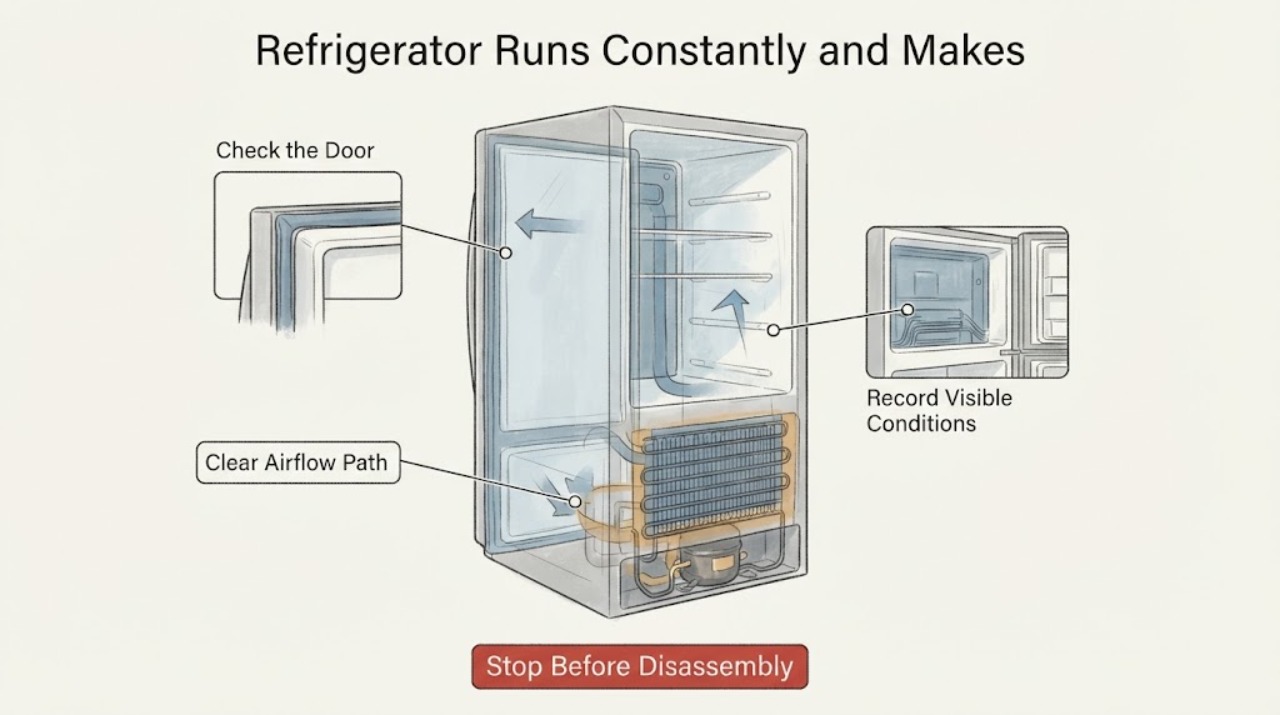
A Kenmore refrigerator that runs constantly is not automatically failing, and a clicking, tweeting, or sputtering sound cannot identify a part by itself. First record whether the refrigerator and freezer are actually warming, whether the noise follows a fan or compressor cycle, whether it stops when a door opens, and whether the doors, vents, and accessible condenser area are clear. Kenmore requires the complete model number to select the applicable manual, and an exact repair thread shows why the sound location and door response matter without proving a diagnosis. If cooling is deteriorating, the noise is persistent or harsh, or there is smoke, burning odor, water near electrics, a hot cord, or repeated breaker tripping, stop using the appliance and arrange qualified service.
Work through in order
Diagnostic checks
Use only checks that match the exact appliance or system and its official guide.
-
Check 1
Without repeatedly opening the doors, record whether the refrigerator and freezer are holding their usual temperatures, whether the compressor runs continuously or cycles, whether doors close and seal, and when the noise began.
Expected result: Temperatures are stable and the symptom follows a recent load or warm condition, or temperatures are rising while the compressor runs for long periods.
Next step: Keep the doors closed, confirm the controls have not been changed, and monitor after the documented recovery condition. If temperatures continue to rise, arrange service with the record.
Stop if: Do not keep running a warming refrigerator to reproduce a noise.
Why this matters
Why: A temporary cooling load may explain longer operation. Rising temperatures despite long operation make airflow, defrost, fan, control, or sealed-system service more likely; the sound alone cannot distinguish them.
-
Check 2
Listen from a safe position and note whether the tweeting or sputtering is brief or continuous, follows a fan or compressor cycle, stops when a door opens, changes with a defrost or water event, or gets louder or harsher.
Expected result: The sound is brief and stage-related, stops with a door response, or repeats with warming, vibration, a click-and-stop start attempt, or another abnormal symptom.
Next step: Make a short recording and note the location and timing. Do not remove covers or reach near fans, the compressor, or wiring to locate it.
Stop if: Stop immediately for grinding with heat, smoke, burning odor, exposed wiring, a hot plug, or repeated breaker trips.
Why this matters
Why: Door response and sound location can narrow which subsystem a technician should inspect, but they do not prove a fan, compressor, relay, damper, or sealed-system failure. A repeating sound with worsening cooling needs service.
-
Check 3
Inspect only the accessible door gaskets, interior air vents, and external clearance for gaps, blocked airflow, or items pressed against a vent. Find the complete Kenmore model number and use the official manual for any permitted condenser or filter care.
Expected result: A door does not seal, an interior vent is blocked, the model manual identifies an accessible care step, or the visible path is clear.
Next step: Correct only the accessible loading or cleaning condition in the matching manual and monitor one normal cycle. If the temperature or noise does not improve, arrange service.
Stop if: Do not pull out a heavy refrigerator alone, remove panels, scrape hidden ice, or clean near energized wiring.
Why this matters
Why: A door leak or blocked airflow can prolong cooling and increase run time. A clear external path does not rule out a hidden defrost, fan, control, compressor, or sealed-system problem.
-
Check 4
Prepare a service record with the complete model number, temperature trend, sound recording, sound location, whether it follows a door or cooling cycle, frost or water observations, and any display or breaker event.
Expected result: The exact manual provides a matching low-risk check, the symptom is not covered, or the abnormal pattern persists after external checks.
Next step: Contact Kenmore or qualified appliance service and provide the record. Kenmore's contact page lists product support and appliance repair routing.
Stop if: Do not test live circuits, bypass a thermostat, open the sealed system, or replace a compressor, relay, fan, or control board from symptoms alone.
Why this matters
Why: Kenmore's model lookup and support routes are the appropriate next step when the layout or symptom is uncertain. Persistent warming with abnormal sound needs diagnosis rather than a guessed replacement part.
Use your observations
Decision map
Find the observation that best matches what you see, then follow the next safe action.
-
PATH 01Next step
What you see
The compartments remain at their usual temperatures, the longer run follows a recent load or warm condition, and the sound is brief or tied to a normal operating stage.
Do this next
Keep doors sealed and vents clear, then monitor through a normal cycle. Arrange service if the sound changes, becomes persistent, or cooling declines.
Why this path and its safety boundary
Why it matters: The available evidence supports monitoring a recovery or operating sound rather than declaring a failed component.
-
PATH 02Next step
What you see
The refrigerator or freezer is warming while the compressor runs for long periods, or the problem remains after door, loading, vent, and accessible care checks.
Do this next
Keep doors closed to protect contents and arrange qualified Kenmore or appliance service with the model and temperature and sound record.
Why this path and its safety boundary
Why it matters: An airflow, defrost, fan, control, compressor-start, or sealed-system issue becomes more likely, but the symptom combination does not identify the failed part.
-
PATH 03Next step
What you see
The tweeting or sputtering repeats with a fan or compressor cycle, becomes louder, or is accompanied by vibration, scraping, or a click-and-stop start attempt.
Do this next
Stop repeated listening tests, keep the recording, and arrange model-specific service. Do not reach behind covers or touch a moving fan.
Why this path and its safety boundary
Why it matters: This requires a technician to distinguish fan, compressor-start, mounting, control, or sealed-system causes; a remote sound description is not a part diagnosis.
-
PATH 04Next step
What you see
Smoke, burning odor, a hot or damaged plug or cord, water near electrical components, exposed wiring, severe movement, or repeated breaker trips is present.
Do this next
Stop using the refrigerator and isolate power only from a safe external control if possible; keep clear and arrange qualified appliance or electrical assistance.
Why this path and its safety boundary
Why it matters: This is a safety stop regardless of the refrigerator's temperature or normal cycling sounds.
Helpful context
Understand the symptom
Start with temperature and timing
Note whether the refrigerator and freezer are warming, whether the compressor ever rests, and whether the change began after a large load, frequent door opening, warm room conditions, or a power event. A long run can be a recovery response, while a long run with rising compartment temperature points toward an airflow, defrost, door-seal, fan, control, or sealed-system diagnosis. The observation does not identify the failed part.
Use the sound as a symptom, not a part number
Describe whether the sound is a brief click, a drip or gurgle, a fan-like whir, or a repeating tweet or sputter. Note whether it starts with cooling, changes when a door opens, comes from the freezer, or comes from underneath or behind the cabinet. An exact Reddit repair thread shows that door response and sound location were useful observations, but the discussion remained a remote possibility assessment rather than a confirmed diagnosis.
Match the model before service or parts
Kenmore's official manual page asks for the complete model number before showing instructions. Use the matching manual for the locations of vents, fans, condenser access, defrost drainage, and safe movement. Do not order a compressor, relay, fan, damper, or control board from a noise description alone; arrange diagnosis when the issue persists.
When checks do not resolve it
Need a professional?
Contact Kenmore or qualified appliance service when cooling is declining while the refrigerator runs constantly, the tweeting or sputtering noise persists or worsens, a fan or compressor behaves abnormally, or the exact manual does not resolve the condition. Stop immediately for smoke, burning odor, a hot or damaged cord or plug, water near electrical parts, exposed wiring, severe movement, or repeated breaker trips.
Common questions
FAQ
Is it normal for a Kenmore refrigerator to run constantly?
A long run can follow warm conditions, a recent load, or frequent door opening, but warming compartments during continuous operation need service assessment. Record the temperature trend and model rather than judging by sound alone.
Can a clicking or sputtering sound identify the failed Kenmore part?
No. Note the sound's location, timing, door response, and relationship to cooling or fan operation. Those observations help a technician choose where to inspect, but they do not prove a compressor, relay, fan, damper, or control failure.
Which Kenmore refrigerator part should I replace first?
Do not choose a part from these symptoms alone. Use the complete model number and the official manual, then obtain a diagnosis before ordering a fan, relay, compressor, control, or defrost component.
Read the exact guide
Official sources
- Kenmore ManualsKenmore · Opened Kenmore's official manual page. It requires the full model number and states that manuals provide appliance-specific instructions for refrigerators and other appliances.
- Kenmore fridge making noise & leaking waterReddit r/appliancerepair · Opened the exact Reddit thread as an anecdotal symptom reference. It is not a Kenmore service document and is not used to assert a diagnosis for another model.
- Kenmore Customer Support Contact UsKenmore · Opened Kenmore's official contact page for product questions and appliance repair routing; it does not diagnose a refrigerator or identify a replacement part.
Community feedback
Share a repair observation
Share a plain-text repair observation. Accepted observations are published automatically; this page may take a moment to update.