
On this page
Start here
Quick answer
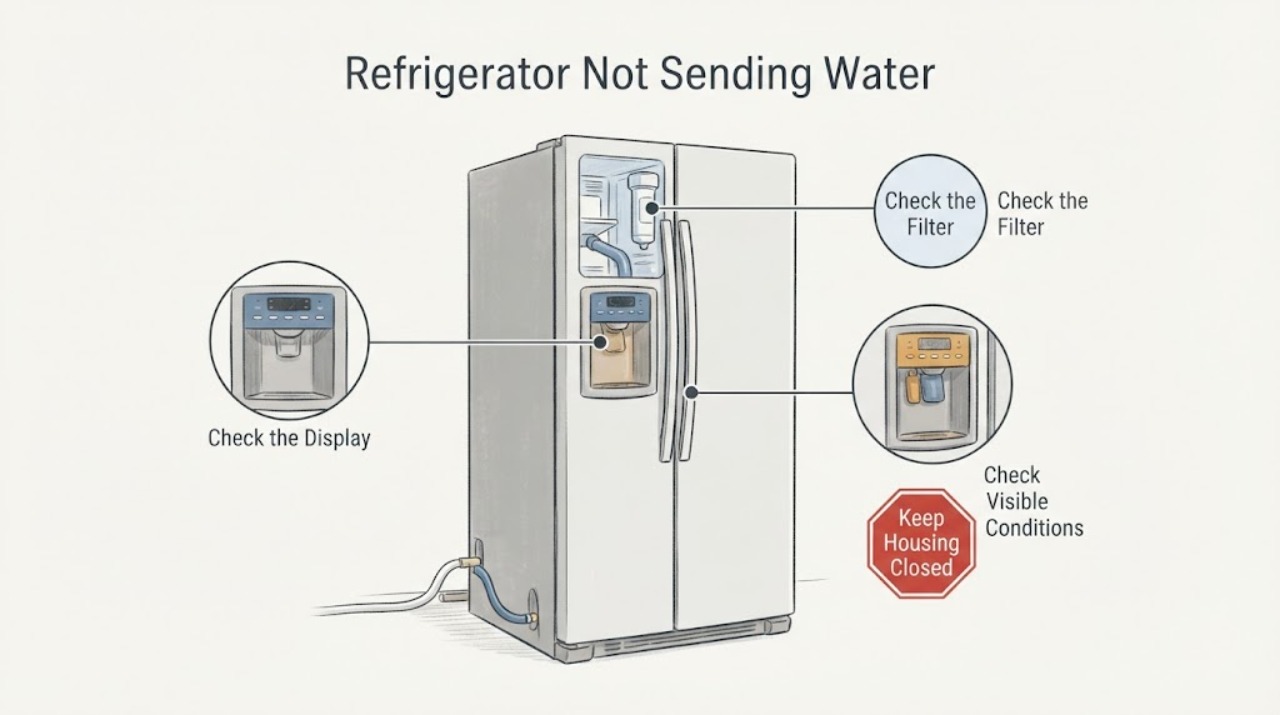
First identify what “not sending water” means: no water from the door dispenser, no water reaching the ice maker, or a leak or internal water path. Those paths can have different controls, filters, tubing, and model instructions. Record the complete Kenmore model number and use its official manual before removing a filter, changing a setting, or accessing any tubing. For a dispenser that is merely slow, Kenmore says its water-filter guidance applies when the filter is due for a change, but that product page is not proof that every Kenmore refrigerator uses that filter or that a no-flow symptom is a filter fault. Check only the external water supply, dispenser selection/lock, visible filter seating, and visible leaks. If there is no flow after the model-supported checks, the line leaks, or access would require moving the refrigerator or opening a panel, stop using the water feature and arrange Kenmore service.
Before you begin
Safety first
- This no-model guide is limited to identifying the failed water path, checking an accessible supply and control state, inspecting model-approved filter seating, comparing dispenser and ice-maker behavior, and observing visible leaks. Do not disconnect water tubing, remove a valve or filter housing, bypass a lock or switch, force an ice-maker harvest, move the refrigerator, open panels, or test wiring from the symptom alone.
Work through in order
Diagnostic checks
Use only checks that match the exact appliance or system and its official guide.
-
Check 1
State exactly what fails: water from the door dispenser, water entering the ice-maker mold, water from an interior reservoir, or a visible supply leak. Record whether ice production, dispenser flow, and refrigerator cooling otherwise work, and photograph any water trail.
Expected result: Only the dispenser fails, only the ice maker fails, both water functions fail, or the symptom is actually a leak rather than no output.
Next step: Follow the matching branch below and retrieve the exact Kenmore manual. Do not order a part or open a panel while the failed path is still ambiguous.
Why this matters
Why: These are different water paths and should not share a valve, filter, or control diagnosis without the model. A leak is a water-damage and electrical-safety branch, not a flow-rate diagnosis.
-
Check 2
Confirm the household refrigerator shutoff is open if it is safely accessible, and check the dispenser's selected mode, lock indicator, and visible control response. Do not reach behind the unit, disconnect a line, or force a stuck paddle or button.
Expected result: The supply is closed, the dispenser is locked or on the wrong mode, the controls respond but no water flows, or the supply/control state cannot be confirmed.
Next step: Correct only a clearly accessible supply or control setting allowed by the model manual. If flow remains absent or access requires moving the refrigerator, stop and arrange service.
Why this matters
Why: A closed supply or control lock can stop output without proving a filter or valve failure. If the controls respond and supply is available, the remaining cause is model-specific and may be downstream of the visible controls.
-
Check 3
If the exact manual identifies a user-accessible water filter, check that the filter is the model-approved type, fully seated, and not visibly damaged. Do not remove a filter housing, force a cartridge, or assume that a filter marketed for one Kenmore platform fits another.
Expected result: The dispenser is slow rather than completely dry, the filter is due for service or not seated, the filter area is wet, or the filter looks correct and flow is still absent.
Next step: Follow the exact manual's filter replacement or seating procedure only if it identifies that filter. If a leak appears, stop using the water feature and close the supply only when safely accessible; if flow remains absent, proceed to service.
Why this matters
Why: Kenmore's opened filter page says a slow water dispenser may indicate a filter due for change, but it does not establish a universal cause for no flow or compatibility across Kenmore platforms. Water around the filter area is a leak branch.
-
Check 4
Without opening the appliance, compare the two observable functions: test the dispenser only as the manual permits and observe whether the ice maker has a normal fill or remains dry. Do not force an ice-maker harvest, bypass a switch, or energize a valve.
Expected result: The dispenser works while the ice maker is dry, the ice maker works while the dispenser is dry, both are dry, or an abnormal sound/leak accompanies one path.
Next step: Use the model-specific manual for the relevant path and document the result for Kenmore service. Stop immediately if water leaks, a control is damaged, or a check would require internal access.
Why this matters
Why: One working path narrows the issue to the other path, while both failing makes supply, filter, control, or shared tubing more plausible. These observations do not identify an inlet valve, solenoid, control board, or internal obstruction.
-
Check 5
Prepare the model number, dispenser versus ice-maker result, supply and filter observations, visible leak location, control/lock state, and any change after a manual-supported check before contacting Kenmore.
Expected result: No water returns after accessible checks, a leak persists, the manual does not match the appliance, or access requires hidden tubing, a valve, wiring, or a panel.
Next step: Leave the water feature off, protect the surrounding area, and use Kenmore's official repair/support route. Do not continue resets, bypass safety controls, or disassemble the water system.
Why this matters
Why: The no-model evidence is insufficient to choose a replacement part or internal procedure. Continuing to cycle a dry or leaking water system can increase damage without identifying the cause.
Use your observations
Decision map
Find the observation that best matches what you see, then follow the next safe action.
-
PATH 01Next step
What you see
The dispenser is dry or slow, the household supply is available, and the exact manual confirms a user-accessible filter.
Do this next
Follow the exact manual's filter check or replacement procedure. If the dispenser remains dry or the filter area leaks, stop using the feature and arrange service.
Why this path and its safety boundary
Why it matters: Filter seating or filter condition is a plausible external branch; Kenmore's filter page specifically associates a slow dispenser with a filter due for service, but not every model uses the same filter.
-
PATH 02Next step
What you see
The dispenser works but the ice maker is not receiving water, or the ice maker works while the dispenser is dry.
Do this next
Use the exact model manual to identify the permitted external checks for that path and give Kenmore service the comparison result. Do not force the ice maker or access internal wiring.
Why this path and its safety boundary
Why it matters: The symptom is isolated to one water path; it does not prove a shared inlet valve, control, or tubing failure.
-
PATH 03Next step
What you see
Both dispenser and ice-maker water functions fail while the external supply and controls appear normal.
Do this next
Leave the water features off and arrange model-qualified Kenmore service. Do not disconnect tubing, pull out the refrigerator, or buy a valve from the symptom alone.
Why this path and its safety boundary
Why it matters: A shared supply, filter, housing, tubing, or control condition is possible, but no-model evidence cannot select one component.
-
PATH 04Next step
What you see
Water is leaking near the filter, tubing, rear connection, floor, or electrical area, or the required check would involve a panel or hidden water component.
Do this next
Stop using the water system, close the supply only if safely accessible, keep away from wet electrical areas, protect the floor, and obtain qualified service.
Why this path and its safety boundary
Why it matters: This is a water-damage or electrical-safety boundary rather than a routine no-flow check.
Helpful context
Understand the symptom
“Not sending water” is not a complete symptom identity. A Kenmore refrigerator may have an in-door dispenser, an ice-maker fill circuit, a filter and housing, an internal reservoir, or only a household supply connection. No-model advice cannot tell whether the button, paddle, lock, filter, inlet valve, tubing, or ice-maker control is involved. Start by identifying which outlet or process fails and record the exact model.
Use a simple split: if the dispenser is selected and the door outlet is dry, record whether the unit makes any sound and whether the ice maker fills separately; if the ice maker is dry but the dispenser works, the issue is in the ice-maker fill path or its model-specific controls; if both are dry, begin with the external water supply, filter seating, and model manual. A visible leak changes the priority to stopping the water feature and protecting the floor.
Keep checks accessible. Do not disconnect tubing, remove a housing, bypass a lock or switch, pull out a built-in refrigerator, or test a valve or wiring. If flow does not return after the exact manual's permitted checks, or water appears where it should not, leave the feature off and use Kenmore's support or repair path with the model and symptom details.
When checks do not resolve it
Need a professional?
Call Kenmore or qualified appliance service when the dispenser or ice-maker path remains dry after model-supported external checks, both paths fail, a filter or water connection leaks, the model manual is unavailable or mismatched, or diagnosis would require moving the refrigerator, disconnecting tubing, opening a panel, or touching wiring.
Safety scope: This no-model guide is limited to identifying the failed water path, checking an accessible supply and control state, inspecting model-approved filter seating, comparing dispenser and ice-maker behavior, and observing visible leaks. Do not disconnect water tubing, remove a valve or filter housing, bypass a lock or switch, force an ice-maker harvest, move the refrigerator, open panels, or test wiring from the symptom alone.
Common questions
FAQ
What does “not sending water” mean on a Kenmore refrigerator?
Specify whether no water comes from the door dispenser, the ice maker is not filling, or water is leaking. Those paths can use different controls and tubing, so the exact model and the working/non-working comparison matter before diagnosing a part.
Could the water filter cause a Kenmore dispenser to stop flowing?
It can be a clue for slow flow on models that use that filter, and Kenmore's official filter page says a slow dispenser may indicate the filter is due for a change. It does not prove that every no-flow symptom is the filter or that the same filter fits every Kenmore platform; follow the exact manual.
What if the dispenser works but the ice maker has no water?
Treat it as an ice-maker fill-path symptom, not proof of a failed valve. Record that the dispenser works, use the exact model manual for permitted external checks, and arrange service if the ice-maker path remains dry.
Should I disconnect the refrigerator water line to test it?
No. With no model and no confirmed water-path identity, do not disconnect tubing or open the water system. If there is a visible leak, stop using the feature, close the supply only if safely accessible, and arrange qualified service.
Read the exact guide
Official sources
- Find Your Manual | Kenmore Appliance Manuals & GuidesKenmore / Transform SR Brands LLC · Opened Kenmore's official manual page. It requires the complete model number to retrieve the applicable manual and explicitly covers refrigerators, freezers, and ice makers.
- Refrigerator Water Filter 500-Gallon CapacityKenmore / Transform SR Brands LLC · Opened Kenmore's official filter page. It says the featured filter increases flow rate and that a refrigerator water dispenser running slowly may indicate the filter is due for a change; it is not used as universal model compatibility or as proof of a no-flow cause.
- Contact Us | Kenmore Customer SupportKenmore / Transform SR Brands LLC · Opened Kenmore's official contact page. It provides product-question context, manual links, and a Sears Appliance Repair support route for unresolved appliance conditions.
Community feedback
Share a repair observation
Share a plain-text repair observation. Accepted observations are published automatically; this page may take a moment to update.