
On this page
Start here
Quick answer
A Kenmore refrigerator that is too warm, too cold, or showing an unusual temperature does not prove that its thermistor has failed. The model number is essential: Kenmore's official manual portal requires the exact model to retrieve the matching manual and parts information, and refrigerator families can use different controls and sensors. First record the model and compare the display or setting with an independent appliance thermometer; the FDA recommends keeping the refrigerator at 40 °F or below and the freezer at 0 °F. Check only safe, visible conditions such as overpacking, blocked airflow, or a door that is not sealing. Do not measure a sensor, open the liner, or order a thermistor from a generic symptom. If the measured temperature stays unsafe, food has warmed, a model-specific sensor code appears, or the exact model manual calls for sensor service, keep food safe and arrange qualified appliance service.
Before you begin
Safety first
- Do not open the liner or control area, perform live voltage or resistance tests, splice sensor wiring, enter an unverified service mode, or order a thermistor by brand name without model fitment. Protect or discard food when safe temperatures or exposure time are uncertain.
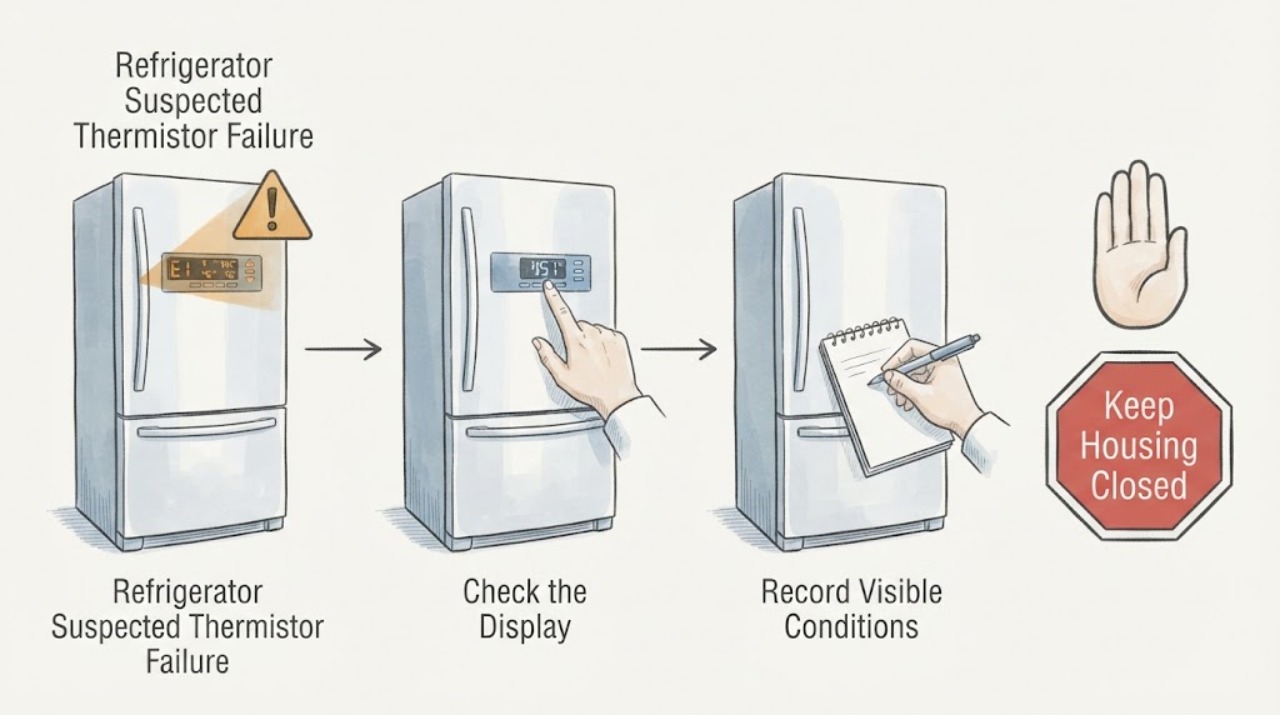
Work through in order
Diagnostic checks
Use only checks that match the exact appliance or system and its official guide.
-
Check 1
Read the complete Kenmore model number from the appliance label and retrieve that exact model's manual before interpreting a sensor code or looking for a thermistor.
Expected result: The full model is available and the Kenmore manual portal returns a matching manual, or the label/model remains unreadable or does not return a match.
Next step: Use the matched manual for the next checks. If the model cannot be verified, stay with external temperature and food-safety checks and arrange service instead of borrowing instructions from another Kenmore family.
Why this matters
Why: Kenmore's official manual portal requires the exact model number and says the manuals provide appliance-specific use, parts, and accessory information. A missing or unmatched model prevents a reliable sensor location, code meaning, test value, or part match.
-
Check 2
Place an appliance thermometer in the refrigerator compartment and, if relevant, another in the freezer; record measured temperatures separately from the control setting or displayed value after the appliance has had time to stabilize.
Expected result: The refrigerator measures at or below 40 °F and the freezer at or below 0 °F; one compartment is above its safe target; or the measured value disagrees with the display or setting.
Next step: Protect or discard food according to FDA guidance when temperatures are unsafe or the duration is unknown. Give the model, setting, and measured readings to service; do not use the reading alone to order a sensor.
Why this matters
Why: The measured temperature establishes the food-safety condition, while a disagreement between a display and an independent thermometer can indicate a sensing, calibration, placement, airflow, or cooling question. It does not by itself identify a failed thermistor.
-
Check 3
Without removing covers, check only visible conditions that can alter the reading: blocked air passages or overpacking, a door or drawer that does not close and seal, a torn gasket, or heavy visible frost. Do not chip ice or reach into the liner, fan, or sensor wiring.
Expected result: Food or containers block an air passage, the door/gasket does not seal, visible frost is present, or the accessible interior appears clear and closes normally.
Next step: Restore visible airflow and door-seal conditions according to the exact manual, then recheck with the appliance thermometer. If frost returns or the temperature remains unsafe, arrange service.
Why this matters
Why: The FDA notes that cold air must circulate and advises avoiding overpacking. These visible conditions can explain a compartment-temperature symptom without proving a sensor failure; a clear interior does not clear the thermistor or cooling system.
-
Check 4
Record any displayed code, alarm, or temperature indication exactly as shown, along with the affected compartment and ordinary observations about cycling. Do not enter an unverified service mode or perform live voltage or resistance tests.
Expected result: A code is present and the exact manual defines it, no code is present, or the code/manual relationship cannot be verified because the model is unknown.
Next step: Follow only the exact model manual for a documented user-level check. Otherwise provide the observation and measured temperatures to qualified refrigerator service; do not open the cabinet or substitute another model's sensor test.
Why this matters
Why: A code can narrow the service path only when it is documented for the exact model. A no-code temperature symptom and an unknown-code symptom do not establish a thermistor failure or a control-board fault.
-
Check 5
Prepare service information: full model and serial, refrigerator/freezer measurements, displayed setting and codes, symptom timing, visible frost or seal condition, recent power interruption, and food-safety impact.
Expected result: The exact model is available but temperatures remain unsafe or the manual points to sensor service, or the model remains unresolved after external checks.
Next step: Keep the appliance and food situation safe and arrange qualified Kenmore/refrigerator service. Do not buy a thermistor by brand name, splice sensor wiring, or open a sealed or insulated compartment from the symptom alone.
Why this matters
Why: The remaining diagnosis may involve the thermistor, wiring, control, airflow, defrost, or sealed cooling system. The no-model symptom cannot distinguish those causes or select a compatible part.
Use your observations
Decision map
Find the observation that best matches what you see, then follow the next safe action.
-
PATH 01Next step
What you see
The exact model is known, the manual documents a temperature-sensor code or check, and the measured compartment temperature matches the reported problem.
Do this next
Follow only the manual's stated user-safe steps and provide the exact code, model, and temperature readings to qualified service. Do not transfer values or parts from another Kenmore family.
Why this path and its safety boundary
Why it matters: The sensor system is a supported service direction for that model, but the code or temperature still does not prove that the thermistor itself rather than its wiring or control has failed.
-
PATH 02Next step
What you see
The model is unknown, the display is abnormal, or an independently measured temperature disagrees with the setting but no exact model manual maps the symptom to a sensor.
Do this next
Find the model label, keep food within safe temperature limits, and arrange service if the condition persists. Do not open the liner or perform an improvised sensor test.
Why this path and its safety boundary
Why it matters: The problem is a real temperature-control or cooling symptom, but thermistor failure remains unconfirmed and a compatible part or test value cannot be selected.
-
PATH 03Next step
What you see
The refrigerator is above 40 °F, the freezer is above 0 °F, food has been warm for an unknown duration, or the thermometer shows a continuing unsafe trend.
Do this next
Move or discard perishables according to FDA guidance and arrange qualified refrigerator service. Avoid repeatedly opening the doors or running questionable food through a diagnostic experiment.
Why this path and its safety boundary
Why it matters: Food safety takes priority over deciding whether the sensor failed. The temperature measurement is evidence of an unsafe storage condition, not a component diagnosis.
-
PATH 04Next step
What you see
Overpacking, blocked airflow, a leaking door seal, or heavy visible frost is found and the exact manual supports correcting that visible condition.
Do this next
Correct only the visible condition using the exact manual, then recheck the independent thermometer. Escalate if the temperature remains unsafe or the frost/seal issue returns.
Why this path and its safety boundary
Why it matters: The accessible condition can explain uneven or incorrect temperature without confirming a thermistor fault.
Helpful context
Understand the symptom
Thermistor failure is a hypothesis until the model and reading are verified
A thermistor is part of a temperature-sensing system, but a warm or frozen compartment can also reflect settings, airflow, door sealing, frost, or a cooling-system problem. With no model in the task, there is no safe universal resistance value, diagnostic-code meaning, connector location, or replacement part. Use the model label and the matching Kenmore manual before treating the sensor as the confirmed cause.
Protect food while you narrow the symptom
The FDA says to verify refrigerator temperature with an appliance thermometer and keep the refrigerator at 40 °F or below and the freezer at 0 °F. A display setting or a single warm item is not the same as a measured compartment temperature. If food has been above a safe temperature for an uncertain period, use the FDA's discard guidance rather than repeatedly testing the refrigerator with perishable food.
When checks do not resolve it
Need a professional?
Stop treating the thermistor as a confirmed diagnosis and call qualified refrigerator service when the exact model is unavailable, measured temperatures remain unsafe, a model-specific sensor code persists, food has warmed, or the manual points to sensor, wiring, control, defrost, or sealed-system service. Do not open the liner or perform live electrical tests.
Safety scope: Do not open the liner or control area, perform live voltage or resistance tests, splice sensor wiring, enter an unverified service mode, or order a thermistor by brand name without model fitment. Protect or discard food when safe temperatures or exposure time are uncertain.
Have this ready
- Full model and serial, refrigerator and freezer thermometer readings, display setting and code, symptom timing, visible frost/airflow/door-seal observations, power events, and any food-safety exposure.
Common questions
FAQ
Does a warm Kenmore refrigerator prove the thermistor failed?
No. A warm compartment can reflect settings, airflow, door sealing, frost, cooling, wiring, controls, or a sensor. Verify the exact model and the actual compartment temperature before assigning the thermistor as the cause.
What temperature should I verify?
The FDA recommends a refrigerator at 40 °F or below and a freezer at 0 °F. Use an appliance thermometer rather than relying only on a control setting or display.
Can I test or replace the thermistor without the model number?
Do not. Kenmore's official manual portal requires the model number to retrieve the matching manual and parts information. Without it, sensor location, test values, wiring, and replacement compatibility are unresolved.
Read the exact guide
Official sources
- Find Your Manual | Kenmore Appliance Manuals & GuidesKenmore / Transform SR Brands LLC · The official portal states that the exact model number is required to access Kenmore appliance manuals and resources, including refrigerators, and that manuals provide appliance-specific use, parts, and accessory information. It does not define a generic thermistor test or confirm the assigned fault.
- Refrigerator Thermometers - Cold Facts about Food SafetyU.S. Food and Drug Administration · Official food-safety guidance used for independent temperature measurement, 40 °F refrigerator/0 °F freezer limits, airflow/overpacking context, and food disposition. It is not a diagnosis of a Kenmore thermistor or other component.
- Refrigerators & Freezers | French Door, Side-by-Side | KenmoreKenmore / Transform SR Brands LLC · The opened Kenmore refrigeration page shows multiple refrigerator configurations and describes model-family temperature-control and monitoring features. It supports the need to keep model scope explicit; it does not confirm a thermistor failure or a universal sensor design.
Community feedback
Share a repair observation
Share a plain-text repair observation. Accepted observations are published automatically; this page may take a moment to update.