
On this page
Start here
Quick answer
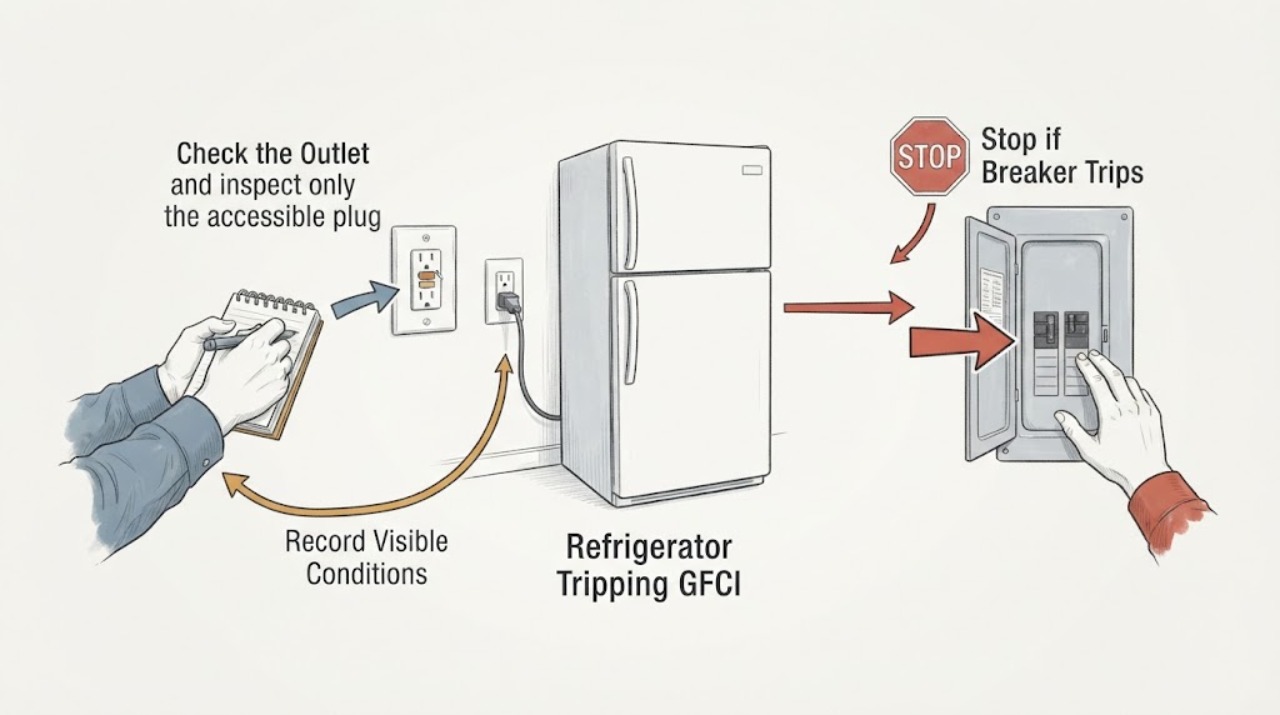
A Kenmore refrigerator that repeatedly trips a GFCI should remain unplugged until the appliance and circuit are assessed. The trip is a protective response to a possible fault or leakage condition; it is not a reason to bypass the GFCI, move the refrigerator to another outlet, use an extension cord or perform a live test. Note whether the trip occurs as soon as the plug is connected or only when cooling, defrost, ice or another function starts, and inspect only the accessible cord, plug and outlet for heat, scorching, cracking or moisture. CPSC says to unplug an appliance that repeatedly trips a fuse or breaker and have it repaired or replaced; use the complete Kenmore model number to obtain the correct manual and arrange qualified appliance/electrical service.
Before you begin
Safety first
- Do not bypass or replace the GFCI to keep the refrigerator running, use an extension cord or alternate outlet as a workaround, remove outlet covers, open the refrigerator, perform live tests or reset repeatedly. Keep power isolated until qualified service assesses the appliance and circuit.
Work through in order
Diagnostic checks
Use only checks that match the exact appliance or system and its official guide.
-
Check 1
If the GFCI trips again, unplug the Kenmore refrigerator and leave it disconnected; do not bypass the GFCI, keep resetting it, move the refrigerator to a non-protected outlet or use an extension cord.
Expected result: The GFCI trips repeatedly with the refrigerator connected, or it holds after the refrigerator is unplugged.
Next step: Keep the refrigerator isolated, protect food and arrange qualified appliance/electrical assessment. Do not restore operation as a test.
Why this matters
Why: CPSC says a repeatedly tripping appliance should be unplugged and repaired or replaced. An RCD/GFCI trip is a protective event and does not prove whether the appliance or household circuit is at fault.
-
Check 2
With the refrigerator unplugged, inspect only the accessible plug, cord, receptacle face and nearby floor/wall for scorching, cracking, moisture, arcing marks, unusual warmth or a loose connection.
Expected result: Heat, burn marks, crackling/arcing evidence, moisture, cord damage or a damaged/loose receptacle is visible, or the accessible exterior looks normal.
Next step: For any visible electrical or moisture damage, keep power off and call a qualified electrician/appliance technician. If no damage is visible, continue only with model and event documentation.
Why this matters
Why: Electrical Safety First says not to ignore burn marks, arcing sounds, tripping or hot products/outlets and directs users to unplug and contact qualified repair help. A normal exterior does not clear the refrigerator or circuit.
-
Check 3
Record whether the trip happens immediately when the plug is connected or only after cooling, defrost, ice-maker, dispenser or another cycle condition would normally begin; do not recreate the event repeatedly.
Expected result: The trip is immediate, occurs only after a delay/function, or cannot be safely characterized because the appliance remains disconnected.
Next step: Give the timing and any sounds/odors to service. Keep the refrigerator disconnected rather than reconnecting it to compare cycles.
Why this matters
Why: Timing helps a qualified technician reproduce the symptom without turning it into a user diagnosis. No timing pattern identifies a specific Kenmore component or permits live testing.
-
Check 4
Read the complete Kenmore refrigerator model number and serial from the rating label or paperwork, then use Kenmore's official manual finder and customer-care route.
Expected result: The full model/manual is available, or the label is incomplete/unreadable.
Next step: Provide the matched model, serial, GFCI type/location and trip timing to service. If the model cannot be matched, do not buy or test an internal electrical part.
Why this matters
Why: Kenmore says the full model number is required to access the correct manual and refrigerator parts/accessory information; customer care routes owners to manuals and repair support.
-
Check 5
Arrange qualified appliance and/or electrical service before reconnecting the refrigerator when the GFCI trips repeatedly, the outlet is hot/damaged, the cord is damaged, moisture is present or the appliance has given a shock.
Expected result: The protective device trips again, the circuit/receptacle shows a hazard, or internal appliance access would be required.
Next step: Keep power isolated, protect/discard food according to actual temperature and service instructions, and give the technician the model, serial and event history. Do not restore power for a technician-free test.
Why this matters
Why: The official safety guidance supports professional repair/electrical assessment and does not support a user diagnosis of a compressor, board, defrost, ice-maker or insulation fault.
Use your observations
Decision map
Find the observation that best matches what you see, then follow the next safe action.
-
PATH 01Next step
What you see
The GFCI trips again when the Kenmore refrigerator is connected or begins operation.
Do this next
Leave the refrigerator unplugged and arrange qualified appliance/electrical service. Do not bypass the GFCI, use an extension cord or keep resetting it.
Why this path and its safety boundary
Why it matters: This is an unresolved electrical safety event; it does not distinguish appliance leakage from a receptacle/circuit issue.
-
PATH 02Next step
What you see
The accessible plug, cord or receptacle is hot, scorched, cracked, wet, arcing or loose.
Do this next
Do not use the receptacle or appliance; keep power off and call a qualified electrician/appliance technician. Do not remove outlet covers or repair the cord yourself.
Why this path and its safety boundary
Why it matters: Electrical Safety First and CPSC treat these signs as potential electrical hazards requiring disconnection and qualified assessment.
-
PATH 03Next step
What you see
The refrigerator remains disconnected, the accessible cord/receptacle look normal and the GFCI has not been retested with the appliance.
Do this next
Use the exact model/manual and arrange professional assessment; protect food while power is off and do not substitute another outlet or extension cord.
Why this path and its safety boundary
Why it matters: A clear exterior does not clear the internal appliance or circuit, and reconnecting only to repeat the trip is not a safe diagnostic method.
-
PATH 04Next step
What you see
The Kenmore model/serial or GFCI/circuit information is unavailable, or the trip pattern cannot be safely documented.
Do this next
Keep the appliance off, document the label and receptacle/GFCI location without opening anything, and request qualified service/electrical evaluation.
Why this path and its safety boundary
Why it matters: Evidence is insufficient to name a refrigerator component, circuit fault or compatible repair.
Helpful context
Understand the symptom
Treat repeated GFCI trips as an electrical stop condition
A GFCI/RCD is designed to disconnect power when it detects current taking an unintended path. Repeated trips can involve the appliance, cord/plug, receptacle or circuit, and the symptom does not identify which one. Leave the refrigerator unplugged after a repeat trip and do not defeat the protective device or keep resetting it to make the refrigerator run.
Make only safe external observations
With power disconnected, note when the trip happens and inspect the accessible cord, plug and receptacle for scorch marks, cracking, moisture, unusual warmth or a loose fit. Do not remove outlet covers, open the refrigerator, measure live voltage or use an extension cord as a workaround. CPSC and Electrical Safety First both treat repeated trips, hot outlets and damaged electrical products as reasons for repair/electrician attention.
Use the Kenmore model manual and service route
Find the complete Kenmore model number and use Kenmore's official manual finder; the correct manual and service team can distinguish the refrigerator's configuration without guessing at a compressor, defrost system, ice-maker circuit or control board. Protect food that could deteriorate while the refrigerator is off. Any internal electrical diagnosis belongs to a qualified technician.
When checks do not resolve it
Need a professional?
Call qualified appliance and electrical service before reconnecting a Kenmore refrigerator that repeatedly trips a GFCI, or immediately for a hot/scorched/wet outlet, damaged cord, arcing, shock, burning smell or other electrical warning. Do not bypass the protective device or perform live testing.
Safety scope: Do not bypass or replace the GFCI to keep the refrigerator running, use an extension cord or alternate outlet as a workaround, remove outlet covers, open the refrigerator, perform live tests or reset repeatedly. Keep power isolated until qualified service assesses the appliance and circuit.
Have this ready
- Provide the full model and serial, GFCI/receptacle location, whether the trip is immediate or delayed, any cooling/ice/defrost timing, photos of accessible cord/plug/receptacle with power off and any odor, heat, moisture or shock history.
Common questions
FAQ
Can I plug the Kenmore refrigerator into another outlet if the GFCI trips?
Do not use another outlet or an extension cord as a workaround. CPSC says a repeatedly tripping appliance should be unplugged and repaired or replaced, and the circuit/appliance should be assessed by qualified professionals.
Does a GFCI trip prove the Kenmore refrigerator compressor is bad?
No. The trip can involve the appliance, cord, receptacle or circuit, and the available official guidance does not map this symptom to a compressor or any other specific component. Keep the refrigerator disconnected and arrange assessment.
What should I do while the refrigerator is unplugged?
Keep the doors closed as practical, protect or discard food according to its actual temperature and safety guidance, and gather the model/serial and trip history for service. Do not reconnect the refrigerator just to repeat the trip.
Read the exact guide
Official sources
- Refrigerator Electronic Control Board Genuine Original Equipment Manufacturer (OEM) partKenmore / Transform SR Brands LLC · Opened Kenmore's official refrigerator electrical-part page. Its unplug-before-installation and food-protection language supports the power-off boundary; it does not diagnose a GFCI trip or establish a part fit.
- Find Your Manual | Kenmore Appliance Manuals & GuidesKenmore / Transform SR Brands LLC · Opened Kenmore's official manual finder. It supports obtaining the exact refrigerator manual from the complete model number; it does not identify a GFCI cause or authorize electrical testing.
- Electricity Made EasyElectrical Safety First · Opened Electrical Safety First official explainer. It explains that an RCD disconnects when current takes an unintended path and says to stop using a faulty appliance and contact a registered electrician; it does not identify a refrigerator part.
- CPSC and NESF Urge Consumers to Plug Into Electrical SafetyU.S. Consumer Product Safety Commission · Opened CPSC official safety release. It supports unplugging an appliance that repeatedly trips a fuse/breaker, qualified electrician review of hot/unsafe outlets and avoiding permanent extension-cord use; it does not diagnose a Kenmore refrigerator component.
- Customer Care & Support | Kenmore AppliancesKenmore / Transform SR Brands LLC · Opened Kenmore's official customer-care page. It routes owners to product manuals and repair/service support; it does not diagnose GFCI trips or identify compatible electrical parts.
- Ratings of electrical appliancesElectrical Safety First · Opened Electrical Safety First official safety guidance. It supports treating tripping, arcing, burn marks and hot products/outlets as hazards, unplugging and contacting qualified repair help; it is not Kenmore model-specific.
Community feedback
Share a repair observation
Share a plain-text repair observation. Accepted observations are published automatically; this page may take a moment to update.