
On this page
Start here
Quick answer
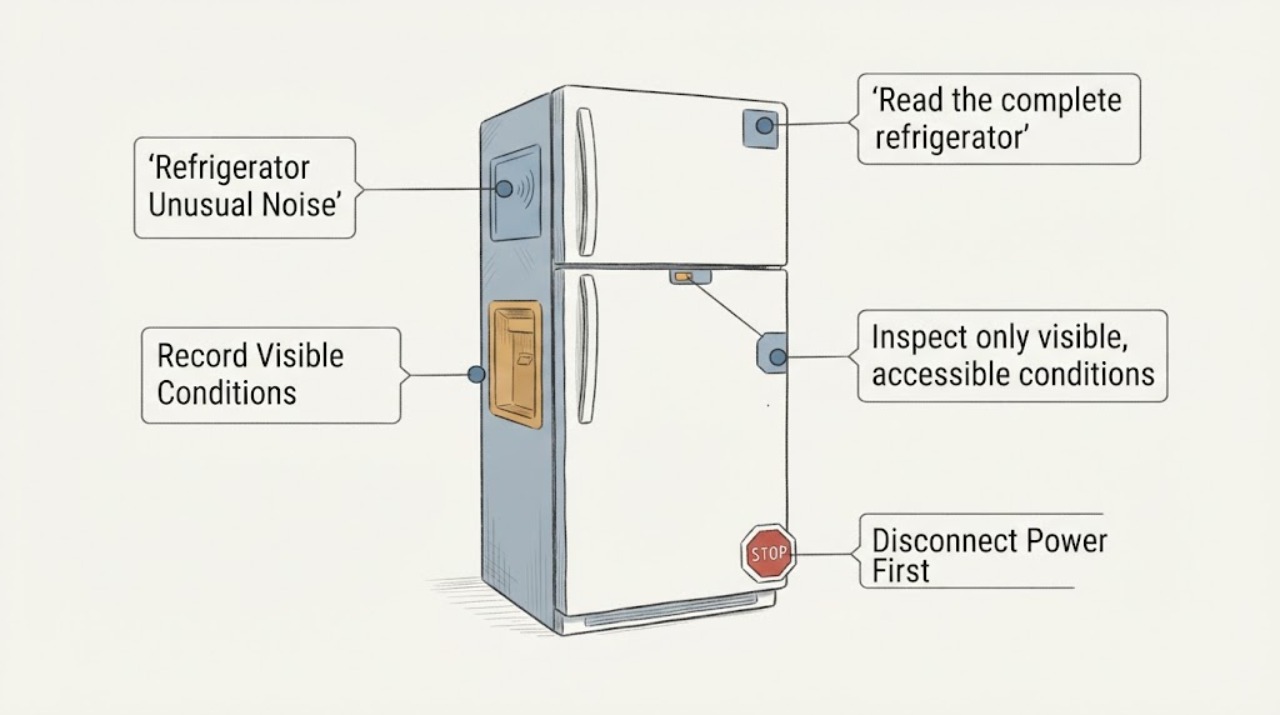
Do not identify a Kenmore refrigerator noise as a compressor, fan, valve or other failed part from the sound alone. Kenmore has many refrigerator families and its official manual finder requires the complete model number for the correct manual and parts information. First record where and when the sound occurs, whether cooling and lights remain normal, and whether the cabinet or stored containers are visibly touching or vibrating. Use the matched manual for model-specific normal-sound and external-check guidance. If the noise is new, persistent, loud, or accompanied by poor cooling, burning smell, water, heat or electrical symptoms, protect food, disconnect power when safe and arrange service; do not remove panels or perform live tests.
Before you begin
Safety first
- Do not remove cabinet panels, reach toward fans, touch wiring, perform live electrical tests, open the sealed cooling system or select an internal part from the sound alone. Protect food and disconnect power before electrical access when safe.
Work through in order
Diagnostic checks
Use only checks that match the exact appliance or system and its official guide.
-
Check 1
Read the complete Kenmore refrigerator model number from the rating label or paperwork and enter it in Kenmore's official manual finder before looking for a sound explanation or part.
Expected result: The full model returns a matching refrigerator manual, or the model is incomplete/unreadable.
Next step: Use the matched manual for the next external checks. If the model cannot be matched, document the label and request model-matched service rather than guessing from the noise.
Why this matters
Why: Kenmore says the model number is required to access the correct manual and that its refrigerator manuals include parts and accessories information. A partial number cannot establish the refrigerator's normal sounds or compatible part.
-
Check 2
Without opening the cabinet, record whether the noise comes from inside the fresh-food/freezer compartment, the rear or underside, a door, or an ice/water area; note whether it occurs during cooling, defrost, dispensing or door movement.
Expected result: The sound has a repeatable location/condition, or it cannot be localized safely.
Next step: Compare the pattern only with the matched manual's normal-sound guidance. If localization would require panels, fans, wiring or sealed-system access, stop and arrange service.
Why this matters
Why: A timing and location record helps the exact manual or technician distinguish an operating condition from a service symptom, but it does not identify a component by itself.
-
Check 3
Inspect only visible, accessible conditions: containers or objects touching the cabinet, the refrigerator rocking or contacting surrounding cabinetry, and any visible water, frost or exterior damage; do not move panels or reach toward fans.
Expected result: A visible contact/rocking/object condition is found, or the exterior is clear and the noise persists.
Next step: Correct only a simple visible placement/stability issue allowed by the manual. If the noise remains or the condition involves wiring, tubing, fans or panels, leave it for service.
Why this matters
Why: A visible contact can explain a vibration without proving an internal failure. A clear exterior does not identify a compressor, fan, valve or sealed-system problem.
-
Check 4
Observe the refrigerator's cooling, interior lights and visible controls while keeping doors closed as much as practical; note whether temperature performance changes with the noise. Do not force a cooling cycle or use live electrical measurements.
Expected result: Cooling and other functions remain normal, or the noise accompanies warming, repeated clicking, odor, heat, water or electrical symptoms.
Next step: For normal performance, document and monitor under the matched manual. For any performance/safety change, protect food, disconnect power when safe and arrange service.
Why this matters
Why: A noise with normal performance still needs the exact manual for interpretation. Noise paired with a performance or safety change is not safely reducible to a normal operating sound.
-
Check 5
Request Kenmore or qualified appliance service when the noise persists after permitted external checks, cannot be matched to the exact manual, is loud/new/worsening, or accompanies poor cooling, burning smell, unusual heat, water or electrical symptoms.
Expected result: The sound is recurring or a safety/performance warning is present.
Next step: Provide the full model/serial, sound recording, location/timing, temperature observations and visible conditions. Do not buy a compressor/fan/valve, remove panels or perform live tests from the sound alone.
Why this matters
Why: The opened Kenmore sources provide model lookup, repair routing and an unplug-before-electrical-work boundary, but no universal noise-to-part mapping.
Use your observations
Decision map
Find the observation that best matches what you see, then follow the next safe action.
-
PATH 01Next step
What you see
The complete model manual documents the observed sound/timing as normal and cooling remains stable with no hazard signs.
Do this next
Monitor under the manual's operating guidance and request service if the sound changes, becomes persistent or is joined by poor cooling or other symptoms.
Why this path and its safety boundary
Why it matters: The model-specific manual supports normal operation for that refrigerator; this cannot be transferred to other Kenmore models.
-
PATH 02Next step
What you see
A container/object touches the cabinet or the refrigerator visibly rocks or contacts nearby cabinetry, and cooling is otherwise normal.
Do this next
Remove the visible contact or correct permitted stability/clearance conditions; service the refrigerator if noise remains after the external correction.
Why this path and its safety boundary
Why it matters: The visible condition can account for vibration or transmitted noise without proving an internal component fault.
-
PATH 03Next step
What you see
Noise occurs with warming food, repeated clicking, burning smell, unusual heat, water, electrical symptoms or visible damage.
Do this next
Protect food, disconnect power when safe and arrange qualified service. Do not open the cabinet, touch wiring or attempt sealed-system work.
Why this path and its safety boundary
Why it matters: The symptom is no longer a standalone sound report and cannot be safely classified as normal from the available evidence.
-
PATH 04Next step
What you see
The model number is unavailable or the sound cannot be localized/timed without opening the appliance.
Do this next
Record the rating-label information and sound description, then use Kenmore customer care or qualified service; do not guess a part or continue invasive testing.
Why this path and its safety boundary
Why it matters: The evidence is insufficient to name a normal sound, failed part or compatible repair.
Helpful context
Understand the symptom
A sound label is not a component diagnosis
"Unusual noise" does not identify whether the sound comes from normal cooling operation, a cabinet contact, a stored container, an ice/water function or an internal electrical/mechanical condition. Without the full model and a sound pattern, do not name a compressor, fan, valve or other part. Record the location, timing, duration, cooling result and what changes when a door opens or a cycle starts, without removing panels.
Use the exact Kenmore manual before interpreting the noise
Kenmore's official manual finder asks for the complete model number and provides model-specific refrigerator manuals and parts/accessory information. Use that manual to see which operating sounds and external checks apply to the refrigerator's layout. Do not transfer a sound description or repair procedure from another Kenmore family.
Persistent or hazardous noise belongs with service
If the noise is new, constant, worsening or paired with poor cooling, burning smell, water, unusual heat or another electrical symptom, stop troubleshooting at the external boundary. Protect food that could deteriorate and disconnect power when safe before any electrical access; Kenmore's official guidance does not authorize live testing or internal diagnosis from a noise report.
When checks do not resolve it
Need a professional?
Call Kenmore or qualified appliance service when the noise is new, persistent, worsening, cannot be matched to the exact manual, or occurs with warming food, repeated clicking, burning smell, unusual heat, water or electrical symptoms. Do not diagnose or replace an internal part from sound alone.
Safety scope: Do not remove cabinet panels, reach toward fans, touch wiring, perform live electrical tests, open the sealed cooling system or select an internal part from the sound alone. Protect food and disconnect power before electrical access when safe.
Have this ready
- Provide the full model and serial, sound recording, location and timing, cooling/temperature observations, whether doors/ice/water functions change the sound, and visible contact, water, frost or damage observations.
Common questions
FAQ
Is every Kenmore refrigerator noise a bad compressor or fan?
No. Without the full model and sound pattern, the available Kenmore evidence does not support a universal part diagnosis. Use the exact model manual, record timing/location and stop at the external boundary if the noise persists or cooling/safety symptoms appear.
What should I check before calling service?
Find the complete model, record where and when the sound occurs, note cooling and visible conditions, and inspect only accessible objects or cabinet contacts without opening panels. The matched manual controls any model-specific check.
When should I unplug a noisy Kenmore refrigerator?
If the noise is accompanied by burning smell, unusual heat, electrical symptoms, visible damage or another unsafe condition, protect food and disconnect power when safe before arranging service. Kenmore's official electrical guidance says to unplug before electrical-part installation; it does not authorize live testing.
Read the exact guide
Official sources
- Refrigerator Electronic Control Board Genuine Original Equipment Manufacturer (OEM) partKenmore / Transform SR Brands LLC · Opened Kenmore's official refrigerator electrical-part page. Its unplug-before-installation and food-protection language supports the electrical safety boundary; it does not diagnose noise or establish any part fit.
- Find Your Manual | Kenmore Appliance Manuals & GuidesKenmore / Transform SR Brands LLC · Opened Kenmore's official manual finder. It supports obtaining the exact refrigerator manual from the complete model number; it does not itself provide a universal noise interpretation.
- Customer Care & Support | Kenmore AppliancesKenmore / Transform SR Brands LLC · Opened Kenmore's official customer-care page. It routes owners to product manuals and repair/service support; it does not identify a refrigerator noise source or compatible internal part.
Community feedback
Share a repair observation
Share a plain-text repair observation. Accepted observations are published automatically; this page may take a moment to update.