
On this page
Start here
Quick answer
Treat a Kenmore 106.50023211 water dispenser that will not stop as a flooding risk first. From a dry, safe position, close the identified household refrigerator water shutoff; keep water away from the plug, outlet, and other electrical parts, and do not open the dispenser or valve. Then note whether the stream stops, whether the external paddle or selection control is visibly stuck, and whether water is actually escaping from the filter housing, hinge area, rear connection, or nozzle. If the stream continues after the supply is isolated, or the shutoff is unknown, inaccessible, leaking, or will not close, use qualified plumbing or appliance help. If closing the supply stops the stream but releasing the paddle does not, an internal control or water-valve path remains possible; do not diagnose it by removing the valve or testing wiring. The exact 106.50023211 manual and rating label control fitment and button behavior; other 106, Whirlpool, or Kenmore models cannot establish a replacement part or test sequence.
Before you begin
Safety first
- Owner checks are limited to safe water isolation, observing the released external dispenser control, reading the model label, and inspecting visible dry-access areas without moving the refrigerator. Do not remove the valve or filter housing, loosen or disconnect tubing, open the dispenser panel, bridge a switch, measure the dispenser circuit, or restore water repeatedly to reproduce a continuous flow.
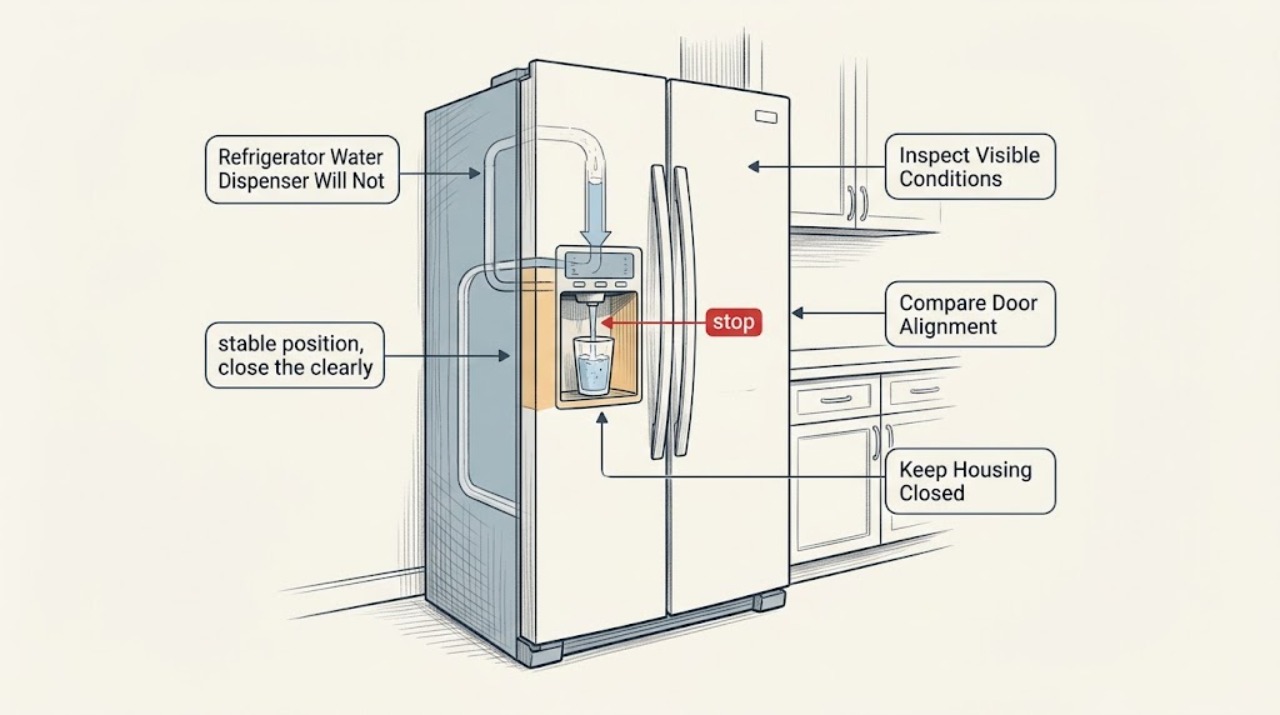
Work through in order
Diagnostic checks
Use only checks that match the exact appliance or system and its official guide.
-
Check 1
From a dry, stable position, close the clearly identified household water shutoff serving the refrigerator. Keep a container or towels on the dry side of the appliance only if they can be placed without touching electrical equipment. Do not move the refrigerator, loosen the water line, or reach into the dispenser while water is running.
Expected result: The stream stops, slows to residual drops, continues, or the shutoff is unknown, inaccessible, damaged, or will not close.
Next step: Leave the water supply off and arrange qualified appliance or plumbing help for a persistent dispenser fault. If the identified shutoff cannot isolate the water safely, use the home's established water-isolation procedure only from a safe dry position and obtain urgent help.
Stop if: Stop for water near a plug or outlet, flooding, a wet floor, an inaccessible or seized shutoff, a damaged line, or any need to pull the refrigerator or disconnect tubing.
Why this matters
Why: This first result separates immediate water containment from appliance diagnosis. A stopped stream confirms that the household supply can isolate the leak; it does not prove whether the dispenser paddle, control, or inlet valve caused the opening. Continued flow or an unusable shutoff is an active plumbing risk.
-
Check 2
With the water supply still isolated, observe the dispenser from the front without forcing anything: note whether the water/ice selection is on water, whether the external paddle or pad returns fully when released, and whether a cup, tray, ice fragment, or trim is holding it engaged. Check the exact Kenmore manual for any control-lock indicator; do not pry the pad or remove its cover.
Expected result: The paddle or pad is visibly held in, sticky, obstructed, or normal; the selection is unclear; or the display shows a lock indication.
Next step: Clear only a harmless visible obstruction and follow the exact manual's documented control-lock instruction. Keep the supply off if the control was normal or the stream returns when water is restored; arrange service rather than bypassing the control.
Stop if: Stop for a cracked or loose pad, exposed wiring, water inside the control area, a stuck mechanism that needs force, or any request to open the dispenser housing.
Why this matters
Why: A physically engaged external control can keep a dispensing request active, while a control-lock state can disable normal dispenser input on some platforms. A normal released control with a previous continuous stream moves the concern toward the model-specific internal control or valve path, not toward a generic button replacement.
-
Check 3
With the supply isolated and the cabinet undisturbed, inspect only visible water paths: the dispenser nozzle and tray, the filter housing area, the hinge or lower door area, and any accessible connection that can be seen without pulling the refrigerator. Look for a stream, a wet trail, a cracked filter, displaced seal, or only a few residual drops.
Expected result: Water is centered at the nozzle, appears at the filter housing or hinge, comes from a rear connection, or there is no visible leak while the dispenser had been running.
Next step: Keep the supply off for any wet housing, rear connection, or damaged filter and arrange exact-model service. Do not tighten fittings, remove the filter, or pull the unit to reach a hidden connection unless the model manual and a qualified person direct it.
Stop if: Stop for water near electrical parts, a cracked filter, a damaged tube, wet flooring, a concealed leak, or any need to move the refrigerator or open a fitting.
Why this matters
Why: A wet filter housing, hinge area, or rear connection can indicate a water-path leak rather than an engaged dispenser command. A few drops immediately after release can be residual water, but an ongoing stream is not explained by normal drip behavior.
-
Check 4
Record the exact model label as Kenmore 106.50023211, the side-by-side/control layout, whether a filter is installed, when the water function was last serviced, and whether the stream began after a filter change, cleaning, move, or power event. Use the official Kenmore manual portal with the complete model number; do not use a manual for a nearby 106 model as a substitute.
Expected result: The complete identity is confirmed; the filter or control arrangement differs from the expected layout; the symptom followed filter service or a move; or the model information is incomplete.
Next step: Give the full label and symptom sequence to Kenmore or qualified appliance service. Leave the water supply off until the continuous-flow cause is resolved; do not order a part by the 106 prefix or by visual similarity.
Stop if: Stop if the rating label cannot be read safely, the appliance must be moved, or identity requires opening a panel or touching wet components.
Why this matters
Why: The first three digits are not enough to select a valve, filter, dispenser switch, or control procedure. A service history can point toward a disturbed seal or fitting, but it cannot establish a failed component without exact documentation.
-
Check 5
Do not restore the water supply for repeated trials. Instead, write down whether the stream had been continuous with the paddle released, whether it stopped only when the household shutoff was closed, whether the dispenser light or controls remained active, and whether any water reached electrical equipment. Do not remove a valve, bridge a switch, or measure the dispenser circuit.
Expected result: The pad was released but flow continued until supply isolation; flow followed a visibly stuck pad; water came from another area; or the event involved electrical wetting or repeated flooding.
Next step: Keep the water supply isolated and arrange qualified appliance service; use plumbing help when the household connection or shutoff is involved. Provide the full model and these observations so the provider can diagnose without repeating the flood.
Stop if: Stop for smoke, odor, a tripping breaker, water on electrical parts, active flooding, or any suggestion to restore water or power to test an unresolved fault.
Why this matters
Why: Flow that continues with a released pad and stops only at the household shutoff is compatible with an internal water-control or valve path, but no safe external observation distinguishes those components. A separate leak path requires water-line or filter diagnosis instead.
Use your observations
Decision map
Find the observation that best matches what you see, then follow the next safe action.
-
PATH 01Next step
What you see
The household refrigerator shutoff closes and the continuous stream stops, but the dispenser pad was already fully released or the control looked normal.
Do this next
Leave the shutoff closed and arrange exact-model appliance service. Provide the complete 106.50023211 label and state that flow stopped only at the household shutoff; do not remove the valve or test the circuit.
Why this path and its safety boundary
Why it matters: The supply isolation contained the event, while an internal dispenser-control or water-valve path remains possible. The observation does not select a Kenmore part and is not a reason to reopen the supply repeatedly.
-
PATH 02Next step
What you see
The dispenser pad or selection control is visibly held engaged, and the stream stops after the harmless obstruction is removed while the supply remains safely controlled.
Do this next
Follow the exact Kenmore manual for normal control-lock or dispenser operation. Keep the water supply off and arrange service if the pad does not return freely, the housing is damaged, or the stream returns.
Why this path and its safety boundary
Why it matters: An external engagement or alignment issue is more plausible than a confirmed internal valve failure, but a sticky or damaged control can recur and should not be forced.
-
PATH 03Next step
What you see
Water is found at the filter housing, hinge/lower-door area, rear connection, or another visible path rather than only at the dispenser nozzle.
Do this next
Keep the household supply off, protect the floor, and arrange qualified appliance or plumbing service. Do not remove the filter, tighten a hidden fitting, or pull the refrigerator to reach the leak.
Why this path and its safety boundary
Why it matters: A water-line, filter seal, or connection leak is more likely than a pure dispenser-command problem. A loose connection can produce occasional or continuous dripping, and a damaged filter can leak.
-
PATH 04Next step
What you see
The water stream continues after the identified shutoff is closed, or the shutoff is inaccessible, seized, leaking, or cannot be identified safely.
Do this next
Move people and valuables away from the water, use the home's safe main-water isolation procedure only if clearly known and accessible, and obtain urgent qualified plumbing or appliance help. Do not loosen tubing or repeatedly cycle the dispenser.
Why this path and its safety boundary
Why it matters: The immediate containment path is unresolved. Treat this as active plumbing and water-damage risk rather than a dispenser-switch diagnosis.
-
PATH 05Next step
What you see
Only one or two drops appear after the paddle is released, then the dispenser stays dry with the supply and control operating normally.
Do this next
Hold the container under the nozzle briefly after release as described by the model guidance and monitor. Escalate if dripping persists, increases, wets the filter/hinge area, or becomes a stream.
Why this path and its safety boundary
Why it matters: A small residual drip can be normal for some refrigerator dispensers and is different from a continuously running stream. It does not justify replacing a valve or switch.
Helpful context
Understand the symptom
Stop the water before troubleshooting the control
A dispenser that keeps running can fill a tray, floor, cabinet, or wall cavity faster than a normal post-dispense drip. Close only the clearly identified household refrigerator water shutoff from a dry position, keep the refrigerator and floor dry, and do not reach behind the cabinet or loosen a fitting. Do not keep reopening the supply to repeat a test while the fault is active.
Why the exact 106.50023211 identity matters
The 106.5002 family is a platform clue, not a complete service identity. Kenmore's official manual portal asks for the complete model number, and control layouts, filter arrangements, and service procedures can vary. The opened Whirlpool pages are generic refrigerator support references only; they are not proof that this Kenmore model accepts a Whirlpool-labeled part or uses the same control-lock or valve test.
When checks do not resolve it
Need a professional?
Use qualified appliance service for a stream that stops only when the household supply is closed, a control that remains engaged or returns to dispensing, a damaged dispenser area, or any internal valve/control diagnosis. Use qualified plumbing help for the household shutoff, rear connection, leak, or water-pressure path.
Safety scope: Owner checks are limited to safe water isolation, observing the released external dispenser control, reading the model label, and inspecting visible dry-access areas without moving the refrigerator. Do not remove the valve or filter housing, loosen or disconnect tubing, open the dispenser panel, bridge a switch, measure the dispenser circuit, or restore water repeatedly to reproduce a continuous flow.
Have this ready
- Provide Kenmore 106.50023211, the complete rating-plate and serial information, side-by-side layout, filter presence and recent service, the timing of the continuous flow, whether the paddle was released, the exact point where water appeared, whether the household shutoff stopped it, and any wet electrical area, flooding, odor, or breaker event.
Common questions
FAQ
What should I do first if the Kenmore dispenser will not stop?
From a dry, safe position, close the clearly identified household refrigerator water shutoff and keep water away from electrical parts. Leave it closed while you record whether the pad was released and where the water was coming from; do not pull the refrigerator or disconnect tubing.
Does a stuck dispenser paddle prove the valve is bad?
No. A visibly engaged or obstructed pad can keep a dispense request active, while a released pad with flow that stops only at the household shutoff leaves an internal control or valve path unresolved. The exact model manual and service diagnosis are needed.
Is a few drops after dispensing the same as continuous dispensing?
No. A small residual drip immediately after release can occur, but a continuing stream or water that keeps accumulating is a leak or control problem. Keep the water supply isolated and arrange service if it persists.
Can I replace the water valve or switch using a nearby 106 or Whirlpool model?
Do not do that. Kenmore 106.50023211 needs the complete model documentation and fitment confirmation; generic Whirlpool support pages explain symptoms but do not authorize a cross-model part or electrical test.
Read the exact guide
Official sources
- How to Check the Water Supply LineWhirlpool · Opened official Whirlpool installation-support guidance. It describes kinks, damaged tubing, shutoff conditions, and visible connection leaks as water-path problems and recommends model-specific instructions. It is not evidence that the Kenmore 106.50023211 uses the same tubing, valve, or service-loop arrangement.
- Leaking from Dispenser - Side by Side RefrigeratorWhirlpool · Opened official Whirlpool support for side-by-side refrigerator dispenser leaks. It distinguishes a few post-release drops from continuous dripping and points to the dispenser area, filter condition, hinge area, and household/rear water connection. It is a generic platform reference only and does not prove Kenmore 106.50023211 fitment or component identity.
- Find Your ManualKenmore · Opened the official Kenmore manual portal. It asks the owner to enter the complete model number and provides manuals for refrigerators and related appliances. It does not expose the 106.50023211 manual in the opened page and is used only to enforce exact-model lookup rather than substitute a nearby 106 model.
- How to Flush the Water System in a RefrigeratorWhirlpool · Opened official Whirlpool filter and water-system guidance. It notes that air after filter replacement can cause temporary dripping and that a small number of post-release drops can be normal. It is used only to distinguish residual drip from a continuous stream and does not establish the Kenmore model's filter type or flush volume.
- Using the Control Lock FeatureWhirlpool · Opened official Whirlpool guidance. It says a control lock can deactivate dispenser controls and pad while not shutting off refrigerator or dispenser power, and that lock instructions vary by model. It is used only to separate control-state observations; it does not validate the Kenmore 106.50023211 lock control or any test sequence.
Community feedback
Share a repair observation
Share a plain-text repair observation. Accepted observations are published automatically; this page may take a moment to update.