
On this page
Start here
Quick answer
For Kenmore 106.51139210, first identify which branch is frozen instead of treating the dispenser and ice maker as one tube. The opened Kenmore 106.5113* side-by-side guide shows the dispenser tubing routed through the freezer-door hinge, while the ice maker is a separate freezer-side function; it also requires a cold supply at 30–120 psi and says to keep supply tubing in areas that remain above freezing. In a new house, check the cold-water shutoff, the exposed rear line, filter seating, recent plumbing work, and whether the dispenser or ice maker alone has stopped. Do not use a heat gun, hair dryer, open flame, sharp object, drill, or improvised puncture to thaw a line. If the rear supply or fitting is wet, the line is in a below-freezing wall or cabinet void, both branches fail, or the line refreezes after a safe room-temperature recovery, shut off the refrigerator water supply and arrange appliance or plumbing service.
Work through in order
Diagnostic checks
Use only checks that match the exact appliance or system and its official guide.
-
Check 1
Confirm the complete model from the refrigerator's rating label and match it to the Kenmore manual record before touching any water connection. Record whether the refrigerator has a door dispenser, an ice maker, or both, and note the room, garage, basement, cabinet, or wall route where the house water line enters.
Expected result: The rating label confirms 106.51139210 within the 106.5113* guide family; the model or suffix is different; or the water line disappears into an inaccessible or potentially cold building space.
Next step: Use the matching manual for the exact model and ask the builder or a licensed plumber to address a concealed line in an unheated or below-freezing space. Do not pull the refrigerator out alone or open walls to find the line.
Why this matters
Why: Kenmore's manual site requires the model number for the correct documentation, and the opened guide is a 106.5113* side-by-side family document. A new-house line route can be outside the refrigerator's serviceable area, so the appliance manual cannot establish the temperature of a concealed building line.
-
Check 2
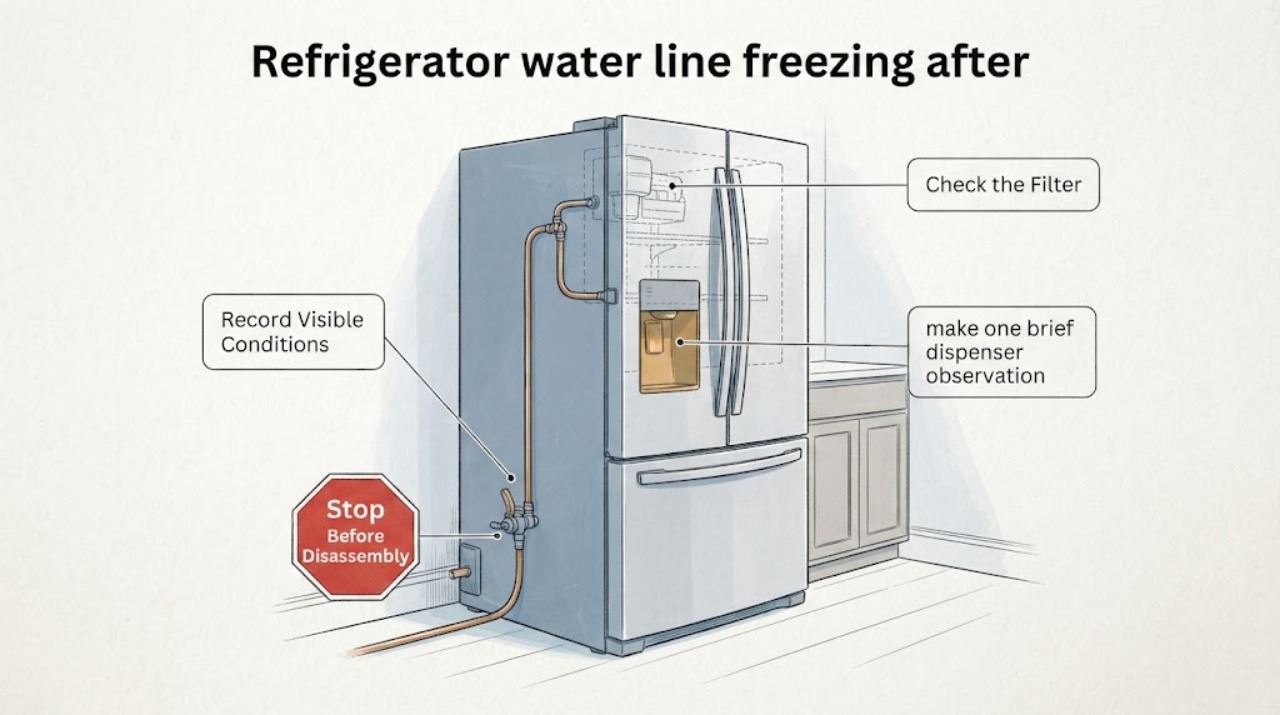
With the refrigerator and floor dry, make one brief dispenser observation using a sturdy container and note whether water is absent, a weak trickle, or normal. Do not repeatedly press the pad to provoke flow. Keep the ice maker observation separate: note whether it is producing ice normally and whether the ice-maker fill sound or ice production has also stopped.
Expected result: The dispenser fails while ice production continues; both dispenser and ice maker fail; the dispenser has a weak flow; or both functions work after the line has warmed in the room.
Next step: Continue with the matching branch without removing a door or valve. If both functions are affected or a weak flow follows a new plumbing connection, check the safe external supply and pressure conditions, then escalate if unresolved.
Why this matters
Why: A dispenser-only failure is more consistent with the door-routed dispenser branch or its filter/valve path, while failure of both functions makes the shared supply, filter, inlet, pressure, or installation path more important. These patterns localize the branch but do not prove a part failure.
-
Check 3
From a dry, safe position, check that the cold-water shutoff is open, the visible rear tubing is not kinked or crushed, the filter cover is fully closed, and there is no wet fitting or frost at an accessible connection. Do not loosen a pressurized fitting, cut tubing, remove a panel, or move the refrigerator without help.
Expected result: A shutoff is closed, the visible line is kinked or wet, the filter was recently installed or is not seated, or all accessible connections are dry and correctly arranged.
Next step: Correct only an obviously closed shutoff or accessible filter seating exactly as the matching manual allows. If a connection leaks, keep the refrigerator water supply off and arrange service; do not keep operating a pressurized leak.
Why this matters
Why: The Kenmore guide lists a closed supply, kinked source line, low pressure, new installation, and incorrectly installed filter as causes of poor dispenser or ice-maker operation. A wet or damaged connection is a leak risk, while a dry visible line shifts concern to the branch inside the door, filter head, valve, or concealed installation.
-
Check 4
Assess the new-house water conditions without opening the plumbing: ask whether the refrigerator line runs through an unheated garage, exterior wall, crawlspace, cabinet void, or other cold area, and obtain the household or refrigerator inlet pressure from a plumber if it is unknown. The guide's target is a cold supply at 30–120 psi; do not guess at pressure from dispenser flow alone.
Expected result: The route is exposed to freezing conditions, the pressure is below 30 psi or above 120 psi, a reverse-osmosis system is involved, or the route and pressure meet the guide's conditions.
Next step: Have a licensed plumber correct the building-side temperature or pressure condition. Do not add an unapproved heater, insulation around a warm appliance component, or a new valve as a trial repair.
Why this matters
Why: A line installed where temperatures fall below freezing can repeatedly freeze regardless of the refrigerator's internal settings. Low pressure, reverse osmosis, or a new plumbing arrangement can reduce flow to both water functions and make a frozen restriction harder to distinguish from a supply problem.
-
Check 5
If the line appears to recover only after the room and refrigerator have returned to normal temperature, stop dispensing and ice-making tests and record which branch recovered first, how long the symptom lasted, and whether the line freezes again. Do not accelerate recovery with a heat tool, boiling water, flame, sharp object, or by dismantling the door or freezer liner.
Expected result: The dispenser recovers but the ice maker remains affected; the ice maker recovers but the dispenser remains blocked; both recover and stay normal; or one or both branches freeze again.
Next step: Leave the water supply or affected function off if recurrence or leakage occurs, and give the technician the branch timing and new-house line route. Arrange appliance service for an internal door, filter, or valve path and plumbing service for a concealed or building-side line.
Why this matters
Why: Different recovery patterns support separate dispenser-door and ice-maker/supply branches, but recurrence means a temperature, restriction, filter, valve, or building-line problem remains. The manual specifically warns against sharp objects in the ice system and requires the water installation to remain above freezing.
Use your observations
Decision map
Find the observation that best matches what you see, then follow the next safe action.
-
PATH 01Next step
What you see
The dispenser has no flow or only a weak flow, but the ice maker continues producing ice and the visible rear supply is dry.
Do this next
Use only the exact model's filter and dispenser instructions. If filter seating is correct and the door branch remains blocked or repeatedly freezes, stop testing and arrange appliance service; do not remove the door or thaw it with tools.
Why this path and its safety boundary
Why it matters: The freezer-door dispenser branch, its filter path, or its valve outlet is more likely than a whole-house supply failure; the guide identifies the dispenser tubing at the freezer-door hinge and treats ice making separately.
-
PATH 02Next step
What you see
Both the dispenser and ice maker fail after the new-house connection, or the dispenser flow is weak at the same time as small or hollow ice.
Do this next
Check only the visible shutoff, line, filter seating, and exact manual requirements. Have a licensed plumber verify pressure and concealed routing; keep the water supply off if any connection is leaking.
Why this path and its safety boundary
Why it matters: A shared supply condition such as a closed or restricted shutoff, kinked house line, filter restriction, low pressure, reverse-osmosis setup, or inlet path is more likely than an isolated dispenser-door freeze.
-
PATH 03Next step
What you see
The ice maker is the only affected function, the dispenser works normally, and the ice bin or fill area shows no visible loose ice that can be removed by the manual's ordinary care step.
Do this next
Use the manual's on/off control and bin check only. Do not chip ice, insert a sharp object, remove the ice-maker assembly, or order a valve or heater before diagnosis; arrange appliance service if the branch remains blocked.
Why this path and its safety boundary
Why it matters: The ice-maker fill branch, its supply valve, or a freezer-side restriction is more likely than a dispenser-door line. A lack of ice production alone does not identify a frozen tube versus a control or water-supply fault.
-
PATH 04Next step
What you see
The water works after warming but freezes again, especially when the line passes through an unheated or concealed cold area in the new house.
Do this next
Shut off the refrigerator water supply when the source is concealed or leaking and have a licensed plumber correct the route or temperature. Arrange appliance service if the recurrence is inside the door or cabinet.
Why this path and its safety boundary
Why it matters: The installation environment is a leading cause; the guide requires water tubing to stay in areas above freezing, so repeated thawing does not resolve the building-side condition.
-
PATH 05Next step
What you see
A fitting is wet, the line is cracked, water reaches the floor or electrical area, the source is behind a panel, or the refrigerator must be moved to inspect it.
Do this next
Close the refrigerator water shutoff, keep water away from power, do not move the appliance alone, and contact Kenmore/Sears appliance repair or a licensed plumber as appropriate.
Why this path and its safety boundary
Why it matters: This is a leak or access hazard rather than a user-thawing task. The manual calls for power disconnection before service and two people for moving the refrigerator.
When checks do not resolve it
Need a professional?
Arrange Kenmore/Sears appliance service when a dispenser-door or ice-maker branch remains blocked after the safe external checks, the line refreezes, a filter or valve path is suspected, or the exact configuration does not match the 106.5113* guide. Use a licensed plumber for a below-freezing building route, low or excessive pressure, reverse-osmosis supply issue, inaccessible shutoff, or concealed line. Shut off the refrigerator water supply for an active leak and do not order a heater, valve, or tubing before diagnosis.
Common questions
FAQ
Why can the dispenser stop while the ice maker still works?
On this side-by-side family, the guide shows the dispenser tubing routed through the freezer-door hinge and treats the ice maker as a separate freezer function. That pattern points toward the dispenser branch or its filter/valve path, but it does not identify a failed part by itself.
Can a new-house installation cause repeated water-line freezing?
Yes. The Kenmore guide says the supply tubing must be installed where household temperatures remain above freezing and calls for a cold supply at 30–120 psi. An unheated or concealed route, low pressure, reverse osmosis, or a restricted filter can keep the symptom recurring.
What should I use to thaw the frozen refrigerator line?
Do not use a heat tool, flame, boiling water, sharp object, drill, or improvised puncture. Record which branch is affected, keep the water supply off if there is leakage, and have appliance or plumbing service address the accessible or concealed cause.
Read the exact guide
Official sources
- Contact Us | Kenmore Customer SupportKenmore / Transform SR Brands LLC · Official Kenmore contact page opened for the service boundary; it does not diagnose a frozen line or identify a component.
- Customer Care & Support | Kenmore AppliancesKenmore / Transform SR Brands LLC · Official Kenmore customer-care page opened to confirm that manuals and repair resources are the supported escalation paths for an older refrigerator model.
- Find Your Manual | Kenmore Appliance Manuals & GuidesKenmore / Transform SR Brands LLC · Official Kenmore manual portal opened for the assigned model; the corresponding 106.5113* Use & Care Guide was also opened during research and used to establish the water-supply, dispenser, filter, and ice-maker distinctions. Exact configuration remains model-checked.
Community feedback
Share a repair observation
Share a plain-text repair observation. Accepted observations are published automatically; this page may take a moment to update.