
On this page
Start here
Quick answer
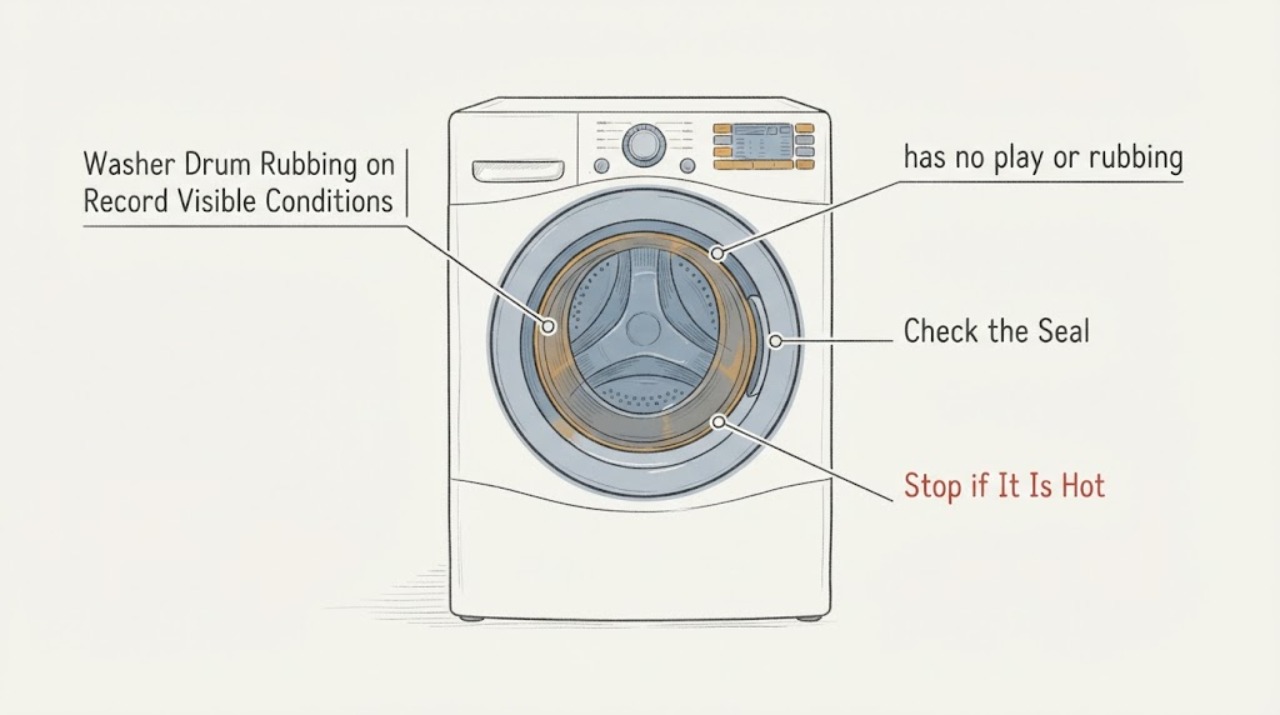
If a Kenmore washer drum is rubbing on the tub, stop the cycle and keep hands away until all movement has stopped. Unplug the washer from a dry, safe position, remove the load, and check whether the basket is visibly off-center, a loose object is caught at the opening, or the noise is only a normal swish that fades during spin. With power removed, turn the empty basket gently by hand and note whether the scrape repeats at one point, feels rough, or the basket has noticeable play. An uneven load or leveling problem can cause shaking, but persistent rubbing, grinding, visible marks or shavings, or a loose basket can indicate an internal suspension, bearing, basket-support, or tub problem. Keep the washer out of service and use the exact model manual or qualified appliance service before opening panels or ordering parts.
Work through in order
Diagnostic checks
Use only checks that match the exact appliance or system and its official guide.
-
Check 1
Stop the washer, wait for all basket movement to end, unplug it from a dry and safe position, and record whether rubbing occurred during agitation, acceleration, high-speed spin, deceleration, or every hand rotation.
Expected result: The sound is a fading swish, a repeated metallic scrape, a hard knock with movement, or accompanied by smoke, burning odor, a hot cord, water near electrical parts, or a basket that will not stop.
Next step: Keep the washer off for any scrape, knock, hazard sign, or uncontrolled movement. Continue only with a visual empty-basket check when the appliance is unplugged, cool, dry, and safe.
Stop if: Do not reach into a moving basket, keep cycling the washer to reproduce the sound, or restore power after smoke, burning odor, sparking, a hot cord, or water near electrical parts.
Why this matters
Why: A fading swish can be normal water or suds movement, while repeated scraping or knocking means the basket may be contacting the tub or moving abnormally. Smoke, heat, or uncontrolled movement is an immediate safety boundary.
-
Check 2
With the washer unplugged and empty, inspect the visible gap, door boot or tub rim, and basket opening for a trapped object, torn seal, fresh rubbing mark, or visibly off-center basket. Turn the basket slowly by hand without forcing it.
Expected result: The scrape repeats at one point, an object or mark is visible, the basket feels rough, or the basket has noticeable up-and-down or side-to-side play.
Next step: Remove only a loose object that is plainly reachable without dismantling anything. Keep the washer out of service and arrange qualified inspection for play, rough rotation, rubbing marks, or an inaccessible object.
Stop if: Do not force the basket, reach behind a seal, remove panels, tip the washer, or test the machine with a cover or interlock defeated.
Why this matters
Why: A localized scrape can come from contact or an object; roughness or play makes a supported internal component more concerning. A clear opening does not rule out a bearing, suspension, basket support, counterweight, or tub problem.
-
Check 3
If the basket turns smoothly, has no play or rubbing marks, and the noise happened only with a bulky or tightly packed load, compare the load and leveling instructions with the exact Kenmore manual before any limited retry.
Expected result: The washer is stable and level, the load was uneven or oversized, and the rubbing does not occur with an empty basket; or the washer rubs empty, walks, or repeats the noise with a suitable load.
Next step: Correct only a clearly authorized load or leveling issue once, then stop if any rubbing returns. Arrange service without further testing for persistent rubbing, walking, or an off-center basket.
Stop if: Do not add water or more laundry to balance the machine, run repeated high-speed cycles, or move a heavy washer to inspect underneath by yourself.
Why this matters
Why: An isolated imbalance or installation issue can explain movement during spin. Rubbing with an empty basket or on every cycle points away from loading and toward a persistent mechanical or support fault.
-
Check 4
Record the full Kenmore model number, washer type, cycle stage, load type, empty-basket result, visible marks, and any leak or error before contacting support.
Expected result: The model identity is complete and the symptom record shows a normal empty-basket check, a visible obstruction, persistent rubbing, or basket play.
Next step: Use the model-specific manual for authorized visible care only; provide the complete record to Kenmore or qualified appliance service for any persistent rubbing or play.
Stop if: Do not substitute instructions or parts from a similar-looking Kenmore washer.
Why this matters
Why: The model number selects the correct Kenmore manual and service path, while the symptom pattern helps distinguish a user-correctable load issue from an internal inspection.
-
Check 5
Keep the washer disconnected and arrange qualified appliance service when rubbing persists, the basket is loose or off-center, marks or shavings appear, or the sound is accompanied by a leak or abnormal vibration.
Expected result: The symptom returns after a safe load or leveling correction, occurs with an empty basket, or cannot be inspected without opening the cabinet.
Next step: Provide the model and symptom record to Kenmore or qualified appliance service and keep the washer out of use until inspected.
Stop if: Do not bypass a lid or door lock, probe live wiring, or order and install an internal part based only on the rubbing sound.
Why this matters
Why: The remaining possibilities include internal suspension or shock components, a bearing or basket support, a counterweight, tub contact, or an inaccessible foreign object; the symptom alone does not identify a replaceable part.
Use your observations
Decision map
Find the observation that best matches what you see, then follow the next safe action.
-
PATH 01Next step
What you see
The sound is a light swish or roar that fades as the washer drains, with no scrape, marks, abnormal movement, or hazard sign.
Do this next
Use the exact Kenmore manual for normal-sound and load guidance, and monitor for a new repeated scrape, grinding, or excessive movement.
Why this path and its safety boundary
Why it matters: Water or suds moving between the basket and tub can be a normal operating sound; this pattern does not establish drum-to-tub contact.
-
PATH 02Next step
What you see
The rubbing occurs only during spin with an uneven or bulky load, and the empty basket is centered, smooth, and free of play or marks.
Do this next
Follow the exact model's loading and leveling instructions once; stop using the washer if rubbing returns with a suitable load or if it begins to walk.
Why this path and its safety boundary
Why it matters: Load distribution, installation, or leveling is more likely than an internal drum fault, although a return of rubbing changes the decision.
-
PATH 03Next step
What you see
The empty basket scrapes at one point, the drum is visibly off-center, there are fresh marks or shavings, or the basket has rough rotation or noticeable play.
Do this next
Keep the washer unplugged and arrange qualified appliance service with the model number and observations.
Why this path and its safety boundary
Why it matters: Contact or an internal support, suspension, bearing, basket-support, counterweight, or tub problem is more likely; a visible symptom does not identify the exact part.
-
PATH 04Next step
What you see
Rubbing is accompanied by a leak, smoke, burning odor, sparking, a hot cord, water near electrical parts, violent movement, or a basket that will not stop.
Do this next
Stay clear, isolate power and water only from a dry safe location if possible, and obtain qualified electrical, plumbing, or appliance help before reuse.
Why this path and its safety boundary
Why it matters: The appliance has reached an immediate electrical, water, fire, or movement safety boundary.
Helpful context
Understand the symptom
Stop the cycle and classify the sound
Press stop or cancel and wait until the basket has completely stopped. From a safe, dry position, note whether the sound is a light swish that fades as water drains, a metallic scrape that repeats with each revolution, or a heavy knock that appears as the washer accelerates. A swish or roar can be normal water or suds moving between the basket and tub, while a repeated scrape or hard knock deserves an inspection before another load. Do not reach into a moving basket or run another cycle just to reproduce the noise.
Check the empty basket without opening the cabinet
After the washer is unplugged and the load is removed, look through the opening for a coin, wire, garment fastener, torn seal, or other object sitting in the gap. On a front-load washer, look for fresh marks on the door boot and whether the drum sits evenly in the opening. On a top-load washer, look at the visible basket rim and tub ring. Turn the empty basket slowly by hand without forcing it. A scrape at one point suggests contact or an object; rough rotation, grinding, or obvious play suggests an internal problem that cannot be confirmed from the opening.
Separate an unbalanced load from a persistent drum fault
If there are no rubbing marks, the basket is centered, and the noise occurred only with one bulky or tightly packed load, check the load instructions in the exact Kenmore manual. A smaller, evenly distributed load and a stable, level floor can reduce movement. If the washer rubs while empty, rubs on every revolution, walks across the floor, or repeats the symptom with a suitable load, stop testing it. A load correction cannot repair a basket that is no longer centered or supported.
Use the model number before choosing a repair path
Record the complete Kenmore model number from the label and identify whether the washer is front-load or top-load. Kenmore's manual search uses the model number to select the correct owner information. Do not assume that a front-load procedure, suspension layout, bearing design, or tub part from another Kenmore platform applies to this washer. Give service the model, the empty-basket result, the cycle stage, whether the drum is visibly off-center, and any marks or debris found.
Keep internal inspection within the service boundary
A basket that remains off-center, has noticeable play, grinds when moved by hand, or rubs the boot or outer tub needs qualified diagnosis. Depending on the washer design, inspection may involve suspension or shock components, a bearing or basket support, a loose counterweight, the tub, or a trapped object that cannot be reached safely. Do not tip the washer, remove the cabinet, bypass the lid or door lock, probe wiring, or order a bearing, shock, seal, or basket from the symptom alone. Leave the water valves closed if a leak is present and arrange Kenmore or qualified appliance service.
Only after diagnosis
Potential parts
- model-specific suspension or shock components
Consider only when the basket is off-center or the washer moves excessively during spin after load and leveling checks are correct.
Confirm the complete Kenmore model and technician diagnosis before selecting a part; do not assume a generic kit fits. - model-specific drum or tub bearing and basket-support assembly
Consider only when the empty basket has rough rotation, grinding, or measurable play and service confirms an internal support fault.
The rubbing sound alone does not identify a bearing or basket-support part. Match the exact model and design after inspection. - model-specific door boot or tub seal
Consider only when a front-load washer shows a torn seal or confirmed contact damage and the exact seal is identified by model.
A visible mark does not establish seal fitment or the root cause; confirm the exact model and cause before ordering.
When checks do not resolve it
Need a professional?
Request qualified service if the drum rubs while empty, the basket is off-center or loose, hand rotation is rough, marks or shavings appear, the washer walks or vibrates severely, the rubbing returns after a safe load correction, or any panel or interlock would need to be removed. Stop immediately for smoke, burning odor, sparking, a hot cord, water near electrical parts, or uncontrolled movement.
Common questions
FAQ
Can I keep using a Kenmore washer if the drum only rubs during spin?
Do not keep using it until you have confirmed from a safe, unplugged inspection that the sound was only an isolated load or leveling issue. Rubbing with an empty basket, repeated scraping, marks, play, or severe movement warrants service.
Does a rubbing drum always mean the bearing is bad?
No. Rubbing can involve an uneven load, leveling, a trapped object, a seal, suspension or shock components, a basket support, a bearing, a counterweight, or tub contact. The symptom alone is not enough to choose a part.
What information should I give a Kenmore technician?
Give the complete model number, washer type, cycle stage, load type, whether the empty basket is centered and smooth, whether it has play, any visible marks or debris, and any leak, error, or recent move or installation change.
Read the exact guide
Official sources
- How to Stop a Washer From ShakingWhirlpool Corporation · General manufacturer washer guidance used for symptom-level checks; it does not establish Kenmore model-specific part fitment.
- Customer Care & Support | Kenmore AppliancesKenmore / Transform SR Brands LLC · Official Kenmore support routing for an unspecified washer model.
- Find Your Manual | Kenmore Appliance Manuals & GuidesKenmore / Transform SR Brands LLC · Official Kenmore manual lookup; the assigned topic has no complete washer model number, so the exact manual must be selected by the reader.
- Washer Roaring or Swooshing Noise During Spin CycleGE Appliances · General washer sound comparison only; use the exact Kenmore manual for model-specific operation.
Community feedback
Share a repair observation
Share a plain-text repair observation. Accepted observations are published automatically; this page may take a moment to update.