
On this page
Start here
Quick answer
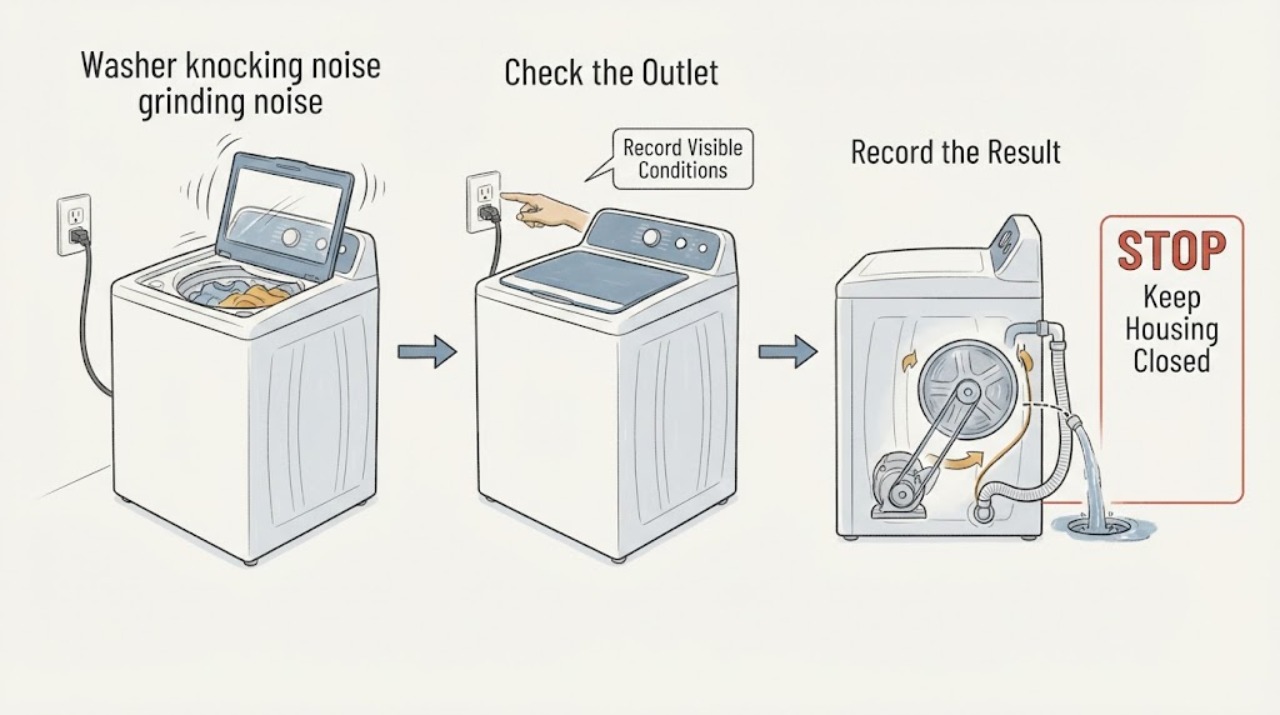
Stop the Kenmore washer and do not run another load just to hear the noise again. A single knock during spin can come from a load or installation condition, but a progression from knocking to grinding together with an abnormal or failed spin raises the service priority. Kenmore's current documentation requires a full model number for the correct manual; 90 Series is a product-line label, not enough to select a platform, gearcase, coupling, pump, or other part. From a safe stationary position, record the cycle phase, whether the sound followed each basket revolution, whether the washer walked, whether water remained, and whether there was smoke, heat, odor, leaking, or a breaker trip. Do not tilt or move the washer, reach into the tub, remove panels, bypass a lid switch, or diagnose a gearcase from sound. If the grinding recurs in the record, the washer will not spin, or any hazard is present, leave it off and arrange qualified appliance service.
Before you begin
Safety first
- Do not run repeated cycles, run an empty test, manually force the basket, tilt, lift, drag, or crawl under the washer; do not open the cabinet, remove panels, bypass a lid switch, insert tools, make live measurements, or choose a gearcase, coupling, clutch, bearing, pump, belt, or suspension part from sound alone. Stop immediately for smoke, sparks, burning odor, unusual heat, severe movement, a leak, water near electricity, or a breaker trip.
Work through in order
Diagnostic checks
Use only checks that match the exact appliance or system and its official guide.
-
Check 1
Stop the washer using its normal control if it is safe, wait until the tub or agitator has completely stopped, and leave it off. From a dry stationary position, check only for smoke, sparks, burning or electrical odor, unusual heat, active leaking, water near the cord or outlet, severe movement, or a repeated breaker trip.
Expected result: A hazard or active leak is present; the washer moved or struck nearby objects; or there is no visible hazard and the machine is fully stopped.
Next step: For any hazard, keep the washer isolated and obtain qualified appliance, electrical, or plumbing help from a safe location. Otherwise continue only with the identity and external observations below.
Stop if: Do not touch a wet cord or outlet, reset a tripped breaker repeatedly, reach into a moving tub, or restart the washer to confirm the sound.
Why this matters
Why: Smoke, heat, electrical odor, water near electricity, severe movement, or a leak is a stop-use condition. The absence of those signs permits only external documentation; it does not make a later grinding noise safe to reproduce.
-
Check 2
Write down the last known sequence without running the washer again: whether the knock occurred during filling, agitation, draining, ramp-up to spin, high-speed spin, or slowdown; when the grinding began; whether it followed each basket revolution; whether the tub actually spun; and whether clothes were left wet or water remained.
Expected result: The knock was limited to one transition or one load; the grind was rhythmic with basket movement; the sound occurred during drain; or the sequence ended with no spin, poor spin, or standing water.
Next step: Preserve a safe-distance recording only if one already exists or can be made without restarting or approaching moving parts. Give the phase, rhythm, and wet-clothes result to the technician.
Stop if: Do not run an empty cycle, manually spin or force the basket, insert a phone or tool into the tub, or keep testing to make the sound repeat.
Why this matters
Why: Phase and rhythm separate a possible load or installation event from a drain-related sound or a persistent mechanical symptom. A knock-to-grind progression with failed spin is a stronger service signal than a single isolated thump, but sound alone still cannot name the failed component.
-
Check 3
Read the complete model and serial label from a safe accessible position, and record every character instead of relying on the words 90 Series. Do not move the washer or remove a console or cabinet panel to find the label.
Expected result: An 11-character-or-longer model number is readable; only 90 Series is visible; or the label is damaged or inaccessible.
Next step: Give the complete label to service or use it only in Kenmore's manual lookup. If it cannot be confirmed, keep all advice at the external symptom level and do not order a component.
Stop if: Do not pull, tilt, lift, drag, or open the washer to expose the label, and do not use a similar-looking Kenmore model as a substitute.
Why this matters
Why: Kenmore uses the complete model number to locate the correct manual. A series name alone cannot establish the washer's age, cycle controls, drive design, drain access, or compatible part.
-
Check 4
With the washer idle and dry, look from outside for a plainly visible contact or installation clue: a hose tapping the cabinet or wall, a stored object leaning against it, obvious rocking, or a displaced unit. Compare the prior load description for a single bulky or tightly packed item, but do not move the washer or adjust feet by guesswork.
Expected result: The prior sound occurred only with an uneven or bulky load and the machine remained stable; an external object or hose could contact the cabinet; or the washer was stable but the grinding and spin failure persisted.
Next step: Remove only a loose object that is plainly separate from the washer and can be taken away without touching connections. Otherwise leave the unit off and arrange service; do not attempt a leveling or mechanical repair from this observation.
Stop if: Do not drag, tilt, lift, wedge, shim, crawl underneath, tighten hidden hardware, or disturb water, drain, or electrical connections.
Why this matters
Why: Load placement, overloading, or an external contact can explain some noise. Kenmore also warns that an unbalanced washer can create noise and premature wear. Persistent grinding or failed spin after a stable-load history makes a hidden drive, tub, suspension, or drain issue more concerning, without proving which one.
-
Check 5
From the outside and only after the washer has stopped, note whether the tub opening is empty of loose visible objects, whether water is still present, and whether a visible hose or drain area shows an obvious leak or backup. Do not reach into the tub, pump area, filter housing, or cabinet.
Expected result: Water remains or draining was slow; a visible leak or household drain backup is present; a loose object is plainly visible at the opening; or the visible areas are clear but the grind and spin problem remain.
Next step: Keep the washer off for standing water, a leak, or an inaccessible object and request qualified appliance or plumbing service as appropriate. Do not infer a pump, coupling, gearcase, or bearing from the sound.
Stop if: Do not drain onto a wet electrical area, force a filter or cap, remove a panel, insert tools, or run another cycle with water or a leak present.
Why this matters
Why: Standing water or a drain-related hum can change the first service path toward drainage, while a visible loose item may explain a rattle if it can be removed without force. Clear visible areas do not rule out a hidden object or internal drive fault.
-
Check 6
Prepare a service note containing the full model and serial number, approximate age if known, the exact knock-to-grind time line, cycle phase, rhythm, spin result, wet-clothes or standing-water result, load description, movement, visible contact, and all odor, heat, leak, or breaker observations. Attach only safe-distance photos or a recording made without another test run.
Expected result: The evidence points mainly to one unbalanced load, a drain symptom, a persistent spin-synchronous grind, an inaccessible source, or an unresolved series-level problem.
Next step: Arrange qualified Kenmore or appliance service for a persistent, worsening, or spin-related grind or any failed spin. Ask the provider to verify the exact platform before quoting a part or repair path.
Stop if: Do not buy a gearcase, coupling, belt, clutch, bearing, pump, or lid switch solely from the 90 Series label or from sound, and do not open the machine to confirm a theory.
Why this matters
Why: A structured time line is more useful than a guessed part because 90 Series does not identify one platform and the same sound can come from load, drain, tub, suspension, or drive conditions.
Use your observations
Decision map
Find the observation that best matches what you see, then follow the next safe action.
-
PATH 01Next step
What you see
The recorded knock happened only as spin began with one bulky or uneven load, the washer did not grind afterward, there was no failed spin, and there was no leak or electrical warning.
Do this next
Keep the washer off until the load and exact manual are reviewed. If the noise returns, becomes a grind, or affects spin, stop using it and arrange service rather than repeating tests.
Why this path and its safety boundary
Why it matters: A load-balance or external-contact explanation is more plausible than a confirmed internal part failure, although one event does not prove the washer is healthy.
-
PATH 02Next step
What you see
The washer first knocked and then produced a grinding or scraping sound, the sound was rhythmic with basket movement or persisted across the failed spin, and clothes were left wet or the basket did not spin normally.
Do this next
Leave the washer off and arrange qualified appliance service. Provide the sound sequence and full model label; do not run another cycle, tilt the machine, or purchase a drive component by symptom.
Why this path and its safety boundary
Why it matters: The progression and performance loss make an internal drive, tub, suspension, or related mechanical path more concerning than a simple one-load imbalance. The 90 Series label cannot distinguish those possibilities.
-
PATH 03Next step
What you see
The sound was mainly a hum or grind during draining, water remained in the tub, draining was slow, or a visible drain backup or leak was present.
Do this next
Keep the washer off for standing water or a leak and obtain qualified appliance or plumbing help. Only use a filter procedure if the exact manual explicitly identifies it as ordinary owner access.
Why this path and its safety boundary
Why it matters: A drain-path or pump-area condition becomes more relevant, but the visible symptom still does not establish a pump or filter failure and the broad series identity does not establish access instructions.
-
PATH 04Next step
What you see
Smoke, sparks, burning or electrical odor, unusual heat, water near power, severe movement, a hot or damaged cord, or a repeated breaker trip accompanied the noise.
Do this next
Keep the washer isolated from a safe dry location and obtain qualified appliance, electrical, plumbing, or emergency help as appropriate. Do not touch a wet or hot electrical area or reset the breaker repeatedly.
Why this path and its safety boundary
Why it matters: This is an immediate safety condition, not a noise-classification exercise. Continued operation could increase fire, shock, flood, or mechanical injury risk.
-
PATH 05Next step
What you see
Only the words 90 Series are available and the full model number cannot be confirmed, or the sound history conflicts with the assumed top-load platform.
Do this next
Stop at the external observations, obtain the model and serial label or qualified service identification, and do not apply a manual or part list from another Kenmore design.
Why this path and its safety boundary
Why it matters: Platform-specific cycle behavior, access, parts, and compatibility are unresolved. A series label cannot safely support a gearcase, coupling, clutch, bearing, pump, or lid-switch conclusion.
Helpful context
Understand the symptom
Why the sequence matters
A knock that appears during spin can be a load or stability clue, especially when the washer moves or the sound changes with the load. A later grinding sound and an incomplete or weak spin add a different observation: the problem is worsening or no longer explained by balance alone. That does not identify a gearcase, coupling, bearing, clutch, pump, or motor. The safest useful result is to stop repeat testing, preserve the time line, and let a technician inspect the exact platform.
Do not use 90 Series as a parts identity
Kenmore's manual page says model numbers are at least 11 characters long and asks owners to enter the complete number. Because several designs can carry a 90 Series label, write down the model and serial exactly as printed before anyone discusses a part or a platform-specific procedure. The checks below are deliberately external and symptom-level; they do not assume a particular lid switch, drain pump, belt, coupling, clutch, bearing, or gearcase.
When checks do not resolve it
Need a professional?
Arrange qualified Kenmore or appliance service when a knock progresses to grinding, the washer does not spin normally, the noise is new, harsh, rhythmic, worsening, or present beyond one load, or the source is not externally clear. Request plumbing help for a drain backup or leak and electrical help for a hot, wet, damaged, or repeatedly tripping power connection.
Safety scope: Do not run repeated cycles, run an empty test, manually force the basket, tilt, lift, drag, or crawl under the washer; do not open the cabinet, remove panels, bypass a lid switch, insert tools, make live measurements, or choose a gearcase, coupling, clutch, bearing, pump, belt, or suspension part from sound alone. Stop immediately for smoke, sparks, burning odor, unusual heat, severe movement, a leak, water near electricity, or a breaker trip.
Have this ready
- Provide the complete model and serial label, market or location, the knock-to-grind sequence, cycle phase and rhythm, whether spin occurred, wet-clothes or standing-water observations, load description, external movement or contact, and any odor, heat, leak, or breaker event. Include only safe-distance photos or recordings.
Common questions
FAQ
Does a Kenmore 90 Series grinding sound prove the gearcase is bad?
No. The series name covers more than one design, and grinding can be associated with load, drain, tub, suspension, or drive conditions. A knock followed by grinding with failed spin is a reason to stop use and have the exact platform inspected, not a reason to order a gearcase from the sound alone.
What should I record before calling for service?
Record the full model and serial number, the phase when the knock and grind occurred, whether the sound followed each basket revolution, whether the basket spun, whether clothes were left wet or water remained, the load description, movement, and any smoke, odor, heat, leak, or breaker event. Do not repeat a cycle solely to obtain a recording.
Can I keep washing if redistributing the load seems to help?
Only a one-load knock with no grinding, no failed spin, no leak, and no other warning can fit a load-balance observation. If the sound progressed to grinding or the washer did not spin correctly, do not keep testing it; leave it off and arrange service even if the next attempt might appear normal.
Read the exact guide
Official sources
- Customer Care & Support | Kenmore AppliancesKenmore · Kenmore customer-care, product-manual, repair, and service routing
- Appliance Maintenance Tips to Help Maximize EfficiencyKenmore Livemore · Kenmore laundry guidance on unbalanced-load noise, overload stress, unusual noises, and professional checking
- Find Your Manual | Kenmore Appliance Manuals & GuidesKenmore · Kenmore exact model lookup; the 90 Series label is not sufficient for platform-specific manuals or parts and the full model number is required
Community feedback
Share a repair observation
Share a plain-text repair observation. Accepted observations are published automatically; this page may take a moment to update.