
On this page
Start here
Quick answer
Do not approve a drum replacement from a floor leak alone. First record the complete Kenmore model number, stop the washer, close the water supplies, and identify whether water starts at an inlet hose, drain path, door or lid, dispenser, pump-out, or underneath the cabinet. Kenmore's official manual route is model-specific, and its parts pages show that even an OEM washer part can fit only a stated set of models. If a technician confirms that the inner basket, outer tub, tub seal, or bearing area is the actual leak source, get a written parts-and-labor estimate and ask whether the exact part is still available. On a 30-year-old machine, replacement is usually the safer economic direction when a drum/tub job is major, parts are uncertain, the quote is high relative to a suitable new washer, or other age-related faults are already present. A targeted repair may still make sense when the leak is an external hose, seal, pump, or connection and the rest of the washer is sound. Do not tip the washer, open the cabinet, or run repeated cycles to locate an internal leak.
Before you begin
Safety first
- Owner checks are limited to stopping the cycle, closing accessible water valves, recording the first wet point, reading the exact model, and inspecting visible external hoses, seals, drawers, and drain paths with safe isolation. Do not tip the washer, open the cabinet, remove a tub, basket, pump, boot, seal, valve, or bearing, disconnect a pressurized hose, or test live wiring.
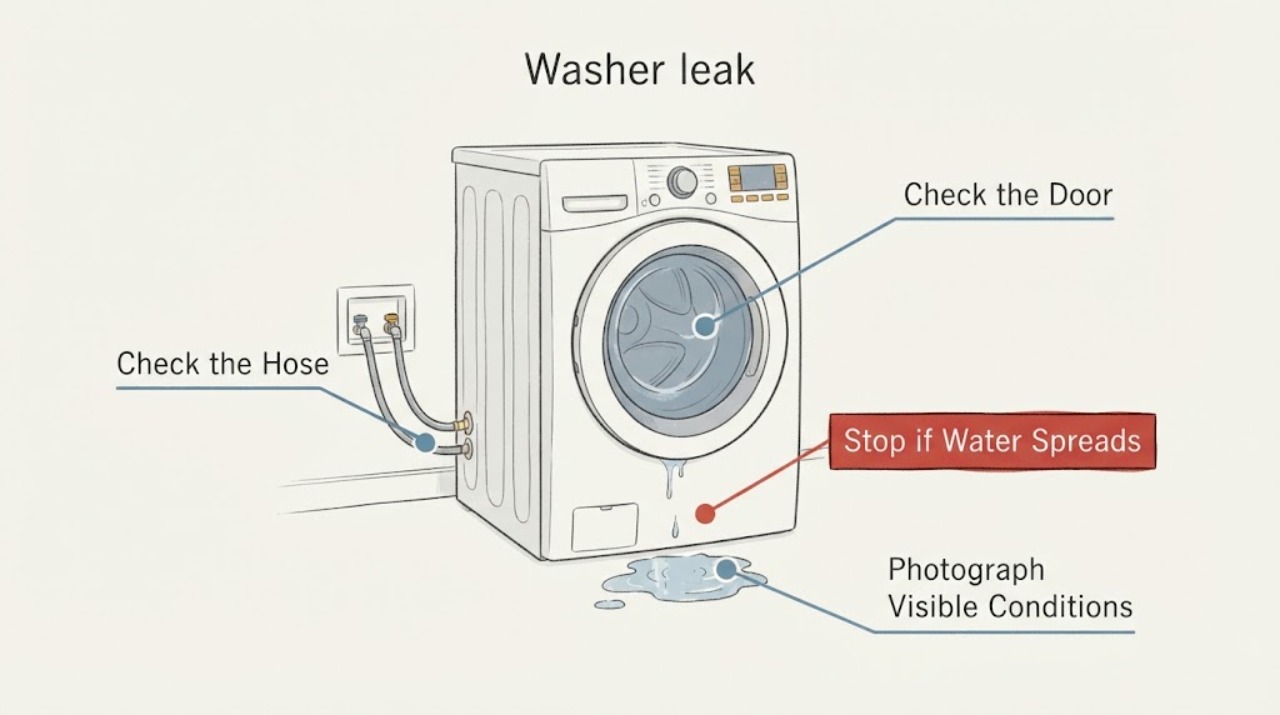
Work through in order
Diagnostic checks
Use only checks that match the exact appliance or system and its official guide.
-
Check 1
Stop the wash cycle, keep hands away from a moving basket, and close both household water valves if they are safely reachable. From a dry, safe position, note where the first water appears and when it starts: fill, wash, drain, spin, door or lid opening, or while the washer is off. Do not run another cycle just to make the leak appear.
Expected result: Water starts at a rear inlet connection, front door or dispenser, drain connection, household drain, underside, or continues while the washer is off; or the first point cannot be seen.
Next step: Photograph the first wet location if safe. Keep the washer off for an underside, recurring, or unknown-source leak and arrange qualified service. Use plumbing help for a household drain or supply-line problem.
Stop if: Do not work on a wet floor, touch wet electrical parts, tip the washer, force a locked door or lid, or continue if there is smoke, burning odor, sparking, a hot plug, repeated breaker operation, or violent movement.
Why this matters
Why: The visible puddle may be downstream from the real leak. A rear fill leak, front seal or dispenser leak, drain backup, and underside leak lead to different repair decisions; an unexplained underside leak cannot prove that the drum is bad.
-
Check 2
Find and photograph the complete Kenmore model number and serial information from the rating label, and record whether the washer is top-load or front-load. Use the Kenmore manual search with the exact model; do not substitute a similar-looking model, a Whirlpool platform, or a generic Kenmore manual.
Expected result: The full model is readable and a matching manual or parts route is available; the label is unreadable; or only a partial badge, series name, or age is known.
Next step: Give the exact model and serial information to the technician and use its matching manual for any permitted owner checks. If the identity cannot be confirmed, do not authorize a part or drum quote based on a look-alike model.
Stop if: Do not remove the rating label, dismantle trim to find it, or assume a part fits because another Kenmore washer has the same capacity or a similar cabinet.
Why this matters
Why: Kenmore's official manual page requires the model number and says the manual supplies model-specific information about parts and accessories. Age and brand alone cannot establish the correct drum, tub, seal, pump, or installation procedure.
-
Check 3
With power and water isolated safely and the washer left in place, inspect only visible external leak paths: inlet-hose connections and washers, the visible drain hose and household standpipe, the front door glass and boot on a front-load model, the dispenser drawer, lid area on a top-load model, and any visible pump or filter access described by the exact manual. Remove only loose visible debris when the manual permits it.
Expected result: A hose connection, gasket, drain route, door boot, drawer, or visible obstruction is damaged or clearly leaking; or the external paths are dry and secure while water appears underneath or near the tub.
Next step: For a damaged hose, active connection drip, backed-up drain, torn boot, or cracked drawer, keep the washer off and obtain model-specific repair or plumbing help. For an underside or inaccessible source, leave the washer off and request a qualified diagnosis rather than a guessed drum replacement.
Stop if: Do not disconnect a pressurized hose, remove the door boot or pump, open the cabinet, reach under the washer, or test with live wiring exposed.
Why this matters
Why: An external hose, connection, boot, drawer, or pump-path issue may be a targeted repair. Dry external paths with water appearing after tub movement make an internal hose, tub seal, bearing area, pump, or outer tub possible, but they do not identify which part.
-
Check 4
Ask the technician to identify exactly what the proposed 'drum' repair means: inner basket, outer tub, tub seal, bearing or shaft area, pump, hose, or another assembly. Request a written diagnosis, parts-and-labor estimate, model-specific part number, availability status, warranty on the repair, and any other defects found during inspection.
Expected result: The diagnosis is an external hose, seal, drawer, pump, or connection; a confirmed inner basket or tub assembly failure; an unavailable part; or multiple unrelated age-related faults.
Next step: Do not authorize a drum or tub until the exact component and part availability are documented. Compare the complete repair quote and expected reliability with the cost and installation requirements of a suitable replacement washer.
Stop if: Do not accept a quote that names only 'the drum,' order a part without the complete model and fitment confirmation, or allow an improvised cabinet repair near water and electricity.
Why this matters
Why: These outcomes have very different scope and risk. A targeted external repair can be evaluated separately from a cabinet-and-tub teardown; an unavailable or major tub assembly makes a 30-year-old washer a replacement candidate, but a brand or age label alone is not the diagnosis.
-
Check 5
Make the repair-versus-replacement decision using the verified diagnosis and the whole-machine condition. For repair, require a confirmed part, a reasonable total estimate, no significant rust or structural damage, reliable controls and motor, and no pattern of repeated leaks or unsafe vibration. For replacement, verify the new unit's width, depth, height, door or lid clearance, water and drain connections, electrical requirements, capacity, delivery route, and old-appliance haul-away before ordering.
Expected result: The leak is isolated to a model-supported external wear part and the washer is otherwise sound; the proposed job requires the tub or drum assembly; parts are unavailable; or the machine has several additional faults or structural corrosion.
Next step: Choose repair only after the written estimate and model-specific part check support it. Otherwise choose a properly sized replacement and have the old washer disconnected and removed by a qualified installer or service provider.
Stop if: Do not keep using a washer with an active leak, water near electrics, a damaged cord or hose, severe walking, smoke, or repeated breaker operation while waiting for a repair-or-replace decision.
Why this matters
Why: A focused repair preserves a machine whose other systems are sound. A major tub/drum job on a 30-year-old washer carries more uncertainty because it combines a large labor scope with an appliance already far into its service history; several additional faults make replacement more defensible. These are decision rules, not a promise of a particular life span or price.
Use your observations
Decision map
Find the observation that best matches what you see, then follow the next safe action.
-
PATH 01Next step
What you see
The first wet point is an inlet connection, drain route, door boot, dispenser, visible hose, or another external path, and the washer has no separate structural, electrical, or severe-vibration problem.
Do this next
Keep the washer off until the active leak is corrected, confirm the exact model-specific part or service procedure, and reassess the whole-machine condition before deciding to replace the washer.
Why this path and its safety boundary
Why it matters: The leak may be a targeted hose, gasket, boot, drawer, pump-path, or plumbing repair rather than a drum or outer-tub failure.
-
PATH 02Next step
What you see
External hoses, connections, door or lid, drawer, and drain path are dry and secure, but water appears underneath after the tub moves or the technician confirms a tub, basket, seal, shaft, or bearing-area failure.
Do this next
Request a written model-specific diagnosis, parts-and-labor estimate, parts availability and repair warranty. Compare that complete figure and expected reliability with a suitable replacement before authorizing work.
Why this path and its safety boundary
Why it matters: A major internal repair is possible, but the word drum does not identify the actual failed assembly or its compatibility. The labor scope and parts availability matter as much as the age.
-
PATH 03Next step
What you see
The exact tub/drum part is unavailable, the quote requires a major cabinet or tub teardown, or the 30-year-old washer also has corrosion, control, motor, vibration, drain, or repeated leak problems.
Do this next
Choose a replacement after checking dimensions, connections, capacity, clearance, delivery, and removal. Keep the old washer disconnected and arrange qualified removal; do not salvage or transfer a part without model-specific fitment.
Why this path and its safety boundary
Why it matters: The risk of paying for a large repair while retaining several other age-related failure points is high enough that replacement becomes the more defensible path, even though no universal age cutoff proves the decision.
-
PATH 04Next step
What you see
Water is near electrical parts, the cord or hose is hot or damaged, smoke, burning odor, sparks, repeated breaker trips, uncontrolled filling, or violent movement occurs.
Do this next
Stop the cycle, close the water valves, isolate power only from a safe dry position, keep people away, and obtain qualified appliance, plumbing, electrical, or emergency help as appropriate.
Why this path and its safety boundary
Why it matters: This is an immediate water, shock, fire, or mechanical hazard; the repair-versus-replacement calculation must wait until the appliance is made safe.
Helpful context
Understand the symptom
A 30-year-old Kenmore washer does not automatically need a new drum, and a puddle does not prove that the drum or tub is leaking. Water can travel down the cabinet from an inlet connection, drain hose, dispenser, door seal, pump, or household drain. The repair-or-replace decision starts only after the first point of leakage is identified and the exact model is recorded.
Use the word drum carefully. A technician may mean the rotating inner basket, the outer tub, a tub seal, a bearing area, or a related support assembly. These are not interchangeable parts, and Kenmore's official parts information is model-specific. Do not order a basket, tub, seal, or pump from the Kenmore name and age alone.
When checks do not resolve it
Need a professional?
Use Kenmore/Sears appliance service for any persistent, underside, internal, or recurring leak and before approving a drum or tub job. Use plumbing help for a house drain or supply leak. Use electrical or emergency help for smoke, fire, sparks, hot or damaged electrics, or repeated breaker operation.
Safety scope: Owner checks are limited to stopping the cycle, closing accessible water valves, recording the first wet point, reading the exact model, and inspecting visible external hoses, seals, drawers, and drain paths with safe isolation. Do not tip the washer, open the cabinet, remove a tub, basket, pump, boot, seal, valve, or bearing, disconnect a pressurized hose, or test live wiring.
Have this ready
- Provide the complete model and serial information, age estimate, top-load or front-load type, photos of the first wet location, cycle stage, water level, error text, external checks, prior repairs, corrosion or vibration observations, and the requested drum/tub diagnosis and written estimate.
Common questions
FAQ
Does a leak mean the drum on my 30-year-old Kenmore washer must be replaced?
No. Water may originate at an inlet hose, drain route, door boot, dispenser, pump, household drain, or another location and travel before reaching the floor. Confirm the first wet point and obtain a model-specific diagnosis before treating the drum or tub as the failed part.
When does a drum or tub repair make sense on a 30-year-old washer?
Consider it only after a technician confirms the exact assembly, parts are available for the complete model, the total parts-and-labor quote is acceptable, and the washer has no significant corrosion, vibration, control, motor, or repeat-leak problems. A 30-year age alone is not a technical diagnosis, but it makes the whole-machine condition and parts uncertainty important.
Can I order a Kenmore drum or tub by brand and capacity?
No. Kenmore's official parts information is model-specific. Its OEM washer part listing names the Kenmore models that a part fits, so confirm the complete model and exact assembly before ordering anything.
What should I check before buying a replacement washer?
Measure the opening and clearance, verify door or lid swing, water and drain connections, electrical requirements, capacity, delivery route, and removal of the old unit. Keep the leaking washer disconnected until it is safely removed or repaired.
Read the exact guide
Official sources
- Customer Care & Support | Kenmore AppliancesKenmore / Transform SR Brands LLC · Kenmore warranty, repair, manuals, parts, and customer-care routing
- Washer & Dryer Parts | Laundry Parts & Accessories | KenmoreKenmore / Transform SR Brands LLC · Kenmore washer and dryer parts category
- Kenmore W10175893 Washer Water Inlet Valve and W89503 Washer Fill Hose BundleKenmore / Transform SR Brands LLC · Kenmore OEM washer part fitment and model-specific compatibility
- Find Your Manual | Kenmore Appliance Manuals & GuidesKenmore / Transform SR Brands LLC · Kenmore appliance model manuals and parts/accessory information
- Contact Us | Kenmore Customer SupportKenmore / Transform SR Brands LLC · Kenmore product questions and Sears appliance repair routing
Community feedback
Share a repair observation
Share a plain-text repair observation. Accepted observations are published automatically; this page may take a moment to update.