
On this page
Start here
Quick answer
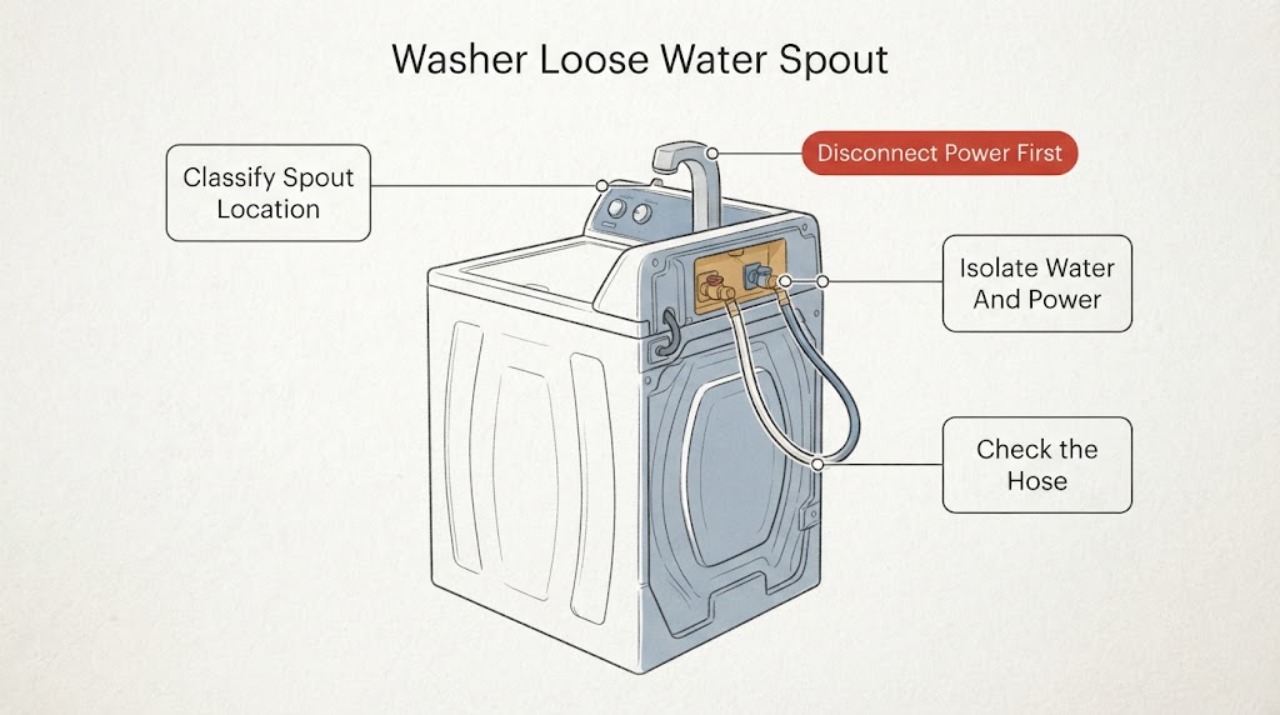
First determine which part is loose. A loose internal plastic piece that guides incoming water into the tub is different from a loose hot/cold fill hose at the wall faucet or washer inlet. Stop the washer, close both water faucets, and unplug it before moving it or looking near water and electrical connections. Do not run a spin cycle with a loose part that can fall into the tub, rub the basket or agitator, contact wiring, or spray water outside the cabinet. Kenmore's official parts information shows that inlet valves and fill hoses are model-specific; its manuals page requires the complete model number to retrieve the correct documentation. Do not order a generic “spout,” glue a broken plastic guide, or substitute a valve from a similar Kenmore. Photograph the loose part, its mounting point and the model tag, then use the exact manual or Kenmore service route to confirm whether the repair is an internal water-guide, valve/hose connection or another assembly.
Before you begin
Safety first
- Limit owner checks to stopping the washer, closing both water faucets, unplugging safely, photographing the model and visible loose part, and observing accessible hose connections. Do not run the washer with a loose guide, reach into moving parts, open the cabinet, disconnect internal hoses, glue/tie the water path, or install a cross-model valve or spout.
Work through in order
Diagnostic checks
Use only checks that match the exact appliance or system and its official guide.
-
Check 1
Identify whether the loose item is inside the tub/cabinet, at a wall faucet or fill-hose coupling, or at the rear washer inlet; photograph it without moving the assembly.
Expected result: The part is an internal plastic guide, an external hose/faucet connection, or its location cannot be safely seen.
Next step: Use the matching external-leak, internal-guide or service branch. Do not remove a panel to make the part visible.
Why this matters
Why: “Spout” is ambiguous and does not identify a universal Kenmore part; the location determines whether the issue is a water-supply connection or an internal guide assembly.
-
Check 2
Stop the washer, close both hot and cold water faucets, unplug the washer, and keep water away from the electrical cord and outlet before pulling it forward.
Expected result: The faucets close and the washer can be unplugged dry and safely, or water continues to flow / the electrical area is wet or damaged.
Next step: Leave the faucets closed and washer disconnected. If the supply cannot be stopped or electrical parts are wet, keep clear and call qualified plumbing/appliance service.
Why this matters
Why: A loose water path can leak during a fill or movement; uncontrolled water or a wet electrical connection is beyond a routine part-identification check.
-
Check 3
With water and power isolated, observe the accessible wall-faucet and rear inlet couplings for a wet thread, missing seal, crack, kink or hose strain; do not loosen a dry fitting to test it.
Expected result: Water is at an external coupling, the hose is damaged/strained, or the external path is dry while the internal guide is visibly loose.
Next step: Keep the faucet closed for a leak or damaged hose and arrange service; if the external path is dry, continue only with model lookup and internal-guide service guidance.
Why this matters
Why: The official Kenmore listing treats the fill hose and inlet valve as the household supply path; that observation does not prove an internal spout or valve fault.
-
Check 4
Look through the open lid only for a loose guide, hose or fragment that could fall into the tub, rub the basket/agitator or redirect water; do not reach inside or run spin to reproduce the movement.
Expected result: The part is hanging, broken, rubbing, missing a mounting tab, or cannot be seen without opening a panel.
Next step: Keep the washer disconnected and arrange model-specific service. Do not glue or tie the part in place, and do not continue washing to see whether it settles.
Why this matters
Why: A loose internal water path can become a moving-part or water-routing hazard, but its correct assembly and attachment are model-specific.
-
Check 5
Read the complete Kenmore model number from the rating label and enter it in Kenmore's manual portal; save the manual page and compare only the illustrated water-path assembly for that model.
Expected result: The exact model is available and its manual identifies the relevant assembly, or the model is missing / the manual does not identify the part.
Next step: Use the model-specific documentation or send the model/photos to Kenmore service. Do not order a valve, hose or spout until fitment is confirmed.
Why this matters
Why: Kenmore states that its model-number lookup provides the appliance manual, while official parts fitment is limited to named models; a family name or similar photo is insufficient.
-
Check 6
Contact Kenmore support or qualified appliance service with the model, photos, location of the loose part, leak timing, faucet state and whether the washer was moved or recently serviced.
Expected result: The part is broken or unmounted, a coupling leaks, water reaches the cabinet/floor, or the repair would require cabinet access or a part decision.
Next step: Keep the washer isolated until the exact assembly and repair method are confirmed; do not operate after an improvised attachment.
Why this matters
Why: The evidence supports a damaged or loose water path but not a universal part number or safe internal repair procedure.
Use your observations
Decision map
Find the observation that best matches what you see, then follow the next safe action.
-
PATH 01Next step
What you see
The loose item is a plastic guide inside the tub/cabinet and can hang into the basket, agitator area or water path.
Do this next
Do not run the washer or glue the guide in place. Photograph the model and mounting point and arrange exact-model parts/service identification.
Why this path and its safety boundary
Why it matters: This resembles the water-guide symptom described in an opened Kenmore 80 Series community post, but the post's model and part cannot be transferred to an unspecified washer.
-
PATH 02Next step
What you see
Water is visible at the wall faucet, fill-hose coupling or rear washer inlet.
Do this next
Close both faucets, keep the washer unplugged, and arrange plumbing/appliance service for a damaged or leaking connection; do not overtighten or run a leak test under pressure.
Why this path and its safety boundary
Why it matters: The immediate issue is on the external water-supply path, not proof that an internal spout or inlet valve has failed.
-
PATH 03Next step
What you see
The model number is available and the exact manual identifies the water-guide or inlet assembly.
Do this next
Follow only the documented user-accessible step or provide the manual/model to a qualified servicer; do not substitute a visually similar part.
Why this path and its safety boundary
Why it matters: A model-specific document can establish the correct name, access boundary and fitment; a generic Kenmore family name cannot.
-
PATH 04Next step
What you see
The part cannot be located safely, the model label is missing, or the only available repair suggestion is glue, a tie, a generic spout or a cross-model part.
Do this next
Keep the washer out of service and use Kenmore support or qualified appliance service with photos; do not improvise the repair.
Why this path and its safety boundary
Why it matters: The evidence does not establish safe fitment or a durable attachment, and an improvised water path can cause leaks or contact moving parts.
-
PATH 05Next step
What you see
Water continues to flow with the faucets closed, reaches an electrical area, or the washer leaks during any attempted operation.
Do this next
Keep clear, do not reconnect power or open panels, and use qualified plumbing/appliance service; do not operate until the leak source is confirmed.
Why this path and its safety boundary
Why it matters: There is an active water or electrical/property-damage risk beyond a safe external check.
Helpful context
Understand the symptom
Identify what “water spout” means on this washer
People use water spout for more than one washer part. It may mean the plastic guide inside a top-load cabinet that directs fill water into the tub, the hose/fitting at the wall faucet, or the inlet-valve connection at the rear of the washer. The repair boundary is different for each. One opened Kenmore 80 Series post describes a broken plastic water guide and later supplies model 110.24812200, but that community example does not prove that every Kenmore uses the same assembly. Do not choose a part from the word spout alone.
Stop water and power before handling the washer
Stop the cycle, close both hot and cold water faucets, and unplug the washer before pulling it forward or inspecting a loose hose or water guide. Keep towels or a shallow pan available for residual water. Do not reach into a moving tub, agitator or basket, and do not continue a cycle if the loose part can contact moving components, wiring or the cabinet opening. If a faucet, hose or fitting continues to leak when closed, use qualified plumbing or appliance service rather than forcing the connection.
Separate an external hose leak from an internal loose guide
With the washer unplugged and faucets closed, look only at accessible hose couplings and the floor behind the machine. A wet wall fitting or rear inlet connection points to the supply path; a plastic guide hanging inside the tub points to a different assembly. Do not loosen a dry connection just to identify it, and do not pull the washer farther than the supply and drain lines allow. Kenmore's official listing identifies the inlet valve and fill hose as connected but separately model-fitted components, so a hose leak does not establish that the inlet valve or internal spout is bad.
Inspect the loose part without running the washer
Photograph the loose part in place, its mounting tabs or hose connection, the tub opening and the complete model/serial label. Do not glue, cable-tie or tape a water guide where a fragment could fall into the tub, obstruct the agitator or basket, or redirect water onto electrical components. Do not remove an internal panel or inlet valve to compare shapes. Use the exact manual to determine whether the visible item is user-accessible; Kenmore's manual portal requires the model number for that lookup.
Do not assume a Kenmore part is universal
Kenmore's official parts listing names specific Kenmore model numbers for its water-inlet-valve and fill-hose bundle. That is evidence that fitment must be checked against the exact model, not that the listed bundle repairs a loose internal water spout. Avoid ordering by a photograph, a generic “washer shower head” name, or a part number found in a different Kenmore series. If the model tag is missing, use the service route with photographs and the washer's dimensions and configuration rather than inventing compatibility.
Escalate a loose or damaged water path
Keep the washer out of service if the water guide is broken, a hose or fitting drips, water reaches the cabinet floor, the loose piece can touch the tub or agitator, or you cannot identify the mounting point. Provide Kenmore or qualified service with the exact model, photos, whether the leak occurs with faucets open or during fill, and whether the part moves during spin. Do not run a “quick test” with the cabinet open or the water supply connected after an improvised repair.
When checks do not resolve it
Need a professional?
Use Kenmore support or qualified appliance/plumbing service for a loose internal guide, leak at a hose or inlet, active water flow, missing model documentation, or any need for cabinet access or part fitment confirmation.
Safety scope: Limit owner checks to stopping the washer, closing both water faucets, unplugging safely, photographing the model and visible loose part, and observing accessible hose connections. Do not run the washer with a loose guide, reach into moving parts, open the cabinet, disconnect internal hoses, glue/tie the water path, or install a cross-model valve or spout.
Common questions
FAQ
What is the loose plastic water spout inside a Kenmore washer called?
The name varies by model and can refer to a water guide, fill spout, hose or part of the inlet/mixing assembly. An opened Kenmore 80 Series post describes a broken plastic piece that guides water into the drum, but its terminology is disputed and its model-specific fit cannot be generalized. Use the full model number before ordering anything.
Can I glue a loose Kenmore washer water spout back in place?
Do not improvise an attachment. Glue or a tie may fail in water, redirect the fill stream, shed fragments into the tub or let the part contact moving components. Keep the washer isolated and obtain the exact model's documented assembly or qualified service.
Is a loose water spout the same as a bad Kenmore inlet valve?
Not necessarily. The inlet valve and fill hose are part of the external supply path, while a plastic guide inside a top-loader can be a different assembly. Kenmore's official parts page lists fitment for specific models, so the symptom alone does not prove which component is involved.
Can I run the washer briefly to see where the loose spout moves?
Do not run a washer with a loose or broken water-path piece that could contact the tub, agitator, basket, wiring or cabinet. Close the faucets, unplug safely, photograph the condition and arrange exact-model service instead.
How do I find the correct Kenmore water-spout part?
Read the complete model number from the rating label and enter it in Kenmore's official manual portal. Use the model-specific documentation or Kenmore support to identify the assembly; do not order a part based only on a family name, photo or similar-looking model.
Read the exact guide
Official sources
- What is this part called?Reddit r/Appliances · An exact Kenmore 80 Series community example of a broken plastic water guide, with model 110.24812200 later supplied by the poster; it does not establish universal terminology, fitment or repair instructions.
- Contact Us | Kenmore Customer SupportKenmore · Official support route for unresolved model-specific washer identification or repair; no phone number or commercial destination is reproduced in the article.
- Kenmore Washer Water Inlet Valve and Fill Hose BundleKenmore · Official Kenmore fitment example showing that inlet valve/hose assemblies are tied to named models; it is not evidence that this bundle fits the task washer or that it is the loose internal spout.
- Find Your Manual | Kenmore Appliance Manuals & GuidesKenmore · Direct Kenmore source for obtaining model-specific washer manuals; the article uses it to require exact model identification and does not infer a repair part from the portal itself.
Community feedback
Share a repair observation
Share a plain-text repair observation. Accepted observations are published automatically; this page may take a moment to update.