
On this page
Start here
Quick answer
Do not diagnose a Kenmore 110.26112310 washer from the volume alone. Confirm the full model on the nameplate and use the matching Kenmore manual, then note whether the sound appears only at high spin, follows a particular load, or remains with a safe empty-drum comparison. First stop for walking, cabinet impact, uncontrolled movement, a leak, smoke, burning odor, sparks, or damaged hoses or cord. With the washer stopped, redistribute a bunched or single heavy load, check that all feet are firmly on a level floor, and look for drain or fill hoses touching the cabinet or wall. If the washer still roars or grinds with a normal load or an empty comparison, do not guess a bearing, gearcase, or other drive part; stop using it and arrange qualified service.
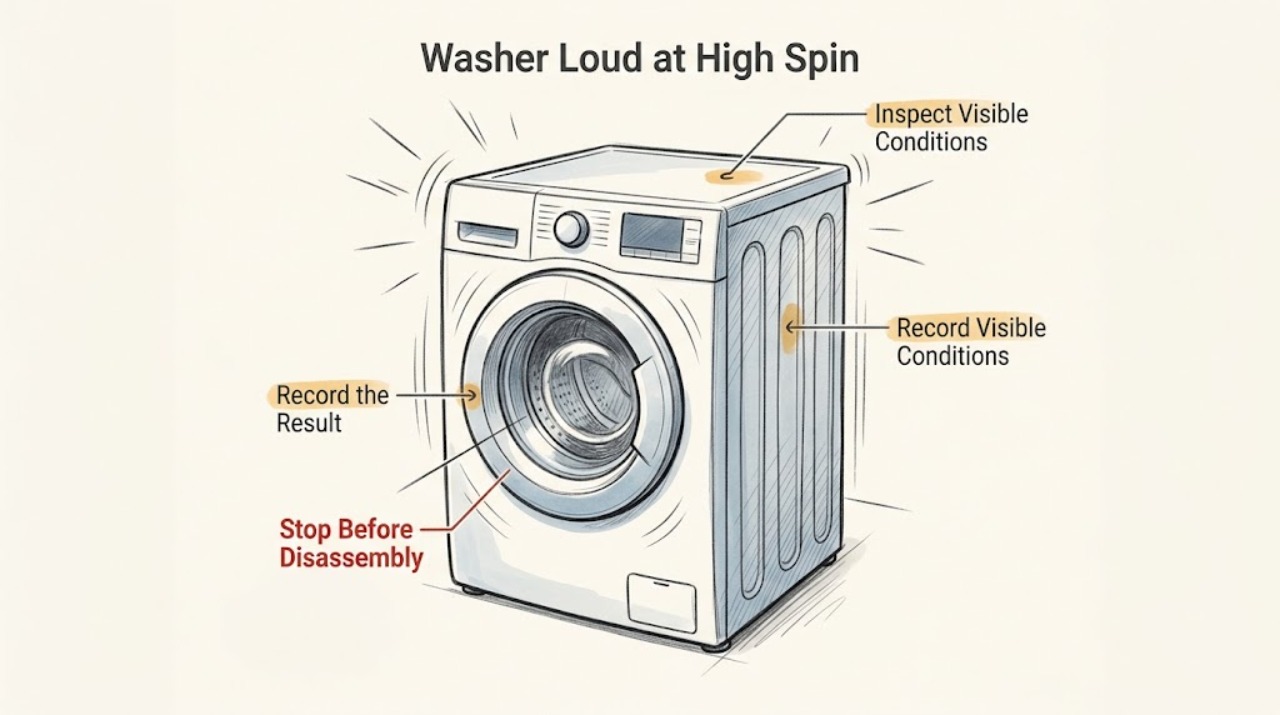
Work through in order
Diagnostic checks
Use only checks that match the exact appliance or system and its official guide.
-
Check 1
Stop the cycle and inspect from a safe, dry position before trying to classify the noise. Look for the washer walking, striking a wall or cabinet, uncontrolled rocking, water on the floor, a leaking hose, smoke, burning odor, sparks, abnormal heat, or a damaged cord or cabinet.
Expected result: The washer is merely loud, or it is moving violently, hitting surrounding structures, leaking, smoking, overheating, sparking, or electrically damaged.
Next step: If the area is dry and the washer is stable, continue with the external checks below. If a hazard is present, keep the washer off, keep people away, close accessible water supplies when safe, and use qualified appliance or electrical service; use emergency help for fire or smoke.
Stop if: Do not run another high-speed cycle, hold the cabinet down, repeatedly reset protection, move a leaking machine, or touch wet or damaged electrical parts.
Why this matters
Why: Violent movement or a water, fire, or electrical sign changes this from a sound comparison to an immediate stop. Continuing a high-speed cycle can increase injury, water, or property damage.
-
Check 2
Read every character on the model and serial tag and record Kenmore 110.26112310 if that is what the appliance shows. Use Kenmore's manual lookup with the full model; do not use a shortened 110-series number or a similar washer's instructions.
Expected result: The tag clearly matches 110.26112310, differs from it, or cannot be read completely.
Next step: Continue only with the confirmed model's guide. If the label is incomplete or different, stop model-specific conclusions and obtain a clear photo or qualified service identification before ordering parts or opening anything.
Stop if: Do not infer a failed bearing, gearcase, suspension component, or compatible part from the 110 prefix alone.
Why this matters
Why: Kenmore states that the exact model is needed to locate the correct manual and appliance resources. A similar-looking 110 washer can have a different tub, suspension, drive layout, or safe-access procedure.
-
Check 3
From outside the closed washer, record when the noise starts and how it changes: drain-to-spin transition, low speed, high speed, steady high speed, deceleration, or after the basket stops. Note whether it is a hum, roar, scrape, rhythmic knock, or impact and whether the cabinet visibly moves.
Expected result: The sound rises with speed, is a repeated impact tied to one basket revolution, appears only with one load, or remains at the same stage with no visible movement.
Next step: Use the load and installation branches below. Make a recording from a safe distance if service is needed, and stop if the sound becomes metallic, grinding, hot, smoky, or violent.
Stop if: Do not reach into the basket, lean over a moving tub, remove panels, or touch hoses while the machine is spinning.
Why this matters
Why: Timing is a branch point, not a part diagnosis. A speed-sensitive sound can be load or contact related, while a repeatable empty-drum sound is less likely to be caused only by clothing distribution; neither observation proves a specific internal component.
-
Check 4
With the washer stopped and the lid or door safely released, remove a single heavy item or unsuitable tightly packed load only as the exact manual permits. Redistribute laundry in loose, even heaps; do not use a wet blanket, rug, or other load to reproduce the noise.
Expected result: The load is tightly bunched, a single heavy item was present, the load was overloaded, or the same noise occurs with a balanced ordinary load.
Next step: Run at most one monitored cycle with a suitable balanced load and the selected spin setting. If the sound returns or the basket begins striking the cabinet, stop and arrange service.
Stop if: Do not open a locked lid or door, overload the tub, continue through banging, or repeatedly run high spin to compare loads.
Why this matters
Why: A load that changes the noise after redistribution supports an out-of-balance or load-impact explanation. A balanced ordinary load that produces the same high-spin roar makes the load a less likely sole cause.
-
Check 5
With the washer empty and off, check that all accessible feet are firmly in contact with a solid floor and that the cabinet is level and stable. Look for a flexing or sagging floor, a loose foot, or a jam nut that is not secured; use the exact installation instructions for any adjustment.
Expected result: A foot is loose or not contacting the floor, the cabinet rocks when safely checked while off, the floor flexes, or the washer is stable and level.
Next step: Correct only the external leveling issue allowed by the manual, then make one monitored test. If the machine is stacked, hard-plumbed, or unsafe to move, have an installer or servicer perform the adjustment.
Stop if: Do not wedge the cabinet while running, lift a full washer, place hands under it, or operate it while a foot is missing or the cabinet is unstable.
Why this matters
Why: An unstable base can become dramatically louder at high spin and can mimic an internal mechanical fault. If the level and floor are sound but the noise persists, installation is less likely to be the sole cause.
-
Check 6
Inspect only the outside of the washer for the drain hose, fill hoses, wall, cabinet, shelving, and nearby objects touching or being struck during spin. Do not disconnect a pressurized hose or pull the washer out if doing so could kink a line or damage the floor.
Expected result: A hose, wall, shelf, cabinet, or nearby item contacts the washer and the sound changes when safe clearance is restored, or the washer remains clear but noisy.
Next step: Restore safe clearance without crushing hoses, then make one monitored test. If clearance cannot be restored safely or the sound remains, stop and schedule service.
Stop if: Do not pull a stacked or full washer, crush the drain hose, disconnect water lines under pressure, or place objects against the cabinet to dampen the sound.
Why this matters
Why: A changed sound supports external contact or installation vibration rather than proving an internal part failure. A clear surrounding area with persistent noise moves the decision toward a controlled service diagnosis.
-
Check 7
Only if the confirmed manual permits an unloaded spin and the washer is stable, perform one short controlled empty-drum comparison from a safe distance at the relevant setting; otherwise have a servicer perform the comparison. Do not touch the basket, cabinet, hoses, or controls while it is moving.
Expected result: The sound is absent or greatly reduced empty, or it remains at high speed with the basket empty and the washer stable.
Next step: For a load-only result, follow the suitable-load branch. For a repeatable empty result, stop further testing and provide the timing, speed, movement, and recording to a qualified servicer.
Stop if: Do not repeat high-speed tests, run with a missing lid or guard, reach toward the moving basket, or remove panels to listen closer.
Why this matters
Why: A load-dependent result makes balance, clothing impact, and load distribution more likely. A repeatable empty-drum result makes a load-only explanation less likely, but it still cannot distinguish a suspension, basket, drive, or other internal cause by sound alone.
Use your observations
Decision map
Find the observation that best matches what you see, then follow the next safe action.
-
PATH 01Safety boundary
What you see
The noise appears with a bunched, single-heavy, or overloaded load and becomes quieter after safe redistribution, while the washer remains level and stable.
Do this next
Use suitable loads arranged evenly and monitor one cycle. If the noise returns with ordinary balanced loads, stop and arrange service rather than increasing the spin tests.
Why this path and its safety boundary
Why it matters: The result supports load balance or clothing impact as the leading explanation for this occurrence; it does not establish a worn drive part.
Safety stop: Do not continue through cabinet strikes, walking, violent shaking, leaks, smoke, or burning odor.
-
PATH 02Safety boundary
What you see
The cabinet rocks, a foot is not firmly seated, the floor flexes, or a hose, wall, shelf, or nearby object touches the washer; the sound changes after safe clearance or leveling is restored.
Do this next
Keep the washer stable and clear, follow the exact installation guide for leveling, and monitor one cycle. Use qualified installation help when the washer is stacked, hard-plumbed, or unsafe to move.
Why this path and its safety boundary
Why it matters: The changed result makes installation, floor, or external-contact vibration more likely than an internal rotating failure.
Safety stop: Do not wedge, lift, drag, or operate an unstable washer, and do not crush or disconnect hoses.
-
PATH 03Safety boundary
What you see
The washer is level and clear, the load is balanced, and the noise is absent empty but returns with a particular load or speed setting.
Do this next
Stop experimenting with high spin, document the exact load, setting, timing, and recording, and arrange qualified diagnosis if the behavior repeats.
Why this path and its safety boundary
Why it matters: The result is load- or speed-dependent but not explained by the first external checks. It does not justify naming a bearing, gearcase, pulley, or suspension part.
Safety stop: Do not keep using a load that causes banging, walking, scraping, or cabinet impact.
-
PATH 04Safety boundary
What you see
The washer is stable, level, clear of contact, and balanced, but the same loud roar, grind, scrape, or rhythmic knock remains during high spin with an empty comparison or normal loads.
Do this next
Stop using the washer and arrange Kenmore or qualified appliance service. Provide the full model, speed setting, whether the sound occurs empty, whether the basket moves, and a safe-distance recording.
Why this path and its safety boundary
Why it matters: A repeatable empty or normal-load sound crosses the user-level classification boundary. Internal suspension, basket, drive, or related components may require inspection, but the sound alone cannot identify which one.
Safety stop: Do not open the cabinet, remove the basket, test live wiring, replace a bearing or gearcase by guesswork, or run repeated high-speed tests.
-
PATH 05Safety boundary
What you see
The washer walks, strikes the wall, moves violently, leaks, smells hot or burnt, smokes, sparks, trips protection, or has damaged hoses, cord, cabinet, or floor.
Do this next
Keep the washer off and keep people away. Close accessible water supplies when safe for a leak, and use urgent qualified appliance or electrical service; use emergency help for smoke or fire.
Why this path and its safety boundary
Why it matters: This is a mechanical, water, fire, or electrical safety stop, not a normal loud-spin diagnosis.
Safety stop: Do not reproduce the movement, hold the machine down, reset protection repeatedly, move a wet appliance, or touch damaged electrical parts.
Helpful context
Understand the symptom
A washer can be loud at high spin without the sound identifying one internal part. The full Kenmore model number is the starting point because Kenmore's official manual service asks owners to enter the exact model to locate the appropriate guide and resources. Confirm 110.26112310 from the nameplate; do not substitute a similar 110-series number.
The most useful split is not loud versus quiet but load-dependent versus repeatable. A bunched load, a washer that is not level, a flexing floor, or a hose or cabinet touching a wall can become much louder as spin speed rises. If the same sound remains with the washer stable and a safe empty comparison, the observation supports a service diagnosis of the suspension or drive area, but it still does not identify a bearing, gearcase, pulley, or other part by itself.
When checks do not resolve it
Need a professional?
When contacting service, provide the full nameplate model 110.26112310, the exact spin setting, whether the noise is a roar, scrape, knock, or impact, whether it occurs with an empty comparison, whether the cabinet walks, and whether changing the load, leveling, hose clearance, or nearby contact changed it. Do not pre-order an internal part from the symptom alone.
Common questions
FAQ
Why is the Kenmore 110.26112310 much louder at high spin?
High speed amplifies imbalance, floor or foot instability, hose or cabinet contact, and internal rotating noise. Compare the result after a safe balanced load and external clearance check; high-spin loudness alone does not prove a bearing or gearcase failure.
Should I run the washer empty to test it?
Only if the confirmed Kenmore manual permits an unloaded spin and the washer is stable; make one short controlled comparison from a safe distance. If the noise remains empty, stop further testing and arrange service rather than repeating high-speed cycles.
Can leveling fix a loud spin cycle?
It can if a loose foot, unstable floor, or cabinet contact is causing the vibration. Check level and firm foot contact with the washer off and follow the exact installation instructions. If the washer remains loud when stable and clear, service is needed.
Should I replace the bearing or gearcase first?
No. A load-dependent or contact-dependent sound can mimic an internal failure, and a repeatable sound still does not identify one part. Have a qualified servicer diagnose the confirmed 110.26112310 before ordering components.
Read the exact guide
Official sources
- Vibration or Out of Balance LoadsWhirlpool Product Help · Platform-level symptom guidance only: supports load, bulky-item, single-item, and leveling observations; it is not an exact Kenmore 110.26112310 service manual.
- Knocking or Thumping - NoiseWhirlpool Product Help · Platform-level symptom guidance only: supports external hose/cabinet contact, load, level, and high-spin noise distinctions for a top-load washer; it does not confirm Kenmore model identity or diagnose an internal part.
- Sounds: Clunk or Clunking Noise During SpinWhirlpool Product Help · Platform-level symptom guidance only: supports distinguishing normal shift noise, imbalance, foreign objects, and service escalation; it does not confirm a Kenmore internal component.
- Vibration - Washing a Single ItemWhirlpool Product Help · Platform-level symptom guidance only: supports single-item and basket-movement interpretation; it does not authorize an empty high-spin test or establish a Kenmore part failure.
- Kenmore Appliance Manuals & GuidesKenmore · Supports the identity-first boundary for the assigned Kenmore 110.26112310: use the complete model number to retrieve the matching manual and resources. It does not identify a failed internal part from sound alone.
Community feedback
Share a repair observation
Share a plain-text repair observation. Accepted observations are published automatically; this page may take a moment to update.