
On this page
Start here
Quick answer
A noisy Kenmore washer should first be described by when the sound occurs and what the washer does at the same time. With no model number, do not label a sound as a normal cycle sound or diagnose a bearing, motor, pump, belt, suspension part, or other internal component. Check the load size and distribution, confirm the washer is level and stable, inspect visible hoses and nearby objects, and use the exact Kenmore manual for model-specific operating sounds. Stop using the washer and arrange service for unusual persistent noise, violent movement, leaks, burning odor, visible damage, or a sound that remains after safe external checks.
Work through in order
Diagnostic checks
Use only checks that match the exact appliance or system and its official guide.
-
Check 1
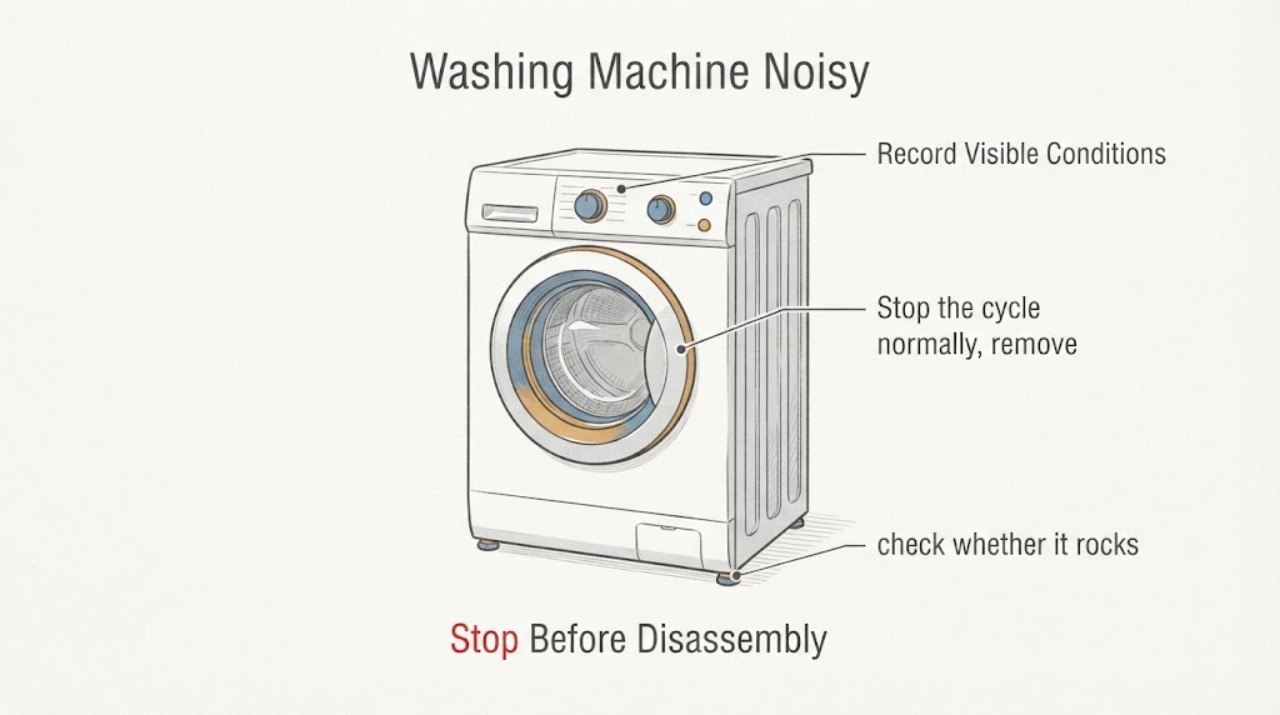
From a safe distance, note when the noise starts and stops: fill, wash, drain, the transition into spin, or sustained spin. Record whether the washer walks, bangs the cabinet, leaves clothes wet, leaks, or shows a message.
Expected result: The sound is brief and tied to one phase, or it is persistent, metallic, worsening, or paired with movement or poor performance.
Next step: Use the exact manual to compare the observed phase and sound. If the sound is severe, new, or accompanied by a hazard, stop using the washer and arrange service before more testing.
Why this matters
Why: Timing narrows the model-specific instructions to consult, but it does not prove a particular component. A persistent or performance-changing noise deserves more caution than a sound listed in the matching manual as normal.
-
Check 2
Stop the cycle normally, remove an overload, and redistribute clothing so it can move freely. Avoid judging the machine from one heavy, bulky, or tightly packed item by itself.
Expected result: Noise and shaking reduce with a smaller, evenly distributed load, or the same noise remains.
Next step: Use balanced loads if the symptom clears. If the noise returns with ordinary loads, continue only with the external checks below and prepare for service.
Why this matters
Why: Kenmore's maintenance guidance says an unbalanced washer can make a lot of noise and that overloading adds stress to the motor and drum. Improvement supports a loading issue; it does not diagnose an internal part.
-
Check 3
With the washer stopped, check whether it rocks and whether it sits evenly on the floor. Use a level only as described by the matching manual; do not dismantle the appliance or adjust an unknown suspension system.
Expected result: The washer rocks or is visibly uneven, or it is stable and level but still noisy.
Next step: Correct a clearly documented leveling issue using the manual. If it is already stable or the sound persists, stop short of internal diagnosis and arrange service.
Why this matters
Why: Kenmore states that level verification and foot adjustment can reduce noise from an unbalanced washer. A stable machine with persistent noise needs a broader model-specific assessment.
-
Check 4
Inspect the accessible area around the stopped washer for hoses with cracks, bulges, or dripping and for nearby objects touching the cabinet. Do not reach behind a wet appliance or move it alone if the hoses are strained.
Expected result: A hose is damaged or contacting the cabinet, a nearby object is touching the washer, or nothing visible explains the noise.
Next step: Keep the washer out of service for a damaged or leaking hose and arrange repair. Remove only a clearly separate nearby object; if no safe external cause is found, use the model manual and service route.
Why this matters
Why: Kenmore recommends regular hose checks for wear and leaks; an accessible hose or object can create noise or a safety issue without proving a motor, pump, bearing, or drum fault.
-
Check 5
Find the Kenmore model number from the appliance label and use Kenmore's manual lookup before selecting any procedure or part. Give the technician the sound timing, load, level result, visible hose condition, and any leak or performance change.
Expected result: The exact model is available, or the model cannot be read and the unusual noise continues.
Next step: Follow only the exact manual for that model. If the noise is unusual or unresolved, schedule qualified service rather than opening the cabinet or ordering an internal part from the symptom alone.
Why this matters
Why: Kenmore's manual page requires the model number to retrieve the matching washer manual and resources. Without it, normal-sound comparisons and part compatibility remain unresolved.
Use your observations
Decision map
Find the observation that best matches what you see, then follow the next safe action.
-
PATH 01Next step
What you see
The exact Kenmore model manual identifies the observed sound and phase as normal, and there is no leak, movement, odor, or performance change.
Do this next
Follow the manual's operating guidance and monitor for a change; obtain service if the sound becomes louder, new, or paired with another symptom.
Why this path and its safety boundary
Why it matters: Only the matching manual supports calling that sound normal for that appliance.
-
PATH 02Next step
What you see
Noise and shaking reduce after an overload or uneven load is removed and redistributed.
Do this next
Use balanced, right-sized loads and avoid repeated overloaded tests.
Why this path and its safety boundary
Why it matters: The observed change supports a load-balance problem, not a confirmed failed component.
-
PATH 03Next step
What you see
The washer rocks, sits unevenly, or a visible hose or nearby object contacts the cabinet.
Do this next
Correct only the clearly documented setup issue or remove the separate object; call service for damaged hoses or continued noise.
Why this path and its safety boundary
Why it matters: Installation stability or an external contact can account for noise without proving an internal washer fault.
-
PATH 04Next step
What you see
The washer is level, the load is balanced, no external source is visible, and the noise remains persistent, metallic, or performance-changing.
Do this next
Stop using the washer and arrange qualified service. Do not open the cabinet or buy a part based on the noise alone.
Why this path and its safety boundary
Why it matters: An internal issue is possible, but the brand-only symptom cannot distinguish a bearing, motor, pump, belt, suspension, or other part.
-
PATH 05Next step
What you see
There is a leak, burning odor, water near electrical parts, violent movement, visible damage, or a repeated worsening noise.
Do this next
Stop the cycle, disconnect power only if safe and dry to do so, keep clear of wet or moving areas, and obtain professional service.
Why this path and its safety boundary
Why it matters: Continued operation can increase water, electrical, fire, or mechanical risk.
Helpful context
Understand the symptom
Describe the noise before diagnosing it
Write down whether the sound occurs while filling, washing, draining, ramping into spin, or at steady spin speed. Also note banging, rattling, squealing, grinding, humming, walking, a leak, or a change in cleaning or spin performance. A brand-only report cannot identify which Kenmore platform or internal component is involved.
Do not assume a sound is normal
Some washer noises are cycle or model specific, but the task does not include the model number. Use the exact Kenmore manual to compare the sound before continuing to operate the appliance. Treat a new, loud, metallic, worsening, or performance-changing noise as a service symptom rather than a normal sound.
Stop before internal work
Do not remove panels, reach under a moving washer, or run a deliberately overloaded test. Unplug before hands-on inspection of an empty, stopped machine. If there is a burning odor, water near electrical parts, violent movement, or visible damage, stop using the washer and obtain qualified service.
When checks do not resolve it
Need a professional?
Call qualified service when unusual noise persists after safe load, level, hose, and external-object checks, or when there is a leak, burning odor, water near electrical parts, violent movement, visible damage, or a performance change.
Common questions
FAQ
Can a Kenmore washer's noise be diagnosed from the brand alone?
No. Kenmore manuals and operating sounds are model-specific, and the same symptom can involve loading, leveling, hoses, normal operation, or an internal issue. Find the model before selecting a procedure or part.
Should I keep running the washer to identify the noise?
Do not run deliberate overload or unsafe tests. If the noise is new, loud, metallic, worsening, or paired with movement, a leak, odor, or poor performance, stop using the washer and arrange service.
Does a noisy washer prove that a bearing or motor failed?
No. The available Kenmore guidance supports checking load balance, level, hoses, model instructions, and service needs; it does not prove a specific internal component from this no-model symptom.
Read the exact guide
Official sources
- Customer Care & Support | Kenmore AppliancesKenmore · Kenmore's official customer-care page separates manuals and parts from repairs and services, supporting service escalation without selecting a component.
- Find Your Manual | Kenmore Appliance Manuals & GuidesKenmore · Kenmore's official manual lookup page; it requires the appliance model number and covers washer manuals and troubleshooting resources.
- Appliance Maintenance Tips to Help Maximize EfficiencyKenmore / Livemore · Kenmore's official maintenance article for general washer care; it supports load balance, leveling, hose checks, load sizing, and service escalation, while exact operating sounds remain model-specific.
Community feedback
Share a repair observation
Share a plain-text repair observation. Accepted observations are published automatically; this page may take a moment to update.