
On this page
Start here
Quick answer
Do not use this old Kenmore washer again while it fills, agitates, or spins with the lid open, or while water will not stop entering. Close the household water valves and switch the machine off from a dry, safe location; do not bypass a lid switch, reach into the basket, or run another cycle to diagnose why it will not agitate. The 70 Series Heavy Duty label is not a complete model number, so the exact manual and parts cannot be selected safely yet. A prior tenant's successful use does not make an unsafe lid-open condition acceptable; arrange qualified appliance service after recording the full label and the observed sequence.
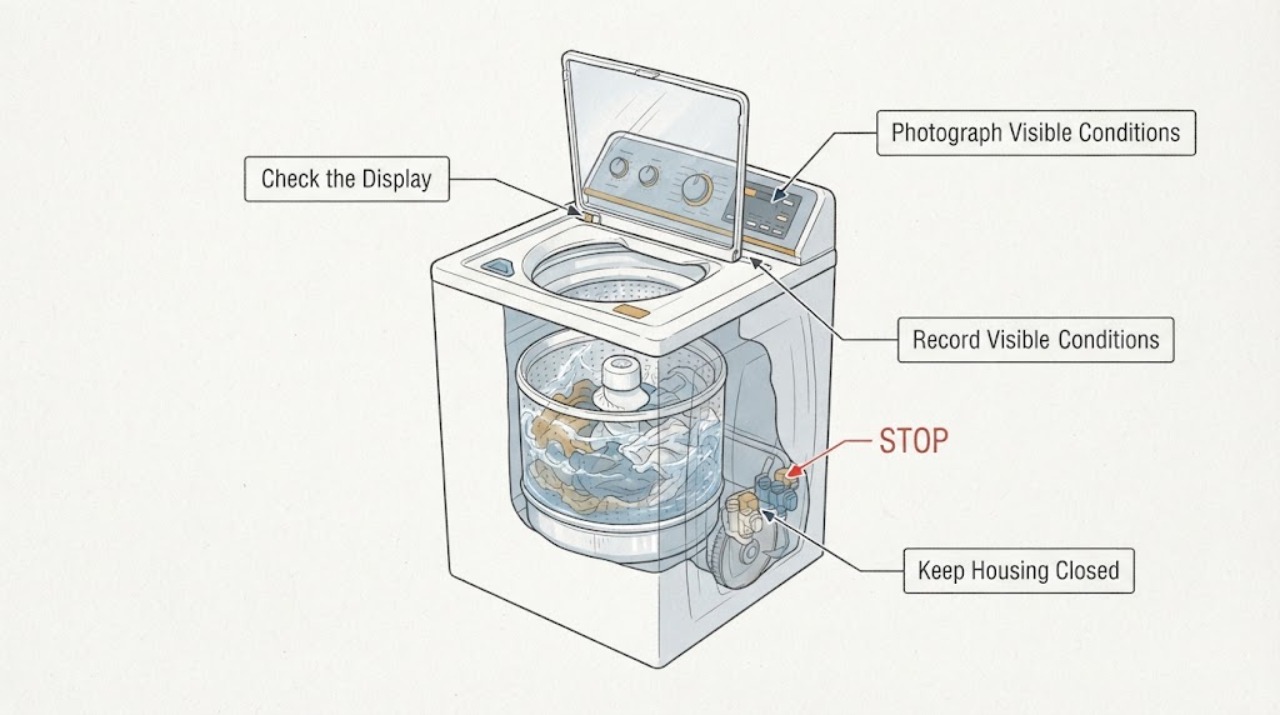
Work through in order
Diagnostic checks
Use only checks that match the exact appliance or system and its official guide.
-
Check 1
From a dry, stable position, turn the washer's cycle control to Off or Stop if that is the normal control, close both household water valves, and isolate electrical power only from a dry, safe location. Keep hands and clothing away from the basket and agitator while any motion continues.
Expected result: Water stops after the valves are closed and motion stops after the normal control or safe power isolation, or water/motion continues, the floor is wet, or electrical access is unsafe.
Next step: Leave the washer out of service and arrange qualified appliance service. Use plumbing help for a household valve or supply problem and electrical help for unsafe power access.
Stop if: Do not reach into the tub, hold the lid switch closed, open the cabinet, or restore water/power to see whether the fault repeats.
Why this matters
Why: Uncontrolled filling and any spinning with the lid open are safety issues, not ordinary no-agitation symptoms. Water or electrical hazards take priority over identifying a drive or inlet part.
-
Check 2
Locate and photograph the complete Kenmore model and serial label without moving the washer or removing a panel. Record the family wording, all digits and letters, the control layout, and whether the machine is a top-load design with an agitator or another mechanism.
Expected result: A complete model number is readable, only '70 Series Heavy Duty' is visible, or the label cannot be reached safely because the washer is wet, unstable, or blocked in place.
Next step: Give the complete label and the exact multi-symptom sequence to the service provider. If the label is incomplete or inaccessible, report that limitation rather than borrowing a procedure from another Kenmore 70 Series machine.
Stop if: Do not pull the washer out by the hose or cord, tip it, remove panels, or order a lid switch, inlet valve, timer, motor, or transmission from the family name.
Why this matters
Why: Kenmore says the complete model number is needed to retrieve the matching owner manual and model-specific troubleshooting. A family name cannot establish the correct lid-safety, fill, or drive design.
-
Check 3
After water and power are isolated, write down what happened in order: whether filling began with the lid open, whether the tub or agitator moved, whether the basket spun, whether the cycle control responded, and whether water stopped when the household valves were closed. Do not conduct a new powered test.
Expected result: The washer was filling with the lid open, the basket was spinning with the lid open, the tub would not agitate, the timer/control would not stop the cycle, or several of these occurred together.
Next step: Keep the machine isolated and provide the sequence to a qualified technician for model-specific diagnosis. The technician should verify the lid safety behavior before any agitation or fill repair is attempted.
Stop if: Do not jumper, tape, press, or otherwise defeat the lid switch or lid-lock mechanism, and do not run a cycle with the lid unable to control motion.
Why this matters
Why: Official guidance says some washer models differ in whether they fill or advance with the lid open, but all washers should not spin with the lid open. A combination of fill-control, lid-safety, and agitation symptoms cannot be assigned to one internal part from observation alone.
-
Check 4
Check only the visible external water and drain paths while the washer remains off and dry: note whether a supply valve or hose is damaged, whether the drain hose is routed into a standpipe or tub, and whether the household drain was backing up. Do not disconnect a pressurized hose or reach behind the cabinet.
Expected result: A valve/hose is visibly damaged, the drain hose is kinked or incorrectly placed, the household drain backs up, or the external paths look normal while the unsafe behavior remains unexplained.
Next step: Keep water closed for a damaged hose or connection and use plumbing or appliance service as appropriate. For normal external paths with continuing multi-symptom behavior, request appliance service without further testing.
Stop if: Do not disconnect tubing, open the cabinet, test live wiring, or use another cycle to separate the symptoms.
Why this matters
Why: A supply or drain installation issue can affect filling, but it does not explain away a basket spinning with the lid open. External routing checks cannot validate the lid-safety or fill-control circuit.
-
Check 5
Prepare the service handoff with the exact label, prior-tenant history, whether the washer was already connected to water and power, the lid-open motion, the non-agitation, the filling behavior, and any leak, sound, smell, breaker, or control symptoms. Do not frame the request as a single failed part.
Expected result: The complete identity and sequence are available, or the machine's history and label remain incomplete.
Next step: Have a qualified technician identify the platform and inspect the lid safety, fill control, drain path, and agitation system. If safe diagnosis is not possible or the cabinet/tub is damaged, ask for a repair-versus-retire assessment based on inspection, not a guessed part.
Stop if: Do not advertise, donate, loan, or return the washer to service while the lid-open motion or uncontrolled filling remains unresolved.
Why this matters
Why: An inherited old appliance with multiple safety and operating symptoms needs platform identification before a repair decision. The history can explain uncertainty but cannot lower the safety boundary.
Use your observations
Decision map
Find the observation that best matches what you see, then follow the next safe action.
-
PATH 01Next step
What you see
The basket spins or the tub moves with the lid open, or the machine can continue motion when the lid is not safely controlling the cycle.
Do this next
Keep water and power isolated from a safe location and arrange qualified appliance service. Do not attempt a lid-switch bypass or another test cycle.
Why this path and its safety boundary
Why it matters: This is an immediate lid-safety stop condition. Whirlpool's official guidance states that all washers should not enter a spin with the lid open, even though fill and wash behavior varies across models.
-
PATH 02Next step
What you see
The washer may fill without stopping, fails to agitate, and also shows a lid-open or spin symptom, but the full model number is unavailable.
Do this next
Do not combine unrelated guesses into a part diagnosis. Preserve the sequence, keep the washer out of service, and have a technician identify the exact platform before testing or quoting a repair.
Why this path and its safety boundary
Why it matters: The symptoms may involve more than one model-specific control or safety path. The 70 Series Heavy Duty label does not identify the correct mechanism or manual.
-
PATH 03Next step
What you see
The only confirmed issue is no agitation after the washer is safely stopped, with no uncontrolled filling, no lid-open motion, and no water or electrical hazard.
Do this next
Use the complete model manual and qualified service to distinguish cycle state, load, lid safety, drain, motor, and drive causes. Do not run the unsafe machine simply to recreate the earlier symptoms.
Why this path and its safety boundary
Why it matters: No agitation can have several causes, but the old-family identity still does not support a component conclusion or a user-level cabinet repair.
-
PATH 04Next step
What you see
A damaged hose, active leak, wet electrical area, burning smell, smoke, sparks, repeated breaker trip, or unstable cabinet is present.
Do this next
Stay clear, close water and isolate power only when safely reachable, and obtain qualified appliance, plumbing, or electrical help as appropriate. Do not move the washer to expose a hidden source.
Why this path and its safety boundary
Why it matters: The immediate problem is water, electrical, fire, or structural safety, not an ordinary agitation diagnosis.
Helpful context
Understand the symptom
Kenmore's official manual page requires the complete model number to retrieve the matching laundry manual and troubleshooting information. '70 Series Heavy Duty' identifies an old family description, not a unique model, and different lid and fill designs can behave differently.
Whirlpool's official top-load guidance notes that washer behavior varies by model: some machines may fill with the lid open, but all washers should not enter a spin with the lid open. That variation is precisely why a lid-open spin, uncontrolled filling, and no agitation should be treated as a stop-use condition until the exact Kenmore documentation and a technician are involved.
When checks do not resolve it
Need a professional?
Keep the old Kenmore washer out of service for any lid-open basket motion, uncontrolled filling, water near electrical parts, active leak, wet floor, burning smell, smoke, sparks, repeated breaker trips, hot cord or outlet, or unstable cabinet. Close the water valves and isolate power only from a dry, safe location. Do not bypass the lid switch, reach into the basket, open the cabinet, disconnect pressurized hoses, or run repeated cycles to diagnose no agitation.
Common questions
FAQ
Is it normal for an old Kenmore 70 Series washer to spin with the lid open?
Treat that as unsafe, not normal. Official washer guidance says models vary in whether they fill or advance with the lid open, but all washers should not enter a spin with the lid open. Close the water valves, isolate power safely, and arrange service.
Could one failed part explain no agitation, nonstop filling, and lid-open motion?
Do not assume that. The symptoms can involve different model-specific safety, fill, control, and drive paths, and the 70 Series Heavy Duty label is not a complete model identity. Keep the washer off and have the exact platform assessed.
What model information does a technician need?
Provide every letter and digit from the rating plate, plus the serial information if readable, and the exact sequence of filling, agitation, lid-open motion, spinning, stopping, leaks, and sounds. Kenmore's official manual lookup requires the complete model number for matching documentation.
Read the exact guide
Official sources
- Lid Light Flashing - Product HelpWhirlpool Product Help · The opened official guidance explains that lid behavior differs by model, that an open lid can pause or prevent stages, and that lock interference or buildup can require service. It is used to establish the safety boundary and not to assign a Kenmore component.
- Not Filling or Long Fill Times - Commercial Grade Washer - Product HelpWhirlpool Product Help · Whirlpool's opened guidance is used only for general safety branching because it explicitly says behavior varies by model: some machines fill or advance with the lid open, some drain after the lid remains open, and all washers will not enter a spin with the lid open. It is not treated as the exact Kenmore 70 Series Heavy Duty manual.
- Find Your Manual | Kenmore Appliance Manuals & GuidesKenmore · Kenmore's opened official page says to enter the complete model number, at least 11 characters and without special characters, to retrieve the matching owner's manual and model-specific laundry troubleshooting resources. It does not expose a unique 70 Series Heavy Duty model procedure, so no lid, fill, or drive part is inferred from the family label.
- Top-Loading WasherWhirlpool · This opened official owner manual is a symptom-level comparison only. It states that the lid must be closed before filling and the wash cycle, and describes agitation, sensing, spin, pauses, and automatic pump-out behavior for its covered models; it is not a model-specific Kenmore manual.
Community feedback
Share a repair observation
Share a plain-text repair observation. Accepted observations are published automatically; this page may take a moment to update.